Every time you open an app, browse a website, or use a smart device, a processor works behind the scenes to execute instructions. But have you ever wondered who decides how those instructions are designed and how software communicates with hardware? This is where RISC-V architecture explained becomes important.
RISC-V is an open-standard instruction set architecture (ISA) that defines the instructions a compatible processor can understand and execute. Unlike a particular CPU or chip, it provides a common foundation that hardware designers can use to build different types of processors. Its open, modular design lets developers create implementations for specific needs, from small embedded systems and microcontrollers to more complex computing platforms. https://riscv.org/specifications/ratified/
One of RISC-V’s most interesting aspects is its flexibility. The architecture combines a base instruction set with optional extensions, allowing designers to select features according to their intended applications. This approach creates opportunities for experimentation, customization, and innovation without requiring every processor to follow the same internal design.
At Technology Moment, we break down complex technology concepts into clear, practical explanations that help readers understand not just what a technology is, but how it works and why it matters. In this guide, we will explore how RISC-V architecture works, what instruction sets and extensions do, how RISC-V compares with ARM and x86, and where this open standard fits into modern computing. Whether you are a technology enthusiast, student, developer, or simply curious about processor design, this guide will help you understand the fundamentals of RISC-V and why it is attracting attention across the global technology industry.
What Is RISC-V Architecture Explained?
RISC-V is an open instruction set architecture (ISA) that establishes the communication framework between software and computer processors. It follows the principles of reduced instruction set computing (RISC), using a defined set of operations that processors can interpret and perform. Rather than representing a specific processor model or physical chip, RISC-V serves as an architectural blueprint that enables different hardware developers to create processors based on a shared set of rules.
Understanding RISC-V begins with the concept of an instruction set. Whenever a program processes information, performs arithmetic, transfers data, or evaluates conditions, it depends on commands that the processor can execute. An instruction set architecture defines these commands, along with registers, supported data formats, and other essential hardware capabilities. By establishing these rules, the ISA creates a standard connection between software applications and processor hardware.
A major characteristic of RISC-V is its publicly available specification. This open-standard approach allows companies, engineers, academic institutions, and independent developers to create processors that follow the architecture without needing exclusive control over the instruction set itself. As a result, RISC-V encourages innovation and accommodates a wide range of computing applications, from resource-constrained embedded devices to advanced, purpose-built processing systems. It is important to distinguish an open instruction set from open-source hardware, since individual processor implementations and related software may have different licensing arrangements.
Learning about RISC-V architecture helps developers, students, and technology professionals understand how processors are structured and how standardized instruction sets influence hardware development. Its adaptable design and open specification have made it an important subject in contemporary computing. The architecture’s official specifications and development are overseen by RISC-V International.
How Does RISC-V Architecture Work?
RISC-V architecture works by defining the instructions a compatible processor must understand and the behavior expected when those instructions execute. When a program runs, its machine-code instructions are processed by the CPU, which fetches instructions, decodes them, performs the required operations, and updates registers or memory as necessary. The exact internal implementation depends on the processor design.
Consider a simple addition operation. A program needs to add two numbers and store the result. A compiler translates the relevant programming-language operations into instructions supported by the target RISC-V ISA. These instructions identify the operation and the registers containing the required values. The processor executes the instruction and writes the result to the destination register. More complex programs combine many such instructions to perform calculations, manage data, and control program flow.
Registers play an important role in this process because they provide locations for holding values that instructions use. RISC-V integer instructions can perform arithmetic, compare values, load data from memory, store data, and change the execution sequence through branches and jumps. Together, these operations form the foundation of RISC-V instruction execution.
The instruction set architecture does not dictate every internal detail of the CPU. Two RISC-V processors can support compatible instructions while using different microarchitectures. One might use a simple execution pipeline for a low-power embedded application, while another could employ more advanced techniques to improve performance.
This distinction explains why RISC-V processor performance, energy consumption, and capabilities can vary significantly between implementations. Software compatibility also depends on whether the target processor supports the instructions and extensions required by the program. Understanding this relationship between machine instructions, processor cores, and microarchitecture makes it easier to see how the RISC-V ISA supports a broad range of computing applications.
What Are the Key Elements That Make Up the RISC-V Architecture?
The main components of RISC-V architecture include the base instruction set, registers, instruction formats, arithmetic and logical operations, memory-access instructions, and control-flow instructions. Together, these elements establish the rules that software uses to interact with a RISC-V processor.
The base integer instruction set provides essential operations that form the foundation of a compatible implementation. These include integer calculations, logical operations, comparisons, data transfers, and instructions that change program execution. For example, arithmetic instructions can add or subtract values, while branch instructions allow a program to make decisions based on particular conditions.
Registers are small storage locations inside the processor that hold values needed during instruction execution. The standard RV32I and RV64I base integer instruction sets provide 32 integer registers, with the register width corresponding to the architecture’s 32-bit or 64-bit design. RV32I uses 32-bit integer registers, whereas RV64I uses 64-bit integer registers. These differences influence the values that can be handled directly and the address space supported by the architecture.
Instruction formats define how an instruction is represented in machine code. Different formats provide fields for identifying operations, source registers, destination registers, and immediate values. The processor decodes these fields to determine what action to perform. Memory-access instructions allow the processor to load data into registers and store data back to memory. Control-flow instructions support branching, jumping, and calling functions, enabling software to execute loops, conditional statements, and reusable routines.
A RISC-V processor core implements these architectural requirements through its internal hardware. Depending on the design, a processor may also include caches, execution pipelines, memory interfaces, and specialized units. These are implementation choices rather than universal requirements of the ISA itself. This separation between the architectural specification and physical hardware allows different manufacturers to develop processors for distinct performance, power, and cost requirements while maintaining compatibility with the instructions they support.
RISC-V Base Instruction Sets and Extensions Explained
RISC-V uses a modular instruction-set design that combines a base integer instruction set with optional extensions. The base defines essential operations, while extensions introduce additional capabilities for particular computing requirements. This approach allows processor designers to balance functionality, complexity, and implementation cost.
Two important base instruction sets are RV32I and RV64I. RV32I provides a 32-bit integer architecture, while RV64I provides a 64-bit integer architecture. Both establish the fundamental instructions needed for integer calculations, memory access, and control flow. The appropriate choice depends on the target system, software requirements, and processor design.
The M extension adds integer multiplication and division instructions, allowing supported processors to perform these operations directly through the instruction set. The A extension provides atomic instructions used for synchronization when multiple execution threads or processors access shared data. These operations are important for concurrent software and operating-system functionality.
Floating-point calculations are supported by the F and D extensions. The F extension provides single-precision floating-point operations, while D adds double-precision capabilities. Such instructions can be useful in scientific calculations, signal processing, and other applications that work with non-integer values. Another useful feature is the C extension, which introduces compressed instruction encodings for eligible operations. The V extension provides vector operations that can process multiple data elements within a single instruction, depending on the supported implementation and workload.
RISC-V also permits custom extensions for specialized applications, subject to compatibility and ecosystem considerations. Ultimately, the combination of base instruction sets and extensions makes RISC-V adaptable to embedded systems, microcontrollers, and more advanced computing platforms. Developers must verify the supported ISA and extensions of a target processor before choosing software or compiling a program for it.
RISC-V vs ARM vs x86: What Is the Difference?
RISC-V vs ARM vs x86 is an important comparison for understanding modern processor architecture. All three define instruction sets that allow software to communicate with compatible processors, but they differ in licensing models, design flexibility, and the ecosystems built around them. To understand these differences, it is essential to separate an instruction set architecture (ISA) from the physical processor that implements it. An ISA defines the instructions available to software, while the processor’s microarchitecture determines how those instructions are executed internally.
RISC-V is an open-standard instruction set architecture based on reduced instruction set computing (RISC) principles. ARM uses proprietary ISA licensing arrangements, while x86 is a proprietary instruction set architecture associated with the broader Intel and AMD processor ecosystem.
| Feature | RISC-V | ARM | x86 |
|---|---|---|---|
| ISA model | Open standard | Proprietary ISA licensing | Proprietary ISA |
| Processor design | Multiple independent implementations | Multiple licensed implementations | Multiple independent implementations |
| Customization | Modular extensions and permitted custom instructions | Depends on licensing and design rights | Depends on licensing and design rights |
| Common applications | Embedded systems, microcontrollers, specialized computing | Mobile devices, embedded systems, laptops and servers | Desktops, laptops and servers |
| Software compatibility | Depends on supported ISA features and platform | Depends on architecture and platform | Depends on architecture and platform |
One major advantage of RISC-V is the freedom to develop processor implementations without licensing a proprietary ISA from a single architecture owner. Its modular instruction set also enables designers to select relevant extensions for particular workloads. ARM offers a mature ecosystem and a wide range of processor implementations, while x86 benefits from extensive desktop and server software compatibility.
However, none of these architectures is automatically the fastest or most energy-efficient. Actual CPU performance depends on the processor’s microarchitecture, manufacturing process, clock speed, memory subsystem, power limits, and workload. RISC-V is therefore best understood as an alternative architectural foundation that expands hardware design choices rather than a universal replacement for ARM or x86.
What Are the Benefits of RISC-V Architecture?
One of the main benefits of RISC-V architecture is its open-standard model. The instruction set specifications are publicly available, enabling companies, universities, researchers, and independent developers to explore processor design without depending on a proprietary ISA licensing arrangement. However, building a complete processor still requires engineering expertise, verification, manufacturing resources, and software support.
Another important advantage is modularity. RISC-V combines a base instruction set with optional standard extensions, allowing designers to configure processors around their intended applications. A small microcontroller may require only a limited set of instructions, whereas a more capable processor may include floating-point, atomic, or vector extensions. This flexibility helps developers avoid treating every possible feature as mandatory for every design.
RISC-V architecture also supports customization. Organizations can develop specialized processors for workloads such as signal processing, industrial control, networking, or other embedded computing tasks. Custom instructions may offer benefits when they are designed carefully and supported by the compiler, software, and hardware toolchain. Nevertheless, customization does not guarantee better performance; improvements depend on the workload and implementation quality.
The architecture can also encourage innovation across the global semiconductor ecosystem. Different organizations can contribute to specifications, develop independent processor cores, and build products for distinct markets. This creates opportunities for education, research, hardware experimentation, and competition among implementations. Open specifications can also make it easier for new teams to study processor architecture and build prototypes using suitable development boards or FPGA platforms.
For embedded systems and Internet of Things (IoT) applications, designers may benefit from selecting an implementation that matches specific power, memory, and performance requirements. Ultimately, the value of RISC-V comes from design freedom, modularity, and an accessible standard. Its practical benefits depend on the available hardware, development tools, implementation costs, and maturity of the surrounding ecosystem.
What Are the Limitations of RISC-V?
Although RISC-V architecture offers flexibility and an open-standard instruction set, it also presents challenges that developers and hardware manufacturers must consider. One important limitation is that compatibility between processors cannot be assumed simply because they support RISC-V. Different implementations may include different base architectures, standard extensions, privilege features, and platform capabilities. Software must target the appropriate combination of features to run reliably on its intended hardware.
Software ecosystem maturity is another consideration. Compilers, debuggers, operating systems, libraries, development tools, and application frameworks all contribute to a processor architecture’s practical usefulness. RISC-V has established support across several software and hardware environments, but the availability and maturity of particular tools can vary by application area. Developers should verify support for their target processor, operating system, and required software before committing to a project.
Hardware development can also be challenging. Designing a processor requires more than implementing the instruction set. Engineers must validate functional correctness, manage power consumption, integrate memory and peripherals, address security requirements, and test the complete system. Manufacturing a physical chip adds further costs and complexity. Although the open ISA can reduce one category of licensing dependency, it does not make processor development or semiconductor production free.
Performance is another area where careful evaluation matters. RISC-V processors vary significantly in execution pipelines, cache design, clock frequency, memory bandwidth, and supported extensions. Some implementations are intended for small embedded systems, while others target more advanced workloads. Comparing an entry-level RISC-V microcontroller with a high-performance ARM or x86 processor would therefore produce misleading conclusions. Fair comparisons require similar workloads, comparable power constraints, and appropriate benchmarks.
Custom ISA extensions can introduce additional compatibility challenges. If an application relies on non-standard instructions, it may not run on a processor that lacks those instructions. Developers must also ensure that compilers and other tools understand the selected extensions. Finally, organizations may need to evaluate long-term product support, documentation, security updates, debugging resources, and hardware availability. RISC-V’s limitations do not make it unsuitable; they mean that selecting a processor requires careful assessment of software requirements, hardware capabilities, development resources, and long-term maintenance needs.
Where Is RISC-V Used?
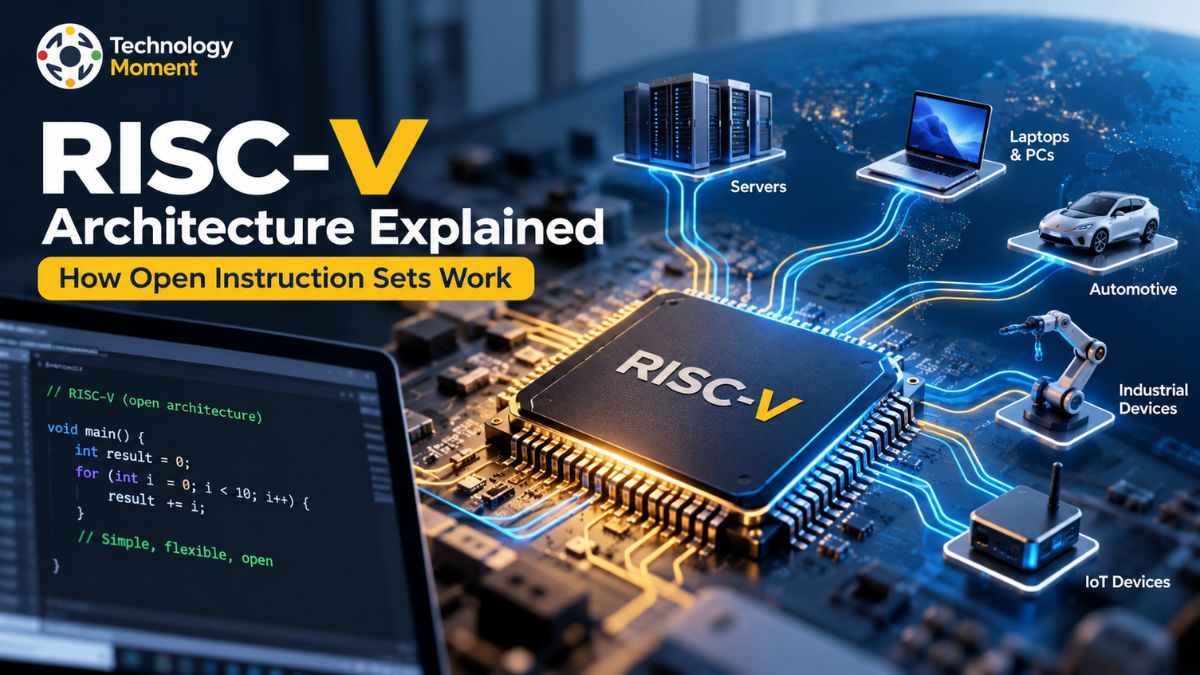
RISC-V architecture is used in a growing range of computing applications, from small embedded devices to specialized processors designed for more demanding workloads. Its open instruction set architecture (ISA), modular design, and support for standard and custom extensions allow hardware developers to build processors around specific technical requirements. Rather than being limited to one category of device, RISC-V provides a common architectural foundation that can be implemented in different ways.
One important application of RISC-V is embedded systems. These systems use processors to perform dedicated tasks in products such as industrial controllers, smart appliances, electronic instruments, and monitoring equipment. RISC-V-based microcontrollers can be designed for applications where memory capacity, power consumption, cost, and predictable operation are important considerations. The exact capabilities depend on the processor and its implementation.
RISC-V is also relevant to the Internet of Things (IoT). Connected sensors, smart devices, and edge computing systems often require processors that balance energy efficiency with computing performance. Developers can select suitable RISC-V implementations and extensions to support particular workloads, including data processing and specialized signal operations. However, not every RISC-V processor includes wireless connectivity or the peripherals required for a complete IoT product.
Another area is system-on-chip (SoC) design. An SoC integrates a processor with components such as memory controllers, interfaces, and other hardware blocks. RISC-V cores can serve as part of these systems, supporting applications ranging from basic control functions to more complex computing tasks. The architecture is also being explored in automotive electronics, research projects, education, and specialized computing platforms.
In education, RISC-V helps students and researchers explore computer architecture, instruction sets, processor design, and hardware-software interaction. Its accessible specifications make it useful for learning and experimentation. According to RISC-V International, the architecture supports applications across IoT, embedded computing, and other processor markets. https://riscv.org/industries/iot-embedded/ Its long-term adoption will depend on hardware availability, software compatibility, development tools, and the needs of individual applications.
Why Does an Open Instruction Set Matter?
An open instruction set matters because it gives hardware designers access to a shared architectural specification without requiring them to obtain exclusive control of the instruction set itself. Its specifications define the instructions that compatible processors can execute, providing a foundation for independent hardware development and software compatibility.
Traditional proprietary instruction set architectures can involve licensing arrangements that influence how companies develop processors. RISC-V offers an alternative by making its ratified ISA specifications openly available under the applicable open licensing framework. This can give organizations more flexibility when planning processor designs, selecting suppliers, or developing specialized hardware. However, the cost of manufacturing chips, developing processor cores, and maintaining software still needs to be considered.
Another important benefit is design freedom. RISC-V uses a modular architecture consisting of a base instruction set and optional extensions. Hardware designers can choose supported standard extensions according to their intended applications and, where appropriate, develop custom instructions. For example, a processor designed for an embedded controller may have different requirements from one intended for vector calculations or specialized acceleration.
An open instruction set also encourages collaboration. Universities, research teams, semiconductor companies, and independent developers can study the specifications and contribute to the wider ecosystem. This can support education, processor research, tool development, and competition among hardware providers. A shared ISA can also help software developers target a defined architecture, although compatibility still depends on supported extensions, platform requirements, and software availability.
It is important to distinguish an open ISA from open-source hardware. RISC-V does not mean that every processor implementation is free, publicly documented, or open source. Companies can develop proprietary processor cores and commercial products based on the standard. RISC-V International maintains the architectural specifications rather than manufacturing or selling processors itself. An open instruction set matters because it expands the choices available to hardware and software developers. Its practical value comes from the combination of accessible specifications, customization opportunities, and a collaborative ecosystem, rather than from a guarantee that every RISC-V product will be cheaper, faster, or more efficient.
Frequently Asked Questions About RISC-V Architecture
What Is RISC-V Architecture?
RISC-V architecture is an open-standard instruction set architecture based on reduced instruction set computing principles. It defines the instructions a compatible processor can execute, and the rules software follows when interacting with hardware. Unlike a specific CPU, RISC-V is an architectural specification that different organizations can implement in their own processors.
Is RISC-V Open Source?
RISC-V is an open-standard instruction set architecture, but that does not mean every implementation is open source. The architectural specifications are publicly available, allowing organizations to develop compatible processors. Some implementations are openly licensed, while others are proprietary commercial designs. Therefore, it is important to distinguish the open ISA from processor hardware, design files, firmware, and software, which may each have separate licensing terms.
Is RISC-V Royalty-Free?
The ratified RISC-V ISA specifications and standard extensions are available under an open, royalty-free model. This means developers can use the architectural standard without paying an ISA royalty simply to implement it. However, processor cores, third-party intellectual property, development tools, manufacturing, and commercial services may involve costs or separate licensing requirements. Companies should review the applicable terms for every component used in a product.
What Are the Main Benefits of RISC-V?
The main benefits of RISC-V architecture include an open instruction set, modular extensions, design flexibility, and opportunities for hardware customization. Developers can create processors for particular applications without relying on a single proprietary ISA provider. The architecture also supports research, education, and collaboration across the semiconductor ecosystem. Actual cost, performance, and power efficiency depend on the processor implementation, supported features, software, and intended workload.
Where Is RISC-V Used?
RISC-V is used or developed for applications including embedded systems, microcontrollers, IoT devices, system-on-chip designs, research, and specialized computing. It is also being explored in automotive electronics and more advanced processor platforms. The suitability of a particular RISC-V processor depends on its capabilities, software support, power requirements, and performance. Not every implementation supports the same operating systems, peripherals, or application workloads.