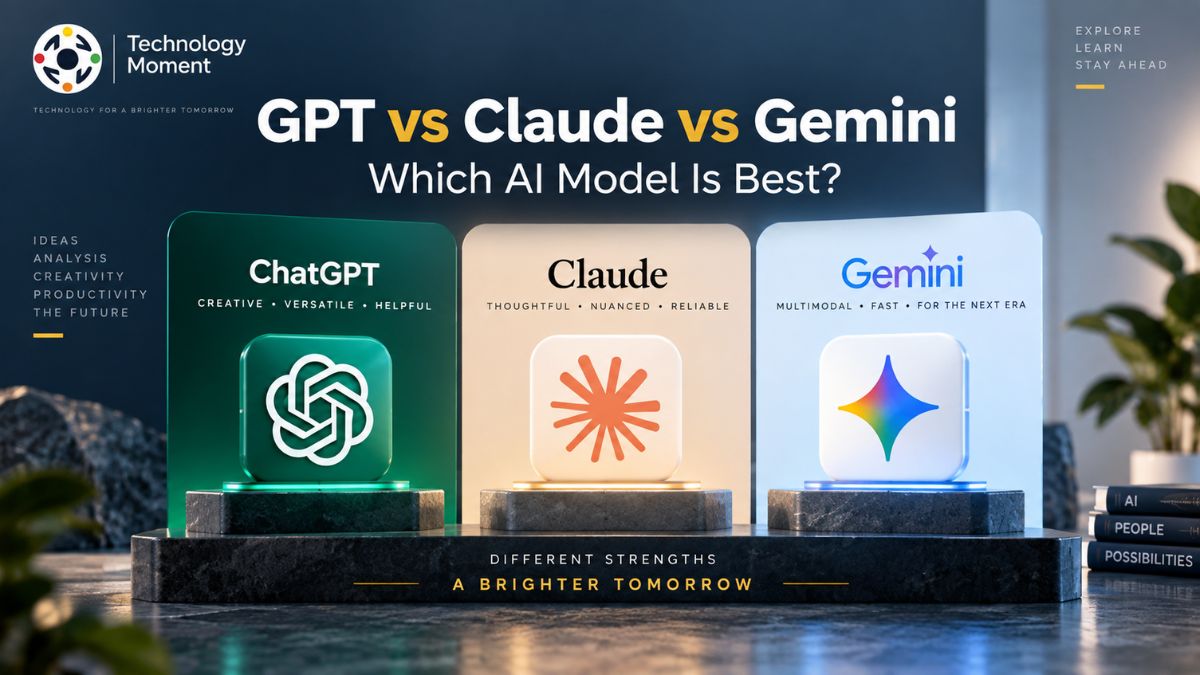
AI is moving faster than ever, and choosing the right AI model is becoming increasingly difficult. GPT, Claude, and Gemini have each developed strong capabilities across writing, coding, research, reasoning, productivity, and everyday tasks. While all three can produce impressive results, they are not designed to perform every task in exactly the same way.
So, which AI model is best: GPT, Claude, or Gemini? The answer depends largely on what you need the model to do. A developer may prioritize coding and technical reasoning, while a writer may care more about response quality and creative output. Students and researchers may look for strong document analysis and research assistance, while businesses may focus on productivity, automation, reliability, and overall value.
At Technology Moment, we believe technology comparisons should do more than list features or declare a single winner. They should help you understand the differences and choose the technology that fits your specific needs. That is why this comparison looks at GPT, Claude, and Gemini across the areas that matter most to real users.
In this guide, we compare their capabilities, coding performance, writing, reasoning, research features, multimodal abilities, accuracy, speed, context handling, pricing, and practical use cases. By the end, you will have a clearer picture of the strengths and limitations of each AI model—and which one may be the right choice for you.
GPT vs Claude vs Gemini: What’s the Difference?
GPT, Claude, and Gemini are three leading AI model families, but they come from different companies and have different approaches to building AI assistants. GPT is developed by OpenAI and powers ChatGPT, Claude is developed by Anthropic, and Gemini is developed by Google. All three are designed to understand natural language, generate text, analyze information, assist with coding, and handle a wide range of everyday tasks.
The biggest difference is not simply which model is “smarter.” Each platform has its own strengths, workflows, integrations, and areas where users may find it particularly useful. GPT is widely used for general-purpose assistance, coding, content creation, reasoning, and productivity. Claude is known for its focus on helpful conversations, long-form work, writing, analysis, and handling complex instructions. Gemini benefits from Google’s broader AI ecosystem and can be particularly useful for users who already rely heavily on Google services.
Their capabilities also continue to evolve, which means a comparison can change as new models and features are released. For that reason, it is better to evaluate GPT, Claude, and Gemini according to specific tasks rather than assuming that one model will always outperform the others.
| Feature | GPT | Claude | Gemini |
|---|---|---|---|
| General Performance | Excellent | Excellent | Excellent |
| Reasoning | Excellent | Best | Excellent |
| Coding | Best | Excellent | Excellent |
| Writing | Excellent | Best | Good |
| Research | Best | Excellent | Best |
| Multimodal AI | Excellent | Good | Best |
| Context Handling | Excellent | Best | Excellent |
| Speed | Best | Excellent | Excellent |
| Productivity | Best | Excellent | Best |
| Best For | All-around use | Writing & analysis | Google ecosystem & multimodal tasks |
GPT vs Claude vs Gemini: Which AI Model Is Best Overall?
There is no single AI model that is the best choice for every person or every situation. GPT, Claude, and Gemini can all be powerful general-purpose AI assistants, but the better option depends on the type of work you regularly perform.
GPT can be an excellent all-around choice for users who want one AI assistant capable of supporting a broad range of activities, including writing, coding, brainstorming, analysis, and productivity. Claude can be particularly appealing when your work involves detailed instructions, long-form writing, document analysis, or thoughtful conversational interaction. Gemini can make sense for users who want AI capabilities closely connected with Google’s ecosystem and related productivity services.
Instead of choosing a winner based only on benchmark scores, consider how well each model fits your actual workflow. Response quality, reliability, speed, available features, integrations, pricing, and ease of use can all influence the final decision.
For Technology Moment readers, the most useful question is therefore not simply “Which AI model is best?” but “Which AI model is best for my needs?” A model that performs exceptionally well for coding may not be the ideal choice for creative writing or research. The overall winner should ultimately be determined by the tasks that matter most to you.
GPT vs Claude vs Gemini for Coding
AI has become an increasingly useful companion for developers, helping with code generation, debugging, documentation, refactoring, explanations, and problem-solving. GPT, Claude, and Gemini can all assist with programming, but their usefulness can vary depending on the language, project complexity, prompt quality, and development environment.
When evaluating the best AI model for coding, developers should look beyond the ability to generate a short code snippet. More important factors include understanding existing code, following project requirements, identifying bugs, explaining technical decisions, and maintaining consistency across larger development tasks.
GPT can be useful as a general-purpose coding assistant for generating implementations, explaining programming concepts, troubleshooting errors, and working through technical problems. Claude can be valuable for developers who frequently work with lengthy code, detailed specifications, or large amounts of technical context. Gemini can also be useful for coding and technical workflows, particularly for users already working within Google’s broader technology ecosystem.
There is no permanent winner because AI coding performance changes as models and developer tools improve. The best AI model for developers is the one that fits their programming workflow and consistently produces useful, understandable, and maintainable results.
Developers should also review AI-generated code carefully, especially when working with security-sensitive, production, or business-critical applications.
GPT vs Claude vs Gemini for Writing
AI writing tools have evolved beyond simple text generation. Today, GPT, Claude, and Gemini can help users brainstorm ideas, create outlines, rewrite passages, summarize documents, improve clarity, and develop long-form content. However, the writing experience can feel different across the three platforms.
GPT can be useful for a wide variety of writing tasks, from brainstorming and drafting to editing and structured content creation. Claude can be attractive to users who prioritize natural-sounding long-form writing, detailed instructions, and careful editing. Gemini can also support writing, research, summarization, and productivity tasks, especially for users who work within Google’s ecosystem.
Choosing the best AI model for writing depends heavily on the type of content being produced. A marketing professional may prioritize speed and versatility, while an author may care more about tone and consistency. A business user may need concise professional communication, whereas a student may need help organizing and understanding complex material.
Regardless of the model, AI-generated content should not automatically be treated as finished work. Human review remains important for accuracy, originality, tone, factual claims, and audience relevance. For publishers such as Technology Moment, AI can accelerate research and drafting, but editorial judgment and quality control should remain central to the publishing process.
GPT vs Claude vs Gemini for Reasoning
Reasoning is one of the most important areas to consider when comparing modern AI models. A capable reasoning model should do more than produce fluent answers; it should be able to work through complex instructions, analyze information, identify relationships, solve problems, and explain its conclusions clearly.
GPT, Claude, and Gemini can all be used for reasoning-oriented tasks, including logical analysis, mathematical problems, technical questions, planning, and multi-step problem solving. However, their performance can differ depending on the specific model version, task, prompt, and evaluation method.
When comparing the best AI model for reasoning, users should avoid relying on a single benchmark. Benchmark results can provide useful evidence, but real-world performance also depends on whether the model understands the context, follows instructions accurately, recognizes uncertainty, and produces a logically consistent response.
GPT may be a strong choice for users looking for broad reasoning and problem-solving capabilities across different workflows. Claude can be useful for detailed analysis and structured reasoning tasks, while Gemini can provide another strong option for users whose work combines reasoning with Google’s broader AI and productivity ecosystem.
The practical winner therefore depends on the problem being solved. For important decisions, AI reasoning should support—not replace—human judgment. Users should verify calculations, factual claims, assumptions, and conclusions before relying on AI-generated reasoning for professional, financial, technical, or other high-impact decisions.
GPT vs Claude vs Gemini for Research
AI research assistants can significantly reduce the time required to gather, organize, summarize, and understand information. GPT, Claude, and Gemini can all support research workflows, but their usefulness depends on the type of research and the tools available with the particular service or model version.
For research, an AI model needs more than strong text generation. It should understand complex questions, summarize lengthy material, compare information, identify important details, and clearly distinguish between facts and uncertainty. GPT can be useful for structured research, brainstorming, analysis, summarization, and turning complex information into easier-to-understand explanations. Claude can be valuable when working with detailed instructions, lengthy documents, and analytical writing. Gemini can be especially relevant for users who want AI assistance connected with Google’s broader information and productivity ecosystem.
However, AI-generated research should not automatically be considered verified information. Models can misunderstand sources, omit important context, or generate inaccurate claims. For serious research, users should check primary sources and confirm important facts before publishing or making decisions.
The best AI model for research is therefore the one that provides the right combination of analysis, source access, document handling, transparency, and usability for your particular research workflow.
GPT vs Claude vs Gemini: Multimodal Capabilities
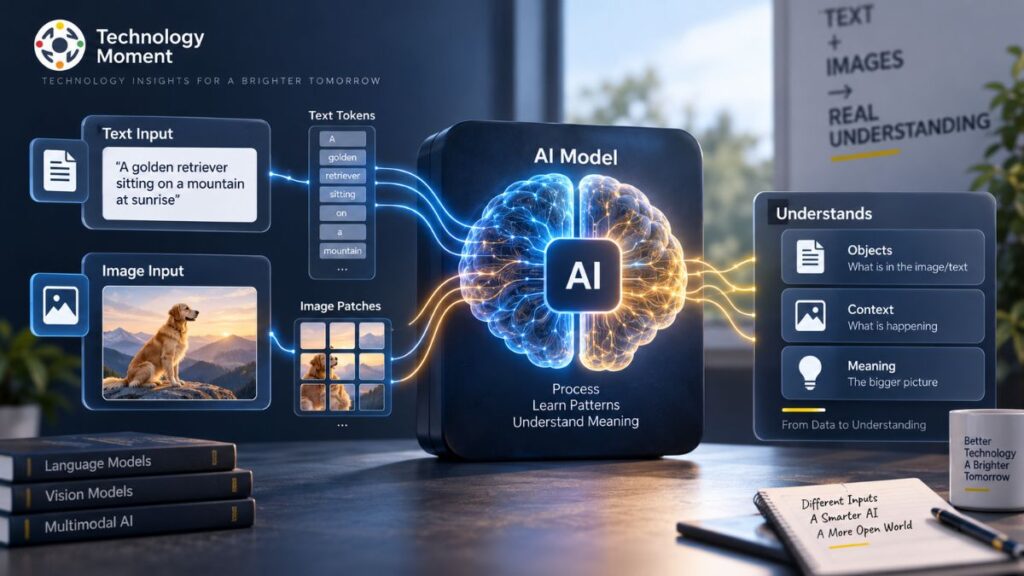
Modern AI is no longer limited to text. Multimodal AI allows models to work with different types of information, such as text, images, documents, and other supported formats. GPT, Claude, and Gemini have all expanded beyond traditional text-based conversations, although the exact capabilities depend on the product and model version being used.
Multimodal capabilities can be useful in many practical situations. A student might ask an AI assistant to explain a diagram, a developer may need help understanding a screenshot of an error, and a business professional might want assistance analyzing a document or visual material. These workflows require the model to understand information across different formats rather than simply generating text.
GPT can support a broad range of multimodal workflows depending on the available product features. Claude can be useful for analyzing visual and document-based information within supported workflows, while Gemini offers multimodal capabilities that fit naturally into Google’s wider AI ecosystem.
When comparing these platforms, users should evaluate the specific formats they need, the quality of interpretation, response consistency, and available tools rather than assuming that multimodal support is identical across platforms.
For everyday users, the best multimodal AI is ultimately the one that handles their preferred combination of text, images, documents, and other inputs reliably and conveniently.
GPT vs Claude vs Gemini: Accuracy and Reliability
A response can sound convincing and still contain incorrect information, missing context, or an unsupported conclusion. GPT, Claude, and Gemini are all capable of producing high-quality answers, but none should be treated as automatically correct in every situation.
AI accuracy can vary according to the question, model version, available context, and whether the task requires factual recall, reasoning, summarization, or interpretation. A model may perform well on one type of problem and produce weaker results on another. This is why broad claims that one platform is always the most accurate can be misleading.
Reliability also involves more than factual correctness. Users should consider whether the model follows instructions, communicates uncertainty, maintains consistency, and avoids inventing information. Hallucinations remain an important consideration when using generative AI, particularly for research, technical work, and other tasks where incorrect information can have serious consequences.
GPT, Claude, and Gemini can each be useful when combined with appropriate verification practices. For important information, users should check authoritative or primary sources rather than relying exclusively on an AI-generated response.
The best approach is to treat AI as an intelligent assistant, not an unquestionable source of truth. Human verification remains essential when accuracy matters.
GPT vs Claude vs Gemini: Speed and Performance
Speed can have a major impact on the overall AI experience. When users interact with an AI assistant throughout the day, even small differences in response time can affect productivity. GPT, Claude, and Gemini can all deliver fast responses, but actual performance depends on the model selected, workload, platform, connection, and complexity of the request.
Simple questions may receive responses quickly, while larger documents, complex reasoning tasks, coding problems, or more demanding workflows can require additional processing. Therefore, response speed should not be evaluated independently from answer quality.
Performance is equally important. A fast response is not necessarily useful if it misunderstands the request or produces an incomplete answer. Conversely, a more detailed response may be worth waiting for when the task involves complex reasoning or analysis.
When comparing GPT, Claude, and Gemini, users should consider the balance between speed, quality, consistency, and task complexity. For casual conversations, quick responses may be the priority. For professional work, reliability and depth can matter more than saving a few seconds.
It is also important to remember that AI performance changes as providers release new models, optimize infrastructure, and introduce different service tiers. A comparison that is accurate today may change over time.
The best platform is therefore the one that delivers an effective combination of speed and quality for your actual workload.
How GPT, Claude, and Gemini Handle Long Contexts
Context window is an important technical factor when comparing large language models. In simple terms, it refers to how much information a model can consider within a particular interaction. This can include previous conversation, documents, instructions, and other information provided to the model.
A larger context capacity can be useful when working with lengthy reports, large codebases, detailed specifications, research material, or long conversations. Instead of repeatedly dividing information into smaller sections, users may be able to provide more relevant material within a single workflow.
GPT, Claude, and Gemini can support substantial context handling, but the exact limits and behavior depend on the specific model, product, and service configuration. Users should therefore avoid treating “GPT,” “Claude,” or “Gemini” as if each represents one fixed context limit.
Token limits are also important because AI systems process text using tokens rather than simply counting words. Input and output requirements can affect how much information can be handled during an interaction.
For developers and advanced users, context capacity can influence application architecture, document processing, coding workflows, and API costs. For everyday users, the practical question is simpler: can the AI comfortably understand the amount of information required for the task?
When choosing between GPT, Claude, and Gemini, context should be considered alongside accuracy, speed, reasoning ability, available tools, and the specific workflow rather than treated as the sole measure of model quality.
GPT vs Claude vs Gemini for Students
AI assistants are becoming useful study companions for students who need help understanding difficult concepts, organizing information, summarizing material, brainstorming ideas, and improving their productivity. GPT, Claude, and Gemini can all support these activities, but the best option depends on the student’s learning style and requirements.
GPT can help students explain complex topics in simpler language, generate study plans, practice questions, summarize information, and work through problems step by step. Claude can be useful for detailed explanations, long-form documents, writing assistance, and structured study tasks. Gemini can also support learning, research, summarization, and everyday academic productivity, particularly for students who already use Google’s ecosystem.
However, students should use AI as a learning assistant rather than a replacement for independent thinking. Simply copying an AI-generated answer may save time, but it does not necessarily improve understanding. A better approach is to ask the model to explain concepts, provide examples, identify mistakes, or create practice exercises.
When choosing the best AI model for students, consider response quality, ease of use, available features, research capabilities, and cost. The right model should help students learn more effectively while encouraging critical thinking, verification, and genuine understanding rather than passive dependence on AI.
GPT vs Claude vs Gemini for Business
Businesses are increasingly using AI for tasks such as research, content creation, customer support, document analysis, coding, brainstorming, automation, and productivity. GPT, Claude, and Gemini can all contribute to these workflows, but organizations should evaluate them according to their specific operational needs.
GPT can be a strong general-purpose option for businesses that want AI assistance across writing, analysis, coding, productivity, and automation. Claude can be particularly useful for organizations working with lengthy documents, detailed instructions, analysis, and knowledge-intensive tasks. Gemini can be attractive to businesses already invested in Google’s productivity and technology ecosystem.
For business users, choosing an AI model involves more than comparing response quality. Security, privacy, administrative controls, integrations, reliability, scalability, pricing, and compliance requirements can be equally important. Organizations should also consider how easily an AI system can fit into existing workflows.
The best AI model for business is therefore not necessarily the model that performs best on a public benchmark. It is the one that creates measurable value within the organization’s real processes.
Businesses should also establish clear policies for sensitive information, human review, and AI-generated outputs. Used responsibly, GPT, Claude, and Gemini can help teams reduce repetitive work, accelerate knowledge tasks, and create more efficient AI-powered workflows.
GPT vs Claude vs Gemini: Strengths and Weaknesses
GPT, Claude, and Gemini each have different strengths, and understanding those differences is more useful than declaring one platform universally superior.
| Model | Strengths | Weaknesses | Best For |
|---|---|---|---|
| GPT | Versatile general-purpose AI, strong coding and reasoning support, writing, analysis, and broad productivity use cases | Capabilities can vary by model and plan; users should verify important information | Overall use, coding, writing, reasoning, productivity |
| Claude | Strong long-form writing, detailed analysis, instruction following, and document-focused workflows | Features and capabilities vary by model, plan, and available integrations | Writing, analysis, long documents, detailed tasks |
| Gemini | Strong multimodal capabilities and integration with Google’s broader technology ecosystem | Experience and available features depend on the model, product, and plan | Multimodal tasks, Google ecosystem, productivity |
The comparison also needs to remain flexible because AI models evolve rapidly. New releases can change performance, features, pricing, and competitive advantages. For that reason, GPT vs Claude vs Gemini should be treated as an ongoing comparison rather than a permanent ranking.
GPT vs Claude vs Gemini: Which One Should You Choose?
Choosing between GPT, Claude, and Gemini becomes much easier when you start with your primary use case instead of trying to identify one universal winner.
| Your Need | Recommended Model |
|---|---|
| Coding | Claude |
| Writing | GPT |
| Research | Gemini |
| Reasoning | GPT |
| Students | Gemini |
| Business | GPT |
| Productivity | GPT |
| Everyday AI | GPT |
| Multimodal Tasks | Gemini |
There is also nothing wrong with using more than one AI model. Different assistants can complement each other, allowing users to choose the most suitable tool for a particular task.
Ultimately, the best AI model is the one that consistently helps you accomplish your goals with the right balance of quality, speed, reliability, features, and value. Technology Moment’s approach is simple: choose based on your needs, not hype or popularity.
Frequently Asked Questions
What is the difference between GPT, Claude, and Gemini?
GPT is developed by OpenAI, Claude by Anthropic, and Gemini by Google. All three are advanced AI systems, but their models, features, tools, integrations, and strengths can differ.
Which AI model is best for writing?
All three can support writing, editing, brainstorming, summarization, and content creation. Your preferred writing style and the type of content you create should determine which model works best for you.
Which AI model is best for research?
The best research model depends on the sources, tools, document types, and verification requirements involved. Regardless of the platform, important information should be checked against reliable sources.
Is Claude better than GPT?
Neither is universally better. Their performance can vary by task, model version, and workflow, so comparing them on the work you actually perform is more useful than relying on a general ranking.
Is Gemini better than GPT or Claude?
Gemini can be a strong choice, particularly for users who value its capabilities and integration within Google’s ecosystem. Whether it is better for you depends on your specific requirements and workflow.