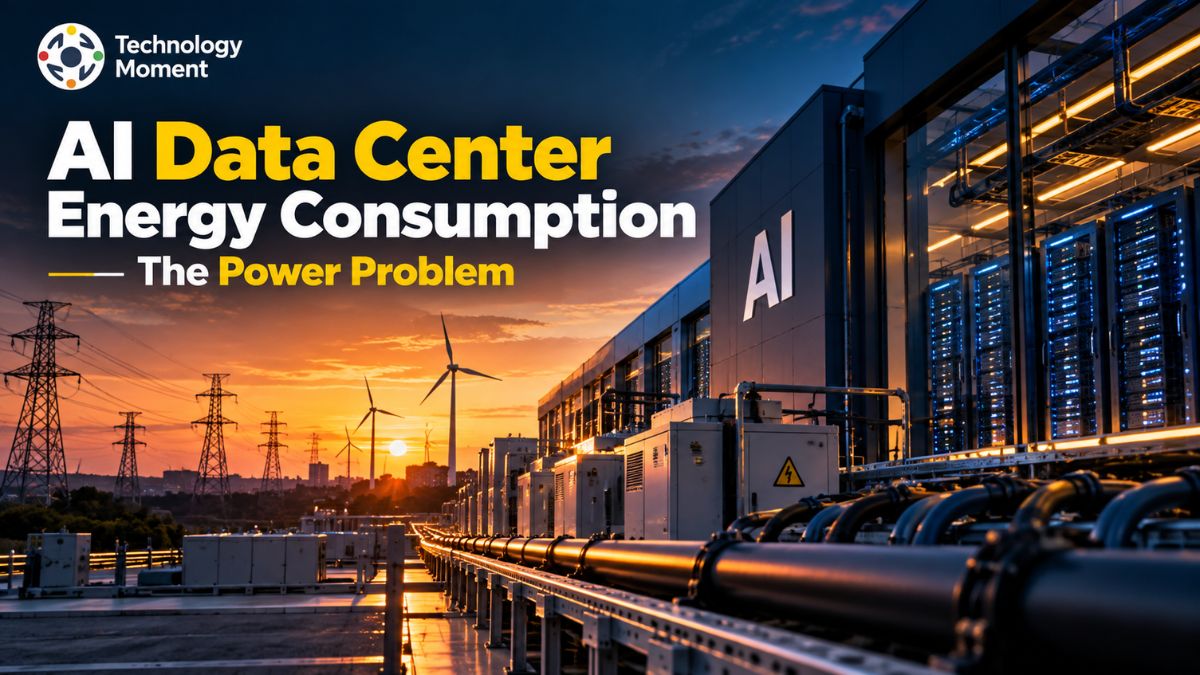
Artificial intelligence is transforming how businesses operate, products are built, and digital services are delivered. But behind every AI model, chatbot, image generator, and automated application is a physical infrastructure that requires something increasingly valuable: electricity. As AI workloads grow, data centers are expanding to support larger models, more intensive computing, and rising demand for AI services.
AI data centers also require high-density computing equipment, advanced cooling systems, reliable power connections, and substantial grid infrastructure. In many markets, connecting new facilities to the grid can take longer than building the data centers themselves. That creates a new infrastructure question for the technology industry: How can the world provide enough reliable, affordable, and sustainable power to support AI’s rapid expansion?
In this article, Technology Moment explores the growing relationship between AI and energy—from rising data-center electricity demand and cooling requirements to grid capacity, renewable power, nuclear energy, and emerging approaches to power infrastructure. Rather than viewing energy as a secondary concern, understanding it is becoming essential to understanding where the next phase of AI development can go.
Why AI Is Reshaping Data Center Electricity Demand
The rapid growth of artificial intelligence is changing the energy profile of modern data centers. Traditional data centers already require substantial electricity to run servers, storage, networking equipment, and cooling systems, but AI workloads are adding a new layer of demand. Training and running advanced AI models rely heavily on GPUs and other accelerated servers that can operate at much higher power densities than conventional computing equipment. The International Energy Agency estimates that global data centers consumed about 415 TWh of electricity in 2024, equivalent to around 1.5% of global electricity consumption.
One important reason behind rising AI data center energy consumption is the increasing scale of AI computing infrastructure. Large language models, generative AI applications, video generation, scientific computing, and other AI workloads require enormous amounts of computation. As companies deploy larger models and serve more users, demand for AI servers and accelerated computing continues to increase. The IEA projects electricity consumption from accelerated servers, largely driven by AI adoption, to grow much faster than consumption from conventional servers.
Power density is another major factor. AI-focused facilities can contain far more computing power within the same physical space than traditional facilities. McKinsey notes that data-center power densities have risen sharply as AI workloads expand, creating additional requirements for electrical systems, power distribution, and cooling. This means the AI data center power demand problem is not simply about building more servers. Operators also need transformers, switchgear, backup power, electrical distribution systems, and reliable connections to the wider electricity grid.
There is also a difference between training and inference. Training an AI model can require intensive computing for extended periods, while inference occurs every time users interact with a trained model. As AI applications become part of search, productivity software, customer service, coding, healthcare, finance, and other industries, inference workloads could become an increasingly important source of electricity demand. The result is a data-center industry where computing growth is increasingly tied to energy availability.
How Big Will AI Data Center Power Demand Become?
The scale of future AI data center electricity demand is difficult to predict precisely because it depends on several variables, including AI adoption, hardware efficiency, model development, data-center construction, electricity availability, and improvements in software. Nevertheless, current projections show that data-center electricity consumption is likely to grow substantially during this decade. The IEA’s updated outlook projects global data-center electricity consumption to rise from approximately 485 TWh in 2025 to around 950 TWh in 2030, roughly doubling over the period.
The more significant challenge is geographic concentration. Data centers are not distributed evenly across countries and electricity networks. Large AI facilities often cluster in locations offering access to land, fiber connectivity, tax incentives, and existing infrastructure. This can create substantial electricity demand in specific regions even when the global percentage remains relatively modest.
According to the IEA, conventional data centers may have capacities in the range of 10–25 MW, while hyperscale AI-focused facilities can reach 100 MW or more. This makes questions such as how much power AI data centers need increasingly dependent on the type, size, and workload of the facility. Future demand will also depend on efficiency. Better AI chips, improved algorithms, more efficient software, advanced cooling, and smarter workload management could reduce electricity required per unit of computation. However, efficiency gains do not necessarily guarantee lower overall electricity consumption.
The IEA therefore uses multiple scenarios rather than treating one forecast as certain. Its analysis shows that stronger AI adoption could push data-center electricity demand substantially higher, while faster efficiency improvements could reduce the electricity required to provide the same level of digital services. The central issue is therefore not simply predicting one number for 2030, but understanding how technology, infrastructure, and demand will interact.
The Grid Problem: Can Power Infrastructure Keep Up With AI?
Rising AI data center power demand creates a challenge that goes beyond electricity generation. Data centers need reliable connections to the power grid, and those connections must often be delivered in locations where electricity infrastructure is already under pressure. A company may be able to construct a data center within a few years, but generation, transmission lines, substations, transformers, and other power infrastructure can require much longer planning and construction periods. The IEA highlights this mismatch between the relatively fast development of data centers and the longer timelines required by the energy system.
This is why grid capacity and grid interconnection have become important parts of the AI infrastructure discussion. A large AI campus does not simply need a connection; it needs a connection capable of supporting substantial and reliable power demand. McKinsey’s recent analysis notes that data-center interconnection requirements can be significantly higher than reported IT capacity because the power system must also account for cooling, engineering buffers, and peak requirements.
The geographic concentration of data centers makes the challenge more complicated. Globally, data centers may represent a relatively small share of electricity demand, but a cluster of large facilities can place considerable pressure on a particular regional grid. The IEA specifically notes that the concentration of data centers makes their integration into electricity networks more challenging than the global percentage alone might suggest.
Transmission infrastructure is another constraint. Building new high-voltage transmission lines involves planning, permitting, land access, equipment procurement, and construction. If data-center projects move faster than these processes, developers may face delays in obtaining the required electricity capacity. McKinsey has identified power availability and transmission constraints as important factors influencing where new data centers can expand.
The solution will likely involve several approaches rather than one technology. Utilities can expand generation and transmission, modernize grids, improve interconnection processes, and use technologies that make existing networks more flexible. Data-center operators can also consider locations with available power, secure long-term electricity contracts, develop on-site generation where appropriate, and coordinate more closely with utilities. This makes power infrastructure for AI data centers a strategic issue for the entire technology industry. The future growth of AI will depend not only on chips and computing capacity, but also on whether electricity systems can deliver reliable power where and when it is needed.
Cooling Is Becoming a Major Part of the AI Energy Problem
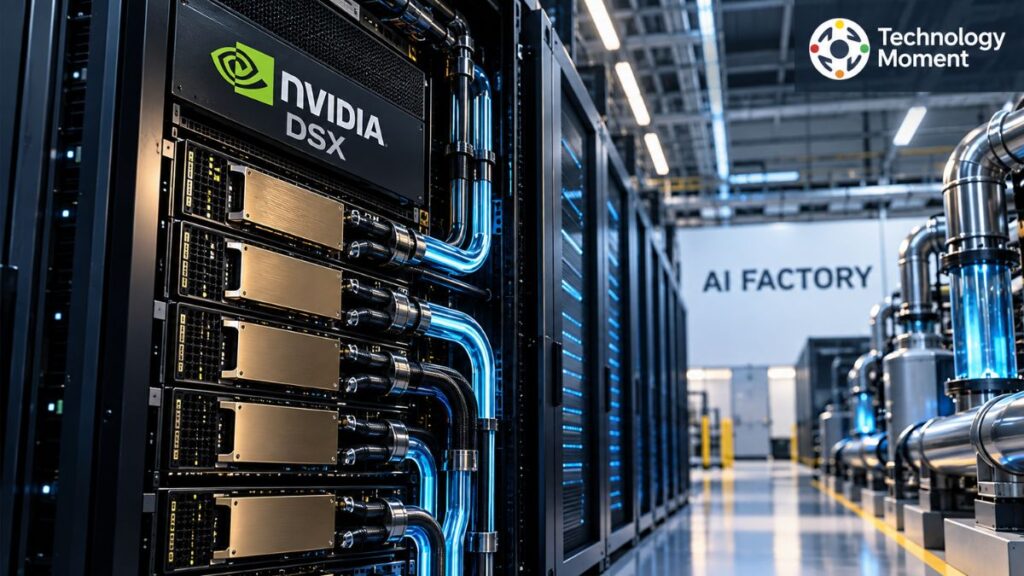
Electricity used by AI data centers does not go entirely toward computation. A significant portion supports the infrastructure required to keep servers operating safely, particularly cooling systems. As AI servers become more powerful and rack-level power density increases, they generate more heat. Removing that heat efficiently is therefore becoming one of the central engineering challenges for modern data-center infrastructure. Traditional data centers have commonly relied on air-based cooling, but the increasing density of AI computing can push conventional systems toward their practical limits. McKinsey notes that high-density AI workloads are driving a shift toward liquid cooling because liquid can remove heat from high-powered equipment more effectively than air.
The importance of cooling also affects overall data center energy consumption. Cooling systems require electricity themselves, meaning inefficient thermal management can increase the total energy required to operate an AI facility. The IEA estimates that cooling and other infrastructure represent a meaningful portion of the growth in data-center electricity consumption through 2030. Improving cooling efficiency can therefore reduce the amount of additional electricity required as computing capacity expands.
Liquid cooling is becoming particularly relevant for AI infrastructure because it can transfer heat more directly from high-power components. Different approaches include direct-to-chip liquid cooling and other rack-level systems. These technologies can potentially support higher computing densities while reducing the energy required for thermal management. McKinsey has reported that some facilities using liquid cooling have achieved improvements in power usage effectiveness compared with conventional approaches.
Cooling also connects the AI energy problem with water consumption. Some data-center cooling designs use water as part of the heat-removal process, creating additional considerations in regions where water resources are constrained. As AI data centers expand internationally, operators therefore have to consider local climate, electricity availability, water resources, and infrastructure when choosing locations and designing facilities.
The future of AI data center cooling is consequently likely to involve a combination of better hardware, liquid cooling, improved thermal management, facility design, and more efficient control systems. Cooling cannot be treated as an afterthought when AI workloads are increasing power density so rapidly. It is becoming a core component of the energy strategy required to build reliable and efficient AI computing infrastructure.
Where Will the Electricity Come From?
As AI data center power demand continues to rise, one of the biggest questions is where the additional electricity will come from. Data-center operators, utilities, governments, and energy companies are increasingly looking at a combination of renewable power, natural gas, nuclear energy, grid electricity, and energy storage to support expanding AI infrastructure. The International Energy Agency (IEA) projects that electricity generation dedicated to data centers will rise from about 460 TWh in 2024 to more than 1,000 TWh by 2030. Renewables are expected to provide nearly half of the additional electricity required during this period, while natural gas and nuclear power also play important roles.
Renewable energy for AI data centers is becoming particularly important because solar, wind, and hydropower can add new electricity generation while helping technology companies pursue lower-carbon operations. Some operators are signing long-term power purchase agreements, while others are exploring projects that place renewable generation closer to their data centers. However, renewable electricity can vary depending on weather and time of day, making storage, grid connections, and other sources of firm power important for facilities that require continuous operation.
Natural gas is also expected to contribute significantly to near-term electricity supply, particularly in regions where gas-fired generation can be expanded relatively quickly. Nuclear power represents another part of the emerging strategy, especially for operators seeking reliable, low-emissions electricity over long periods.
The broader trend suggests that the future of AI energy demand will depend on a diversified electricity system rather than one dominant technology. The challenge will be balancing reliability, cost, availability, and environmental considerations while AI infrastructure continues to expand.
The New Energy Strategy for AI Data Centers
Building additional servers is only one part of the expansion equation. Operators also need reliable electricity connections, substations, transformers, cooling systems, backup power, and access to sufficient generation capacity. Because data centers can be built faster than some electricity infrastructure, energy planning increasingly needs to happen alongside technology and construction planning rather than after a facility has been designed.
One element of a new data center energy strategy is location. A site with abundant power capacity and access to transmission infrastructure can reduce some of the challenges associated with connecting a large AI facility. The IEA highlights the different timelines between data-center construction and energy-system development: a data center can become operational within a few years, while major electricity infrastructure can require longer planning, permitting, and construction periods.
The second element is diversification. Instead of relying entirely on one source, operators can combine grid electricity with renewable generation, long-term power purchase agreements, storage, and other sources of firm electricity. The IEA expects renewables to meet nearly half of the growth in global data-center electricity demand through 2030, while natural gas and nuclear also contribute substantially.
Efficiency should form another part of the strategy. More efficient AI servers, workload optimization, improved power distribution, and advanced cooling can reduce the amount of electricity required for a given amount of computing. However, efficiency should not be viewed as a guarantee that total electricity consumption will fall. If lower computing costs lead to much greater AI usage, overall demand can still increase.
A successful strategy therefore needs to connect AI infrastructure investment with long-term energy planning. Technology companies and utilities will need to consider generation, transmission, storage, cooling, grid capacity, and operational efficiency together. The objective is not simply to find more electricity, but to create an energy system capable of supporting AI reliably as computing demand evolves.
Can AI Data Centers Reduce Their Energy Footprint?
Reducing the AI data center energy consumption associated with rapidly growing workloads will require improvements across the entire infrastructure stack. Better chips are an obvious starting point, but hardware efficiency alone cannot solve the problem. Data centers also consume electricity through networking equipment, storage, cooling, power distribution, backup systems, and other supporting infrastructure. The IEA estimates that accelerated servers, which are largely driven by AI adoption, will account for almost half of the net increase in global data-center electricity consumption between 2024 and 2030 in its base case. Cooling and other infrastructure account for another significant portion of the increase.
One approach is to improve the efficiency of AI computing itself. New generations of GPUs and specialized AI accelerators can deliver more computational performance for a given amount of electricity. Software can also influence energy use through better model architectures, workload scheduling, quantization, and resource utilization. These improvements can reduce the energy required for individual AI tasks, although total demand may continue rising as AI becomes more widely used.
Cooling is another major opportunity. Higher power density in AI facilities makes thermal management increasingly important. Advanced liquid-cooling technologies can help remove heat from high-performance computing equipment more efficiently than traditional approaches in suitable deployments. Better cooling design can therefore contribute to overall data center energy efficiency while allowing operators to support increasingly dense AI hardware.
Operators can also reduce their energy footprint through renewable electricity, battery storage, efficient power-management systems, and smarter workload scheduling. In some situations, workloads could potentially be shifted according to electricity availability, helping operators use periods when lower-carbon or lower-cost power is available. The IEA’s scenarios demonstrate why efficiency matters. Its High Efficiency Case shows that greater improvements in hardware, software, and infrastructure can substantially reduce future data-center electricity demand compared with the base case.
However, efficiency has a complicated relationship with demand. If AI becomes cheaper and easier to deploy, organizations may use significantly more AI services. Therefore, reducing energy use per computation does not automatically mean reducing total electricity consumption. The more realistic goal is to make every unit of computing progressively more efficient while building cleaner and more flexible electricity infrastructure to support continued growth.
The Global Challenge: AI Power Demand Is Not Just a U.S. Problem
The conversation around AI power demand often focuses on the United States because it is one of the world’s largest data-center markets and is experiencing rapid AI infrastructure expansion. But the energy challenge is global. The IEA expects the United States, China, and Europe to remain the largest regions for data-center electricity demand, while Southeast Asia and other emerging markets are also seeing significant growth.
The United States illustrates the scale of the challenge particularly clearly. The IEA expects U.S. data-center electricity consumption to increase by around 240 TWh between 2024 and 2030, representing roughly a 130% increase from 2024 levels. Data centers are also projected to account for nearly half of U.S. electricity-demand growth through 2030. This makes grid capacity, generation investment, transmission, and data-center location important parts of the country’s AI infrastructure discussion.
China presents a different energy landscape. Its data-center electricity supply is currently heavily influenced by coal, although renewable and nuclear generation are expected to become increasingly important. The IEA projects substantial growth in both renewable and nuclear electricity for Chinese data centers over the longer term.
Europe has another model. Renewables and nuclear power are expected to provide most of the additional electricity required by European data centers through 2030. Meanwhile, Southeast Asia is becoming an increasingly important data-center region, with electricity demand from data centers expected to more than double by 2030. India is also relevant to the broader AI computing infrastructure story. The IEA’s 2026 electricity outlook expects India’s electricity demand to grow strongly through 2030, with solar PV providing a major share of additional generation and nuclear generation also expanding.
These regional differences matter because there is no universal solution to the AI and electricity demand challenge. Each market has different grid structures, energy resources, regulations, costs, and development timelines. The global AI industry will therefore need energy strategies adapted to local conditions while maintaining a common objective: providing reliable electricity for expanding computing infrastructure without ignoring efficiency, grid resilience, or the changing electricity mix.
What Happens If the Power Grid Cannot Keep Up?
The rapid expansion of AI data centers is creating a new challenge for electricity systems: power infrastructure must grow quickly enough to support facilities that can require enormous amounts of electricity around the clock. If grid capacity cannot keep pace, the problem may not immediately appear as a global shortage of electricity. Instead, it is more likely to emerge through longer connection timelines, delayed data-center projects, limited capacity in major technology hubs, higher infrastructure costs, and increasing pressure on local power systems. For companies planning large AI campuses, access to reliable electricity is becoming an important factor when deciding where new facilities can be built.
One of the biggest challenges is the difference between the speed of AI infrastructure development and the time required to expand electricity infrastructure. New data centers can be developed relatively quickly, while transmission lines, substations, transformers, and generation projects often require extensive planning, permitting, equipment, and construction. This creates a potential mismatch between AI power demand and available grid capacity. McKinsey’s recent analysis of the U.S. market highlights that data-center demand is growing rapidly and that some regions could face significant power constraints as generation and transmission capacity struggle to expand at the same pace.
The impact can also be highly regional. Data centers tend to cluster around locations with strong connectivity, available land, established technology ecosystems, and existing infrastructure. When several large facilities are concentrated in the same area, their combined electricity requirements can place considerable pressure on the local grid even if data centers represent a relatively modest share of electricity demand at the global level. This makes grid interconnection, transmission infrastructure, and regional generation capacity increasingly important to AI expansion.
If the power grid cannot keep up, operators may look toward alternative approaches, including on-site generation, battery storage, long-term electricity contracts, renewable power projects, and flexible workload management. These approaches can provide additional options, but they do not eliminate the need for broader investment in power infrastructure. McKinsey’s 2026 analysis notes that data-center developers and power-sector companies are increasingly considering on-site generation and other solutions as they respond to tight grid conditions.
The issue therefore goes beyond whether the world has enough electricity in total. The more immediate question is whether the right amount of reliable power can reach the right location at the right time. For the AI industry, electricity availability is becoming part of the infrastructure equation alongside GPUs, networking, land, and computing capacity.
Frequently Asked Questions About AI Data Center Energy
How much electricity do AI data centers use?
AI data centers use large amounts of electricity because they operate high-performance GPUs and accelerated servers for demanding workloads. Their consumption varies significantly depending on facility size, hardware, workload, cooling system, and utilization. Training large models can require substantial computing resources, while inference adds continuing electricity demand as AI services are used by millions of people and businesses. As AI adoption grows, electricity consumption from AI-focused data centers is expected to increase significantly.
How does AI affect the power grid?
AI affects the power grid by increasing electricity demand from large data centers, particularly in regions where several facilities are concentrated. Large AI campuses can require significant new generation, transmission, substations, and grid connections. If infrastructure expansion is slower than data-center construction, developers may experience longer connection timelines. The impact is primarily regional rather than evenly distributed worldwide, making grid capacity, transmission planning, and local electricity availability important factors in determining where AI infrastructure can expand.
Can renewable energy power AI data centers?
Renewable energy can supply a significant share of electricity for AI data centers through direct generation, power purchase agreements, or grid-based electricity systems. Solar, wind, and hydropower can help provide lower-carbon electricity, but their availability varies by location and time. Because data centers generally require reliable power around the clock, renewable generation may need to be combined with grid electricity, battery storage, firm generation, or other balancing resources depending on the local energy system.
How can AI data centers reduce energy consumption?
AI data centers can reduce energy consumption through more efficient processors, improved software, workload optimization, advanced cooling, efficient power distribution, and better facility design. Liquid cooling can help manage the heat produced by high-density AI servers, while more efficient chips can deliver greater computing performance per unit of electricity. Renewable power does not reduce electricity consumption itself, but it can reduce the carbon intensity of the electricity used. The strongest approach combines hardware, software, cooling, and infrastructure improvements.
What is the future of AI data center energy demand?
AI data-center energy demand is expected to grow substantially as AI workloads expand. The IEA projects global data-center electricity consumption to more than double by 2030, with AI-optimized facilities among the fastest-growing sources of demand. Future growth will depend on AI adoption, computing efficiency, cooling technology, electricity availability, and infrastructure investment. Renewable energy, natural gas, nuclear power, storage, and grid modernization are all expected to contribute differently across regions as the industry scales.