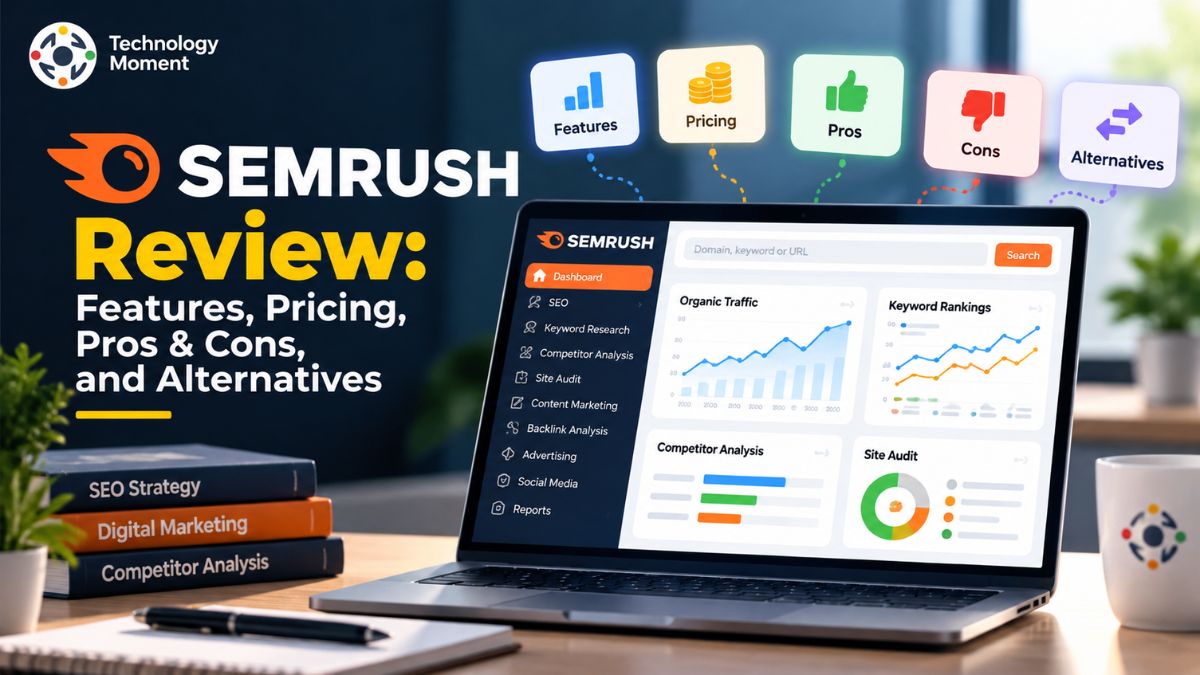
In today’s competitive digital landscape, improving search engine visibility requires more than publishing quality content. Businesses, bloggers, and digital marketers need reliable data to identify valuable keywords, understand competitors, and discover opportunities to attract relevant organic traffic. This is where Semrush Review can make a difference. From keyword research and competitor analysis to backlink tracking, rank monitoring, and technical SEO audits, Semrush brings multiple search optimization tools together in one platform.
But is Semrush worth the investment? Beginners might need time to understand its reports, while experienced SEO professionals and agencies may appreciate having several research and optimization tools under one roof. Throughout this review, we will examine how Semrush supports different SEO workflows, what you should know about its pricing plans, and where competing platforms such as Ahrefs, Moz, and SE Ranking may offer a suitable alternative. We will also consider its strengths and weaknesses to provide a balanced perspective rather than simply highlighting its features.
At Technology Moment, our goal is to make technology and software decisions easier through practical, informative reviews. Whether you manage a personal blog, run a small business, or handle SEO campaigns for multiple clients, this guide will help you evaluate Semrush against your goals, workflow, and budget before making a decision.
What Is Semrush?
Semrush is an all-in-one digital marketing and SEO platform designed to help businesses improve their online visibility, understand competitors, and make informed marketing decisions. It brings together several tools for keyword research, competitor analysis, backlink analysis, technical SEO audits, and rank tracking.
One of the main reasons SEO professionals use Semrush is its keyword research capability. It helps users explore keyword search volume, keyword difficulty, search intent, and related keyword opportunities. These insights can help bloggers, content creators, and businesses identify topics that match their audience’s interests. However, keyword metrics are estimates and should be considered alongside actual website performance and search results.
Semrush also provides competitor analysis tools that help users investigate competing websites, discover their organic keywords, examine estimated traffic, and identify gaps in their content strategy. For example, a blogger can analyze a competing article to discover related search terms and topics that their own content may not cover. Similarly, a digital marketing agency can use competitor research to develop more informed SEO strategies for its clients. Its Site Audit tool can identify technical SEO issues, while backlink analysis helps users understand the links pointing to their websites.
The platform also includes content optimization, marketing reporting, paid advertising research, and tools for monitoring visibility in AI-powered search experiences. The availability of particular features depends on the relevant toolkit and subscription plan. Semrush can be useful for SEO professionals, bloggers, freelancers, small businesses, and digital marketing agencies. However, it may be more than some users need if they only want basic keyword suggestions. Ultimately, understanding your goals and required features is essential before choosing an SEO platform.
Semrush Features Review
Semrush offers a broad collection of features that support different stages of an SEO campaign, from researching keywords to monitoring website performance. The value of these tools depends on how effectively users apply the data to their content and marketing strategies. The Keyword Magic Tool helps expand an initial keyword into a wider list of relevant search queries. Bloggers can use these insights to plan articles, while businesses can identify keywords that align with their products or services. However, a high search volume does not automatically guarantee traffic or conversions.
Competitor analysis is another useful feature. Semrush allows users to examine competitors’ organic keyword rankings, estimated traffic, paid search activity, and leading pages. Its Keyword Gap tool helps compare keyword opportunities across websites. This information can reveal subjects competitors cover successfully and areas where your website may have room to improve. Backlink analysis provides information about referring domains, backlink profiles, and newly discovered or lost links. These insights can support link-building campaigns and help marketers evaluate their websites’ link profiles.
Backlink Audit can also help identify potentially problematic links that deserve further investigation, although automated indicators should not be treated as definitive proof that a link is harmful. The Site Audit tool crawls a website and identifies technical SEO issues, including broken links, crawlability problems, and other potential optimization concerns. Addressing relevant issues can help search engines access and understand website content more effectively. The recommendations should be reviewed carefully because not every reported issue has the same impact.
Position Tracking helps monitor keyword rankings across selected locations and devices. Marketers can use these reports to understand ranking changes and evaluate the performance of their SEO campaigns over time. Semrush also provides content optimization tools and reporting capabilities that can support editorial planning and client communication.
Semrush Pricing and Plans
Semrush pricing depends on the toolkit, subscription plan, billing cycle, and additional features required. For users primarily interested in SEO, the traditional SEO Classic plans are Pro, Guru, and Business. These plans are designed for different levels of SEO activity, from individual projects to agency operations.
The Pro plan is intended for beginners, freelancers, and individuals managing a relatively small number of websites. Semrush lists this plan at $139 per month when billed monthly, or an equivalent of approximately $117.33 per month with annual billing. It includes keyword research, competitor analysis, backlink tools, Site Audit, and Position Tracking. The annual option requires payment under the applicable annual billing terms, so the displayed monthly equivalent should not be confused with a monthly payment.
The Guru plan is designed for growing businesses and marketing teams that need additional research capabilities. Its listed price is $249 per month with monthly billing, or approximately $208.33 per month when billed annually. Compared with Pro, Guru supports more websites and tracked keywords and adds historical data and content optimization features. These capabilities can be useful for marketers managing multiple campaigns or developing a more detailed SEO content strategy.
| Feature | Pro Plan | Guru Plan | Business Plan |
|---|---|---|---|
| Standard Monthly Cost | $139/month | $249/month | $499/month |
| Monthly Cost with Annual Billing | $117.33/month | $208.33/month | $416.66/month |
| Maximum Websites Supported | 5 websites | 15 websites | 40 websites |
| Daily Keyword Tracking Limit | 500 keywords | 1,500 keywords | 5,000 keywords |
| Access to Historical Data | Not listed as a standard feature | Available | Available |
| Content Optimization Tools | Limited functionality | Included | Included |
| API Integration Access | Not listed as a standard feature | Not listed as a standard feature | Available |
These figures reflect the listed SEO Classic plan pricing and standard plan comparisons; taxes, promotions, regional pricing, and changes to the offering may affect the final cost. For most individual bloggers and freelancers, Pro may provide sufficient core SEO functionality. Guru may be more suitable for growing businesses that need historical research and content optimization, while Business is generally better suited to agencies and organizations with higher usage requirements.
Semrush also offers free access with limited functionality, and eligible paid plans may include a free trial. Review the current terms before signing up. Additional users, reporting options, or other toolkits may incur separate charges. Ultimately, the best Semrush plan is the one that fits your actual workflow and budget. Compare the features and usage limits you will regularly need rather than paying for advanced capabilities that your team may rarely use.
Semrush Pros and Cons
Semrush is a comprehensive SEO software platform that helps marketers research keywords, analyze competitors, monitor backlinks, audit websites, and track search engine rankings. Its broad feature set makes it useful for businesses that want to manage several aspects of digital marketing in one place.
Users can explore keyword search volume, keyword difficulty, search intent, and related search terms to identify content opportunities. These insights can help bloggers plan articles, businesses improve their organic search strategy, and SEO professionals prioritize keywords that match their target audience. Its competitor analysis features also allow users to examine competing websites, discover ranking keywords, and identify potential content gaps.
The Site Audit tool helps identify technical problems, while backlink reports provide insights into referring domains and link profiles. Position Tracking allows users to monitor keyword rankings and evaluate SEO performance over time. Agencies can also benefit from reporting capabilities that support campaign monitoring and client communication.
Despite these strengths, Semrush may be expensive for beginners, individual bloggers, and small businesses with limited budgets. Users who need only basic keyword research may find that a more affordable tool meets their requirements. The platform also has a learning curve because its many reports, metrics, and toolkits can initially feel overwhelming. Furthermore, plan-specific limits on projects, reports, and tracked keywords may affect users managing multiple websites.
Another consideration is data accuracy. Semrush provides estimates of organic traffic, keyword search volume, and competitor performance rather than direct access to every competitor’s private analytics data. These estimates are useful for identifying trends, but they should not be treated as exact figures. Overall, Semrush is worth considering if you need a broad collection of SEO and digital marketing tools. Before subscribing, compare its features, pricing, and limitations with your actual workflow. This will help you determine whether its capabilities justify the investment or whether an alternative SEO platform would offer better value.
Semrush User Reviews and Data Accuracy
When evaluating Semrush user reviews, it is important to look beyond star ratings and promotional claims. SEO professionals generally assess an SEO platform based on its usability, keyword research capabilities, competitor analysis, reporting options, data quality, and subscription cost. These factors help determine whether Semrush is suitable for a particular workflow.
One of Semrush’s main strengths is the amount of information available within its platform. Users can research keywords, examine competing websites, estimate organic traffic, monitor backlinks, and track keyword positions without switching between several different tools. For digital marketing agencies, these capabilities can simplify research and campaign reporting. Bloggers and small business owners can also use the platform to identify content opportunities and monitor their SEO progress.
Semrush includes numerous reports, metrics, and specialized tools, and understanding which information matters most may take time. The subscription price can also be a concern for independent publishers and users who only require basic keyword research. Before purchasing a plan, it is sensible to evaluate whether the available features justify the ongoing cost. Data accuracy is another important consideration. Semrush estimates website traffic, keyword search volume, and competitor performance using its own datasets and statistical models. It does not have direct access to the private Google Analytics data of every competing website. Consequently, its traffic estimates may differ from a website owner’s actual analytics figures.
For your own website, compare its reports with Google Search Console and Google Analytics where appropriate. Search Console provides information about impressions, clicks, and search queries for your property, while Analytics helps measure website activity. The same principle applies when comparing Semrush with Ahrefs or Moz. Different databases, crawling processes, and calculation methods can produce different estimates for the same website. A difference in reported traffic or backlinks does not automatically prove that one tool is inaccurate. The best evaluation considers usefulness, consistency, cost, and how well the tool supports your actual marketing objectives.
Semrush vs. Ahrefs vs. Moz
Semrush, Ahrefs, and Moz are established SEO platforms, but each offers a different combination of keyword research, competitor analysis, backlink tracking, site auditing, and reporting features. Choosing between them depends on your priorities, budget, technical experience, and the number of websites you manage. No single platform is automatically the best choice for every SEO professional.
Semrush is particularly suitable for users who want a broad digital marketing toolkit. Its features include keyword research, competitor keyword analysis, backlink monitoring, technical SEO audits, rank tracking, and content optimization capabilities. It also provides tools for paid search research and other marketing activities. The main trade-offs are its subscription cost and the time required to learn its extensive features.
Its Site Explorer and Keywords Explorer tools help users investigate competing websites, examine backlink profiles, research keywords, and discover content opportunities. It is a strong option for SEO professionals who focus heavily on link building and organic search research. Ahrefs also offers Site Audit and Rank Tracker, although specific usage limits and reporting capabilities depend on the subscription plan.
Moz Pro provides core SEO tools, including keyword research, rank tracking, site auditing, and link analysis. Its Link Explorer and Domain Authority metric can help marketers assess link profiles and compare websites. Moz may appeal to users who prefer a more focused SEO workflow, although its available features and usage limits should be compared with the other platforms before subscribing.
| Comparison factor | Semrush | Ahrefs | Moz Pro |
|---|---|---|---|
| Best suited for | All-in-one digital marketing | Backlink and competitor research | Core SEO workflows |
| Keyword research | Extensive | Extensive | Core keyword research |
| Backlink analysis | Strong | Particularly strong focus | Link analysis |
| Competitor analysis | Organic and paid search research | Organic search and backlink research | Core competitive SEO research |
| Site audits | Available | Available | Available |
| Rank tracking | Available | Available | Available |
| Content optimization | Dedicated capabilities on applicable plans | Content discovery and research | SEO content and keyword workflows |
| Pricing approach | Higher-priced core plans | Multiple tiers, including a lower-cost Starter plan | Multiple tiers with a lower entry price |
| Main consideration | Cost and feature complexity | Plan limits and feature requirements | Whether its toolset meets advanced needs |
For backlink-focused specialists, Ahrefs deserves serious consideration. For bloggers, freelancers, and businesses seeking core SEO functionality, Moz may be sufficient. Before making a decision, compare current pricing, keyword limits, project allowances, and the reports you will use regularly. The most effective SEO platform is not necessarily the one with the largest database or the most features. It is the one that provides useful insights for your target market, fits your budget, and helps you turn research into measurable improvements.
Best Semrush Alternatives
If Semrush does not fit your budget or SEO workflow, several alternatives offer keyword research, competitor analysis, backlink tracking, and website auditing. The best Semrush alternatives depend on whether you need an all-in-one SEO platform, advanced backlink analysis, affordable keyword research, or competitor advertising insights.
| SEO tool | Best for | Key features | Main advantage | Limitation |
|---|---|---|---|---|
| Ahrefs | Backlink and competitor research | Keywords Explorer, Site Explorer, Site Audit, Rank Tracker | Strong backlink and content research | Costs and usage limits depend on plan |
| SE Ranking | All-in-one SEO workflows | Keyword research, rank tracking, site audits, backlink monitoring | Broad SEO functionality | Check plan limits and current pricing |
| Moz Pro | Core SEO and link analysis | Keyword Explorer, Link Explorer, rank tracking, site audits | Useful core SEO toolkit | May not match Semrush’s wider marketing scope |
| SpyFu | Competitor and PPC research | Competitor keywords, paid search history, advertising research | Strong focus on competitor advertising | Less suitable as a complete replacement for every SEO workflow |
| Ubersuggest | Budget-conscious users | Keyword ideas, traffic estimates, backlink data, site audits | Accessible entry-level SEO research | Evaluate data depth and feature limits |
| Mangools | Bloggers and freelancers | KWFinder, SERPWatcher, LinkMiner | Focused keyword research toolkit | More limited marketing capabilities than an all-in-one suite |
These are practical comparisons of each platform’s main use cases, not a claim that every product offers identical features. Check the official plan details before choosing a subscription.
Ahrefs is worth considering if backlink analysis and competitor content research are your main priorities. SE Ranking is a strong candidate if you want several core SEO tools in one platform. Moz Pro may suit users who primarily need keyword research, link analysis, and rank tracking. If competitor advertising is your focus, SpyFu offers a more specialized approach, while Ubersuggest and Mangools are worth comparing for simpler keyword research workflows.
Is Semrush the Right SEO Tool for Beginners, Bloggers, and Digital Marketing Agencies?
Semrush can be useful for beginners, bloggers, small businesses, and digital marketing agencies, but its suitability depends on the user’s experience, budget, and SEO requirements. Its main advantage is that it combines keyword research, competitor analysis, backlink tracking, site audits, and rank tracking within one platform. However, not everyone needs every feature. These features can help new website owners develop a structured approach to search engine optimization. The challenge is learning how to interpret the different metrics and reports. Beginners should start with a few essential tasks, such as keyword research and site auditing, instead of trying to master the entire platform immediately.
For bloggers and content creators, Semrush can help identify article topics, analyze competing pages, find related keywords, and monitor rankings. However, keyword search volume alone should not determine what you publish. Search intent, audience needs, content quality, and the difficulty of competing in the results are equally important considerations. For small businesses, Semrush can support local or national SEO research, website health monitoring, and competitor analysis. Businesses should evaluate whether the potential benefits justify the subscription cost, especially if they manage only one small website.
For digital marketing agencies, Semrush may be particularly valuable because it supports multiple projects, competitor research, reporting, and campaign monitoring. Agencies should nevertheless account for subscription costs, additional user charges, and the amount of reporting their clients actually require. Beginners with simple requirements may prefer a more affordable solution, while experienced professionals and agencies may benefit from its broader capabilities. The best choice depends on your workflow, budget, and long-term marketing goals.
Frequently Asked Questions About Semrush
What is Semrush Reviews used for?
Semrush is an SEO and digital marketing platform used for keyword research, competitor analysis, backlink monitoring, site audits, and rank tracking. It also supports content optimization and paid search research. Businesses and marketers use these tools to discover opportunities, investigate competitors, and monitor website performance. Its usefulness depends on the features required and how effectively users apply its insights to their marketing strategies.
How much does Semrush cost?
Semrush subscription costs vary according to the plan you choose, your payment schedule, and the tools included in your package. The SEO Classic lineup offers Pro, Guru, and Business options to accommodate different marketing needs. Since pricing and usage restrictions may be updated, check the official Semrush pricing page for the latest details. Before selecting a plan, evaluate keyword tracking capacity, project limits, reporting tools, and potential extra fees to find an option that fits your budget and workflow.
Is Semrush free to use?
Semrush offers limited free access, allowing users to explore selected tools and reports within specified usage limits. Free access may be sufficient for basic research, but frequent keyword analysis, extensive competitor research, and larger projects may require a paid subscription. Review the current free-access restrictions before relying on it for regular SEO work. You can also combine free SEO tools with Semrush’s limited features.
Is Semrush better than Ahrefs?
Semrush may be better suited to users who want SEO research alongside paid search analysis and broader marketing capabilities. Both platforms provide useful SEO data, but their databases, metrics, and subscription limits differ. Compare them using your actual workflow and target keywords rather than assuming one tool is universally better.
What are the best Semrush alternatives?
Popular Semrush alternatives include Ahrefs, SE Ranking, Moz Pro, SpyFu, Ubersuggest, and Mangools. Ahrefs suits backlink-focused research, SE Ranking provides a broad SEO toolkit, and SpyFu emphasizes competitor advertising intelligence. The best alternative depends on your budget, required features, and preferred workflow.
Is Semrush worth the money?
Semrush can be worth the investment for SEO professionals, growing businesses, and agencies that regularly use its keyword research, competitor analysis, auditing, and reporting tools. However, casual bloggers or beginners may not need its full feature set. Evaluate how often you will use the platform, compare its subscription cost with alternatives, and consider whether its insights can support measurable improvements in your website’s organic search performance.