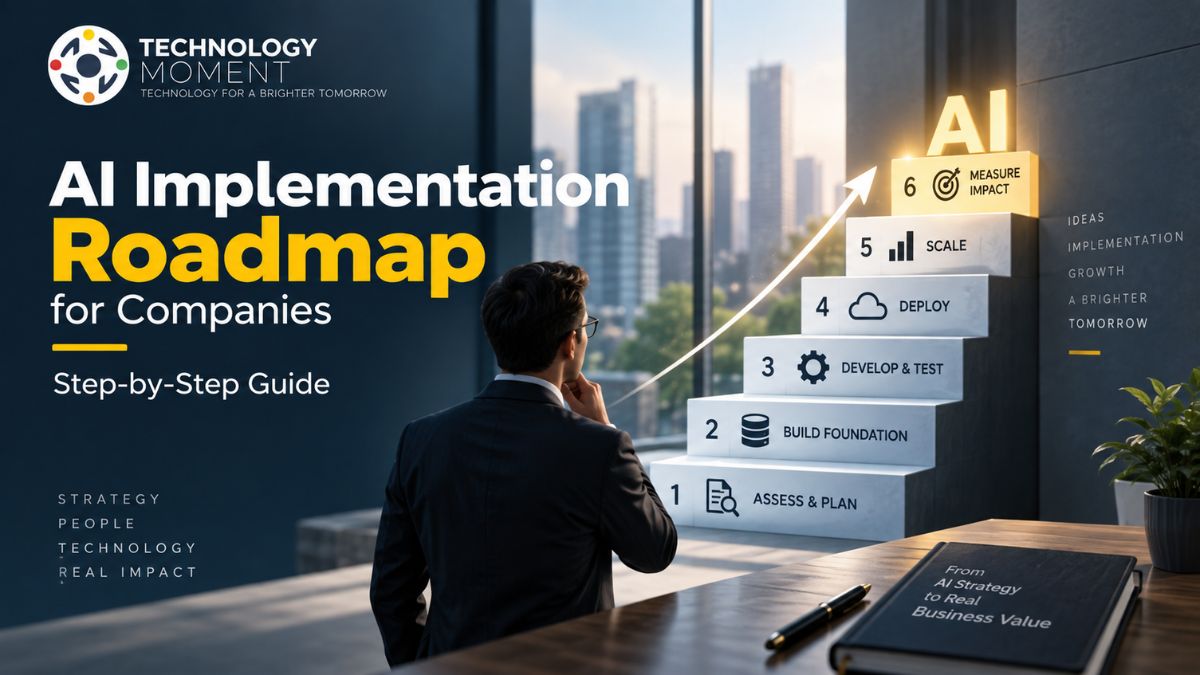
Companies are using AI to automate repetitive work, analyze information, improve customer experiences, support employees, and make faster decisions. But adopting AI successfully involves much more than choosing a powerful AI tool or model. Without a clear plan, organizations can end up investing in disconnected AI projects, overlooking data and security requirements, or struggling to turn promising pilots into measurable business results. An effective AI implementation roadmap provides a structured path from identifying business opportunities to deploying, measuring, and scaling AI across an organization.
At Technology Moment, we focus on making complex technology easier to understand and apply in the real world. This guide takes a practical approach to AI implementation for companies, covering AI readiness, use-case prioritization, pilot projects, technology selection, workflow integration, governance, security, performance measurement, and long-term scaling.
Whether your organization is exploring its first AI project or developing an enterprise-wide AI strategy, the roadmap below can help you understand what needs to happen at each stage—and how to move from AI experimentation to sustainable business value.
What Is an AI Implementation Roadmap?
It connects business objectives with AI technology, data, infrastructure, people, and operational requirements so that implementation happens in a deliberate sequence rather than through disconnected experiments. An effective roadmap can include everything from an initial AI readiness assessment and use-case evaluation to technology selection, pilot projects, deployment, governance, and performance measurement.
An AI strategy defines what an organization wants to achieve with artificial intelligence and why those goals matter, while an implementation roadmap explains how those goals will be executed. It gives teams a practical path for turning an AI adoption strategy into real projects, integrating AI into existing workflows, and eventually expanding successful solutions across the organization.
For companies, the roadmap may also cover AI model selection, data preparation, AI infrastructure, security, compliance, employee training, and AI governance. These elements become increasingly important as an organization moves beyond individual AI experiments. A well-structured AI implementation framework helps decision-makers understand dependencies, establish priorities, allocate resources, and track progress from an initial proof of concept through production deployment.
Why Companies Need an AI Implementation Strategy
AI adoption can create significant opportunities, but purchasing AI tools alone does not guarantee meaningful business results. Companies need an AI implementation strategy to determine where artificial intelligence can solve genuine business problems, what resources are required, and how new systems will fit into existing operations. Without this planning, organizations may launch multiple AI projects without clear objectives, duplicate efforts, or invest in solutions that are difficult to integrate and maintain.
A structured approach also helps companies prioritize AI use cases according to business value, technical feasibility, available data, implementation costs, and potential risks. Instead of attempting to introduce AI everywhere at once, organizations can begin with focused AI pilot projects, measure their results, and use those findings to determine which initiatives should move toward broader deployment.
An effective implementation strategy also addresses the organizational side of AI adoption. Employees may need new skills and training, existing workflows may need to change, and teams responsible for data, security, compliance, and technology need clear responsibilities. Establishing AI governance, responsible AI practices, risk management, and performance monitoring early can make it easier to manage these challenges as adoption grows.
The ultimate purpose is to create a repeatable path from experimentation to measurable value. Companies can use an implementation strategy to connect AI projects with business goals, control unnecessary costs, manage operational risks, and create the foundation required for enterprise AI implementation and long-term AI scaling.
The 8-Step AI Implementation Roadmap for Companies
Step 1: AI Implementation Roadmap for Companies
Begin by determining what the organization actually wants to accomplish with AI. Instead of choosing a technology first, identify the business challenges that could benefit from an AI-driven solution. This might involve lowering operating expenses, increasing team efficiency, improving customer support, speeding up decision-making, or achieving another clearly measurable result. Establishing specific goals at the beginning makes it easier to select suitable AI use cases and assess whether the implementation delivers meaningful business value.
Step 2: Assess AI Readiness
Before launching an AI project, organizations should evaluate whether they have the data, technology, infrastructure, skills, and operational capabilities needed to support it. An AI readiness assessment can reveal gaps in data quality, systems integration, employee expertise, security, and governance. Identifying these limitations early helps companies avoid committing resources to projects that are not yet practical to deploy.
Step 3: Evaluate and Select High-Value AI Opportunities
Companies should identify potential AI use cases and compare them based on expected business value, feasibility, available data, implementation effort, cost, and risk. This AI use case prioritization process helps organizations focus resources on projects with a clear purpose and realistic path to implementation. High-value opportunities can then be selected for further testing instead of attempting to implement every possible AI application simultaneously.
Step 4: Validate the AI Solution With a Pilot Project
A focused AI proof of concept allows a company to test whether a proposed solution can work under realistic conditions before making a larger investment. The pilot should have clearly defined objectives and measurable success criteria. Teams can evaluate factors such as accuracy, productivity improvements, user adoption, operating costs, and workflow impact. The results can then inform the decision to refine, expand, or discontinue the project.
Step 5: Evaluate AI Solutions and Select the Right Technology
Once a use case has demonstrated potential, the organization can evaluate the technology required for implementation. This may involve selecting an AI model, API, platform, software solution, or combination of technologies. AI model selection should consider factors such as performance, cost, data requirements, security, integration capabilities, scalability, and the specific needs of the business. Companies should also determine whether building, buying, or integrating an existing AI solution makes the most practical sense.
Step 6: Integrate AI Into Business Workflows
AI becomes more useful when it is connected to the systems and processes employees already use. AI integration may involve connecting models with business applications, databases, customer platforms, internal knowledge systems, or other software. Organizations can also use AI workflow automation to reduce repetitive tasks while keeping appropriate human oversight for decisions that require judgment or accountability.
Step 7: Establish AI Governance, Security, and Compliance
Before expanding an AI solution, companies need appropriate controls for data protection, security, privacy, monitoring, and responsible use. An AI governance framework can define who is responsible for AI systems, how models and outputs are evaluated, how risks are managed, and when human review is required. Depending on the organization and its use cases, compliance requirements may also influence data handling, model deployment, documentation, and monitoring practices.
Step 8: Deploy, Measure, and Scale AI
The final step is moving a validated solution into production and continuously evaluating its performance. Companies should track both technical indicators and business outcomes, including accuracy, adoption, efficiency, cost savings, customer impact, and AI ROI. Ongoing AI monitoring can identify performance issues or changes in the underlying data. When a solution consistently delivers the expected value, the organization can begin AI scaling by extending it to additional teams, workflows, or business functions.
How to Create an AI Implementation Roadmap
Creating an AI implementation roadmap requires translating the organization’s broader AI strategy into a sequence of practical phases. The roadmap should show what needs to happen first, what depends on previous work, which resources are required, and how progress will be measured. It should also remain flexible enough to change when pilot results, technology capabilities, business priorities, or risk assessments reveal new information.
A useful roadmap can be organized around the following stages:
| Phase | Main Objective | Key Activities |
|---|---|---|
| AI Readiness | Understand the organization’s starting point | Assess data, infrastructure, technology, skills, security, and operational readiness |
| AI Strategy | Establish clear priorities | Define business goals, identify opportunities, and set AI objectives |
| Use-Case Prioritization | Select practical projects | Evaluate business value, feasibility, cost, data availability, and risk |
| Pilot Development | Validate the proposed solution | Build an AI proof of concept, test workflows, and measure initial results |
| Technology Integration | Connect AI with existing operations | Integrate models, applications, data sources, and business workflows |
| Governance | Establish responsible operating controls | Define security, compliance, human oversight, risk management, and monitoring |
| Production Deployment | Put validated AI solutions into operation | Deploy the system, train users, monitor performance, and manage adoption |
| AI Scaling | Expand proven solutions | Extend successful AI applications across teams, processes, and business functions |
This phased approach allows organizations to treat AI implementation as an ongoing process rather than a single technology project. Early stages establish the foundation, pilots provide evidence, integration connects AI with real business operations, and measurement determines whether an initiative is ready to scale. As the organization gains experience, the roadmap can evolve into a broader enterprise AI roadmap that supports continued adoption, governance, and transformation.
AI Implementation Roadmap by Business Maturity
Companies do not begin their AI journey from the same starting point. Some are still exploring what artificial intelligence can do, while others already have multiple AI systems operating across departments. An effective AI implementation roadmap should therefore reflect the organization’s current level of AI maturity rather than applying the same plan to every business. At the AI exploration stage, the organization is learning where AI could create value. Teams identify potential AI use cases, study emerging technologies, and begin discussing business objectives. At this point, the focus should be on understanding opportunities rather than deploying AI everywhere.
The next stage is AI experimentation, where companies move from ideas to controlled AI pilot projects and proof-of-concept initiatives. Teams test selected applications, evaluate technical feasibility, and gather evidence about potential business value. Successful pilots can provide the foundation for broader adoption.
At the AI adoption stage, organizations begin incorporating proven solutions into regular business processes. AI tools may support customer service, operations, marketing, software development, analytics, or other functions. This stage requires stronger processes for employee training, security, data management, and performance measurement. The AI integration stage connects multiple AI systems with existing applications, workflows, and business data. Organizations increasingly need an AI governance framework, standardized processes, and clear ownership.
Finally, at the AI scaling stage, successful solutions are expanded across departments and locations. An organization may develop an enterprise-wide AI operating model, improve its AI infrastructure, and continuously monitor performance. This maturity-based approach helps companies move progressively from experimentation to sustainable enterprise AI implementation without scaling faster than their capabilities allow.
How to Prioritize AI Use Cases
Identifying dozens of potential AI use cases is relatively easy; deciding which ones deserve investment is much harder. Companies should avoid selecting projects simply because a technology is popular or because competitors are experimenting with it. Effective AI use case prioritization starts with the business problem and evaluates whether AI can produce a meaningful, measurable improvement. The first consideration should be business value. A potential project may reduce operating costs, improve productivity, increase revenue, improve customer experiences, or accelerate decision-making. The expected impact should be clearly connected to an existing business objective.
The second consideration is technical feasibility. Organizations need to determine whether the necessary data exists, whether that data is usable, and whether the current technology environment can support the proposed solution. An AI readiness assessment can reveal gaps in infrastructure, data quality, integration capabilities, or internal AI skills. Implementation effort and cost should also be evaluated. A project with significant potential may still be unsuitable if it requires excessive infrastructure investment, complex integration, or extensive data preparation. Companies should compare expected benefits with the resources required to deliver and maintain the solution.
Risk is another important factor. AI projects involving sensitive information, automated decisions, or regulated processes may require stronger controls for AI security, compliance, and risk management. A practical prioritization framework can therefore consider business impact, technical feasibility, data readiness, implementation effort, cost, risk, and expected AI ROI. Projects that demonstrate strong value while remaining practical to implement can then move into an AI proof of concept or controlled pilot. This approach turns an AI strategy into a focused portfolio of projects rather than an unstructured list of possibilities.
Common AI Implementation Challenges
Implementing artificial intelligence across an organization involves more than deploying an AI model. Companies can encounter technical, operational, financial, and organizational barriers at almost every stage of the process. Understanding these AI adoption challenges early allows teams to build appropriate controls into their implementation strategy. One common challenge is poor data quality or limited data availability. AI systems depend heavily on relevant and reliable information. Inconsistent, incomplete, outdated, or poorly structured data can reduce system performance and make otherwise promising projects difficult to deploy.
Another challenge is the shortage of appropriate AI skills. Employees may understand their business processes but lack experience with AI technologies, while technical teams may understand models without having enough knowledge of the business context. Employee AI training and cross-functional collaboration can help close this gap. Integration can create another significant obstacle. An AI solution may work effectively in isolation but become difficult to operate when connected to existing databases, applications, or workflows. Companies therefore need to consider AI integration and infrastructure requirements during the planning stage rather than after development is complete.
Security, privacy, and compliance are also important. Organizations need to understand how information is collected, processed, stored, and accessed by AI systems. Appropriate AI governance, responsible AI practices, security controls, and risk management should be established according to the use case. Employee resistance can also slow adoption. People may be uncertain about new workflows, concerned about job changes, or simply unfamiliar with AI-assisted processes. Clear communication, training, and human oversight can make adoption easier.
How to Measure AI Implementation Success
Measuring AI implementation success requires more than counting how many AI tools a company has deployed. A solution can be technically impressive while producing little meaningful business value. Organizations should therefore connect AI performance measurement to the objectives established at the beginning of the implementation process. Depending on the use case, companies may measure reductions in operating costs, improvements in productivity, faster task completion, increased revenue, improved customer satisfaction, or reduced manual work. These indicators help determine whether AI is solving the problem it was introduced to address.
Organizations should also monitor AI system performance. Relevant measurements can include accuracy, error rates, response quality, processing time, reliability, and the frequency of human intervention. The appropriate metrics depend on the application. For example, an internal document assistant may prioritize answer accuracy and employee adoption, while an automation system may focus on processing time and error reduction. User adoption is another important measurement area. If employees or customers do not use an AI system consistently, the expected benefits may not materialize. Adoption rates, active users, task completion, satisfaction, and feedback can reveal whether the solution fits actual workflows.
Financial analysis is also essential. Companies can compare implementation and operating costs against measurable benefits to estimate AI ROI. Costs may include software, models, infrastructure, integration, training, monitoring, and maintenance. Continuous AI monitoring is particularly important after deployment. Model performance and business conditions can change over time, meaning a system that performs well initially may require adjustment later.
A strong measurement framework therefore combines business KPIs, technical performance, user adoption, operational efficiency, cost metrics, and AI ROI. These measurements give decision-makers evidence for improving, expanding, or replacing AI initiatives and provide a clearer basis for long-term AI scaling.
AI Implementation Costs: What Companies Should Consider
AI implementation costs vary considerably depending on the use case, organization size, technology choices, data requirements, and level of integration. There is no single cost that applies to every AI project. Instead, companies should evaluate the complete cost of building, deploying, operating, and maintaining an AI solution. The first category is AI software and model costs. Organizations may use commercial AI platforms, APIs, open-source models, or internally developed systems. Pricing can depend on usage, model capabilities, number of users, and required processing capacity.
Infrastructure is another consideration. AI applications may require cloud computing, storage, databases, networking, security systems, and other technical services. More complex solutions can require greater computing resources, particularly when organizations process large datasets or run sophisticated models. Data preparation can also represent a substantial part of implementation effort. Data may need to be collected, cleaned, structured, labeled, secured, or integrated before an AI system can use it effectively. Companies should account for both technical resources and personnel involved in this work.
Integration costs are equally important. Connecting AI with CRM platforms, enterprise applications, databases, websites, or internal workflows may require custom development and ongoing maintenance. Companies should also consider employee AI training. Successful adoption may require employees to learn new tools, workflows, security practices, and responsible AI procedures. Training costs can therefore extend beyond the initial technology investment. Finally, organizations need to budget for AI operations, monitoring, security, maintenance, and continuous improvement after deployment. These recurring expenses are sometimes overlooked when evaluating an AI project.
A practical cost assessment should therefore consider the full lifecycle: technology + data + infrastructure + integration + people + governance + operations + maintenance. Comparing these costs with expected business benefits and potential AI ROI provides a more realistic basis for deciding which AI initiatives should move forward.
How to Scale AI Across an Organization
Scaling AI across an organization requires more than deploying additional tools. Companies need a repeatable AI implementation strategy that allows successful projects to move from individual teams into broader business operations. The process should begin with solutions that have already demonstrated measurable value through controlled pilots. Instead of scaling every experiment, organizations can use performance data, user feedback, cost analysis, and risk assessments to determine which initiatives are ready for wider adoption.
A clear AI operating model can help define responsibilities between business teams, IT, data specialists, security teams, and leadership. Standardized processes for model selection, deployment, monitoring, documentation, and support can reduce duplication and make future AI projects easier to manage. Companies should also establish consistent policies for AI governance, security, compliance, and responsible AI before expanding solutions into sensitive workflows.
Technology integration becomes increasingly important as adoption grows. Successful AI systems may need to connect with enterprise applications, internal databases, customer platforms, analytics systems, and automated workflows. Building reusable integration patterns and reliable AI infrastructure can make future deployments faster and more manageable. Employee adoption is another major part of AI scaling. Teams need appropriate training, clear guidance, and an understanding of where AI should assist humans rather than replace human judgment. Organizations can create internal AI champions or specialist teams to support adoption across departments.
As more systems are deployed, continuous AI monitoring and performance measurement become essential. Companies should track accuracy, usage, costs, reliability, security events, and business outcomes. Successful initiatives can then be expanded gradually across functions, locations, or customer segments. This approach allows enterprise AI implementation to grow while maintaining control over quality, cost, risk, and business value.
AI Implementation Roadmap Checklist
A practical AI implementation checklist helps companies ensure that important activities are not overlooked during planning and deployment. The checklist should cover business objectives, technical requirements, people, governance, measurement, and long-term scaling rather than focusing only on AI technology.
Business and strategy
- Define the business problem AI will address
- Establish clear AI objectives
- Connect the project with business priorities
- Define measurable success criteria
- Estimate expected business value and potential AI ROI
AI readiness
- Assess data availability and quality
- Review existing technology and infrastructure
- Evaluate internal AI skills
- Identify integration requirements
- Assess security, privacy, and compliance needs
Use-case selection
- Identify relevant AI use cases
- Evaluate business impact
- Assess technical feasibility
- Estimate implementation and operating costs
- Evaluate potential risks
- Prioritize projects using a consistent framework
Pilot and development
- Define the AI proof of concept
- Select appropriate AI models and tools
- Establish pilot success metrics
- Test the solution with a controlled user group
- Collect employee and customer feedback
- Document pilot results
Deployment and integration
- Integrate AI with required business systems
- Establish human oversight
- Implement security controls
- Prepare employees through AI training
- Establish an AI governance framework
- Deploy the validated solution into production
Measurement and scaling
- Monitor AI performance
- Track adoption and usage
- Measure business outcomes
- Review costs and AI ROI
- Identify performance or security issues
- Improve the system continuously
- Scale successful AI projects across the organization
Using this checklist alongside an AI implementation framework gives teams a repeatable process for moving from AI planning to deployment and long-term AI scaling.
Frequently Asked Questions About AI Implementation
What is an AI implementation roadmap?
An AI implementation roadmap provides companies with a clear path for turning AI opportunities into operational solutions. It outlines the key stages involved, from defining business goals and evaluating organizational readiness to choosing suitable use cases, testing AI solutions, integrating them into existing workflows, and establishing proper governance. The roadmap also guides organizations through deployment, performance evaluation, and expansion, helping them turn AI initiatives into measurable business value.
How do companies prioritize AI use cases?
Companies can prioritize AI use cases by comparing business value, technical feasibility, data availability, implementation effort, cost, risk, and expected ROI. High-value projects with realistic technical requirements and manageable risks can be selected for pilot programs before larger investments are made.
How do you assess AI readiness?
An AI readiness assessment examines whether a company has the data, infrastructure, technology, workforce skills, governance processes, security controls, and organizational support required for AI adoption. The assessment helps identify gaps that should be addressed before a company invests heavily in AI implementation.
What are the biggest challenges of AI implementation?
Common AI adoption challenges include poor data quality, limited AI skills, unclear objectives, integration difficulties, security and privacy concerns, employee resistance, governance requirements, and difficulty moving successful pilots into production. Addressing these issues early can reduce implementation risk and create a stronger foundation for enterprise AI adoption.
How do you measure AI implementation success?
AI implementation success should be measured using both business and technical indicators. Depending on the project, companies can track productivity, cost savings, revenue impact, user adoption, customer satisfaction, accuracy, reliability, processing time, operating costs, and AI ROI to determine whether the solution is delivering its intended value.
What should an AI implementation plan include?
An AI implementation plan should include business objectives, readiness assessment, prioritized use cases, data requirements, technology and model selection, implementation costs, pilot milestones, integration requirements, security, governance, employee training, performance metrics, deployment procedures, and a strategy for scaling successful AI initiatives.
How long does AI implementation take?
The timeline depends on the complexity of the use case, data readiness, integration requirements, technology, and organizational capabilities. A focused AI pilot may require considerably less time than an enterprise-wide transformation. Companies should establish milestones based on readiness and measurable outcomes rather than assuming every AI project requires the same implementation period.