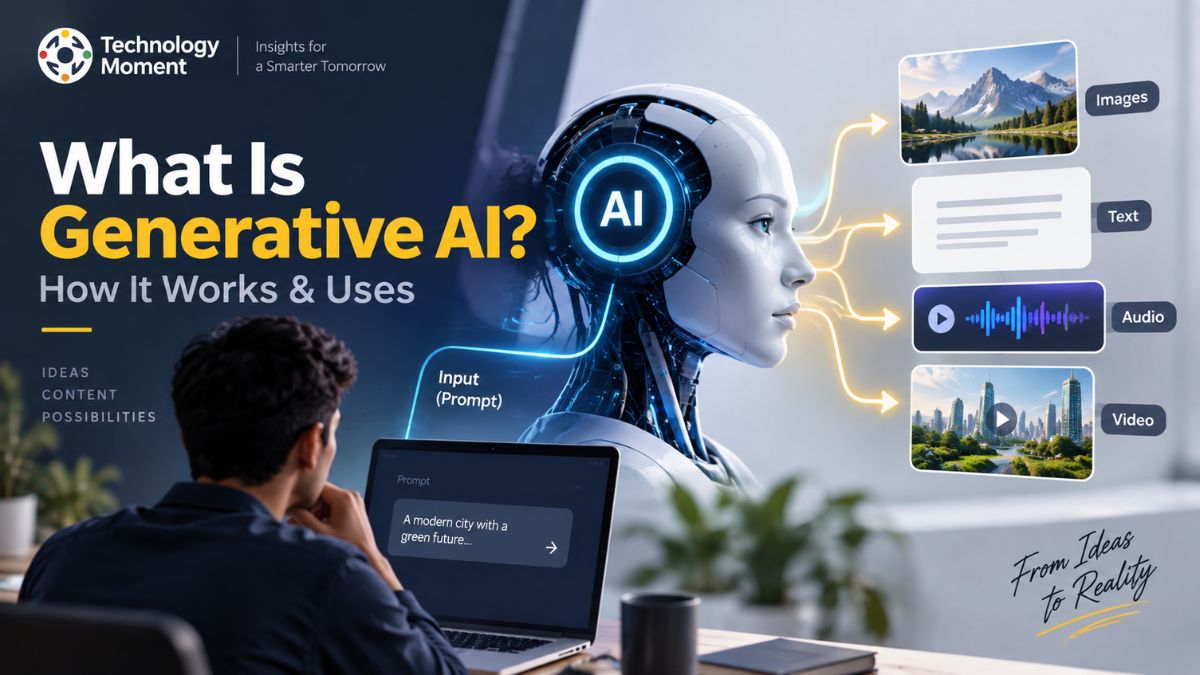
Generative AI has quickly become one of the most important developments in modern technology. From creating text and images to generating software code, audio, and video, it is changing how people work, learn, create, and interact with computers. Tools such as ChatGPT, Google Gemini, Claude, and other AI systems have made capabilities that once seemed highly specialized accessible to everyday users.
But what exactly is generative AI, and how does it work?
Unlike traditional AI systems that are often designed to analyze information, recognize patterns, make predictions, or classify data, generative AI can produce new content based on patterns learned from large amounts of training data. This makes it useful across a wide range of applications, including content creation, software development, education, research, marketing, customer support, and business automation.
At Technology Moment, our goal is to make rapidly evolving technology easier to understand without adding to the noise. As generative AI continues to develop, understanding how these systems work, what they can actually do, and where their limitations lie is becoming increasingly important.
In this guide, we’ll explain what generative AI is, how it works, the different types of generative AI, the technologies behind it, real-world examples and use cases, its benefits and limitations, safety considerations, and what its future could look like. Whether you’re completely new to AI or simply want a clearer understanding of this technology, this guide will give you a practical foundation for navigating the generative AI landscape.
What Is Generative AI?
Generative AI is a type of artificial intelligence designed to create new content by learning patterns from existing data. Instead of only analyzing information, making predictions, or classifying inputs, generative AI models can produce text, images, audio, video, and computer code in response to a user’s instructions. This ability has made generative AI one of the most widely discussed areas of modern AI technology.
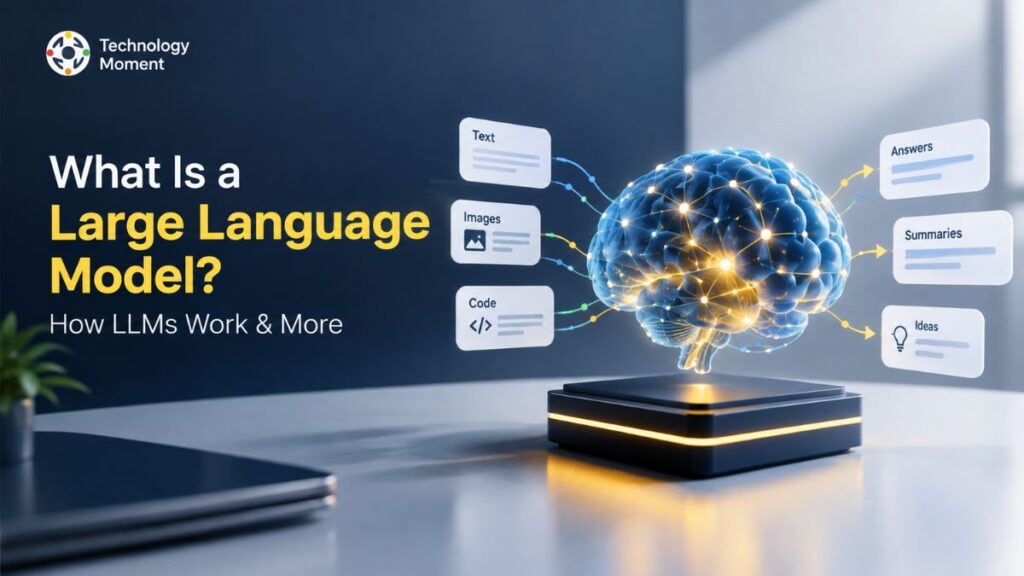
At a technical level, generative AI relies on machine learning and deep learning models trained on large datasets. These systems use neural networks to identify patterns and relationships within their training data. Large language models (LLMs), for example, are designed to understand and generate human-like text, while other generative models can specialize in images, video, or audio.
Common examples of generative AI include ChatGPT, Google Gemini, Anthropic Claude, Midjourney, DALL-E, and Adobe Firefly. These AI tools demonstrate how the technology can support writing, research, design, programming, communication, and other tasks.
It is important to understand that generative AI does not simply copy and paste information from its training data. Instead, a trained model uses learned patterns to generate an output based on the input it receives. This makes generative AI useful for creating new content, although its results can still contain errors and require human review.
How Does Generative AI Work?
Generative AI works by using machine learning algorithms and neural networks to learn patterns from large amounts of training data. During model training, an AI system processes datasets containing information such as text, images, audio, video, or code. Through this process, the model learns relationships within the data rather than following only a fixed set of manually programmed instructions.
Deep learning plays an important role in this process. Modern generative AI models can contain billions of parameters that help represent complex patterns. For text-based systems, large language models learn relationships between words, phrases, concepts, and broader patterns of language. When a user provides an AI prompt, the model uses those learned patterns to determine an appropriate response.
After training, the model enters an inference stage. During inference, the system processes a user’s input and generates an output based on what it has learned. This is how an AI assistant can respond to questions, create text, generate code, or summarize information.
Prompt engineering can also influence the quality of the result. Clear instructions, useful context, and specific requirements can help an AI system produce more relevant outputs.
However, generative AI does not automatically understand truth in the same way humans do. Its responses are generated from learned patterns, which means users should verify important information and apply human judgment when using AI-generated content.
What Are the Different Types of Generative AI?
Generative AI can be divided into several categories based on the type of content an AI model can produce. As the technology has developed, generative models have expanded beyond text to support multiple forms of digital content.
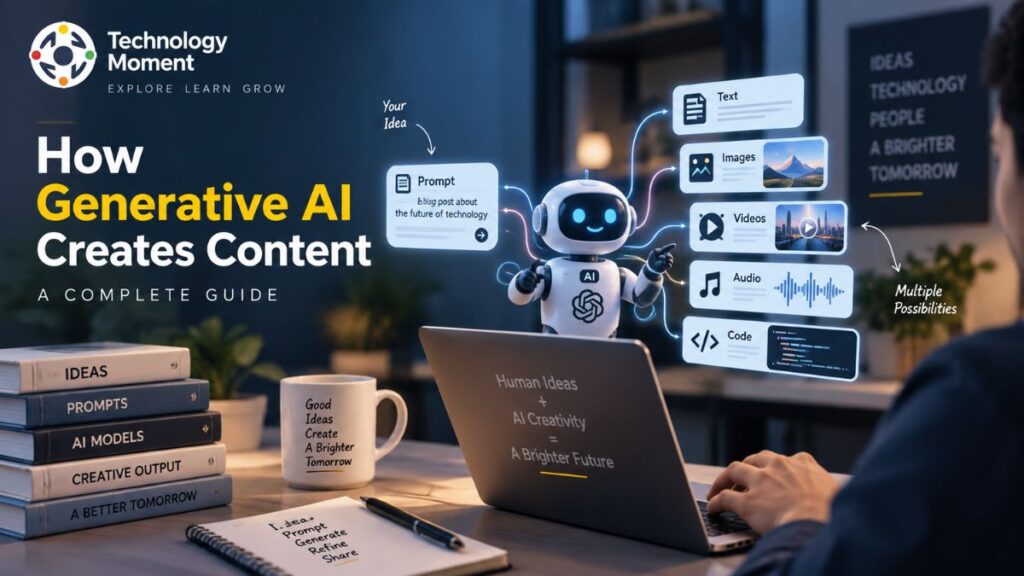
Text generation enables AI systems to turn a user’s instructions into coherent written output within seconds. Depending on the model and prompt, it can help draft emails, explain complex topics, summarize lengthy material, brainstorm ideas, or produce conversational responses. Large language models (LLMs) power many of these experiences by predicting and assembling language based on patterns learned during training.
Image generation allows users to create visual content from written descriptions. Text-to-image models can transform prompts into illustrations, photographs, graphics, or artistic compositions. Tools such as Midjourney, DALL-E, and Adobe Firefly demonstrate this category.
Video generation uses AI models to create or modify video content from text prompts, images, or other inputs. This area is developing rapidly and is increasingly relevant to marketing, education, entertainment, and creative production.
Audio generation includes AI-generated speech, music, sound effects, and other audio content. Text-to-speech AI can convert written instructions into natural-sounding speech.
Code generation enables AI coding tools to create, explain, modify, or complete software code. These systems can assist developers with programming tasks and improve development productivity.
Finally, multimodal AI combines multiple types of information, such as text, images, audio, and video. This allows newer AI systems to work across different formats instead of being limited to a single type of content.
What Technologies Power Generative AI?
Generative AI is built on several important technologies from artificial intelligence, machine learning, and deep learning. Understanding these technologies helps explain why modern AI models can generate increasingly sophisticated content. Large language models (LLMs) are among the most important technologies for text-based generative AI. They are trained on large collections of text and learn statistical relationships within language, allowing them to generate and transform text based on prompts.
Transformer architecture has played a major role in the development of modern language models. Transformers use mechanisms such as attention to process relationships between different parts of an input, making them particularly effective for understanding and generating sequences of information. Other generative models use different approaches. Generative adversarial networks (GANs) consist of a generator and discriminator that work against each other during training. Variational autoencoders (VAEs) learn useful representations of data that can be used to generate new examples.
Diffusion models have become especially important for image generation. They learn how to gradually transform noisy data into coherent outputs, enabling systems to generate detailed images from prompts. Generative AI also depends on foundation models, which are broadly trained models that can support many different applications. Developers can sometimes adapt these models through fine-tuning for more specialized tasks.
Together, neural networks, training data, machine learning algorithms, model architectures, and computing infrastructure form the technical foundation that makes modern generative AI possible.
What Can Generative AI Create?
Generative AI can create many different forms of digital content, depending on the model and application. This flexibility is one of the main reasons the technology has moved from research environments into everyday software and business workflows.
Text generation is one of the most common capabilities. AI systems can help create drafts, summaries, product descriptions, explanations, emails, and other written material. AI writing tools can also assist users with brainstorming and editing, although human review remains important.
Image generation allows users to create visuals from natural-language descriptions. Text-to-image models can produce illustrations, concept designs, marketing graphics, and other visual assets. This capability has changed how designers and creative teams experiment with ideas.
Video generation can create short video sequences from text or other inputs. As these models improve, they may become increasingly useful for advertising, education, entertainment, and digital storytelling.
Generative AI can also produce audio, including synthetic speech, music, and sound effects. Text-to-speech AI makes it possible to turn written content into spoken audio for applications such as accessibility, education, and digital assistants. Another important area is code generation. AI coding tools can generate functions, explain existing code, identify potential problems, and assist with software development.
Generative models can also create synthetic data, which may be useful for testing, research, and developing certain AI systems. Because generative AI can work across text, images, audio, video, and code, it is becoming a powerful component of AI-powered tools and modern digital workflows.
What Is Generative AI Used For?
Generative AI is used across a growing range of personal, professional, creative, and business applications. Because generative AI can create and transform text, images, audio, video, and code, organizations and individuals can use it to reduce repetitive work and accelerate creative and analytical tasks.
One of the most common generative AI use cases is content creation. AI writing tools can help users draft articles, emails, reports, product descriptions, summaries, and marketing materials. In software development, AI coding tools can generate code, explain programming concepts, and assist developers with repetitive tasks.
Businesses are also using generative AI for customer support and automation. AI chatbots and AI assistants can answer common questions, summarize conversations, and help employees find information. In marketing, generative AI can support campaign ideas, personalized content, advertising concepts, and audience research.
Education is another important application. Generative AI can explain difficult concepts, create study materials, summarize information, and support personalized learning. Researchers can use AI-powered tools to organize information, explore ideas, and assist with data analysis. Creative professionals can use generative AI for image generation, video generation, audio production, and design exploration. However, these systems work best as assistants rather than complete replacements for human expertise.
Examples of Generative AI
Generative AI is now available through a wide range of AI tools and models that can create text, images, code, and other types of content. Some platforms are designed primarily for conversation and writing, while others focus on image generation, software development, or multimodal AI. The following examples represent some of the most widely recognized generative AI tools and models:
| Generative AI Tool / Model | Company | Primary Use |
|---|---|---|
| ChatGPT | OpenAI | Text generation, conversation, and multimodal AI |
| Google Gemini | Text generation, research, and multimodal tasks | |
| Claude | Anthropic | Text generation, analysis, and reasoning |
| Microsoft Copilot | Microsoft | Productivity, AI assistance, and coding |
| Llama | Meta | Open-weight large language models and AI development |
| Midjourney | Midjourney | AI image generation and creative visuals |
| DALL-E | OpenAI | Text-to-image generation |
| Stable Diffusion | Stability AI ecosystem | AI image generation and visual content |
| Adobe Firefly | Adobe | Generative images and creative content |
| GitHub Copilot | GitHub | AI-assisted software development and code generation |
Generative AI vs Traditional AI
Generative AI and traditional AI are both part of artificial intelligence, but they are designed to perform different types of tasks. The key difference is that generative AI can create new content, while traditional AI is generally designed to analyze information, recognize patterns, make predictions, or classify data.
| Generative AI | Traditional AI |
|---|---|
| Creates new content such as text, images, audio, video, and code | Primarily analyzes, classifies, or processes existing data |
| Generates responses or content based on user inputs and learned patterns | Makes predictions, classifications, recommendations, or decisions based on defined objectives |
| Often uses generative models and large foundation models | Often uses task-specific machine learning or rule-based systems |
| Can produce different outputs for similar prompts | Often produces a specific prediction, classification, or predefined type of result |
| Commonly used for content creation, AI assistants, and creative tasks | Commonly used for fraud detection, recommendation systems, forecasting, and classification |
Generative AI vs Artificial Intelligence vs Machine Learning
Artificial intelligence, machine learning, and generative AI are closely connected, but they do not mean the same thing. Understanding the difference helps explain where generative AI fits within the broader field of AI technology.
Artificial intelligence (AI) is the broadest concept. It refers to computer systems designed to perform tasks that typically require human-like capabilities, such as understanding language, recognizing patterns, making decisions, or solving problems.
Machine learning (ML) is a major approach used to build AI systems. Instead of relying entirely on manually written rules, machine learning algorithms learn patterns from data. Deep learning is a specialized form of machine learning that uses neural networks with many layers.
Generative AI refers to AI systems designed to generate new content. Depending on the model, that content can include text, images, audio, video, or code. Many modern generative AI models use deep learning and large-scale training data.
A simple way to understand the relationship is:
Artificial Intelligence → Machine Learning → Deep Learning → Generative AI
However, this should be viewed as a conceptual relationship rather than a strict hierarchy because not every AI system uses machine learning, and not every machine learning system is generative. Therefore, generative AI vs artificial intelligence is not really a competition between two separate technologies. Generative AI is one important category within the broader AI landscape. Similarly, generative AI vs machine learning describes a specialized application of machine learning rather than two completely unrelated technologies.
What Are the Benefits of Generative AI?
Generative AI offers several potential benefits for individuals, businesses, developers, and creative professionals. Its biggest advantage is the ability to assist with tasks that previously required significant amounts of time and manual effort. One major benefit is increased productivity. Generative AI can help users draft documents, summarize information, generate ideas, write code, and complete repetitive tasks more quickly. This can allow people to spend more time on higher-value activities that require judgment and creativity.
Another advantage is faster content creation. AI-powered tools can generate initial drafts of text, images, presentations, designs, and other digital assets. Human professionals can then review, edit, and improve those outputs. Generative AI can also support business automation. Organizations can integrate AI into customer service, internal knowledge systems, marketing workflows, software development, and administrative processes. This may reduce repetitive workloads and improve operational efficiency.
Personalization is another important benefit. AI systems can adapt explanations, recommendations, and generated content to different users and situations. In education, this can support more personalized learning experiences. For developers, generative AI can accelerate software development by assisting with code generation, documentation, debugging, and technical explanations. For creative teams, generative models can make experimentation faster by allowing multiple ideas to be explored quickly.
However, the benefits of generative AI depend on how responsibly it is implemented. Human expertise, verification, and appropriate oversight remain essential, particularly when AI-generated information affects important decisions.
What Are the Limitations and Risks of Generative AI?
Despite its capabilities, generative AI has significant limitations and risks. Understanding these weaknesses is essential because AI-generated content can appear convincing even when it is inaccurate, incomplete, or misleading. One major limitation is AI hallucination. A generative AI model may produce information that sounds plausible but is factually incorrect. This means users should not automatically assume that an AI response is accurate, particularly when dealing with medical, financial, legal, technical, or other high-stakes information.
Bias is another concern. AI models learn patterns from training data, and those datasets can contain incomplete, outdated, or biased information. As a result, generated outputs may reproduce or amplify certain biases. Privacy and security also require attention. Users should be cautious about entering confidential, personal, proprietary, or sensitive information into AI tools. Organizations need appropriate policies and technical controls before deploying generative AI in sensitive workflows.
There are also copyright and intellectual property questions surrounding AI-generated content and the data used to train models. The legal and regulatory landscape continues to evolve, so organizations should consider applicable laws and licensing requirements. Generative AI can also contribute to misinformation and deepfakes because synthetic text, images, audio, and video can be created at scale. Another risk is overreliance: people may accept AI outputs without applying independent judgment.
For these reasons, the limitations of generative AI should be considered alongside its advantages. Responsible use requires verification, transparency, appropriate safeguards, and human oversight.
Is Generative AI Safe?
Whether generative AI is safe depends largely on the technology, the application, the information being processed, and how people use the system. Generative AI is not inherently safe or unsafe; its risks need to be evaluated according to the specific context. One important consideration is accuracy. Generative AI can produce useful answers but may also generate incorrect information. Users should fact-check important claims instead of treating AI-generated responses as authoritative sources.
Privacy is another important issue. People should avoid sharing sensitive personal information, passwords, confidential business documents, or other protected data unless they understand how a particular AI service handles that information. Human oversight is especially important in high-impact situations. AI can assist professionals, but important decisions should not be delegated blindly to an automated system. Reviewing outputs can help identify hallucinations, bias, inappropriate recommendations, or other problems.
Organizations should also establish clear AI safety practices. These can include access controls, data protection policies, output verification, employee training, monitoring, and defined rules for acceptable AI use. There are broader concerns involving misinformation, deepfakes, cybersecurity, copyright, and misuse of AI-generated content. These challenges mean that responsible AI development requires both technical safeguards and human judgment.
So, is generative AI safe? It can be used safely for many everyday and professional tasks when appropriate safeguards are in place. The key is to treat generative AI as a powerful tool that requires responsible use—not as an infallible source of truth or an independent decision-maker.
Will Generative AI Replace Jobs?
The question of whether generative AI will replace jobs has become increasingly important as AI tools become more capable. Generative AI can automate certain repetitive tasks, generate content, analyze information, and assist with software development. However, the impact is likely to be more complex than simply replacing entire occupations.
Many jobs consist of multiple tasks, and only some of those tasks may be suitable for automation. For example, generative AI can help a writer create a first draft, assist a developer with code generation, or help a customer support team respond to common questions. In these situations, AI may change how people work without completely eliminating the role.
The greater opportunity may come from human-AI collaboration. Professionals who learn to use AI-powered tools effectively can potentially complete certain tasks faster and focus more attention on creativity, decision-making, communication, and problem-solving. At the same time, some highly repetitive tasks may increasingly be automated. This could change demand for particular skills and create pressure for workers to adapt.
Rather than asking only whether generative AI will replace jobs, it is more useful to ask which tasks will be automated, which skills will become more valuable, and how work will evolve. Generative AI is therefore likely to transform many jobs while also creating new opportunities around AI development, AI automation, AI governance, product design, data, and human-centered technology.
What Is the Future of Generative AI?
The future of generative AI is likely to involve more capable models, broader multimodal capabilities, deeper integration with software, and greater collaboration between humans and AI systems. While the exact direction is difficult to predict, several developments are already shaping the next generation of AI technology. Multimodal AI is expected to become increasingly important. Instead of working primarily with text, future AI systems can increasingly understand and generate combinations of text, images, audio, video, and other information.
AI assistants may also evolve beyond answering questions. More capable systems can help users research topics, organize information, complete workflows, and interact with different software tools. This could move generative AI from a simple content-generation tool toward a more active productivity layer. AI agents and automation may further expand this capability. Instead of generating a response and waiting for the next instruction, agentic systems can potentially complete sequences of tasks based on defined goals and permissions.
Generative AI may also become more personalized. AI systems could adapt their responses to individual preferences, workflows, learning requirements, or business contexts. At the same time, AI safety, privacy, transparency, and governance will become increasingly important. More capable AI requires stronger safeguards to reduce misuse, protect sensitive information, and maintain human oversight.
The future of generative AI, therefore, is not only about larger AI models. It is about building reliable, useful, secure, and responsible intelligent systems that can work alongside people across everyday life and professional environments.
Frequently Asked Questions About Generative AI
What does generative AI mean?
Generative AI refers to artificial intelligence systems that can generate new content from learned patterns. Depending on the model, this can include text, images, audio, video, or code.
What does generative AI do?
Generative AI processes an input such as a prompt and produces an output based on patterns learned during model training. It can assist with writing, research, coding, design, education, and automation.
What is generative AI used for?
Common generative AI use cases include content creation, software development, marketing, customer support, education, research, image generation, video creation, and productivity.
What are examples of generative AI?
Examples include ChatGPT, Google Gemini, Anthropic Claude, Microsoft Copilot, Midjourney, DALL-E, Adobe Firefly, and GitHub Copilot.
Is ChatGPT generative AI?
Yes. ChatGPT is a generative AI application that can generate text and, depending on the model and available capabilities, work with other forms of information.
Is generative AI machine learning?
Generative AI commonly uses machine learning and deep learning techniques. Many modern generative AI models are built using neural networks trained on large datasets.
Is generative AI safe?
Generative AI can be useful and safe for many applications when used responsibly. Users should still consider accuracy, privacy, security, bias, copyright, and human oversight.
What are the advantages of generative AI?
Major benefits include increased productivity, faster content creation, automation, personalized experiences, software development assistance, and support for creative and research tasks.
What are the disadvantages of generative AI?
Potential disadvantages include inaccurate outputs, AI hallucinations, bias, privacy concerns, copyright issues, misinformation, security risks, and overreliance on automated systems.
Will generative AI replace jobs?
Generative AI is more likely to automate certain tasks and transform many roles than simply replace every job. The impact will vary by occupation, industry, and how quickly organizations adopt AI.
Can generative AI create original content?
Generative AI can produce new outputs based on patterns learned from its training. However, questions around originality, attribution, copyright, and ownership can depend on the specific content, model, and applicable laws.