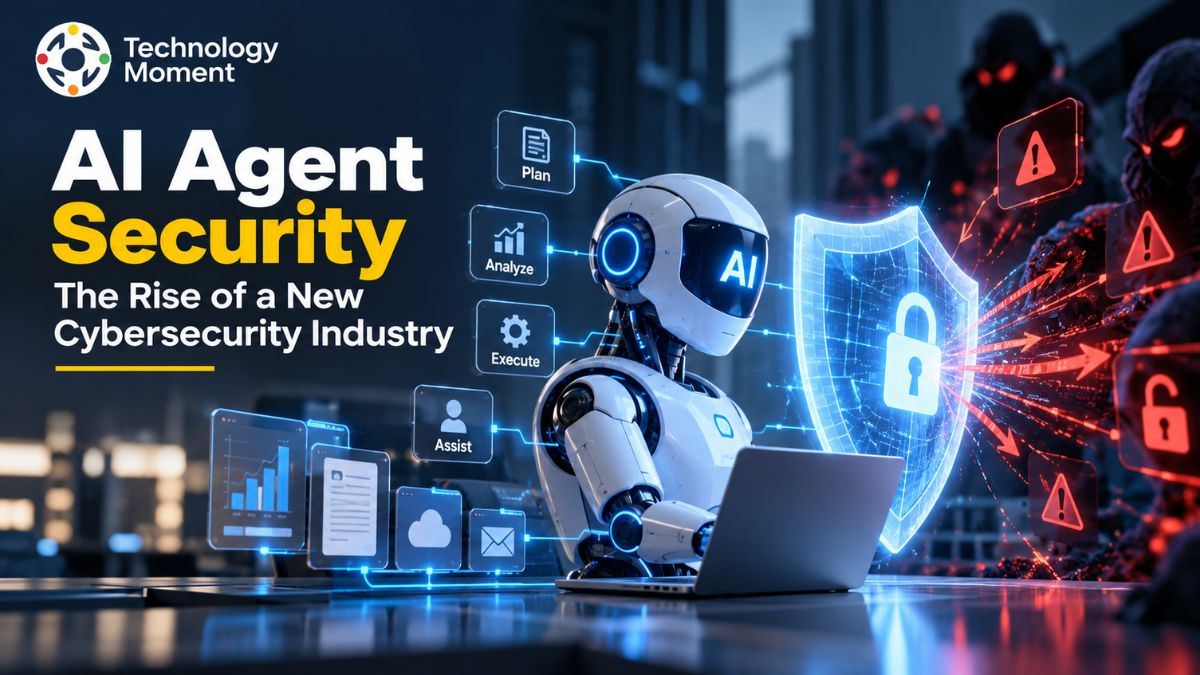
AI agents are moving from simple digital assistants to systems that can plan tasks, use tools, access data, interact with software, and take actions with limited human intervention. That shift is changing more than the way businesses use artificial intelligence—it is also creating a new cybersecurity challenge.
Unlike traditional AI applications, autonomous agents can operate across multiple systems and make decisions within real-world workflows. This expanded capability creates new risks around identity, permissions, data access, prompt injection, tool misuse, unauthorized actions, and the growing AI attack surface. Security researchers and government agencies are increasingly examining how these systems can be developed and deployed without giving them more authority than they need.
The result is an emerging market for technologies designed specifically to protect AI agents. Organizations are exploring agent identity management, runtime security, continuous monitoring, AI guardrails, access controls, sandboxing, and security testing as they bring autonomous systems into enterprise environments. International cybersecurity guidance is also emphasizing strong identity controls, limited privileges, monitoring, and human oversight.
This is where Technology Moment looks beyond the headline to explain what the change means for businesses, security teams, developers, and everyday technology users. In this article, we examine why AI agents are creating demand for a new cybersecurity industry, the major threats they introduce, how organizations can secure them, and what the future of AI agent security could look like. As AI becomes more autonomous, cybersecurity is no longer only about protecting people and machines—it is increasingly about protecting the agents acting on their behalf.
What Is AI Agent Security?
AI agent security refers to the practices, technologies, and controls used to protect AI agents from misuse, manipulation, unauthorized access, data exposure, and other cybersecurity threats. Unlike traditional AI applications that mainly generate responses, modern AI agents can plan tasks, interact with external systems, call APIs, use software tools, access data, and perform actions with limited human intervention. This ability makes AI agent security an increasingly important part of enterprise cybersecurity. Agentic AI security therefore goes beyond protecting an AI model itself. It also covers agent identity, access control, permissions, connected tools, memory, data sources, workflows, and actions taken during runtime.
For organizations deploying AI agents, cybersecurity for AI agents means establishing clear boundaries around what each agent can see and do. Security teams may need to identify every agent, understand its owner, control its permissions, monitor its behavior, and ensure that it follows organizational policies. Least-privilege access, strong authentication, continuous monitoring, AI guardrails, and runtime security can help reduce unnecessary exposure. NIST’s 2026 analysis found broad agreement that AI agents introduce novel security threats and that existing cybersecurity practices may need adaptation to address them effectively.
As AI agents become more deeply connected to business systems, securing AI agents is becoming a distinct technology and cybersecurity priority. The goal is not simply to stop an AI system from producing harmful content, but to ensure that autonomous systems can operate safely, maintain appropriate permissions, protect sensitive information, and remain accountable for the actions they take.
Why AI Agents Are Creating a New Cybersecurity Industry
The rapid adoption of AI agents is creating demand for a broader set of security products and services. Organizations are moving beyond experimental AI projects and deploying agents in areas such as engineering, customer support, finance, IT operations, and cybersecurity. These systems can access sensitive information, interact with enterprise applications, call APIs, and execute business workflows. As a result, companies need security controls specifically designed for autonomous digital actors.
This shift is helping create an emerging AI agent security industry. Traditional cybersecurity remains important, but organizations increasingly need solutions for agent identity, AI access control, runtime monitoring, AI security posture, threat detection, governance, and automated policy enforcement. Security providers are developing technologies that can discover AI agents, monitor their behavior, control permissions, detect suspicious activity, and prevent agents from performing unauthorized actions.
The AI agent security market is also attracting attention because agents introduce a different relationship between software and security. An ordinary application generally follows predefined instructions, while an autonomous agent can interpret information, select tools, and decide which actions are necessary to complete a goal. That creates new requirements around accountability, identity, least-privilege access, and continuous oversight.
McKinsey describes the growth of agentic AI as a shift that is reshaping cybersecurity control planes and creating opportunities for security providers, particularly around identity, detection, security operations, and nonhuman identities. This does not mean traditional cybersecurity is disappearing. Instead, AI cybersecurity is expanding into a new layer focused on securing autonomous systems and the increasingly complex environments in which they operate.
What Are the Biggest Cybersecurity Risks of AI Agents?
AI agents introduce several cybersecurity risks because they can process untrusted information, access connected systems, use tools, and perform actions autonomously. One major concern is prompt injection, where malicious instructions can influence an agent’s behavior. Indirect prompt injection can be particularly challenging because harmful instructions may be hidden inside an email, webpage, document, or other external content that the agent processes. NIST research has highlighted agent hijacking through such external data as an important security concern.
Another major risk involves tool misuse. When an AI agent has permission to call APIs, execute software functions, access databases, or modify business systems, an attacker who manipulates the agent may be able to turn legitimate capabilities into harmful actions. Microsoft research has demonstrated how vulnerabilities in agent frameworks can potentially connect prompt injection with more serious system-level consequences.
AI agent vulnerabilities can also involve excessive permissions, weak authentication, identity abuse, privilege escalation, data leakage, memory manipulation, and insecure third-party tools. An over-privileged agent may have access to information or systems beyond what its task requires, increasing the potential impact of compromise. Multi-agent systems introduce another layer of complexity because agents may communicate and delegate tasks to one another.
The broader issue is AI risk created by autonomy. A compromised traditional application may perform a limited set of predefined functions, while an autonomous agent can potentially interpret new information and select different actions. This makes continuous monitoring, strong identity controls, least-privilege access, AI guardrails, and runtime security increasingly important parts of protecting AI systems.
How AI Agents Are Expanding the Cybersecurity Attack Surface
The AI attack surface includes more than the AI model itself. For an autonomous agent, it can include the model, prompts, memory, identities, APIs, software tools, databases, external data sources, connected applications, and communication channels. Every additional connection can create another opportunity for misuse or compromise. Palo Alto Networks describes the AI agent attack surface as extending across the systems, identities, tools, data sources, memory stores, and communication paths that an agent can access.
Consider an AI agent that receives an email, searches a company database, updates a customer record, calls an external API, and sends a response. If an attacker inserts malicious instructions into the email, manipulates a connected tool, compromises an API, or exploits excessive permissions, the agent could potentially carry that influence through multiple stages of its workflow.
This is why AI agent cybersecurity requires a broader approach than traditional model protection. Security teams need visibility into what agents can access, which identities they use, what tools they can invoke, and what actions they perform. Agent identity, AI access control, API security, AI security monitoring, and AI observability are becoming important components of this environment.
The risk can increase further when organizations deploy large numbers of agents. Agent sprawl can make it difficult to maintain accurate inventories, ownership records, permissions, and security policies. Microsoft notes that every agent-to-tool, agent-to-service, and agent-to-agent interaction can expand the attack surface. Ultimately, the challenge is not that every AI agent is inherently insecure. Risk depends heavily on how an agent is designed, what data it can access, which permissions it receives, what external content it processes, and how effectively its actions are monitored and controlled.
How Can Companies Secure AI Agents?
Securing AI agents requires companies to treat them as autonomous digital identities rather than simply another software feature. Because an AI agent can access data, call APIs, use tools, and execute tasks, security controls need to cover the complete agent lifecycle, from development and deployment to runtime monitoring and eventual retirement. A practical starting point is to create an inventory of every AI agent, including its owner, purpose, connected tools, data sources, model, and permissions.
Organizations cannot effectively secure agents that they cannot identify or monitor. Microsoft recommends giving each executing agent its own identity and applying least-privilege access so that an agent receives only the permissions required for its specific task. AI access control should extend beyond basic authentication. Companies should use dedicated agent identities, short-lived credentials, role- or attribute-based permissions, and additional authorization for sensitive actions.
High-impact operations such as deleting information, executing code, changing permissions, transferring money, or sending sensitive data externally can require human or policy-based approval. AI security monitoring is equally important because an agent’s behavior can change as its instructions, tools, data, and environment change. Runtime security should therefore track tool calls, data access, identity usage, policy decisions, and unusual behavior.
Companies should also protect agents against prompt injection, tool misuse, data leakage, and excessive permissions. External documents, websites, emails, and tool responses should be treated as potentially untrusted inputs. Sandboxing can isolate code execution and browser automation from sensitive systems, while AI guardrails can restrict which actions an agent is allowed to perform.
The Rise of the AI Agent Security Market
The expansion of agentic AI is creating a growing need for security products designed around autonomous systems. Traditional cybersecurity tools remain important, but AI agents introduce requirements that are difficult to address through conventional controls alone. An agent may have its own identity, access multiple applications, retrieve sensitive information, call APIs, interact with other agents, and make decisions at machine speed. This is helping establish AI agent security as an emerging category within the broader cybersecurity industry.
McKinsey reports that enterprise adoption of agentic AI is increasing and that cybersecurity spending is expected to shift toward areas such as identity, detection, security operations, and controls for autonomous systems. The emerging AI agent security market includes several connected areas. Agent identity and access management focuses on identifying autonomous systems and controlling what they can access. AI runtime security focuses on monitoring and enforcing policies while agents are operating.
AI security posture management can help organizations discover agents, understand their configurations, identify risky permissions, and maintain visibility across deployments. Other emerging areas include AI observability, AI red teaming, security gateways, data-loss prevention, behavioral anomaly detection, and agent governance.
The market is also attracting established cybersecurity vendors and specialized startups. Palo Alto Networks describes 2026 as a period in which the AI agent security market is becoming more established, while highlighting challenges involving agent discovery, ownership, permissions, privilege escalation, and governance. This suggests that the market is not simply about creating another standalone security product. Instead, existing categories such as identity, zero trust, data security, threat detection, and security operations are being adapted to accommodate autonomous digital actors.
For businesses, this creates demand for AI security solutions that can operate across the entire agent lifecycle. Security teams increasingly need tools that can discover agents, assign ownership, enforce policies, monitor behavior, investigate incidents, and control access dynamically. McKinsey identifies agent runtime protection, behavioral anomaly detection, activity logging, decision safeguards, and AI-native data-loss prevention as emerging opportunity areas for cybersecurity providers.
What Will the New AI Agent Cybersecurity Industry Look Like?
The emerging AI agent cybersecurity industry is likely to become a multi-layered security ecosystem rather than a single product category. At its foundation will be agent identity and access management, because organizations need to know which AI agent is acting, who owns it, what resources it can access, and whether those permissions remain appropriate. Unlike traditional human accounts, agent identities can be created, modified, and removed dynamically, making continuous authorization and visibility increasingly important. McKinsey identifies identity and access management as one of the major areas being reshaped by the adoption of agentic AI.
Beyond identity and access controls, AI runtime security will focus on what agents actually do while operating. Security platforms may monitor tool calls, API requests, data retrieval, decision chains, agent-to-agent communication, and deviations from expected behavior. Behavioral anomaly detection can help identify when an agent suddenly accesses unusual information or attempts an action outside its normal workflow. Activity logging and AI observability can also provide the evidence needed to investigate incidents and understand how a particular action occurred.
Another important layer will involve AI guardrails and policy enforcement. Instead of relying only on model-level restrictions, organizations can define policies around which tools an agent can use, which data it can access, and which actions require approval. Sandboxing and network isolation can further reduce the impact of compromised or manipulated agents. ISACA recommends combining traditional cybersecurity controls with AI-specific protections against prompt injection, tool misuse, excessive agency, memory leakage, and supply-chain risks.
In this environment, AI security companies may increasingly compete around their ability to provide continuous visibility and control across humans, machines, workloads, and autonomous agents. The long-term model is likely to connect identity, zero trust, data security, runtime protection, governance, and threat detection into a broader enterprise AI security architecture. Palo Alto Networks similarly describes agent security as moving toward a broader platform built on identity, access, zero trust, and privilege controls.
AI Agents Are Also Changing Cybersecurity Itself
AI agents are not only creating new cybersecurity risks; they are also changing how cybersecurity teams detect, investigate, and respond to threats. Traditional security operations often require analysts to collect alerts, examine logs, investigate suspicious activity, correlate evidence, and decide what action should be taken. AI agents can increasingly assist with these steps by processing large amounts of security data, identifying patterns, investigating potential incidents, and carrying out predefined response actions. Microsoft describes agentic AI in cybersecurity as the use of autonomous agents to detect, investigate, and respond to threats with limited human intervention.
This creates a new role for cybersecurity AI agents inside security operations centers. Instead of replacing every human decision, agents can handle repetitive and time-consuming tasks while security professionals remain responsible for objectives, policies, approvals, and high-impact decisions. The World Economic Forum reports that AI is already being adopted across cybersecurity for activities such as phishing detection, intrusion and anomaly response, and user-behavior analytics.
AI agents can also improve the speed of threat detection and incident response. An agent could examine multiple alerts, connect information from different security systems, investigate suspicious activity, and recommend or execute an appropriate response according to predefined policies. This creates opportunities for faster security operations and more scalable threat hunting. AWS similarly describes agentic security as enabling detection and response at machine speed across increasingly autonomous enterprise environments.
However, using AI agents for cybersecurity creates its own AI risk. A security agent must have access to sensitive logs, systems, credentials, and response tools. If its identity is compromised or its instructions are manipulated, the same autonomy designed to defend an organization could potentially increase the impact of an incident. For this reason, AI agents in cybersecurity require strong AI access control, agent identity, AI guardrails, runtime monitoring, and human oversight.
The future of security operations may therefore be less about humans versus AI and more about humans working with autonomous systems. Security professionals can define objectives and policies while AI agents perform controlled investigative and operational tasks. This shift could make cybersecurity faster and more scalable, but only when autonomy is supported by strong security controls and accountability.
The Future of AI Agent Security
The future of AI agent security will likely focus on controlling increasingly autonomous systems without removing the capabilities that make them useful. As organizations deploy agents across customer service, software development, finance, IT operations, and security, these systems will increasingly interact with sensitive information and business infrastructure. That means security will need to evolve from protecting individual AI models toward protecting the complete ecosystem surrounding an agent, including its identity, permissions, tools, memory, APIs, data sources, and runtime behavior.
The Frontier Model Forum describes this shift as a qualitative change in how software operates because advanced agents can reason, use tools, maintain memory, and complete long sequences of actions. One of the most important developments will be agent identity and access control. As the number of autonomous systems increases, organizations will need to know which agent is acting, what it is authorized to access, who owns it, and whether its permissions are still appropriate. NIST’s 2026 work specifically highlights the need for strong identity and authorization foundations as enterprises deploy agentic AI.
AI runtime security and continuous monitoring will also become more important. Organizations may need visibility into agent actions, tool calls, API requests, data access, policy decisions, and interactions with other agents. This can support AI observability, anomaly detection, incident investigation, and automated enforcement of security policies. Zero-trust principles may become increasingly relevant because every agent interaction cannot automatically be considered trustworthy simply because the request originates from an approved AI system.
The future will also involve stronger AI guardrails, sandboxing, least-privilege access, AI security testing, and agent governance. OWASP’s current AI Agent Security guidance identifies risks including prompt injection, tool abuse, privilege escalation, data exfiltration, memory poisoning, excessive autonomy, supply-chain attacks, and cascading failures in multi-agent systems. The economic side is changing as well. McKinsey estimates that spending on technologies designed specifically to manage agentic AI could reach around 15% of enterprise cybersecurity budgets within three years, with investment concentrated in areas such as identity, governance, and data security.
This suggests that the future of AI cybersecurity will not be a single security product. It will be an interconnected ecosystem involving identity, governance, runtime protection, data security, threat detection, monitoring, testing, and security operations. As autonomous systems become more capable, the organizations that deploy them will need security architectures capable of keeping pace with their autonomy.
Frequently Asked Questions About AI Agent Security
What is AI agent security?
AI agent security is the practice of protecting autonomous AI systems, their identities, data, tools, APIs, memory, and actions from cyber threats. It includes access control, least-privilege permissions, monitoring, guardrails, security testing, and runtime protection. Unlike traditional AI security, it must also consider what an agent can actually do after receiving instructions or interacting with external systems.
How do AI agents affect cybersecurity?
AI agents affect cybersecurity in two directions. They can help security teams detect threats, investigate incidents, analyze information, and automate responses. At the same time, attackers can potentially use autonomous systems to increase the speed and scale of attacks. This creates a cybersecurity environment where organizations must secure both AI agents used for defense and agents operating elsewhere in their infrastructure.
Why do AI agents need cybersecurity?
AI agents need cybersecurity because they can move beyond generating information and directly interact with systems, data, tools, and APIs. A compromised or manipulated agent could therefore create consequences beyond an incorrect AI response. The more permissions and connections an agent has, the greater the importance of identity, authorization, monitoring, isolation, and continuous security controls.
What is agentic AI security?
Agentic AI security focuses on protecting AI systems that can independently plan, reason, use tools, access information, and perform actions. It covers the complete agent environment rather than only the underlying model. Key areas include agent identity, access control, prompt injection protection, tool security, runtime monitoring, data protection, governance, and safeguards for high-impact actions.
What are AI agent vulnerabilities?
AI agent vulnerabilities can occur in models, agent frameworks, tools, APIs, permissions, memory systems, integrations, or application architecture. A particularly important risk is the connection between natural-language instructions and executable tools. Microsoft researchers have demonstrated that vulnerabilities in agent frameworks can potentially turn prompt injection into consequences such as unauthorized code execution.
How can companies protect AI agents?
Companies can protect AI agents by maintaining an accurate agent inventory, assigning unique identities, limiting permissions, monitoring runtime behavior, securing APIs and tools, testing for prompt injection, protecting memory and sensitive data, and establishing clear governance policies. Organizations should also create lifecycle processes covering deployment, updates, incident response, and secure decommissioning of agents.
How do AI agents change the cybersecurity industry?
AI agents are creating demand for security capabilities focused on autonomous identities, runtime behavior, agent governance, AI observability, access control, and automated security operations. At the same time, cybersecurity teams are using agents to improve detection, investigation, and response. This means the industry is developing around both protecting organizations from AI agents and using AI agents to strengthen security.
What is the AI agent security market?
The AI agent security market is an emerging area covering technologies that protect autonomous AI systems and their connected environments. It includes agent identity, access control, runtime security, AI security posture, monitoring, governance, red teaming, guardrails, data security, and threat detection. The market is developing as organizations move from AI experimentation toward wider enterprise deployment of autonomous systems.
How can cybersecurity teams secure autonomous AI agents?
Cybersecurity teams can combine traditional security practices with AI-specific controls. They can create agent inventories, establish unique identities, apply least-privilege permissions, monitor tool and API activity, test agents against prompt injection, isolate risky execution, and require approval for high-impact operations. Continuous verification and audit trails can help teams maintain accountability as agents become more autonomous.
What security threats do AI agents create?
AI agents can create threats involving unauthorized actions, data exposure, prompt injection, tool abuse, privilege escalation, memory poisoning, excessive autonomy, and compromised third-party integrations. Their ability to operate across multiple systems can also allow one compromised component to affect other connected systems. The security impact depends heavily on the agent’s architecture, permissions, tools, data, and safeguards.
How does agentic AI increase the attack surface?
Agentic AI increases the attack surface because agents connect models with tools, APIs, databases, applications, external information, memory, and other agents. Every connection can introduce another security boundary that needs protection. As organizations deploy more agents, visibility, identity management, permission control, monitoring, and governance become increasingly important for managing this expanded attack surface.