Artificial intelligence is becoming capable of understanding far more than text alone. Modern AI systems can work with images, audio, video, and other forms of information, allowing them to understand situations from multiple sources at once. This approach is known as multimodal AI, and it is changing how people interact with AI systems.
But what exactly are multimodal AI models, and how do they work? Instead of relying on a single type of input, these models can combine information from different modalities to build a richer understanding of a user’s request. For example, an AI system might analyze an image, interpret a written question about it, and provide a response based on both.
At Technology Moment, we focus on making complex technology easier to understand without losing the important details. In this guide, we’ll explain what multimodal AI models are, how they process different types of data, how they differ from traditional and unimodal AI, and where they are being used in the real world. We’ll also look at their benefits, limitations, and the technologies behind this rapidly evolving area of artificial intelligence.
What Is Multimodal AI?
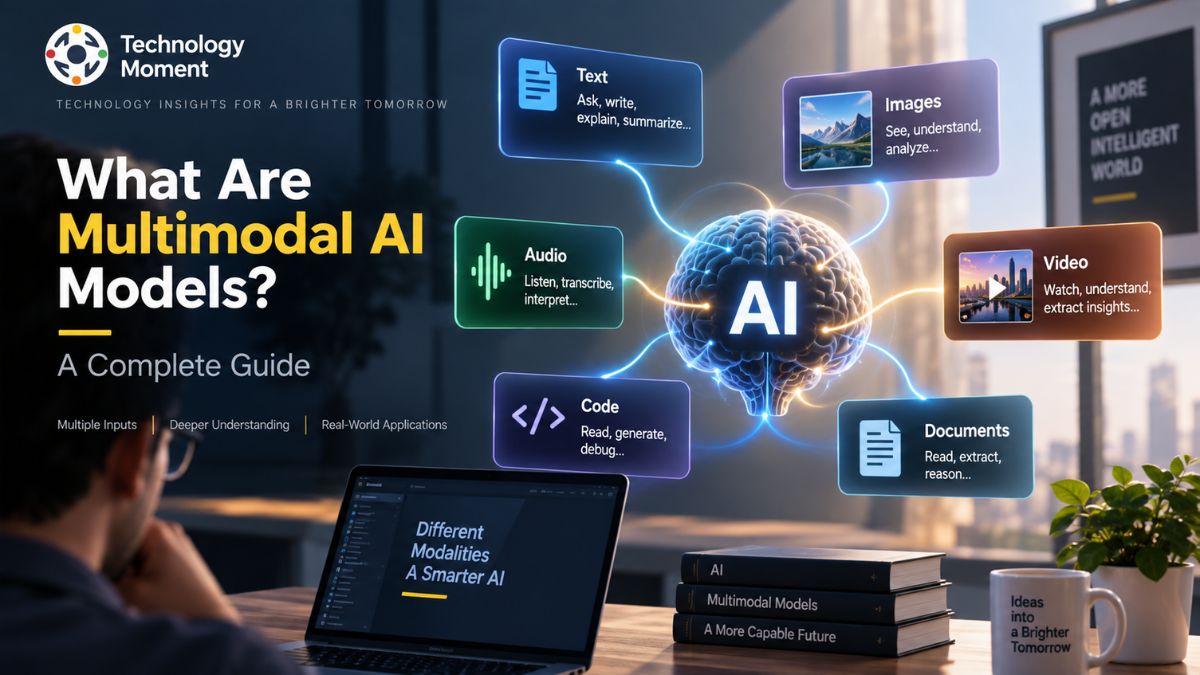
Multimodal AI is a type of artificial intelligence that can understand and work with information from more than one type of data, or modality. While some AI systems are designed primarily around text, multimodal artificial intelligence can combine inputs such as text, images, audio, and video to understand a request in a broader context. The idea behind multimodal AI is similar to how people understand the world. We can read a description, look at an image, listen to a sound, and combine those signals to understand what is happening. Multimodal AI systems attempt to bring a similar ability to machine learning.
For example, a user could provide an image of a product together with a written question asking about its features. An AI system capable of multimodal understanding can consider both pieces of information rather than treating the image and text as completely separate inputs. This can make interactions more useful when a question depends on information contained in different formats. Multimodal AI is closely related to multimodal machine learning, multimodal learning, computer vision, natural language processing, speech recognition, and other AI technologies. The important distinction is that multimodal systems are designed to work across multiple forms of information.
This technology is increasingly relevant to generative AI as well. Modern multimodal generative AI systems can understand combinations of inputs and, depending on their capabilities, generate responses or content based on them. In simple terms, multimodal AI allows AI systems to move beyond a single type of information and work with several modalities together.
What Are Multimodal AI Models?
Multimodal AI models are AI models designed to process, understand, or generate information involving multiple data modalities. These modalities can include text, images, audio, video, and other forms of structured or unstructured information. A conventional model may be optimized for a particular kind of input. For example, a language model primarily works with text, while a computer vision model focuses on visual information. A multimodal AI model brings capabilities associated with different modalities into a broader system, allowing information from one modality to be interpreted alongside information from another.
Consider a simple example. A user uploads a photograph and asks, “What is shown in this image?” The system needs to interpret the visual content and connect it with the meaning of the written question. If the user then asks a follow-up question about something visible in the photograph, the model needs to maintain the relevant context while reasoning across the inputs.
This ability is often associated with large multimodal models, multimodal large language models, vision-language models, and multimodal foundation models. These terms can overlap, although they may describe different architectures, capabilities, or model designs. The broader field also includes multimodal machine learning, where researchers study how systems can learn from multiple sources of information and combine those signals effectively.
How Do Multimodal AI Models Work?
The way multimodal AI models work can vary significantly depending on the model architecture, but the general process involves receiving information from different modalities, creating useful representations of that information, combining the signals, and producing an appropriate output. First, the model receives one or more inputs. These might include a written prompt, an image, an audio recording, or a video. Each type of information has different characteristics, so the system must transform the raw inputs into representations that its underlying architecture can process.
For example, natural language processing techniques can help represent text, while computer vision methods can extract meaningful information from images. Audio may require speech recognition or other forms of audio processing, while video can involve both visual and temporal information. The next challenge is connecting these representations. This is where concepts such as cross-modal learning, data fusion, and modality fusion become important. The system needs to identify relationships between different inputs rather than analyzing every modality independently.
Suppose someone uploads a product photograph and asks whether the device shown supports a particular feature. The visual information may identify the product or relevant details, while the text provides the actual question. The model combines these signals to determine what information is relevant to the response. Multimodal reasoning can then help the system use the combined context to produce an output. Depending on the model, that output might be text, an image, audio, or another form of generated information.
What Types of Data Can Multimodal AI Process?
One of the defining characteristics of multimodal AI is its ability to work with multiple data modalities. Depending on the particular system, multimodal AI models can process text, images, audio, video, or combinations of these formats.
Text
Text is one of the most common modalities used in AI. Multimodal systems can interpret written questions, descriptions, instructions, documents, captions, and other textual information. Text can also provide context for another modality, such as a question about an uploaded image.
Images
Images provide visual information that cannot always be expressed effectively through words. Multimodal AI can use computer vision capabilities to identify objects, understand scenes, interpret visual details, and connect those observations with other inputs.
Audio
Audio can contain speech, sounds, and other useful signals. When combined with natural language capabilities, AI systems can process spoken questions, transcripts, or audio information and use it alongside other forms of data.
Video
Video combines visual information with time-based changes and, in many cases, audio. Video understanding therefore requires a system to consider what happens across multiple frames and potentially connect those events with spoken or written information.
Multiple Modalities Together
The real strength of multimodal AI appears when several modalities are used together. For instance, a system might receive an image and text prompt, analyze a video alongside spoken instructions, or combine information from documents and visual content. This is why phrases such as multimodal AI models for text, image, audio, and video describe an important direction in modern AI. However, not every multimodal model supports every modality. Capabilities depend on the model’s architecture, training, and implementation.
Multimodal AI vs Unimodal AI
The main difference between multimodal AI and unimodal AI is the number and variety of information types a system is designed to work with. A unimodal system generally focuses on one primary modality, while a multimodal system can work across two or more modalities.
| Feature | Unimodal AI | Multimodal AI |
|---|---|---|
| Primary input | Usually one data modality | Multiple data modalities |
| Text processing | Model-dependent | Common capability |
| Image processing | Model-dependent | Often integrated with other inputs |
| Audio processing | Model-dependent | Can be combined with other modalities |
| Video processing | Model-dependent | Can be combined with visual, audio, or text information |
| Cross-modal understanding | Limited or not central | A core capability |
| Context | Usually based on one information type | Can combine information from different sources |
| Example interaction | Text-only question and answer | Image plus text question and answer |
A unimodal model can still be highly capable. For example, a model specialized in text may perform sophisticated language tasks without needing visual or audio information. The limitation is that it may not be designed to directly reason across different modalities. Multimodal AI takes a broader approach. It can connect information from different sources so that one modality can provide context for another. A written question can refer to something in an image, while an audio recording can provide information that helps interpret a video.
This does not automatically make every multimodal system better for every task. The appropriate architecture depends on the problem, available data, required accuracy, computational resources, and the model’s actual capabilities. The key distinction is therefore cross-modal understanding: multimodal AI is designed to connect different forms of information rather than treating each modality as an isolated source.
Multimodal AI vs Multimodal Machine Learning
Multimodal AI and multimodal machine learning are closely related terms, but they describe slightly different concepts. Multimodal machine learning is primarily a field of AI research focused on enabling machine learning models to learn from and combine multiple types of information, such as text, images, audio, and video. Multimodal AI is a broader term that describes AI systems capable of using multiple modalities to understand, reason, or generate information. In simple terms, multimodal machine learning provides many of the underlying techniques, while multimodal AI describes their application in practical AI systems.
| Feature | Multimodal Machine Learning | Multimodal AI |
|---|---|---|
| Main focus | Learning from multiple modalities | Building AI systems using multiple modalities |
| Scope | Primarily a research and technical field | Broader technology and application area |
| Data | Text, images, audio, video, and other modalities | Multiple data types depending on the system |
| Key techniques | Cross-modal learning, data fusion, modality fusion | Multimodal understanding, reasoning, generation |
| Applications | Model research and development | Assistants, healthcare, education, robotics, business |
| Goal | Learn relationships between modalities | Use those relationships to perform useful tasks |
Types of Multimodal AI Models
There are several types of multimodal AI models, and their capabilities can differ considerably. Some focus on understanding relationships between text and images, while others can work with additional modalities such as audio or video.
Vision-Language Models
They can process an image together with a text prompt and use information from both modalities to answer questions, describe visual content, or perform other tasks.
Multimodal Large Language Models
Multimodal large language models, often called multimodal LLMs, extend language-model capabilities to additional input types. Instead of working exclusively with text, they can be designed to interpret information such as images, audio, or other supported modalities.
Large Multimodal Models
Large multimodal models are broader systems designed to handle multiple forms of information at scale. Their exact capabilities depend on the model architecture, training data, and supported modalities.
Multimodal Foundation Models
Multimodal foundation models are trained as general-purpose foundations that can support a variety of downstream applications. They can provide a common base for tasks involving different types of information.
Multimodal Generative Models
Multimodal generative AI systems can use information from several modalities when generating an output. Depending on the system, this may involve generating text, images, audio, or other content. These categories can overlap. A single model may function as a vision-language model, a multimodal LLM, and part of a broader multimodal foundation-model architecture.
The important point is that the label alone does not determine capability. When evaluating a multimodal AI model, users should check which modalities it actually accepts, what it can generate, how well it reasons across inputs, and what limitations apply.
Examples of Multimodal AI Models
Examples of multimodal AI models can be found across modern generative AI platforms and research systems. Their exact capabilities vary, so it is more useful to understand what makes them multimodal than to treat a model name as a guarantee of specific functionality. OpenAI’s GPT-4o is a well-known example of a model designed around multimodal interaction, with capabilities involving text, vision, and audio. Google’s Gemini model family is another example of multimodal AI, with models designed to work across modalities such as text, images, audio, and video, depending on the specific model and version.
Other AI research and commercial systems have also explored vision-language models, multimodal LLMs, and multimodal foundation models. These systems demonstrate how language and visual understanding can be brought together within a single AI workflow. Imagine uploading a photograph of a computer setup and asking an AI model to identify the visible components. The model must interpret visual information and connect it with the meaning of the text prompt. A more advanced interaction could involve providing an image, asking a spoken question, and receiving a written response.
Multimodal AI model examples are therefore not limited to chatbots. They can include systems designed for document understanding, image analysis, video interpretation, speech interaction, robotics, research, and other specialized tasks. When comparing a list of multimodal AI models, users should look beyond the model name. Important factors include supported modalities, input and output capabilities, context handling, reasoning performance, latency, privacy, accessibility, and intended use.
Because AI models evolve quickly, capabilities can change between model versions. For that reason, current technical documentation should be checked before selecting a model for a specific application.
What Can Multimodal AI Do?
What can multimodal AI do? The answer depends on the model, but its central capability is connecting information from different modalities to understand a task more completely. One common capability is understanding images and text together. A user can provide an image and ask a question about something visible in it. The system can combine visual information with the written instruction instead of treating the two inputs independently.
Multimodal AI can also work with audio. Systems with appropriate audio capabilities can process spoken language, interpret conversations, or use sound as part of a broader AI interaction. When video is supported, the model can analyze visual information over time and potentially combine it with accompanying audio or text. Another important capability is multimodal reasoning. Rather than simply identifying individual objects or words, a system can use information from multiple sources to address a more complex request. For example, an AI system could analyze a chart in an image and explain its information in response to a written question.
Multimodal AI models can also support content generation. Depending on the architecture, they may generate text from visual information, respond to spoken interactions, create images from instructions, or transform information between different formats. These capabilities make multimodal AI systems useful for tasks where context is distributed across different sources. However, multimodal does not mean unlimited understanding. Models can misinterpret images, misunderstand speech, overlook video details, or produce incorrect conclusions. Their performance depends on the quality of the inputs, model design, training, and the complexity of the task.
The practical value of multimodal AI therefore comes from combining different information sources while recognizing that the model’s output still needs appropriate verification.
Real-World Applications of Multimodal AI
Real-world applications of multimodal AI are expanding because many practical problems involve more than one type of information. Instead of analyzing text, images, audio, or video separately, organizations can use multimodal AI to connect these sources within a single workflow. Healthcare can involve medical images, clinical notes, laboratory information, and other data. Multimodal AI research can combine different sources to support analysis and information retrieval. Such systems require strong validation, privacy protections, and appropriate professional oversight.
In education, multimodal AI can combine written questions, diagrams, images, spoken explanations, and learning materials. This can support more interactive learning experiences and help explain complex concepts through different forms of information. Businesses can use multimodal AI to analyze documents, charts, product images, presentations, customer conversations, and other information. This can support research, customer service, document analysis, and internal knowledge workflows.
Robotics is another important area. Robots operate in physical environments where information can come from cameras, microphones, sensors, language instructions, and other inputs. Multimodal systems can help connect these signals when interpreting an environment or following instructions. Multimodal AI can also assist with image understanding, video analysis, transcription, content creation, and information extraction. For technology publishers and knowledge platforms, these capabilities can support richer ways of explaining complex subjects.
The broader opportunity is that real-world information rarely exists in only one format. A product may have specifications in text, photographs, demonstration videos, and customer feedback in audio or written form. Multimodal AI can potentially connect these sources and create a more complete understanding. However, organizations should evaluate accuracy, privacy, security, cost, and human oversight before deploying multimodal AI in important workflows. The technology is powerful, but its usefulness depends on implementing the right model for the specific task.
Benefits of Multimodal AI
People communicate through text, speech, images, and other formats. Multimodal AI can support more flexible interactions by allowing users to provide information in different ways. This is particularly useful for AI assistants, customer support systems, educational platforms, and accessibility-focused applications. Different modalities can contain complementary information. A document may include written content and charts, while a video can contain both visual scenes and spoken explanations. Multimodal understanding allows an AI system to consider these elements together.
Multimodal AI applications can extend across healthcare, education, business, robotics, content creation, research, and software development. Multimodal generative AI can also combine different inputs when producing outputs, depending on the model’s capabilities. Multimodal AI systems can potentially reduce the need to analyze different information sources separately. Instead, multiple forms of data can become part of a connected workflow. However, these advantages depend on the quality and capabilities of the underlying model. Multimodal does not automatically mean more accurate, and each application still requires appropriate testing and validation.
Despite its capabilities, multimodal AI has important limitations and challenges. Processing multiple forms of information is technically complex, and a model’s ability to accept different inputs does not guarantee that it will interpret them correctly. Text, images, audio, and video have very different structures. Combining these modalities requires sophisticated model architectures and training methods. The system must learn meaningful relationships between different types of information while preserving the important characteristics of each modality.
Multimodal AI models can require substantial computing resources, particularly when processing high-resolution images, long videos, large documents, or multiple inputs simultaneously. This can affect infrastructure requirements, response times, and operating costs. A multimodal model can misunderstand information or produce an incorrect response. For example, it may overlook an important visual detail, misinterpret speech, or draw an unsupported conclusion from multiple inputs. Multimodal reasoning therefore does not eliminate the risk of AI hallucinations.
Poor-quality input can affect results. Blurry images, incomplete documents, background noise, ambiguous questions, or missing context may make accurate interpretation more difficult. Multimodal systems may process sensitive information such as photographs, recordings, documents, or video. Organizations need appropriate privacy and security controls when handling this type of data. Not every multimodal AI model supports every modality. Some systems may handle text and images but not audio or video. Even when a modality is supported, capabilities may vary significantly between models.
Why Is Multimodal AI Important?
Modern digital environments contain text, images, audio, video, documents, charts, and other forms of data. An AI system that can work across these modalities can potentially understand a wider range of real-world information. Traditional AI systems were often designed around specific tasks or individual data types. Multimodal AI represents a broader direction in which different forms of information can be connected within the same AI workflow.
One important benefit is improved contextual understanding. Consider a technical document containing written explanations, diagrams, screenshots, and tables. Understanding only the text may leave out important information contained in the visual elements. A capable multimodal system can potentially analyze these different components together. Multimodal AI is also important for human-AI interaction. People may prefer to type a question, speak an instruction, upload a photograph, or provide a combination of these inputs. Supporting multiple modalities can make AI systems more flexible and accessible.
The technology also has implications for generative AI and foundation models. Multimodal foundation models and multimodal large language models are helping expand AI beyond text-based interactions into systems capable of working with richer forms of information. Its importance extends across practical areas such as healthcare, education, business, robotics, research, and content creation. In each case, the potential value comes from connecting information that may previously have been handled separately.
At the same time, multimodal AI should not be viewed as a solution to every AI problem. Its usefulness depends on model quality, data, implementation, cost, privacy, and the specific task. Its significance lies in making AI capable of working with a broader representation of the information people use in the real world.
Frequently Asked Questions About Multimodal AI
What data can multimodal AI process?
Depending on the model, multimodal AI can process text, images, audio, video, documents, and other forms of information. Not every model supports every modality, so users should check the capabilities and technical specifications of the particular AI system.
Can multimodal AI process audio and video?
Some multimodal AI systems can process both audio and video. Video understanding may involve analyzing visual information over time while also considering accompanying speech or sounds. However, supported formats, duration limits, and capabilities vary between models.
What are examples of multimodal AI?
Examples include vision-language models, multimodal large language models, and multimodal foundation models. Systems from major AI providers can combine capabilities such as text understanding with image, audio, or video processing, although specific features differ between models and versions.
What are the benefits of multimodal AI?
The benefits of multimodal AI include broader contextual understanding, more flexible human-AI interaction, richer information processing, and support for diverse use cases. By connecting multiple modalities, these systems can potentially analyze information that would be difficult to understand using only one type of data.
What are the limitations of multimodal AI?
Multimodal AI can face challenges involving data quality, computational requirements, model accuracy, privacy, cost, and cross-modal reasoning. Models can also misunderstand information or produce incorrect responses. Supporting multiple modalities does not eliminate the need for testing, verification, and appropriate human oversight.
How is multimodal AI used in business?
Businesses can use multimodal AI to analyze documents, images, presentations, charts, customer conversations, and other information. Potential applications include research, customer service, knowledge management, document analysis, and workflow automation, although organizations should evaluate accuracy, privacy, security, and cost before deployment.
How is multimodal AI used in healthcare?
Multimodal AI can combine different healthcare information sources, such as medical images and clinical documentation, for research and analytical applications. Because healthcare involves sensitive data and high-stakes decisions, these systems require rigorous validation, privacy safeguards, appropriate regulation, and qualified professional oversight.