In today’s connected world, people are constantly sharing opinions, experiences, and feedback about businesses across social media, online communities, forums, blogs, and review platforms. A single customer comment or public discussion can influence how others perceive a brand. For businesses, keeping track of these conversations is essential for understanding customer expectations, protecting their reputation, and identifying opportunities to improve.
Unlike basic social media monitoring, which primarily focuses on tracking individual mentions and interactions, social listening helps businesses understand the wider conversations surrounding their products, services, competitors, and industries. With the right platform, marketing and communication teams can make more informed decisions instead of relying on assumptions.
However, choosing the right solution can be challenging because different platforms offer different monitoring capabilities, analytics, reporting features, and data coverage. Some are designed for large enterprises managing extensive brand conversations, while others provide more accessible monitoring options for smaller businesses and marketing teams.
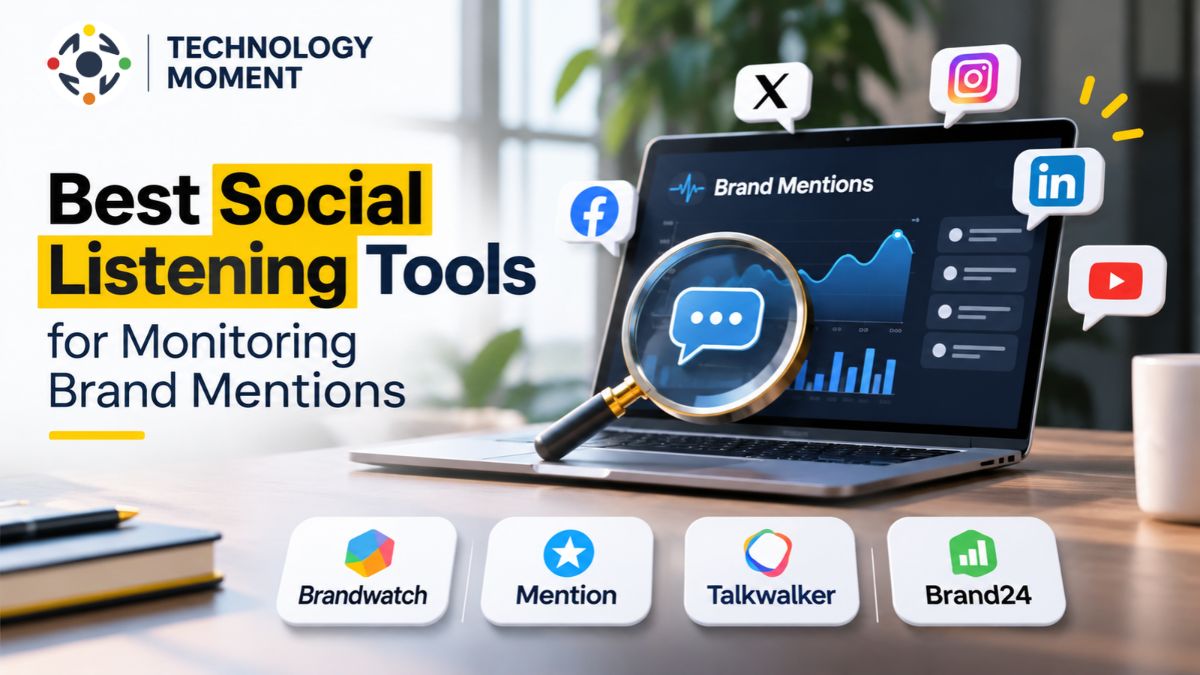
At Technology Moment, we explore practical technology and digital solutions that help readers make informed decisions. In this guide, we compare four notable platforms: Brandwatch, Mention, Talkwalker, and Brand24. We will examine their key features, brand mention tracking capabilities, sentiment analysis, competitor monitoring, and other important considerations to help you understand what each platform offers. Whether you manage a growing business, work in digital marketing, or handle brand communications, this comparison will help you identify the social listening solution that best matches your monitoring needs.
What Are Social Listening Tools?
Social listening tools enable businesses to understand how people discuss their brands, products, competitors, and industries across digital channels. These platforms gather and analyse conversations from sources such as social networks, online communities, blogs, customer review websites, forums, and digital publications. They allow companies to identify relevant discussions beyond their own social media pages, including public conversations where users mention a product or business without tagging its official account.
By examining these discussions, organisations can gain a clearer picture of customer expectations, public opinions, and market developments. For instance, recurring comments about product performance may highlight areas that need improvement, while discussions around competitors can reveal changing customer preferences or gaps in the market. Social listening also helps marketing and customer experience teams recognise potential reputation issues, understand audience sentiment, and identify topics that deserve attention. These findings can support better-informed decisions across marketing, product development, customer service, and brand management.
Although social listening and social media monitoring are closely related, they serve different purposes. Social media monitoring is primarily concerned with tracking specific activities, such as brand mentions, comments, direct messages, and customer enquiries, so businesses can respond to individual interactions. Social listening takes a broader analytical approach by studying recurring themes, conversation patterns, audience attitudes, and shifts in public opinion over time. While monitoring focuses on individual interactions, social listening provides a wider understanding of the reasons, opinions, and trends behind online conversations.
Modern social listening tools bring this information together through searchable dashboards, analytics, alerts, and reporting features. Depending on the platform, businesses can monitor brand mentions, compare competitors, track hashtags, measure share of voice, and examine online brand reputation. These capabilities can support marketing decisions, public relations activities, customer experience improvements, and product development. For businesses of different sizes, selecting the right social listening solution depends on their monitoring requirements, preferred data sources, reporting needs, and budget. A suitable platform can make it easier to understand public conversations and respond to changes in customer expectations.
Key Features to Look for in Social Listening Tools
Choosing the right social listening tools requires more than checking how many social media platforms they support. Businesses should evaluate whether a platform can collect relevant conversations, organise brand mentions, identify meaningful patterns, and present information in a way that supports practical decisions. The most useful features will depend on whether the main objective is reputation monitoring, competitor research, customer feedback analysis, or broader marketing performance measurement.
A reliable platform should allow users to monitor company names, product names, branded hashtags, campaign terms, and relevant variations. This is particularly useful when customers discuss a business without tagging its official social media account. Real-time brand monitoring and custom alerts can also help teams identify important conversations quickly, especially when a sudden increase in mentions requires attention.
This capability helps businesses organise conversations into positive, negative, and neutral categories, providing an overview of customer opinions. Although automated sentiment classifications are not always accurate, they can help teams identify changes in brand perception and investigate conversations that require further attention. Access to the original posts remains important when interpreting the results.
Competitor monitoring is another valuable feature. By tracking competing brands, businesses can compare mention volumes, audience discussions, campaign responses, and share of voice. A good social listening dashboard should also provide useful analytics and reporting. Historical data, engagement measurements, audience insights, trend analysis, and exportable reports can help teams understand how conversations change over time. Cross-platform monitoring is equally important because customers may discuss the same brand on social networks, blogs, forums, and review websites.
Finally, consider ease of use, notification settings, search filters, integrations, data coverage, and pricing. Some platforms offer advanced capabilities for large organisations, while others focus on accessible brand monitoring for smaller teams. Evaluating these features together will help businesses choose social listening software that matches their actual requirements.
Best Social Listening Tools for Monitoring Brand Mentions
Finding the right platform for monitoring brand mentions can make a significant difference in how businesses understand their online presence. Different social listening platforms offer different approaches to collecting conversations, analysing customer opinions, tracking competitors, and measuring brand visibility. Some focus on large-scale consumer intelligence and historical research, while others provide practical monitoring features for marketing teams that need to follow online discussions and respond to relevant mentions.
When comparing the best social listening tools, businesses should consider the channels covered, monitoring accuracy, sentiment analysis, reporting capabilities, alert options, and overall usability. It is also important to understand whether a platform can identify untagged brand mentions, monitor industry-related discussions, and provide useful information about customer feedback. These capabilities help organisations move beyond basic social media analytics and develop a clearer understanding of their audiences.
For example, an international company operating in several markets may need multilingual monitoring and extensive online source coverage. A smaller business, on the other hand, may prioritise real-time brand mention alerts, competitor tracking, and straightforward reporting. Therefore, the best solution is not necessarily the platform with the largest number of features; it is the one that supports the organisation’s specific monitoring goals.
In this comparison, we look at four recognised platforms: Brandwatch, Mention, Talkwalker, and Brand24. Each has a different focus and offers capabilities suited to particular business requirements. We will examine their main features, brand monitoring capabilities, sentiment analysis options, and potential use cases to help readers understand their differences.
The following sections provide a closer look at each platform, beginning with Brandwatch, which is particularly relevant to organisations looking for extensive social listening and consumer intelligence capabilities. Comparing these platforms can help marketing professionals, business owners, and communication teams make a more informed decision before selecting their preferred brand monitoring software.
1. Brandwatch – Best for Enterprise Brand Monitoring
Brandwatch is a social listening and consumer intelligence platform designed to help organisations understand online conversations at scale. It enables businesses to explore discussions about their brands, products, competitors, and industries across a wide range of digital sources. This makes it relevant for enterprise marketing departments, research teams, and public relations professionals who need more than basic social media monitoring.
One of Brandwatch’s notable capabilities is its extensive online data coverage. Its Listen product provides access to conversations across social networks, forums, review websites, and other online sources. According to Brandwatch, its platform provides access to insights from more than 100 million online sources. This broad coverage can help organisations discover brand mentions and discussions that may not appear in their own social media notifications.
The platform also offers advanced search capabilities, including Boolean operators, which allow users to create more specific monitoring queries. Businesses can use these searches to track brand names, product references, competitor mentions, industry topics, and relevant keywords. Historical data can help research teams examine how conversations and brand perception have changed over time.
Another important capability is sentiment analysis, which helps users understand whether online conversations are generally positive, negative, or neutral. Brandwatch also provides features for exploring individual mentions, analysing trends, and identifying changes in conversation volumes. Its multiple-language capabilities can be useful for organisations monitoring brand reputation across international markets. Brandwatch can be particularly suitable for companies that require detailed audience insights, competitor brand monitoring, and extensive reporting capabilities. However, its advanced functionality may be more than a small business needs, and organisations should evaluate its pricing and available plans before making a decision.
2. Mention – Best for Online Brand Mention Tracking
Mention is a social listening and media monitoring platform designed to help businesses discover what people are saying about their brands across social media and the wider web. It is particularly useful for marketing professionals, public relations teams, and businesses that want to monitor brand mentions without manually checking multiple websites and social channels. The platform brings relevant conversations into a central monitoring environment, making it easier to follow customer opinions, industry discussions, and competitor activities.
One of Mention’s key features is its alert-based monitoring system. Users can create alerts around brand names, product names, competitors, hashtags, and industry-related topics. The platform searches for matching conversations and collects relevant mentions from supported sources, including social networks, news websites, blogs, forums, and review platforms. Its advanced search options, including Boolean queries, help users refine monitoring results and reduce unrelated mentions.
Mention also provides analytics and reporting features that help businesses understand the performance of their tracked topics. Users can examine mention volume, reach, sentiment, influence, and other indicators to identify changes in online conversations. Competitor benchmarking and share of voice measurements can also help marketing teams understand how their brand visibility compares with other businesses. Notifications allow users to stay informed when new mentions or significant changes appear in their monitoring results.
Another useful aspect is its reporting and collaboration functionality. Teams can organise monitoring activities, share insights, and use integrations to connect information with other business workflows. However, available features and limits depend on the selected subscription and product configuration. Mention is worth considering for organisations that prioritise online brand monitoring, keyword-based alerts, and straightforward social listening workflows. Before choosing it, businesses should check current pricing, supported data sources, historical data access, and plan limitations to ensure that the platform meets their requirements.
3. Talkwalker – Best for International Brand and Audience Intelligence
Talkwalker is an enterprise-focused social listening and media monitoring platform designed for organisations that need to understand brand conversations across international markets. It is particularly relevant for global companies, large marketing departments, and public relations teams that monitor customer discussions across different countries, languages, and digital channels. Its broad monitoring capabilities make it useful for tracking brand reputation, industry trends, and competitor activities beyond individual social media networks.
One of the platform’s major strengths is its extensive data coverage. Talkwalker states that its monitoring capabilities include more than 150 million websites across 239 countries and regions. Its wider listening ecosystem also covers social networks, blogs, forums, news, reviews, podcasts, and other media sources. This coverage can help international businesses identify conversations that might otherwise remain scattered across different online platforms.
Another notable capability is visual social listening. Businesses can use visual recognition features to identify brand logos and other visual references in images and videos, including situations where a written brand name is not included. This can provide additional information for companies whose products, packaging, or logos frequently appear in online content.
Talkwalker also offers sentiment analysis, custom alerts, trend monitoring, and reporting capabilities. These features help communication teams identify changes in customer sentiment, follow campaign discussions, and monitor potential reputation issues. Its multilingual monitoring capabilities are particularly useful when a company operates in markets where customers communicate in different languages. However, Talkwalker’s extensive capabilities may be more suitable for organisations with larger monitoring requirements and dedicated marketing or research teams. Businesses should evaluate its implementation requirements, available data sources, reporting options, and subscription costs before making a decision.
4. Brand24 – Best for Real-Time Brand Monitoring
It is particularly useful for teams that want to monitor brand mentions from a central dashboard and identify important changes in online discussions. Rather than checking individual social media accounts and websites throughout the day, users can create monitoring projects and collect relevant mentions in one place.
The platform works through keyword-based monitoring. Users can enter a company name, product, competitor, campaign phrase, or hashtag to discover matching conversations across supported online sources. Brand24 states that its monitoring system covers more than 30 million online sources and supports 108 languages. These sources include social media networks, news websites, blogs, forums, podcasts, and review platforms. Its Boolean search and context filtering capabilities can also help users reduce irrelevant results.
Real-time brand monitoring is one of Brand24’s important capabilities, although update frequency depends on the subscription plan. Its pricing information currently shows updates every 12 hours on the Individual plan, hourly updates on the Team plan, and real-time updates on Pro and higher plans. This distinction is important for businesses that need immediate awareness of brand conversations or potential reputation issues.
Brand24 also provides sentiment analysis, mention volume tracking, reach measurements, influence indicators, and share of voice reporting. These features help marketing teams understand how frequently their brand is discussed, which sources generate the most conversations, and whether customer opinions are changing. Users can also monitor competitors and compare their online visibility.
The platform offers different subscription levels based on keyword limits, mention volumes, update frequency, and additional capabilities. Its 14-day free trial gives businesses an opportunity to explore the platform before purchasing a subscription. Brand24 is worth considering for growing businesses, marketing agencies, and teams that need accessible social listening, real-time alerts on suitable plans, and practical brand mention tracking.
Brandwatch vs. Mention vs. Talkwalker vs. Brand24: Comparison
Choosing between Brandwatch, Mention, Talkwalker, and Brand24 depends on the type of brand monitoring a business needs. Although all four platforms support social listening and online mention tracking, they differ in data coverage, analytics, monitoring capabilities, and pricing structures. A detailed comparison can help businesses identify which platform is suitable for their marketing objectives and available budget.
Brandwatch is designed for organisations that need extensive consumer intelligence and detailed analysis of online conversations. Mention focuses on keyword-based monitoring, alerts, and online brand tracking. Talkwalker is particularly relevant for international businesses that require multilingual monitoring and visual brand recognition. Brand24 offers accessible monitoring projects, mention tracking, and different update frequencies depending on the subscription plan.
| Comparison factors | Brandwatch | Mention | Talkwalker | Brand24 |
|---|---|---|---|---|
| Best for | Enterprise brand monitoring | Online brand mention tracking | Global social listening | Real-time brand monitoring |
| Primary focus | Consumer intelligence | Media and social monitoring | Enterprise media intelligence | Online brand monitoring |
| Data coverage | 100M+ online sources (vendor-reported) | Social networks and web sources | 150M+ websites (vendor-reported) | 30M+ online sources (vendor-reported) |
| Language support | Multiple languages | Multiple languages | 187 languages (vendor-reported) | 108 languages |
| Brand mention tracking | Yes | Yes | Yes | Yes |
| Real-time monitoring | Available features and refresh rates vary | Real-time monitoring advertised | Custom alerts and monitoring | Plan-dependent update frequency |
| Sentiment analysis | Yes | Yes | Yes | Yes |
| Competitor monitoring | Yes | Yes | Yes | Yes |
| Boolean search | Advanced search queries | Advanced Boolean alerts | Advanced search capabilities | Boolean operators |
| Visual recognition | Available capabilities vary by product | Not a primary focus | Image and video recognition | Not a primary focus |
| Analytics and reporting | Advanced analytics and reporting | Analytics and custom reports | Custom reports and dashboards | Reports, reach and mention analytics |
| Historical data | Available, subject to product and access | Historical data available as an add-on on relevant plans | Availability depends on package | Plan and search dependent |
| Pricing model | Custom pricing | Subscription and quote-based options | Custom pricing | Published subscription plans |
| Free trial | Demo or sales consultation | Check current trial availability | Demo or sales consultation | 14-day free trial |
How to Choose the Right Social Listening Tool for Your Business
Choosing the right social listening tool for your business requires a clear understanding of your marketing objectives, monitoring requirements, and available budget. Although many social listening platforms offer similar features, their data coverage, reporting capabilities, alert systems, and analytics can differ significantly. A suitable platform should help your team track brand mentions, understand customer conversations, monitor competitors, and identify useful insights without creating unnecessary complexity.
Start by identifying what you want to achieve through brand monitoring. Some businesses primarily want to track customer feedback and online reviews, while others need to monitor competitor activities, measure brand reputation, or analyse industry conversations. If your main objective is tracking brand mentions, look for tools that support keyword monitoring, custom alerts, and coverage across relevant social media networks, blogs, forums, and news websites. This will help you discover conversations even when customers do not directly tag your official accounts.
Next, evaluate the platform’s sentiment analysis and reporting capabilities. Social media sentiment analysis can help businesses understand whether online discussions are generally positive, negative, or neutral. However, automated classifications should be reviewed because sarcasm, context, and industry-specific language can affect accuracy. Look for reporting features that provide mention volume, engagement measurements, audience insights, and share of voice tracking. These metrics can make competitor monitoring and brand performance analysis more useful.
Business size and pricing should also influence your decision. Large organisations may benefit from enterprise platforms such as Brandwatch or Talkwalker, while growing businesses may prefer more accessible monitoring solutions such as Mention or Brand24. Compare subscription limits, keyword allowances, historical data access, update frequency, and additional costs rather than selecting a platform based only on its starting price. Finally, consider ease of use, integrations, team collaboration, and customer support. If possible, test a free trial or request a product demonstration before purchasing. The right social listening software should fit naturally into your existing marketing workflow and turn online conversations into information your team can actually use.
Benefits of Using Social Listening Tools for Brand Monitoring
Social listening tools provide businesses with a practical way to understand how customers, competitors, and industry communities discuss their products and services online. Instead of depending entirely on surveys or direct customer messages, companies can examine public conversations across social media, blogs, forums, news websites, and review platforms. These discussions can reveal valuable information about customer expectations, brand perception, and market developments. When used consistently, social listening can support several important areas of business and marketing.
One major benefit is improved online brand reputation management. By tracking brand mentions and customer feedback, businesses can identify complaints, questions, and negative discussions before they develop into larger reputation problems. Real-time alerts, where supported, help communication teams identify important conversations and respond more quickly. Positive mentions can also reveal satisfied customers who may be interested in sharing their experiences or recommending a product.
Another advantage is a better understanding of customer sentiment. Sentiment analysis helps organisations examine the general tone of online discussions and recognise recurring opinions about their products, services, or customer experiences. For example, repeated complaints about delivery delays or product quality may indicate an area that needs improvement. These customer insights can help businesses make more informed decisions about product development, customer service, and marketing communication.
Competitor monitoring is another valuable use case. Businesses can track competitor brand mentions, compare share of voice, examine campaign discussions, and identify topics that attract audience attention. This information can reveal market opportunities and help marketing teams understand how their brand visibility compares with other businesses.
Social listening also supports trend identification and campaign measurement. Monitoring hashtags, industry discussions, and changing conversation volumes can help companies recognise emerging customer interests. Similarly, analysing brand mentions during and after a marketing campaign can provide additional context about audience reactions and engagement. Social listening software helps businesses move beyond simply counting online mentions. It provides a broader understanding of customer conversations, brand reputation, competitor activities, and industry developments. By combining these insights with customer research and business data, organisations can improve their marketing strategies and build stronger relationships with their audiences.
Frequently Asked Questions About Social Listening Tools
How Can I Monitor Brand Mentions on Social Media?
You can monitor brand mentions by creating tracking alerts using your company name, product names, branded hashtags, and common spelling variations. Select a social listening platform that covers the networks where your audience is active. Review incoming mentions regularly, organise feedback by topic, and respond to important conversations. Monitoring untagged references can also help discover discussions beyond your official accounts.
What Is the Difference Between Social Listening and Social Media Monitoring?
Social media monitoring focuses on tracking individual mentions, comments, messages, and interactions so businesses can respond to conversations. Social listening examines broader discussions to identify customer sentiment, recurring topics, industry trends, and competitor activities. Monitoring helps organisations understand what people are saying, while listening provides context about why those conversations matter and how businesses can use the insights.
Which Social Listening Tool Is Best for Businesses?
The best social listening tool depends on business size, monitoring requirements, and budget. Brandwatch is worth considering for enterprise consumer intelligence, Mention for online brand mention tracking, Talkwalker for global social listening, and Brand24 for accessible brand monitoring. Compare their data coverage, sentiment analysis, alert frequency, reporting capabilities, and subscription limits before selecting a platform for your organisation.
How Can I Track Brand Mentions in Real Time?
To track brand mentions in real time, choose a platform that offers frequent monitoring updates and custom notifications. Add your brand name, product terms, competitor names, and relevant hashtags to monitoring projects. Configure alerts for important mentions and sudden increases in conversation volume. Check the platform’s update frequency because real-time monitoring may depend on its subscription plan and available data sources.
Can Social Listening Tools Monitor Competitors?
Yes, many social listening tools support competitor monitoring. Businesses can create separate tracking projects for competing brand names, products, campaigns, and industry-related topics. The collected information can help compare mention volumes, audience discussions, sentiment, and share of voice. These insights allow marketing teams to identify competitor strengths, understand customer expectations, and discover potential opportunities to improve their own positioning.
How Do Social Listening Tools Measure Brand Sentiment?
Social listening tools analyse the language and context of online mentions to classify conversations as positive, negative, or neutral. Some platforms also provide sentiment trends and topic-level analysis. Businesses can use these results to understand public perception and identify recurring customer concerns. However, automated sentiment analysis may misunderstand sarcasm, slang, or complex discussions, so important results should be reviewed manually.
How Much Do Social Listening Tools Cost?
The cost of social listening tools varies according to monitoring limits, data coverage, analytics, and subscription features. Some platforms publish monthly or annual plans, while enterprise solutions such as Brandwatch and Talkwalker generally require custom pricing discussions. Before purchasing, compare keyword limits, mention allowances, historical data, update frequency, and additional charges to understand the total cost of the service.
Are There Free Social Listening Tools?
Yes, businesses can start with free monitoring options such as Google Alerts for tracking selected brand names and topics across indexed web content. However, free options generally provide fewer analytics and monitoring capabilities than dedicated social listening platforms. Businesses requiring sentiment analysis, competitor comparisons, advanced reporting, and broader social media coverage may eventually need a paid monitoring solution.