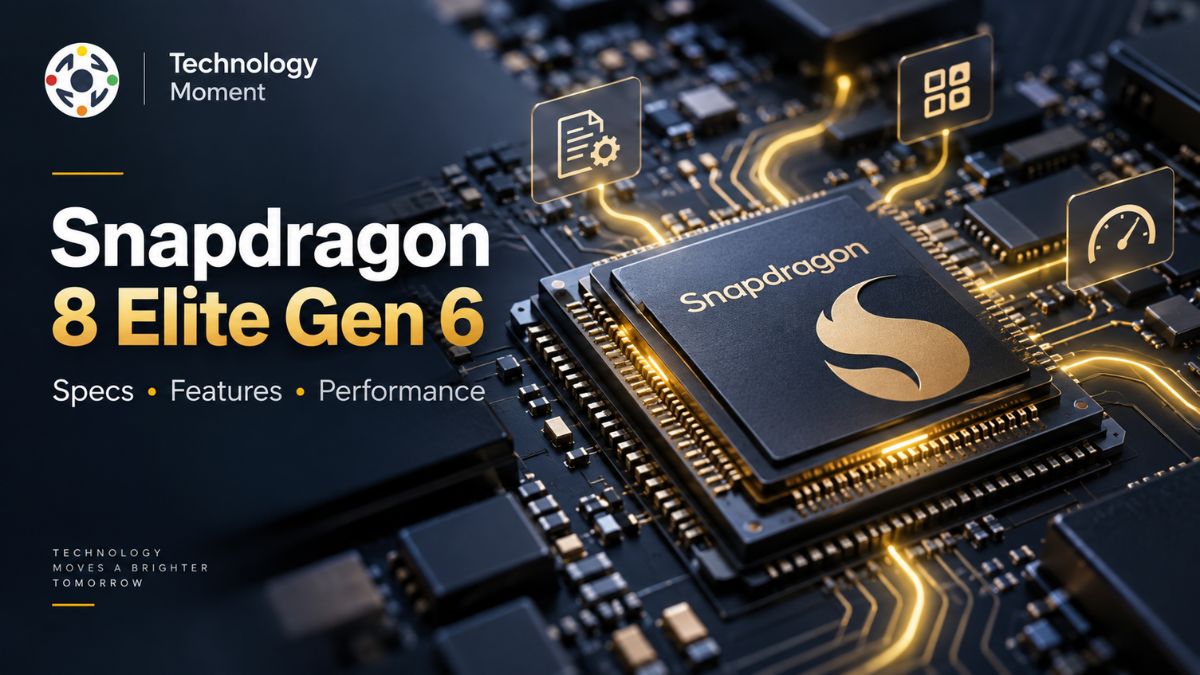
Qualcomm has officially introduced the Snapdragon 8 Elite Gen 6, its latest flagship mobile chipset designed to power the next generation of premium smartphones. The new platform brings advancements across processing performance, graphics, on-device AI, connectivity, and power efficiency, making it an important development in the Android smartphone market.
For readers trying to understand what the new chipset actually changes, the headline specifications only tell part of the story. This Snapdragon 8 Elite Gen 6 guide breaks down its key features, CPU and GPU capabilities, AI performance, efficiency improvements, expected smartphones, and how it compares with the previous generation. At Technology Moment, we focus on turning major technology announcements into clear, useful information so readers can understand what new hardware means beyond the specifications.
Qualcomm Snapdragon 8 Elite Gen 6: What’s New?
Qualcomm Snapdragon 8 Elite Gen 6 represents the company’s next step in its flagship mobile chipset lineup, bringing a new generation of processing, graphics, AI, and connectivity capabilities to premium smartphones. As smartphone workloads continue to move beyond traditional apps and toward on-device artificial intelligence, advanced gaming, computational photography, and demanding multitasking, the role of the smartphone chipset has become increasingly important. The Snapdragon 8 Elite Gen 6 is therefore positioned not simply as a faster mobile processor, but as a broader flagship mobile platform designed to handle a wider range of workloads efficiently.
One of the most important areas to watch is processing performance. The Snapdragon 8 Elite Gen 6 chipset is expected to build on Qualcomm’s focus on high-performance CPU architecture while continuing to improve efficiency for everyday smartphone workloads. This matters because flagship devices need to balance peak performance with sustained battery life rather than simply delivering short bursts of speed. Alongside the CPU, the GPU plays a major role in demanding applications, particularly mobile gaming, high-resolution graphics, and other visually intensive workloads.
AI is another central part of the new platform. Modern smartphones increasingly use local AI processing for features such as image enhancement, voice processing, generative AI functions, and intelligent system experiences. The Snapdragon 8 Elite Gen 6 AI capabilities are therefore important because dedicated AI hardware, including the neural processing unit, can process certain workloads directly on the device. This can reduce reliance on cloud processing and potentially improve responsiveness and privacy for compatible applications.
The platform also brings attention to camera processing and connectivity. Qualcomm’s image signal processor technology is an important component of flagship smartphone photography, while 5G and other wireless technologies remain essential for high-speed mobile communication. Overall, the Snapdragon 8 Elite Gen 6 is aimed at supporting the next generation of premium Android flagship phones, with improvements spanning performance, graphics, AI processing, imaging, connectivity, and power efficiency.
Snapdragon 8 Elite Gen 6 Specifications
The Snapdragon 8 Elite Gen 6 specifications are best understood as a combination of several major technologies rather than a single CPU specification. At the heart of the platform is its CPU, which is responsible for general computing workloads ranging from launching applications and multitasking to demanding productivity and gaming tasks. CPU architecture and core design have a direct influence on how quickly a smartphone can respond to demanding workloads, but real-world performance also depends on factors such as device cooling, software optimization, memory, and power management.
The GPU is equally important for a modern flagship chipset. Graphics performance affects mobile gaming, user-interface rendering, video processing, and other visually demanding applications. A capable GPU can allow smartphone manufacturers to target higher graphical quality and more sophisticated gaming experiences while maintaining smooth performance. For users who purchase premium smartphones primarily for gaming or multimedia, the GPU capabilities of the Snapdragon 8 Elite Gen 6 will therefore be an important part of the overall platform.
AI processing is another major specification area. The Snapdragon 8 Elite Gen 6 incorporates dedicated AI capabilities intended to handle increasingly sophisticated workloads directly on compatible devices. The neural processing unit can be used for AI-related tasks without requiring every operation to be sent to a remote server. On-device AI can support features such as image recognition, language processing, voice functions, personalization, and generative AI experiences, depending on how smartphone manufacturers implement the platform.
The chipset also includes technologies supporting camera processing, connectivity, and overall efficiency. The image signal processor is responsible for processing camera data and can contribute to computational photography features, while 5G connectivity enables high-speed mobile communications. Power efficiency is particularly significant because flagship processors must deliver high performance without creating excessive battery drain or heat. For that reason, the Snapdragon 8 Elite Gen 6 should be viewed as a complete smartphone SoC rather than simply a faster mobile processor. The final specifications and capabilities available to consumers, however, can vary by device implementation and should be confirmed against Qualcomm’s official documentation and individual smartphone specifications.
Snapdragon 8 Elite Gen 6 Performance
Snapdragon 8 Elite Gen 6 performance will ultimately depend on how Qualcomm’s platform translates into real-world smartphones. Benchmark results can provide useful information about CPU and GPU capabilities, but they do not always represent everyday experience because smartphone cooling systems, software optimization, memory configuration, and power limits can produce different results between devices. For this reason, performance should be considered across several areas rather than through a single benchmark number.
CPU performance is particularly important for demanding applications, multitasking, productivity workloads, and general responsiveness. A flagship processor needs to provide enough processing power for applications while maintaining efficient operation during lighter workloads. GPU performance becomes more important during gaming and other graphics-heavy tasks. The Snapdragon 8 Elite Gen 6 gaming performance will depend not only on its graphics architecture but also on sustained thermal performance and how individual games are optimized for the platform.
AI performance is another area where the new generation of mobile chipsets is becoming increasingly relevant. Rather than relying entirely on cloud-based AI services, smartphones can use dedicated hardware for selected AI workloads directly on the device. This approach can potentially improve response times and provide greater control over sensitive data. Applications may use on-device AI for camera effects, voice features, text processing, translation, personalization, and other intelligent functions.
Power efficiency is closely connected to all of these areas. Higher performance is useful only when a smartphone can sustain it without excessive heat or battery consumption. Efficient CPU, GPU, and AI processing can help manufacturers balance performance with battery life. However, actual battery results will vary significantly between smartphones because battery capacity, display technology, cooling, software, and manufacturer-level power management all influence endurance. As a result, independent testing of commercial devices will provide a clearer picture of the Snapdragon 8 Elite Gen 6’s real-world performance than specifications alone.
Snapdragon 8 Elite Gen 6 vs Snapdragon 8 Elite Gen 5
| Feature | Snapdragon 8 Elite Gen 6 | Snapdragon 8 Elite Gen 5 |
|---|---|---|
| Process Node | 2nm | 3nm |
| CPU | Qualcomm Oryon | Qualcomm Oryon |
| CPU Architecture | 64-bit | 64-bit |
| Peak CPU Clock Speed | Up to 5 GHz | Up to 4.74 GHz |
| GPU | Qualcomm Adreno | Qualcomm Adreno |
| GPU API | Vulkan 1.4, OpenCL 3.0 FP, OpenGL ES 3.2 | Vulkan 1.3, OpenCL 3.0 FP, OpenGL ES 3.2 |
| AI Processor | Reengineered Qualcomm Hexagon NPU | Qualcomm Hexagon NPU |
| AI Features | Fused AI Accelerator, Hexagon Direct Link, Micro Tile Inferencing, New Element Accelerator | Hardware matrix acceleration, Hexagon Scalar/Tensor Accelerator, HVX |
| Sensing Hub | Dual-core AI processor, Dual Micro NPUs, Personal Scribe | Dual-core AI processor, Personal Scribe, Personal Knowledge Graph |
| 5G Modem | Qualcomm X105 5G Modem-RF | Qualcomm X85 5G Modem-RF |
| Peak 5G Download | 14.8 Gbps | 12.5 Gbps |
| Peak 5G Upload | 4.2 Gbps | 3.7 Gbps |
| Wi-Fi System | FastConnect 8800 | FastConnect 7900 |
| Peak Wi-Fi Speed | 11.65 Gbps | 5.8 Gbps |
| Wi-Fi Generation | Wi-Fi 8, Wi-Fi 7, Wi-Fi 6 | Wi-Fi 7, Wi-Fi 6E, Wi-Fi 6 |
| Bluetooth | Bluetooth 6.0 | Bluetooth 6.0 |
| Camera ISP | Qualcomm Spectra AI ISP, Triple ISP, 20-bit | Qualcomm Spectra AI ISP, Triple ISP, 20-bit |
| Triple Camera | Up to 64 MP, MFNR/ZSL at 30 fps | Up to 48+48+48 MP, MFNR/ZSL at 30 fps |
| Single Camera | Up to 108 MP with MFNR/ZSL at 30 fps | Up to 108 MP with MFNR/ZSL at 30 fps |
| Maximum Single Camera | 320 MP | 320 MP |
| Video Capture | 4K at 120 fps | 4K at 120 fps |
| Slow Motion | 1080p at 960 fps | 1080p at 480 fps |
| Video Playback | Up to 8K at 30 fps | Up to 8K at 60 fps |
| Storage | UFS 4.1 | UFS 4.1 |
| Maximum On-Device Display | QHD+ at 240 Hz | QHD+ at 240 Hz |
| Memory | LPDDR5x, 5300 MHz | LPDDR5x, 5300 MHz |
| USB | USB-C, USB 3.1 Gen 2 with DisplayPort | USB-C, USB 3.1 Gen 2 |
| Quick Charge | Quick Charge 5 | Quick Charge 5 |
Snapdragon 8 Elite Gen 6 vs Apple and MediaTek
The Snapdragon 8 Elite Gen 6 vs Apple and MediaTek comparison is important because Qualcomm competes in a flagship smartphone market where CPU performance, GPU capabilities, AI processing, power efficiency, and connectivity all influence the user experience. Apple develops its own silicon for iPhones, while MediaTek competes with Qualcomm through its Dimensity flagship platforms. The Snapdragon 8 Elite Gen 6 therefore enters a market where each manufacturer takes a different approach to mobile chip design and platform optimization.
| Feature | Snapdragon 8 Elite Gen 6 | Apple flagship chips | MediaTek flagship chips |
|---|---|---|---|
| Platform | Qualcomm Snapdragon | Apple silicon | MediaTek Dimensity |
| CPU | Flagship mobile CPU platform | Apple-designed CPU | Flagship Arm-based CPU |
| GPU | Qualcomm flagship GPU | Apple-designed GPU | MediaTek flagship GPU |
| AI | Dedicated on-device AI capabilities | Dedicated AI/ML processing | Dedicated AI processing |
| Smartphone ecosystem | Primarily premium Android devices | iPhone and Apple ecosystem | Primarily Android devices |
| 5G | Supported through Qualcomm platform | Supported through Apple device modem solution | Supported through MediaTek platform |
| Camera processing | Qualcomm ISP technology | Apple image-processing system | MediaTek imaging technology |
| Gaming | Flagship mobile gaming focus | High-performance gaming support | Flagship gaming focus |
A direct Snapdragon 8 Elite Gen 6 vs Apple chip comparison should therefore not be reduced to a single CPU or benchmark number. Apple controls both its chip design and operating system, allowing close hardware-software integration. Qualcomm, by contrast, supplies a platform used by multiple Android smartphone manufacturers, which gives device makers greater flexibility but can also lead to differences between individual phones.
The comparison with MediaTek is similarly broader than raw processing speed. Snapdragon and Dimensity platforms compete across CPU, GPU, AI, camera processing, 5G connectivity, and power efficiency. Actual performance can vary depending on the smartphone, cooling solution, software optimization, memory configuration, and battery capacity. As independent Snapdragon 8 Elite Gen 6 benchmark results and commercial devices become available, those tests will provide a clearer picture of how the new Qualcomm platform compares with specific Apple and MediaTek solutions.
What Phones Will Use Snapdragon 8 Elite Gen 6?
The arrival of a new flagship chipset usually leads smartphone manufacturers to prepare a new generation of premium devices around the platform. Phones with Snapdragon 8 Elite Gen 6 are expected to target the high-end Android market, where manufacturers compete on processing performance, mobile gaming, cameras, AI features, displays, and connectivity. However, the chipset itself does not determine every feature of a smartphone. Manufacturers can configure their devices differently depending on their product strategy, region, cooling design, memory, battery, and software.
For consumers searching for Snapdragon 8 Elite Gen 6 phones, the most useful information will be confirmed device announcements rather than early speculation. A smartphone should only be identified as using the chipset when the manufacturer or another reliable source confirms it. This is particularly important around launch periods because unofficial reports can sometimes mix upcoming devices with rumors or unannounced specifications.
The Snapdragon 8 Elite Gen 6 supported phones may therefore expand over time as more manufacturers introduce their flagship products. Different brands can use the same Qualcomm platform while offering significantly different experiences. One phone might prioritize gaming and thermal performance, while another could focus more heavily on cameras, battery life, or a premium design.
Availability can also differ by market. A smartphone announced in one country may launch later in another region, and some models may use different processors depending on the market. Buyers should therefore check the processor listed for their specific regional model before purchasing. For Technology Moment readers, the most useful approach is to distinguish confirmed Snapdragon 8 Elite Gen 6 phones from rumored devices and update the list as manufacturers publish official information.
Snapdragon 8 Elite Gen 6 Release Date and Availability
The Snapdragon 8 Elite Gen 6 release date and commercial availability are two different milestones. Qualcomm can announce a new Snapdragon platform before consumers can purchase a smartphone using it. After the chipset launch, manufacturers need time to integrate the platform into their devices, complete software optimization, perform testing, and prepare products for individual markets. As a result, the Snapdragon 8 Elite Gen 6 launch does not necessarily mean that compatible smartphones become available immediately.
The Snapdragon 8 Elite Gen 6 announcement is particularly relevant for the premium Android market because it establishes the technology platform that manufacturers can use for their next flagship devices. Once smartphone makers confirm their products, buyers can begin evaluating the complete package rather than the chipset alone. Factors such as camera hardware, display quality, battery capacity, thermal management, software support, and pricing will all influence the final device experience.
Regional availability is another important consideration. A Snapdragon 8 Elite Gen 6 phone may launch in one market before becoming available internationally, while some models may have limited regional distribution. Buyers should therefore distinguish between the chipset’s global announcement, the first smartphone announcements, and actual retail availability in their country.
For readers following the Snapdragon 8 Elite Gen 6 release date, the most reliable sources are Qualcomm and individual smartphone manufacturers. Technology Moment can provide useful context around these announcements, but exact launch dates should be tied to confirmed information rather than predictions. As more devices reach consumers, availability information can also be updated with specific markets, retailers, and official product pages.
Is Snapdragon 8 Elite Gen 6 Good for Gaming?
A flagship mobile platform needs strong GPU performance, efficient CPU processing, effective thermal management, and software optimization to deliver a consistent gaming experience. The Snapdragon 8 Elite Gen 6 is positioned as a premium smartphone chipset, making graphics performance and mobile gaming important areas of its overall design.
The GPU is particularly important for games because it handles much of the graphical workload involved in rendering detailed environments, effects, lighting, textures, and high frame rates. A powerful GPU can give smartphone manufacturers more headroom for demanding titles, but sustained gaming performance also depends on the device’s cooling system. Even a highly capable chipset can reduce performance when a phone becomes excessively hot during long gaming sessions.
The Snapdragon 8 Elite Gen 6 gaming performance should therefore be evaluated through several factors, including frame-rate consistency, thermal behavior, power consumption, and performance over extended sessions. Short benchmark tests can demonstrate peak capability, but longer gaming tests are often more useful for understanding whether performance remains stable.
AI features may also become increasingly relevant to mobile gaming. On-device AI processing can support selected features such as image optimization, intelligent resource management, voice functions, or other software experiences, depending on how developers and manufacturers implement them. However, AI capability should not be confused with raw GPU performance. Ultimately, the best assessment of Snapdragon 8 Elite Gen 6 gaming performance will come from independent testing of commercial smartphones. Different devices using the same chipset may produce different results because manufacturers make their own decisions about cooling, power limits, displays, and software optimization.
Snapdragon 8 Elite Gen 6 AI Features
AI has become one of the most important parts of modern smartphone platforms, and the Snapdragon 8 Elite Gen 6 AI features reflect this broader shift toward on-device intelligence. Instead of depending entirely on cloud servers, compatible smartphones can use dedicated hardware to process selected AI workloads locally. This can support faster responses, lower dependence on an internet connection, and potentially greater privacy for certain tasks. The exact features available to users will depend on how individual smartphone manufacturers and application developers implement Qualcomm’s platform.
The Snapdragon 8 Elite Gen 6 AI performance is closely connected to its dedicated neural processing capabilities. AI workloads can include voice processing, image recognition, computational photography, language-related tasks, personalization, and generative AI functions. By distributing workloads between the CPU, GPU, and NPU, a smartphone can use the most appropriate processing resources for different tasks. This approach can also help maintain efficiency when AI features are running alongside conventional applications.
On-device AI is particularly relevant as smartphones become more capable of handling advanced features without continuously sending data to remote servers. For example, compatible applications could use local processing for selected translation, image enhancement, voice, or text-related functions. AI processing can also contribute to smarter camera experiences by analyzing scenes and optimizing images in real time.
However, the Snapdragon 8 Elite Gen 6 AI capabilities should not be judged only by the chipset’s hardware. Software optimization, operating-system integration, application support, and manufacturer implementation all influence the final user experience. The most meaningful assessment will come from commercial devices and independent testing. For now, AI represents one of the major areas in which the new flagship platform is designed to support the evolving role of smartphones as intelligent computing devices.
What Does Snapdragon 8 Elite Gen 6 Mean for Flagship Smartphones?
The arrival of the Snapdragon 8 Elite Gen 6 has implications beyond a single processor upgrade. Flagship smartphones are increasingly expected to function as powerful computing platforms capable of handling gaming, photography, productivity, connectivity, and AI workloads simultaneously. A next-generation mobile chipset gives manufacturers additional performance and efficiency capabilities that they can use to differentiate their premium devices.
For everyday users, the impact may appear through faster application performance, smoother multitasking, more capable graphics, and improved support for demanding applications. Mobile gaming is another important area because flagship GPUs provide the processing resources required for sophisticated graphics and high-performance experiences. However, the actual results will vary between Snapdragon 8 Elite Gen 6 phones because manufacturers control thermal design, battery capacity, software optimization, display configuration, and power limits.
AI could have an even broader effect. As on-device AI becomes more capable, flagship smartphones can perform an increasing number of intelligent tasks locally. This may include camera enhancements, voice functions, text processing, personalization, and generative AI experiences. The Snapdragon 8 Elite Gen 6 provides the underlying processing platform, while manufacturers and developers determine how those capabilities become useful consumer features.
The chipset can also influence the direction of premium Android smartphones by encouraging manufacturers to build around more demanding workloads. Better processing efficiency can potentially allow devices to deliver stronger performance without requiring proportionally greater power consumption. At the same time, the chipset alone does not guarantee a better smartphone. Hardware design, software quality, battery performance, camera implementation, update support, and overall device engineering remain important.
For buyers, the Snapdragon 8 Elite Gen 6 should therefore be viewed as one component of a flagship smartphone rather than the complete product. Its value becomes clearer when combined with a well-designed device that makes effective use of its CPU, GPU, AI, imaging, and connectivity capabilities.
Frequently Asked Questions
When was Snapdragon 8 Elite Gen 6 launched?
The Snapdragon 8 Elite Gen 6 launch refers to Qualcomm’s introduction of its next-generation flagship mobile platform. The chipset announcement and consumer smartphone availability are separate events, because manufacturers need additional time to develop, optimize, test, and launch devices using the new platform.
What are the Snapdragon 8 Elite Gen 6 specifications?
The Snapdragon 8 Elite Gen 6 specifications cover its CPU, GPU, AI processing, imaging, connectivity, and efficiency capabilities. Exact technical specifications should be checked against Qualcomm’s official documentation because individual smartphone manufacturers may also implement the platform differently in their commercial devices.
How powerful is Snapdragon 8 Elite Gen 6?
Snapdragon 8 Elite Gen 6 is positioned as a flagship mobile platform intended for demanding smartphone workloads. Its practical performance will depend on the complete device, including cooling, software optimization, memory, battery, and power limits. Independent Snapdragon 8 Elite Gen 6 benchmark testing will provide more useful real-world comparisons.
What phones will use Snapdragon 8 Elite Gen 6?
Snapdragon 8 Elite Gen 6 phones are expected to target the premium Android smartphone segment. Specific models should be considered confirmed only after manufacturers officially announce them. Availability can also differ between markets, so buyers should verify the processor and configuration of the exact regional model before purchasing.
When will Snapdragon 8 Elite Gen 6 phones be available?
Chipset availability and smartphone availability do not necessarily occur at the same time. After Qualcomm’s announcement, manufacturers must integrate the platform, optimize software, test their devices, and prepare regional launches. The first commercial Snapdragon 8 Elite Gen 6 phones will therefore depend on individual manufacturers and markets.
How does Snapdragon 8 Elite Gen 6 compare with Gen 5?
Snapdragon 8 Elite Gen 6 represents the newer generation of Qualcomm’s flagship mobile platform. The relevant comparison areas include CPU, GPU, AI processing, imaging, connectivity, and efficiency. However, the practical difference between generations will depend on commercial devices and independent testing rather than chipset specifications alone.
What are the new features of Snapdragon 8 Elite Gen 6?
Key areas include next-generation CPU and GPU processing, AI capabilities, on-device intelligence, camera processing, connectivity, and power efficiency. The exact features available to consumers will depend on smartphone manufacturers and application developers, since the same chipset can be implemented differently across flagship devices.
How much faster is Snapdragon 8 Elite Gen 6?
A precise performance improvement should be based on verified Qualcomm specifications and independent benchmarks rather than assumptions. CPU, GPU, and AI performance can vary across devices because cooling, software, memory, and power limits affect results. Reliable comparisons should therefore use controlled testing between comparable smartphones.