AI agents are becoming more capable of planning tasks, using tools, processing information, and completing multi-step workflows with less human intervention. As these systems evolve, one important architectural question is becoming increasingly relevant: should a task be handled by one AI agent or coordinated across multiple agents?
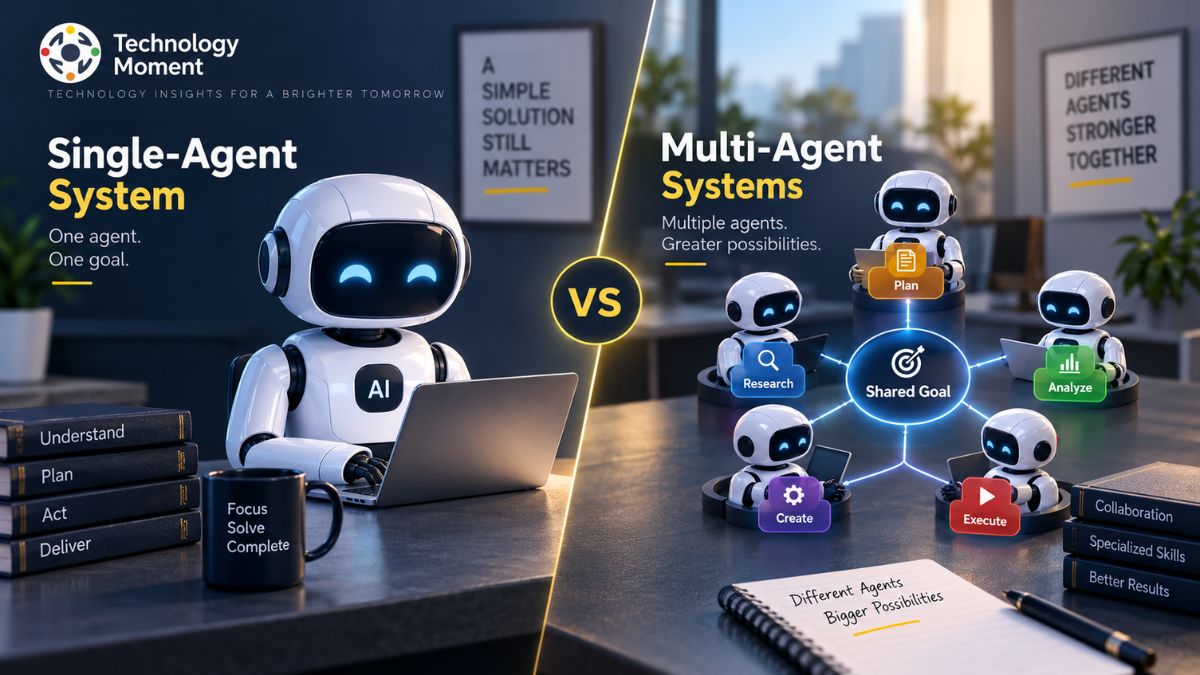
A single-agent system uses one agent to understand a goal, reason through the required steps, use available tools, and produce an outcome. A multi-agent system, in contrast, divides responsibilities among multiple specialized agents that can communicate, coordinate, and work together toward a shared objective. The right approach depends on factors such as task complexity, specialization, coordination requirements, performance, and system architecture.
At Technology Moment, we focus on making complex technology easier to understand through clear, practical explanations rather than unnecessary jargon. This guide breaks down the differences between single-agent and multi-agent systems, including how their architectures and workflows operate, where each approach can be useful, and what trade-offs developers and businesses should consider. By the end, you’ll have a clearer understanding of single-agent vs multi-agent systems and a practical framework for deciding which architecture makes sense for a particular AI workflow.
What Is a Single-Agent System?
A single-agent system is an AI system in which one autonomous agent is responsible for understanding a goal, planning the required steps, using available tools, and producing the final result. Instead of distributing responsibilities across several agents, the system relies on a single reasoning process to manage the workflow from beginning to end.
In a typical single-agent architecture, the agent receives an instruction, interprets the user’s objective, determines what actions are necessary, and may interact with external tools such as APIs, databases, search systems, or software applications. The agent can also use memory and previous context when those capabilities are available. This makes a single agent system suitable for workflows where one capable agent can manage the required tasks without extensive coordination.
For example, an AI research assistant could receive a question, search relevant sources, analyze the information, and generate a structured response. Similarly, a coding agent might inspect a codebase, identify an issue, modify files, and explain the changes. One major characteristic of single-agent AI is simplicity. There is generally less communication and coordination overhead because only one agent is responsible for the workflow. This can make development, testing, monitoring, and debugging easier.
What Is a Multi-Agent System?
A multi-agent system consists of multiple AI agents that work together to accomplish a shared objective. Rather than asking one agent to manage every stage of a complex workflow, the system can divide the work between specialized agents with different responsibilities. In a typical multi-agent architecture, each agent may have a particular role. For example, one agent could perform research, another could analyze information, another could generate an output, and a final agent could review the result. An orchestration layer can coordinate these activities and determine how information moves between agents.
This approach is particularly relevant to multi-agent AI systems, where different agents can communicate, exchange results, and contribute specialized capabilities. The workflow may be sequential, parallel, or a combination of both, depending on the task. Consider a software development workflow. A planning agent could break a requirement into smaller tasks, a coding agent could implement the solution, a testing agent could evaluate the code, and a review agent could inspect the final changes. This illustrates agent specialization, where each AI agent focuses on a defined responsibility instead of attempting to handle the entire workflow.
Multi-agent systems can also support task decomposition, allowing a complicated objective to be separated into manageable components. However, additional agents introduce additional architectural requirements. Communication, coordination, state management, error handling, and monitoring all become more important. Therefore, a multi-agent system is not automatically preferable to a single agent. Its usefulness depends on whether the workflow actually benefits from multiple specialized agents working together.
Single-Agent vs Multi-Agent Systems: Key Differences
The main difference between single-agent vs multi-agent systems is how responsibility is organized. A single-agent system places the workflow under one AI agent, while a multi-agent system distributes responsibilities across multiple agents that may communicate and coordinate with one another. A single agent can be effective when the objective is relatively focused and does not require several specialized roles. Multi-agent systems become relevant when a workflow can be divided into distinct tasks that benefit from specialization or parallel execution.
| Feature | Single-Agent System | Multi-Agent System |
|---|---|---|
| Agents | One primary agent | Multiple cooperating agents |
| Task handling | One agent manages the workflow | Responsibilities can be distributed |
| Architecture | Usually simpler | Usually more complex |
| Specialization | Limited to one agent’s capabilities | Different agents can have specialized roles |
| Communication | Minimal agent-to-agent communication | Agent communication can be central |
| Coordination | Relatively straightforward | Requires coordination or orchestration |
| Debugging | Generally simpler | Can be more difficult |
| Workflow complexity | Suitable for focused workflows | Useful for complex workflows |
| Infrastructure | Often easier to manage | May require additional infrastructure |
| Maintenance | Fewer moving parts | More components to monitor |
Single-Agent vs Multi-Agent Architecture
Single-agent vs multi-agent architecture describes two different ways of organizing AI agents, tools, memory, and workflow control. The single-agent model concentrates responsibility in one agent, while the multi-agent model distributes responsibilities across several agents. In a single-agent architecture, the main agent typically receives the objective, reasons about the task, selects appropriate tools, performs actions, and produces the output. The architecture can therefore remain relatively compact. This can be useful when simplicity, predictable control, and easier maintenance are important.
A multi-agent architecture introduces several cooperating components. Agents may have specialized roles, individual tools, separate memories, or different instructions. An orchestrator or coordination mechanism can determine which agent should handle a particular task and how results should be passed between them.
| Architecture Aspect | Single-Agent Architecture | Multi-Agent Architecture |
|---|---|---|
| Core structure | One primary agent | Multiple specialized agents |
| Decision-making | Centralized within one agent | Distributed across agents or coordinated by an orchestrator |
| Task allocation | One agent manages tasks | Tasks can be assigned to specialized agents |
| Communication | Mostly internal to the workflow | Agent-to-agent communication may be required |
| Coordination | Low | Moderate to high |
| Specialization | One agent handles multiple capabilities | Agents can focus on specific capabilities |
| Complexity | Lower | Higher |
| Monitoring | Fewer components | Multiple agents and interactions |
| Scalability | Simpler for focused workflows | Can support more complex workflows when well designed |
Single-Agent vs Multi-Agent Workflow
A single-agent vs multi-agent workflow differs mainly in how tasks are planned, executed, and coordinated. In a single-agent workflow, one AI agent typically manages the complete sequence. In a multi-agent workflow, the overall objective can be divided into smaller tasks handled by different agents.
A simple single-agent workflow can look like this:
User Request → Agent Planning → Tool Use → Reasoning → Final Result
The agent receives the objective, determines what needs to be done, uses available tools, evaluates the information, and generates the result. This model can work well when the workflow is straightforward or when the same agent needs to maintain context throughout the process.
A multi-agent workflow may look like this:
User Request → Task Decomposition → Agent Assignment → Specialized Agents → Coordination → Final Result
For example, a technology research task could involve a research agent gathering information, an analysis agent examining the findings, a verification agent checking important details, and a writing agent preparing the final output. This demonstrates AI agents working together through specialization and coordination.
The major advantage of this structure is that complex workflows can be divided into smaller responsibilities. Agents can potentially work sequentially or in parallel, depending on the architecture. However, agent orchestration becomes important because the system must determine which agent performs each task and how their outputs are combined. Communication is another important consideration. Multi-agent collaboration requires reliable ways for agents to exchange information and handle failures or conflicting results.
Benefits of Single-Agent Systems
One of the main benefits of single-agent systems is architectural simplicity. A single AI agent can manage planning, reasoning, tool use, and execution within one workflow. Because fewer components are involved, developers can often build, test, monitor, and maintain the system with less operational complexity. A single agent system can also maintain a consistent context throughout a task. Instead of passing information between several specialized agents, one agent can keep track of the objective and determine the next action. This can be useful for focused workflows such as research assistance, customer support, coding help, information retrieval, and routine AI automation.
Another advantage is lower coordination overhead. A single agent does not need extensive agent communication or multi-agent orchestration. This can reduce the number of interactions required to complete a workflow and make system behavior easier to trace when something goes wrong. Single-agent systems can also be easier to scale operationally for straightforward use cases. A development team can concentrate on improving one agent’s instructions, tools, memory, and reasoning capabilities rather than managing a network of specialized agents.
However, simplicity does not mean that a single-agent architecture is suitable for every problem. As a workflow becomes more complex, the agent may need to manage many responsibilities simultaneously. This can make its planning process and tool selection more complicated. For this reason, single-agent AI is generally most useful when one capable agent can handle the required tasks without needing extensive specialization or collaboration. The goal should be to use the simplest architecture that can reliably accomplish the intended workflow.
Benefits of Multi-Agent Systems
The primary advantage of multi-agent systems is the ability to divide complex work among multiple specialized AI agents. Instead of requiring one agent to perform every responsibility, developers can create agents with distinct roles, tools, instructions, or areas of expertise. This enables task decomposition, where a larger objective is separated into smaller tasks. For example, a research workflow might use one agent to collect information, another to analyze it, and another to verify important findings. Each agent can concentrate on its assigned responsibility while the overall system coordinates the results.
Agent specialization can also make workflows more modular. Developers can modify or improve one specialized agent without necessarily redesigning the entire system. This structure can be useful for software development, research, data analysis, business automation, and other complex workflows. Another potential benefit is parallel execution. When tasks are independent, multiple agents may be able to work simultaneously rather than completing every step sequentially. This can create opportunities for more sophisticated agent workflows.
Multi-agent systems also support multi-agent collaboration. Agents can exchange information, request additional work, review another agent’s output, or contribute different perspectives to the same objective. An orchestration layer can coordinate these interactions and determine how individual results contribute to the final outcome. However, these benefits come with additional system complexity. More agents mean more communication paths, states, tools, and potential failure points. Effective AI orchestration therefore becomes an important part of the architecture.
Challenges of Single-Agent Systems
Although a single-agent architecture is relatively straightforward, it can face limitations as task complexity increases. One common challenge is that the same agent may need to handle planning, reasoning, tool selection, execution, memory management, and validation simultaneously. As more responsibilities are added, the agent workflow can become increasingly difficult to control. A task that initially requires a few steps may eventually involve many tools, conditional decisions, external systems, and intermediate results. Managing all these elements through one AI agent system can make the workflow harder to design and test.
Another challenge involves specialization. A general-purpose agent may be capable of performing many different tasks, but it may not be optimized for each individual responsibility. For example, research, code generation, testing, and verification may require different instructions and tool configurations. Long workflows can also create context-management challenges. The agent must keep track of previous actions and intermediate results while deciding what to do next. If the workflow becomes too large, maintaining reliable state and reasoning can become increasingly difficult.
There can also be a practical limit to how much functionality should be placed inside one agent. Continuously adding tools and instructions may make the system more complicated rather than simpler. This does not mean single-agent systems are inherently limited. For focused applications, their simpler architecture can be an advantage. The challenge is recognizing when the workload has grown beyond what one agent can manage efficiently.
Challenges of Multi-Agent Systems
The flexibility of multi-agent systems comes with a significant increase in architectural complexity. Once several AI agents participate in the same workflow, developers must consider how those agents communicate, coordinate tasks, exchange information, and handle failures. One major challenge is agent coordination. The system needs a reliable mechanism for deciding which agent should perform each task and when another agent should receive the result. Poor coordination can lead to duplicated work, missing steps, conflicting outputs, or unnecessary interactions.
Agent communication introduces another layer of complexity. Agents need appropriate information at the right time, but passing too much information can increase overhead, while passing too little can reduce the quality of downstream decisions. Debugging can also become more difficult. With a single agent, developers can usually inspect one main reasoning and execution path. With multiple agents, a problem may originate from an individual agent, the communication layer, task assignment, shared state, or the orchestration logic.
Multi-agent systems can also require more infrastructure and monitoring. Each agent may have different tools, permissions, prompts, memory, or responsibilities. Developers therefore need stronger observability to understand what happened during a workflow. Another consideration is whether additional agents actually provide enough value to justify the complexity. Simply adding agents does not guarantee better results. In some cases, coordination overhead can outweigh the benefits of specialization.
Single-Agent vs Multi-Agent Performance
Comparing single-agent vs multi-agent performance requires more than measuring how quickly an agent produces an answer. Performance can depend on task complexity, architecture, coordination overhead, tool usage, resource consumption, reliability, and the number of steps involved. A single-agent system can have an advantage in straightforward workflows because it avoids agent-to-agent communication and additional orchestration. The execution path may be easier to manage, which can simplify monitoring and reduce coordination overhead.
A multi-agent system may provide advantages for complex workflows when tasks can be divided among specialized agents. Multiple agents can potentially work on different components or perform independent operations in parallel. However, communication and coordination introduce additional processing and architectural overhead.
| Performance Factor | Single-Agent System | Multi-Agent System |
|---|---|---|
| Simple task execution | Often straightforward | May introduce unnecessary coordination |
| Complex task handling | Can become difficult as responsibilities grow | Can divide work across specialized agents |
| Coordination overhead | Low | Higher |
| Parallel execution | Limited by the single workflow | Possible when tasks are independent |
| Specialization | Usually handled by one agent | Different agents can specialize |
| Debugging | Generally simpler | More complex |
| Resource requirements | Often lower | Can increase with additional agents |
| Scalability of workflow complexity | Can become harder to manage | Can support decomposed workflows |
| Communication | Minimal | Agent-to-agent communication may be required |
| Performance consistency | Easier to trace | Depends partly on coordination quality |
When Should You Use a Single-Agent System?
A single-agent system is generally a practical choice when one AI agent can handle the complete workflow without requiring extensive specialization or agent-to-agent coordination. The key consideration is not how advanced the system sounds, but whether the task actually benefits from multiple agents. A single agent can work well for focused tasks such as answering questions, summarizing information, retrieving data, assisting with coding, drafting content, or performing straightforward AI automation. These workflows usually have a clear objective and can be completed by one agent using a defined set of tools.
Another reason to choose a single-agent architecture is simplicity. Fewer components mean fewer communication paths, fewer coordination problems, and generally easier testing and monitoring. This can be particularly useful when a team is building an initial AI agent system and wants to validate the workflow before introducing additional complexity. Consider a customer-support assistant. If one agent can understand customer questions, retrieve account information, access a knowledge base, and provide an appropriate response, dividing those responsibilities among several agents may not provide enough additional value to justify the added orchestration.
A single-agent approach can also be appropriate when consistent context is important. One agent can maintain the conversation and workflow state without passing information between multiple specialized agents. In practical terms, consider a single-agent system when the task is relatively focused, the workflow is predictable, specialization is limited, and simplicity is an important requirement. Starting with one capable agent can also provide a useful baseline before determining whether a multi-agent system is genuinely necessary.
When Should You Use a Multi-Agent System?
A multi-agent system becomes more relevant when a workflow contains multiple distinct responsibilities that can benefit from specialization, collaboration, or task decomposition. Instead of asking one AI agent to manage every part of the process, developers can assign different responsibilities to specialized agents. For example, a complex research workflow could use one agent for information retrieval, another for analysis, another for fact verification, and another for producing the final report. This structure allows specialized AI agents to concentrate on different parts of the same objective.
Task decomposition is one of the strongest reasons to consider a multi-agent architecture. A large objective can be divided into smaller tasks, which may then be processed sequentially or in parallel. When tasks are independent, multiple agents may work simultaneously before their results are combined. Multi-agent systems can also be useful when agent collaboration is an essential part of the workflow. For example, a software development system might include planning, coding, testing, and review agents. Each agent contributes to a different stage while an orchestration mechanism coordinates the overall process.
However, using multiple agents introduces additional requirements. Agent communication, state management, coordination, monitoring, and error handling become important architectural concerns. More agents can also increase resource usage and workflow complexity. Therefore, developers should not choose a multi-agent system simply because it appears more sophisticated. It makes more sense when specialization, parallel execution, collaboration, or complex task decomposition provides a measurable benefit.
Single-Agent vs Multi-Agent: Real-World Examples
The difference between single-agent vs multi-agent systems becomes easier to understand through practical examples. The appropriate architecture depends heavily on the structure and complexity of the workflow.
Research: A single research agent could search sources, summarize information, and produce a report. For a more complex research workflow, separate agents could handle source discovery, analysis, verification, and report generation. This creates a multi-agent workflow in which specialized agents contribute to one outcome.
Software development: A single coding agent may be able to inspect code, write changes, and explain them. A larger development workflow could instead use a planning agent, coding agent, testing agent, and review agent. This allows each agent to focus on a specific responsibility.
Customer support: A single support agent can answer common questions, search documentation, and guide users through basic problems. A multi-agent system could use specialized agents for billing, technical support, account issues, and escalation, with an orchestrator directing each request.
Business analysis: A single agent may collect and summarize business information. A multi-agent system could divide the workflow among research, data analysis, market analysis, and reporting agents.
Content workflows: One agent can research and draft an article. A multi-agent workflow might separate research, fact-checking, SEO analysis, editing, and quality review.
These examples show that AI agents working together can be useful when a workflow naturally contains distinct roles. However, every example does not automatically require multiple agents. A simpler workflow may be easier to operate with one capable agent. The important distinction is architectural fit. Multi-agent AI examples are most meaningful when specialization or collaboration solves a real workflow problem rather than simply increasing the number of components.
How to Choose Between Single-Agent and Multi-Agent Systems
Choosing between a single-agent and multi-agent architecture starts with understanding the workflow rather than selecting the technology first. The central question is: Can one agent reliably complete the required task, or does the workflow naturally benefit from multiple specialized agents? A single-agent system is often appropriate when the objective is focused, the workflow has relatively few steps, and one agent can access the necessary tools. It can also be a sensible choice when simplicity, lower coordination overhead, and easier maintenance are priorities.
A multi-agent system becomes more relevant when the workflow contains several distinct responsibilities. If those responsibilities require different capabilities or can be performed independently, task decomposition can make a multi-agent approach useful.
Consider these practical factors:
| Decision Factor | Single-Agent Approach | Multi-Agent Approach |
|---|---|---|
| Task complexity | Focused or moderate | Complex or multi-stage |
| Specialization | Limited need | Strong need for specialized roles |
| Workflow | Relatively linear | Multiple branches or stages |
| Coordination | Minimal | Important |
| Parallel execution | Usually unnecessary | Potentially useful |
| Maintenance | Simpler | More involved |
| Communication | Low requirement | Agent communication required |
| Infrastructure | Generally simpler | More orchestration needed |
| Debugging | Easier to trace | More complex |
| Best starting point | Many focused applications | Workflows with clear multi-role requirements |
Start with the simplest architecture that satisfies the requirements. Then measure actual performance, reliability, resource consumption, and workflow complexity. If the single agent becomes overloaded with responsibilities, agent specialization and AI orchestration may provide a logical next step. The goal is not to build the most complicated system. The goal is to build an AI workflow in which architecture, tools, agents, and coordination match the problem being solved.
Frequently Asked Questions
How do single-agent systems work?
A single agent receives an objective, reasons about the required steps, selects tools when necessary, performs actions, evaluates information, and generates a result. The agent typically manages the workflow itself rather than delegating tasks to other AI agents.
How do multi-agent systems work?
Multi-agent systems typically break a larger objective into smaller tasks and assign those tasks to specialized agents. Agents may communicate sequentially or work in parallel, while an orchestration layer coordinates their activities and combines their outputs.
When should you use a single-agent system?
Use a single-agent system when one capable agent can reliably complete the workflow. Focused tasks, straightforward automation, limited specialization, and simpler operational requirements are common situations where this architecture can be appropriate.
When should you use a multi-agent system?
Consider a multi-agent system when a workflow contains distinct tasks that benefit from specialization, collaboration, or parallel execution. Complex research, software development, and multi-stage business workflows are examples where multiple agents may be useful.
Are multi-agent systems better than single-agent systems?
Neither architecture is universally better. A single-agent system may be more suitable for a focused workflow, while a multi-agent system may fit a complex workflow requiring specialized agents. The appropriate choice depends on task requirements, coordination needs, performance, and operational complexity.
How do AI agents communicate with each other?
AI agents can communicate by passing structured messages, task results, context, or other information through an orchestration layer or shared system. The exact communication design depends on the architecture, workflow requirements, and tools used by the agents.