Artificial intelligence is becoming part of how we search for information, create content, write software, and solve everyday problems. Behind many of these AI experiences is a technology called a large language model (LLM). But what exactly is a large language model, and how does it produce answers that sound remarkably human?
In simple terms, a large language model is an AI system trained on vast amounts of text to recognize patterns in language and generate responses based on those patterns. Technologies such as GPT, Claude, Gemini, and Llama have made LLMs increasingly visible, but understanding what happens behind the interface can help you use these tools more effectively—and understand their limitations.
At Technology Moment, our goal is to make complex technology easier to understand through clear, practical, and trustworthy explanations. Whether you are exploring AI for the first time or already using AI tools in your work, understanding the fundamentals can help you make better decisions about the technology around you.
In this guide, we will explain what a large language model is, how LLMs work, how they are trained, what they can do, and where they can fall short. We will also look at transformer architecture, tokens, parameters, AI hallucinations, real-world applications, and the differences between LLMs, AI, generative AI, and chatbots.
What Is a Large Language Model?
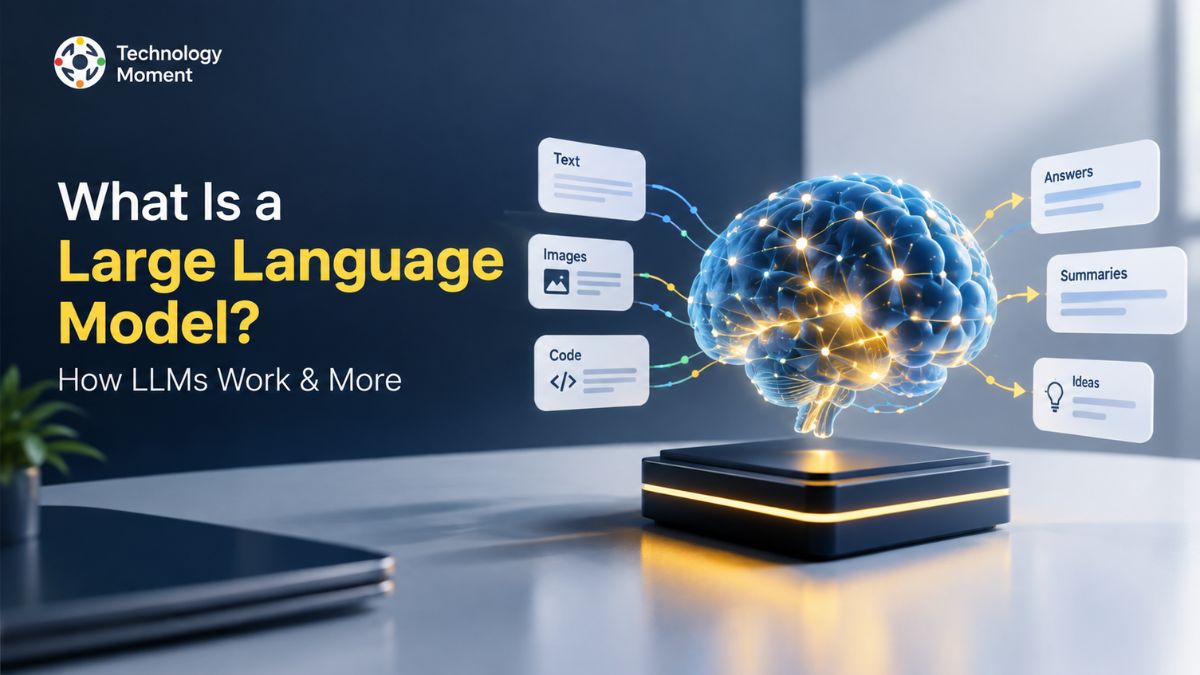
A large language model (LLM) is an artificial intelligence system designed to process and generate human language. In simple terms, an LLM learns patterns from extremely large collections of text and uses those patterns to predict and generate useful responses. The term LLM stands for large language model, while “large” generally refers to the scale of the model, its training data, and the number of parameters used to represent learned patterns.
A language model in AI is built to work with language-related tasks, such as predicting text, answering questions, summarizing information, translating languages, and generating content. Modern LLMs can also support coding, research, analysis, and conversational AI applications. Unlike a traditional software program that follows a fixed set of instructions, an LLM uses a neural network trained through machine learning. During training, it processes huge amounts of text and learns statistical relationships between tokens, words, phrases, and broader contextual patterns.
These models power many AI applications, although the model itself is only one component of a complete AI product. Understanding what a large language model is provides the foundation for understanding how modern generative AI systems work and why they have become so useful across technology, business, education, and everyday workflows.
How Do Large Language Models Work?
To understand how large language models work, it helps to think of an LLM as a system that learns language patterns rather than memorizing a simple collection of answers. The process begins with large amounts of training data, which can include books, articles, websites, code, and other forms of text.
Before the information can be processed, the text is divided into smaller units called tokens. A token may represent a complete word, part of a word, punctuation, or another piece of text. The model converts these tokens into numerical representations that its neural network can process.
During training, the model repeatedly analyzes sequences of tokens and learns to predict what token is likely to come next. This next token prediction process allows the model to develop an understanding of relationships between words and the surrounding context. When you send a prompt to an LLM, the model enters the inference stage. It analyzes the input, considers the available context, and generates an answer one token at a time. This process is known as natural language generation.
The result can look like reasoning or conversation to a human user, but technically the model is generating a sequence based on patterns learned during training and the information available in its context.
What Is the Architecture of an LLM?
The architecture of an LLM describes the underlying neural-network structure that allows the model to process language and generate text. Most modern large language models are based on the Transformer architecture, a breakthrough approach that made it practical to process relationships between different parts of a sequence more effectively.
One of the most important components of a transformer model is the attention mechanism. More specifically, self-attention allows the model to evaluate how different tokens in an input relate to one another. This helps an LLM use surrounding context when interpreting a sentence rather than treating every word independently.
LLMs also contain enormous numbers of parameters. These parameters are numerical values adjusted during training as the model learns language patterns. A larger number of parameters can provide greater representational capacity, although model quality does not depend on parameter count alone.
Another important concept is embeddings. Tokens are converted into numerical vectors that allow the neural network to represent relationships between pieces of information mathematically. These vector embeddings help the model work with meaning and context in a numerical form.
The context window determines how much information a model can consider within a particular interaction. Larger context windows can allow models to process longer documents, conversations, or codebases, although practical performance depends on the model and task. Together, transformers, attention, parameters, embeddings, and context form the foundation of modern LLM architecture.
How Are Large Language Models Trained?
The LLM training process typically begins with pretraining. During this stage, a model is exposed to very large datasets containing text and other relevant information. The model learns by repeatedly attempting tasks such as predicting missing or upcoming tokens and adjusting its internal parameters when its predictions differ from the training objective.
This process requires substantial computing resources because modern models can contain billions or even more parameters. Training allows the model to develop broad capabilities for recognizing linguistic structures, relationships, patterns, and information contained within its training data. After pretraining, developers may use fine-tuning to adapt a pretrained model for particular behaviors, tasks, or domains. Fine-tuning can help make a model more useful for specific applications or improve how it follows instructions.
Some systems also use human feedback and other evaluation techniques to improve response quality, safety, helpfulness, and alignment with user expectations. The exact methods vary between AI companies and models. It is also important to distinguish training from inference. Training is the computationally intensive process through which a model learns its parameters. Inference occurs when the trained model receives a prompt and generates an output.
Because an LLM learns from its training process rather than receiving guaranteed factual knowledge, training does not automatically make every generated answer correct. This distinction is important when evaluating the reliability and limitations of AI systems.
What Can Large Language Models Do?
The capabilities of LLMs extend far beyond simple text generation. Depending on the model and the application surrounding it, large language models can perform a wide range of language and knowledge-related tasks. One common use is question answering, where an LLM responds to natural-language questions and explains concepts in conversational language. LLMs can also summarize long documents, rewrite text, translate between languages, generate ideas, and help users communicate more efficiently.
Another major application is coding. Modern AI systems can explain programming concepts, generate code, identify potential errors, and help developers understand unfamiliar code. This makes LLMs useful as productivity tools for software development, although generated code should still be reviewed and tested. Businesses use LLMs for customer support, document processing, internal knowledge systems, research assistance, content workflows, and AI automation. Individuals may use them for learning, brainstorming, writing, planning, and everyday productivity.
LLMs can also serve as the foundation for AI assistants and other conversational AI products. When connected to external tools, databases, search systems, or business software, their capabilities can become considerably broader. However, what an LLM can do should not be confused with what it can do reliably. Models can produce inaccurate information, misunderstand context, or generate convincing but incorrect answers. For that reason, human judgment, verification, and appropriate safeguards remain important when using LLMs for research, business, coding, or other consequential tasks.
What Are Some Examples of Large Language Models?
There are several well-known examples of large language models developed by leading AI companies. While these models share the ability to understand and generate language, they differ in design, capabilities, access options, and the products built around them.
| Large Language Model | Organization | General Use |
|---|---|---|
| GPT | OpenAI | General-purpose AI and language tasks |
| Gemini | AI assistance and multimodal tasks | |
| Claude | Anthropic | Conversational and knowledge-focused tasks |
| Llama | Meta | Open model ecosystem and AI development |
What Is the Difference Between an LLM and AI?
The terms AI and LLM are often used interchangeably, but they do not mean the same thing. Artificial intelligence (AI) is the broader field focused on creating systems that can perform tasks that typically require human intelligence, such as recognizing patterns, making predictions, understanding language, or solving problems. A large language model (LLM) is one specific type of AI model designed primarily to process and generate language.
A simple way to understand the relationship is to think of AI as the larger category. Machine learning is a major approach within AI, while deep learning uses multi-layer neural networks to learn complex patterns. LLMs are generally built using deep learning and are commonly based on transformer architectures.
This means an AI system does not necessarily have to be an LLM. For example, an AI model can analyze medical images, detect fraudulent transactions, recommend products, recognize speech, or predict demand without functioning as a language model.
The difference between AI and an LLM therefore comes down mainly to scope and specialization. AI describes a broad technological field, while an LLM is a specialized AI model focused on language-related capabilities. Understanding this distinction makes it easier to evaluate modern technologies without assuming that every AI product is powered by an LLM.
LLM vs. Machine Learning vs. Generative AI
| Technology | What It Does | Common Examples |
|---|---|---|
| Artificial Intelligence (AI) | Broad field of technology that enables machines to perform tasks associated with human intelligence | AI assistants, expert systems, computer vision |
| Machine Learning (ML) | Enables systems to learn patterns from data and make predictions or decisions without being explicitly programmed for every task | Recommendation systems, fraud detection, spam filtering |
| Deep Learning | Uses multi-layer neural networks to learn complex patterns from large amounts of data | Image recognition, speech recognition, autonomous driving |
| Generative AI | Creates new content such as text, images, audio, video, or code based on learned patterns | ChatGPT, image generators, AI coding tools |
| Large Language Model (LLM) | AI model specialized in understanding and generating human language | GPT, Claude, Gemini, Llama |
LLM vs. Chatbot: What’s the Difference?
The difference between an LLM and a chatbot can be confusing because many popular AI assistants use large language models behind the scenes. However, an LLM and a chatbot are not the same thing. An LLM is the underlying AI model that processes language and generates text. A chatbot is an application or interface designed to communicate with users through conversation. In other words, an LLM can power a chatbot, but a chatbot does not necessarily have to use an LLM.
Traditional chatbots often rely on predefined rules, decision trees, or scripted responses. They may recognize specific keywords and provide predetermined answers. Modern AI chatbots, on the other hand, can use an LLM to interpret natural-language questions and produce more flexible responses.
For example, a conversational AI product may combine an LLM with a user interface, conversation history, safety controls, search, databases, and external tools. The LLM provides language-generation capabilities, while the surrounding software turns those capabilities into a complete product.
ChatGPT is a useful example of this distinction. Users interact with ChatGPT as an AI assistant, while underlying GPT models provide important language-processing and generation capabilities. Therefore, LLM vs. chatbot is not really a competition between two equivalent technologies. An LLM is a model; a chatbot is an application experience that may use that model.
What Are the Benefits of Large Language Models?
The growing adoption of large language models is largely driven by their ability to work with natural language in a flexible and accessible way. Instead of learning complicated software interfaces, users can often describe what they need using ordinary language. One major benefit is AI productivity. LLMs can help summarize documents, organize information, generate drafts, explain unfamiliar subjects, brainstorm ideas, and assist with repetitive knowledge-work tasks. These capabilities can save time when used appropriately.
Another important advantage is their versatility. A single language model can support multiple applications, including question answering, translation, content generation, research assistance, customer support, and software development. Developers can also integrate LLMs into products and workflows rather than building every language capability from scratch.
LLMs can make information easier to access by explaining technical concepts in different levels of detail. A student, developer, business professional, and researcher can potentially ask about the same subject using different language and receive responses adapted to their requests. They also support AI automation by helping applications process and generate large volumes of text. Businesses can use this capability for document classification, support workflows, knowledge management, and other language-heavy processes.
However, these benefits depend heavily on implementation. An LLM is most valuable when it is combined with reliable data, appropriate tools, human oversight, and a clear understanding of what the model can and cannot do.
What Are the Limitations of Large Language Models?
Despite their impressive capabilities, large language models have important limitations that users should understand before relying on them for important decisions. One of the most widely discussed problems is AI hallucination, where a model produces information that sounds convincing but is inaccurate, incomplete, or entirely fabricated.
An LLM generates responses from patterns learned during training and information available through its context or connected tools. It does not automatically guarantee that every statement it produces is factually correct. This means users should verify important claims, particularly when dealing with medical, legal, financial, security, or other high-impact information.
Another limitation involves bias. Because models learn from large datasets, unwanted biases or problematic patterns in those datasets can influence their outputs. Developers use different techniques to reduce these risks, but eliminating them completely remains challenging. LLMs can also have context limitations. Even models with large context windows may struggle with extremely long, complex, or poorly structured information. Their performance can vary depending on the task, prompt quality, available context, and model design.
Privacy is another consideration. Users and organizations need to understand how an AI system handles prompts, uploaded information, and other data before using it with sensitive material. Finally, LLMs require significant computational resources for development and operation. Their speed, cost, reliability, and availability can therefore vary.
The best approach is not to treat an LLM as an infallible source of truth, but as a powerful tool whose outputs require appropriate evaluation and human judgment.
Can Large Language Models Think and Understand Language?
One of the most interesting questions about large language models is whether they can actually think and understand language as humans do. The answer depends on what we mean by “think” and “understand.” LLMs can process language, identify relationships between concepts, follow instructions, and generate remarkably coherent answers. However, this does not necessarily mean they think or understand in the same way a human does.
An LLM learns patterns from training data and uses those patterns to generate an appropriate sequence of tokens. When you provide a prompt, the model analyzes the available context and predicts what text should come next. This can produce responses that appear to involve reasoning, explanation, or understanding.
So, can LLMs think? They can perform tasks that resemble certain forms of reasoning, such as comparing information, solving structured problems, or explaining relationships. However, these capabilities should not automatically be interpreted as human-like consciousness, intentions, or subjective experience.
Can LLMs understand language? They demonstrate sophisticated language processing, but their “understanding” is fundamentally different from human experience. They do not experience the world, emotions, or physical reality in the way people do. This distinction is important because an LLM can generate a confident answer while still being wrong. Understanding how models generate answers helps users appreciate both their impressive capabilities and their limitations.
What Is the Future of Large Language Models?
The future of LLMs is likely to involve more capable, efficient, specialized, and deeply integrated AI systems. Instead of being limited to generating text inside chat interfaces, language models are increasingly becoming components of broader software experiences. One important direction is multimodal AI, where models can work with combinations of text, images, audio, video, and other information. This can make AI assistants more useful for research, communication, education, software development, and creative workflows.
Rather than simply answering a question, an AI agent can potentially plan tasks, use external tools, retrieve information, interact with software, and complete multi-step workflows. This could significantly expand the practical role of language models. Smaller and more efficient models are also likely to become increasingly important. Improvements in model architecture, hardware, and optimization can make powerful AI capabilities less expensive and more accessible.
At the same time, AI safety and responsible AI will remain critical. Future systems will need stronger approaches to accuracy, privacy, transparency, security, bias, and human oversight. For businesses and individuals, the most valuable progress may not simply be larger models. Better reliability, specialized capabilities, useful integrations, and trustworthy AI experiences could ultimately matter more than model size alone.
Conclusion: Understanding Large Language Models
A large language model (LLM) is a powerful type of AI designed to process and generate human language. By learning patterns from extensive training data, LLMs can perform tasks such as answering questions, summarizing information, translating text, generating content, assisting with coding, and supporting research and productivity.
As we have seen, the technology behind an LLM involves several important concepts, including tokens, neural networks, transformer architecture, self-attention, parameters, embeddings, training, fine-tuning, and inference. These components work together to enable modern language models to process context and generate responses.
However, understanding what LLMs cannot reliably do is just as important as understanding their capabilities. AI hallucinations, bias, outdated information, context limitations, privacy concerns, and inconsistent accuracy mean that users should not treat generated answers as automatically correct.
At Technology Moment, we believe understanding technology should go beyond simply knowing what a new tool can do. Knowing how it works, where it performs well, and where caution is necessary helps people make better technology decisions. LLMs are already changing how people interact with information and software, and their role will likely expand as AI assistants, multimodal systems, and AI agents continue to develop. The key is to use these technologies thoughtfully—with curiosity, verification, and a clear understanding of their limitations.
Frequently Asked Questions
What Is an LLM in Simple Terms?
A large language model (LLM) is an AI system trained on huge amounts of text to learn language patterns. It can understand prompts and generate human-like responses. LLMs are commonly used for answering questions, writing, summarizing, translating, coding, research, and other language-based tasks.
What Does LLM Stand For in AI?
LLM stands for Large Language Model. It refers to an AI model designed to process and generate human language. Modern LLMs use advanced neural networks, often based on transformer architecture, to analyze text patterns and produce responses for applications such as AI assistants, chatbots, research, and content generation.
How Does a Large Language Model Generate Answers?
An LLM generates answers by processing your input as tokens and analyzing the context around them. During inference, it predicts likely next tokens based on patterns learned during training. These predictions are generated sequentially, creating a complete response that can appear conversational and contextually relevant.
How Are Large Language Models Trained?
Large language models are typically trained using massive datasets containing text and other information. During pretraining, the model learns patterns by predicting tokens. Developers may then use fine-tuning and additional alignment techniques to improve instruction following, helpfulness, safety, and performance for specific applications.
What Are the Main Uses of LLMs?
LLMs have many applications, including question answering, content generation, summarization, translation, coding, research, education, customer support, and productivity. Businesses can also integrate LLMs into workflows for document processing, knowledge management, and AI automation, making language-based tasks faster and easier to handle.
Is ChatGPT an LLM or an AI Chatbot?
ChatGPT is an AI application and conversational assistant that uses GPT-family language models. An LLM is the underlying model technology, while a chatbot is the user-facing application. Therefore, ChatGPT can be described as an AI chatbot or assistant powered by large language model technology.
Is GPT Considered a Large Language Model?
Yes, GPT refers to a family of generative pretrained transformer language models. GPT models are designed to process and generate language, making them examples of large language models. Different GPT generations may vary significantly in architecture, capabilities, training methods, context capacity, and supported features.
Why Do Large Language Models Sometimes Hallucinate?
LLMs can hallucinate because they generate text based on learned patterns rather than guaranteeing factual accuracy. When information is missing, ambiguous, or outside reliable context, a model may produce an incorrect response that sounds convincing. Important information should therefore be independently verified before being trusted or acted upon.
Can LLMs Actually Understand Human Language?
LLMs can process complex language patterns, context, relationships, and meanings well enough to perform sophisticated language tasks. However, their processing is fundamentally different from human understanding. LLMs do not necessarily possess human consciousness, experiences, intentions, or emotions when they generate language.
What Is the Difference Between AI and an LLM?
Artificial intelligence (AI) is a broad field involving systems that perform tasks associated with intelligence. An LLM is a specific type of AI model focused primarily on language. AI also includes technologies for computer vision, robotics, recommendations, prediction, speech recognition, and many other applications.