Artificial intelligence is changing far more than the software people interact with every day. Behind every generative AI model, intelligent application, and AI-powered service is a growing physical infrastructure built from advanced semiconductors, high-performance computing systems, and massive data centers. As AI adoption expands, the semiconductor industry is being pushed to rethink how chips are designed, manufactured, packaged, and supplied around the world.
The shift is already visible across the AI Semiconductor Supply Chain. Demand for GPUs and AI accelerators is rising alongside the need for high-bandwidth memory (HBM), advanced packaging, and leading-edge manufacturing capacity. HBM has become particularly important because modern AI systems need to move enormous volumes of data between processors and memory, while advanced packaging helps bring these components together efficiently.
At the same time, the growth of AI data centers is creating new pressure on semiconductor manufacturers and their suppliers. Memory capacity, wafer production, packaging infrastructure, and specialized equipment are increasingly interconnected, meaning a constraint in one part of the chain can affect the wider AI hardware ecosystem.
In this Technology Moment analysis, we examine how AI is reshaping chips, data centers, and the global semiconductor supply chain—from the technologies powering AI workloads to the manufacturing and supply challenges emerging across the industry. Understanding this transformation provides a clearer view of the infrastructure supporting the next phase of AI.
How AI Is Driving Demand for Semiconductors
Artificial intelligence is changing the semiconductor industry by creating demand for a new generation of high-performance computing hardware. AI models require enormous amounts of computing power for training and inference, which is increasing demand for GPUs, AI accelerators, memory chips, networking components, and other data center semiconductors. Unlike many traditional computing workloads, AI workloads move and process huge volumes of data simultaneously, making performance, memory bandwidth, and energy efficiency increasingly important.
This shift is turning AI infrastructure into one of the most important drivers of semiconductor demand. Industry forecasts for 2026 show the scale of this transformation, with IDC projecting global semiconductor revenue to reach $1.29 trillion, while Deloitte expects AI-related chips to account for a substantial share of industry revenue. The impact extends beyond individual AI chips. Semiconductor manufacturers are expanding leading-edge production, memory capacity and semiconductor equipment investment to respond to demand from hyperscale data centers and AI infrastructure providers.
AI chip demand is also affecting the broader semiconductor supply chain because producing advanced processors requires specialized manufacturing processes, materials, packaging technologies and testing capabilities. SEMI expects semiconductor manufacturing equipment sales to reach a record $165.9 billion in 2026, reflecting increased investment in leading-edge logic, advanced memory, testing and packaging. As AI computing continues to expand, the semiconductor industry is therefore moving toward a more interconnected ecosystem in which chip design, manufacturing capacity, memory, packaging,g and data-center infrastructure all influence the availability and performance of AI hardware.
What Chips Are Used in AI Data Centers?
AI data centers rely on much more than GPUs. At the center of modern AI computing are GPUs and specialized AI accelerators designed to perform large numbers of parallel calculations required by machine-learning workloads. These processors work alongside CPUs, which continue to handle general-purpose computing and system management tasks. Together, these components form the compute layer of AI servers, but their performance also depends heavily on memory, networking, and power-management technologies. As AI workloads become larger, data centers increasingly require high-performance hardware that can move information quickly between processors, memory,y and storage systems.
High-bandwidth memory, or HBM, has become particularly important because AI accelerators need rapid access to large volumes of data. Conventional DRAM remains important as well, while NAND flash and other storage technologies support the broader data infrastructure. Networking chips are another critical component because AI systems often distribute workloads across multiple processors and servers. High-speed connections allow these systems to exchange data efficiently, making networking performance an increasingly important part of AI computing.
The requirements do not stop at semiconductors. AI servers generate substantial heat and consume significant amounts of electricity, creating demand for specialized power systems, cooling technologies, and high-speed optical or electrical networks. Deloitte notes that AI chips cannot simply be inserted into conventional data-center infrastructure because they require specialized packaging, cooling, power,r and communication systems. This means the growth of AI data centers is simultaneously increasing demand for GPUs, AI accelerators, memory chips, networking semiconductors, and the supporting hardware needed to operate them reliably at scale.
Why HBM Has Become Critical to AI Chips
High-bandwidth memory, commonly known as HBM, has become one of the most important technologies in the AI semiconductor supply chain because modern AI workloads require processors to access enormous amounts of data at very high speeds. A powerful GPU or AI accelerator can only deliver its full potential when the memory system can supply data quickly enough. HBM addresses this challenge by stacking multiple DRAM dies and connecting them closely with the computing processor, providing very high memory bandwidth within a relatively compact package. This makes HBM particularly valuable for AI training, inference, and high-performance computing systems.
The rapid expansion of AI infrastructure has consequently pushed HBM demand much higher. Omdia reports that AI demand is outpacing the industry’s ability to produce and package certain semiconductor components, with HBM, advanced packaging,g and leading-edge node capacity among the areas facing constraints. The situation also illustrates how closely connected different parts of the semiconductor supply chain have become. Increasing HBM production requires not only additional DRAM wafer capacity but also specialized processes for stacking, connecting and packaging the memory.
HBM demand can also influence the supply of conventional memory because manufacturers use overlapping production resources. Samsung said HBM could account for nearly 30% of industry DRAM wafer capacity in 2027, compared with about 20% currently, while noting that HBM and standard DRAM compete for wafer capacity. As AI chip demand continues to grow, HBM therefore represents more than a memory upgrade. It has become a strategic component connecting AI accelerators, memory manufacturing, advanced packaging, and the wider global semiconductor supply chain.
Advanced Packaging Is Becoming a New AI Chip Bottleneck
As AI chips become more powerful, simply manufacturing smaller transistors is no longer enough to deliver the performance required by modern data centers. Advanced semiconductor packaging has become increasingly important because it allows processors, memory, and other components to work together within highly integrated systems. Technologies such as 2.5D packaging, 3D packaging, chiplets,s and silicon interposers can bring computing dies and HBM closer together, helping reduce communication distances and improve bandwidth. This makes advanced packaging a fundamental part of the AI hardware supply chain rather than a final manufacturing step.
The importance of packaging is particularly visible in AI accelerators that combine powerful logic with multiple HBM stacks. CoWoS and other advanced packaging approaches allow these components to be integrated into sophisticated computing packages. However, packaging capacity is difficult to expand quickly because it requires specialized equipment, materials, engineering expertise,e and manufacturing processes. Omdia identifies advanced packaging alongside HBM and leading-edge node capacity as a major constraint on the semiconductor industry’s ability to keep pace with AI demand.
The bottleneck can extend across the global semiconductor supply chain. Deloitte describes AI systems as dependent on a narrow stack of globally distributed capabilities, including advanced logic design, leading-edge wafer fabrication and advanced packaging. It also highlights the growing importance of OSAT providers, equipment manufacturers and other specialized suppliers. This means a shortage in packaging capacity can delay otherwise available chips and memory. As AI data centers continue to scale, advanced packaging will increasingly determine how quickly new AI processors can move from semiconductor fabrication to finished AI servers.
How AI Is Transforming Semiconductor Manufacturing
Artificial intelligence is changing semiconductor manufacturing by increasing the need for advanced chips, higher wafer capacity,ty and more sophisticated production technologies. AI workloads require processors capable of handling enormous amounts of data efficiently, which is driving investment in leading-edge process nodes such as 3nm and 2nm. Semiconductor foundries are therefore under growing pressure to expand advanced manufacturing capacity while maintaining high yields and reliability. According to SEMI, global semiconductor manufacturing equipment sales are forecast to reach a record $165.9 billion in 2026, supported by investment in leading-edge logic, advanced memory, testing, and packaging for AI and other high-performance computing applications.
The transformation extends beyond chip fabrication. AI hardware increasingly depends on advanced semiconductor packaging, HBM, chiplets, and complex integration techniques. These technologies allow processors and memory to work together more efficiently and are becoming important as conventional scaling alone becomes less sufficient for improving system performance. AI-driven demand is also encouraging manufacturers to increase investment in semiconductor equipment, materials,s and specialized production lines. SEMI expects memory-related equipment spending to rise substantially through 2028 as manufacturers respond to demand for HBM, advanced DRAM and NAND technologies.
This creates a more interconnected semiconductor manufacturing ecosystem. A shortage of wafer capacity, packaging equipment, or specialized materials can affect the production of finished AI chips. TrendForce has reported capacity constraints around 3nm–2nm wafers and 2.5D/3D advanced packaging, showing how AI demand is extending throughout the manufacturing process. As a result, AI is not simply increasing chip production; it is influencing how semiconductor companies plan capacity, technology development, equipment purchases, and long-term manufacturing strategies.
How AI Is Changing the Global Semiconductor Supply Chain
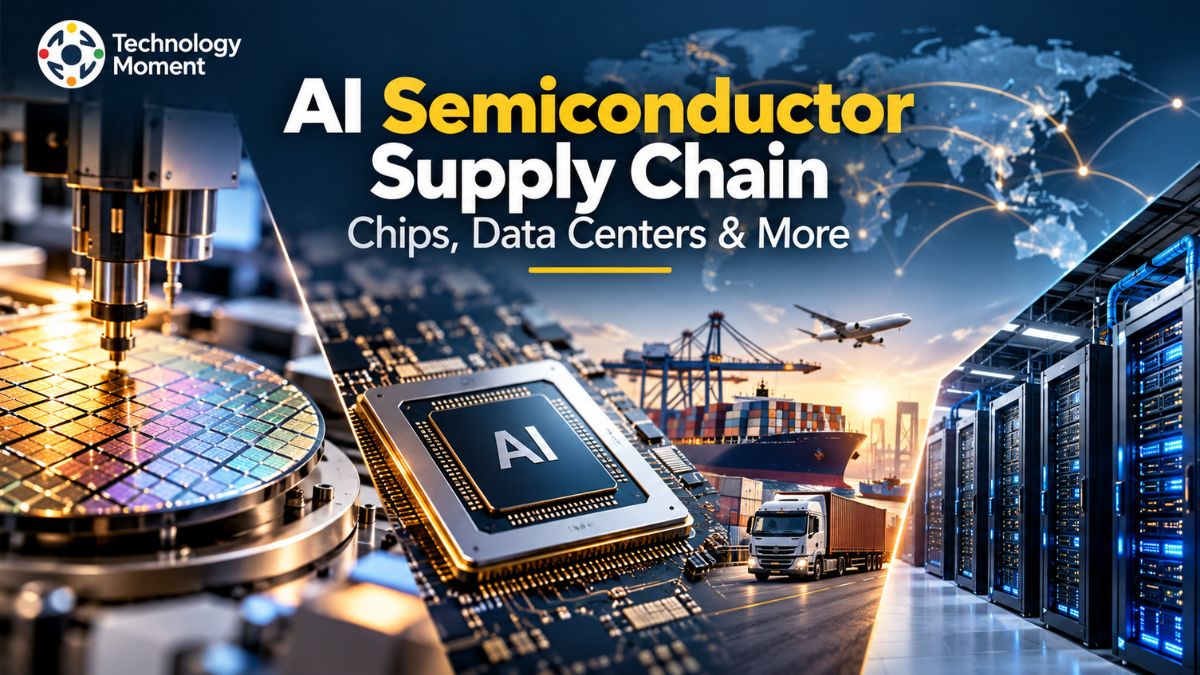
The global semiconductor supply chain is becoming increasingly shaped by AI demand. Producing an AI processor involves far more than designing and fabricating a chip. The wider AI hardware supply chain includes semiconductor foundries, memory manufacturers, advanced packaging providers, semiconductor equipment companies, materials suppliers, OSAT providers, and data-center operators. Each stage contributes to the final system, meaning disruption or capacity constraints at one point can affect the availability of AI hardware further downstream.
AI is also changing the balance of demand across different semiconductor categories. GPUs and AI accelerators require advanced logic manufacturing, while HBM has become essential for supplying data quickly to those processors. Advanced packaging then brings these components together into increasingly complex systems. Omdia reports that AI demand has exceeded the industry’s current ability to produce and package certain chips, with constraints affecting HBM, advanced packaging, and leading-edge node capacity.
This interconnected structure makes the global chip supply chain more sensitive to capacity decisions. Manufacturers are responding through new fabs, additional memory production, packaging expansion,n and increased semiconductor capital expenditure. At the same time, companies are paying greater attention to supply-chain resilience and regional manufacturing capabilities. Deloitte notes that the back-end semiconductor process, including assembly, testing and packaging, is becoming increasingly important to the timely delivery of AI products.
The result is a semiconductor manufacturing ecosystem increasingly organized around AI infrastructure requirements. Instead of demand being concentrated only on individual processors, AI is creating pressure across wafers, memory, packaging, networking components, materials and equipment. This makes the global semiconductor supply chain an essential part of the AI expansion story and explains why capacity decisions made today can influence the availability of AI hardware in the years ahead.
Where Are the Biggest Semiconductor Bottlenecks?
The biggest semiconductor bottlenecks created by AI are not limited to the production of advanced logic chips. Modern AI systems depend on several interconnected components, and constraints in HBM, advanced packaging, wafer capacity, and supporting infrastructure can all limit the number of completed AI systems that reach data centers. Omdia identifies HBM, advanced packaging,ng and node capacity as key areas where AI demand is exceeding current industry capabilities.
HBM has become particularly important because AI accelerators require extremely high memory bandwidth. Increasing HBM production, however, requires additional DRAM capacity and specialized stacking and packaging processes. Samsung said HBM could account for nearly 30% of industry DRAM wafer capacity in 2027, compared with around 20% currently, while noting that HBM and standard DRAM compete for wafer capacity. This illustrates how expanding AI memory production can influence the wider memory chip supply.
Advanced packaging is another major constraint. Technologies such as CoWoS, 2.5D packaging,g and 3D integration are increasingly necessary to combine AI processors with HBM. TrendForce reported that AI-driven competition has created bottlenecks in 3nm–2nm wafers and 2.5D/3D advanced packaging, with pressure extending to equipment, substrates, and packaging materials.
There is also a broader infrastructure bottleneck beyond semiconductors themselves. Recent reporting has highlighted shortages involving power availability, cooling, transformers, and data-center construction, which can prevent available GPU servers from being deployed at the expected pace. Therefore, understanding the AI chip shortage requires looking at the entire AI hardware supply chain rather than focusing only on semiconductor fabrication.
AI Data Centers Are Changing Semiconductor Demand
AI data centers are changing semiconductor demand because their computing requirements are fundamentally different from many traditional workloads. Large-scale AI training and inference require powerful GPUs and AI accelerators, but those processors depend on high-bandwidth memory, fast networking, storage, and power-management components to operate effectively. As hyperscale data centers expand their AI capabilities, demand is therefore increasing across several parts of the semiconductor industry rather than being concentrated on a single type of chip.
Memory is one of the clearest examples. HBM has become critical for AI accelerators because it provides the high bandwidth needed to move large amounts of data between memory and processors. IDC projects strong semiconductor growth in 2026 and identifies AI infrastructure as a major driver, with DRAM revenue benefiting significantly from HBM and other memory demand from hyperscalers and AI infrastructure providers.
AI servers also require high-speed networking chips because modern AI workloads are distributed across large numbers of processors and machines. As these systems scale, communication between GPUs, memory,y and servers becomes increasingly important. Deloitte expects substantial spending on AI data centers and notes that chips can represent a significant portion of this infrastructure investment.
However, semiconductor availability is only one part of the equation. AI data centers require electricity, cooling systems, networking infrastructure,e and physical space. Recent analysis has highlighted a potential mismatch between projected GPU server deliveries and available data-center power and construction capacity in the United States. This means the growth of AI infrastructure is creating a broader demand chain: more AI applications require more computing, more computing requires more semiconductors, and those semiconductors ultimately require data centers capable of powering and cooling them. The result is a tightly connected relationship between AI computing, data center infrastructure, and the global semiconductor supply chain.
How AI Is Reshaping the Semiconductor Business
Artificial intelligence is reshaping the semiconductor business by changing both the scale and the composition of chip demand. The industry is no longer focused only on producing faster processors; it is increasingly building an integrated hardware ecosystem around AI computing. GPUs, AI accelerators, high-bandwidth memory, networking chips, power-management components,s and advanced packaging are all becoming important parts of AI infrastructure. The Semiconductor Industry Association notes that AI data centers require a broad range of semiconductor technologies, including advanced logic, HBM, DRAM, NAND, networking and power chips. This broader demand is influencing semiconductor investment, manufacturing strategies and the allocation of production capacity.
The business impact can already be seen in the scale of investment surrounding AI infrastructure. McKinsey reports that five major hyperscalers have announced planned capital expenditures of about $800 billion for 2026 and $1 trillion for 2027, with most of that spending directed toward AI infrastructure. Semiconductor manufacturers are responding by expanding capacity, investing in advanced manufacturing, and securing longer-term customer commitments. Recent developments in the memory market provide a clear example: Micron said its long-term supply commitments had risen to $32 billion, while demand for HBM continues to exceed available capacity.
This transformation is also changing the economics of the semiconductor industry. Companies must increasingly coordinate chip design, semiconductor manufacturing, memory, advanced packaging and data-center deployment rather than treating each stage independently. AI is therefore creating a more interconnected semiconductor business in which technological performance, manufacturing capacity and supply-chain availability increasingly influence one another.
What Are the Risks to the Global Semiconductor Supply Chain?
The global semiconductor supply chain faces several interconnected risks as AI increases demand for advanced computing hardware. One major risk is geographic concentration. Semiconductor production depends on specialized capabilities distributed across different countries and regions, meaning a disruption at one critical stage can affect companies much further along the supply chain. The Semiconductor Industry Association and Boston Consulting Group have identified more than 50 points in the semiconductor value chain where a single region holds more than 65% of global market share, creating potential points of vulnerability.
AI is adding another layer of pressure because modern AI systems depend on a narrow combination of leading-edge logic, HBM, advanced packaging and specialized manufacturing equipment. Deloitte describes the AI semiconductor ecosystem as deeply interdependent and highlights risks associated with geopolitical tensions, export controls and concentrated suppliers. Restrictions affecting semiconductor equipment, materials, software, packaging and advanced chips can therefore have effects beyond a single product category.
Capacity shortages are another concern. HBM has become particularly important because AI accelerators depend on high memory bandwidth. Samsung said HBM could account for nearly 30% of industry DRAM wafer capacity in 2027, up from around 20% currently, while noting that HBM and standard DRAM compete for wafer capacity. That creates a potential trade-off between AI memory demand and conventional memory supply.
Other risks include semiconductor manufacturing bottlenecks, advanced packaging shortages, energy constraints, transportation disruptions, natural disasters,s and changing trade policies. For companies operating in the global semiconductor supply chain, resilience increasingly requires diversified sourcing, additional capacity,y and visibility across multiple layers of the AI hardware supply chain.
Frequently Asked Questions About AI and Semiconductors
How is AI changing the semiconductor industry?
AI is transforming the semiconductor industry by increasing demand for AI chips, GPUs, AI accelerators, HBM, and advanced packaging. Modern AI systems require higher computing performance, memory bandwidth, and energy efficiency, encouraging manufacturers to invest in leading-edge process nodes and semiconductor capacity. The transformation also extends to networking, power, and foundational chips, making AI infrastructure an important driver across the broader semiconductor industry and manufacturing ecosystem.
How is AI affecting semiconductor supply chains?
AI is putting greater pressure on the global semiconductor supply chain because advanced computing systems require multiple specialized components. AI chip production depends on leading-edge wafers, HBM, advanced packaging, semiconductor equipment, materials,s and testing. A constraint in any one area can affect the wider AI hardware supply chain. As demand grows, manufacturers are expanding capacity and companies are increasingly focusing on supply-chain resilience and diversified production.
What chips are used in AI data centers?
AI data centers use a broad range of semiconductors rather than a single type of chip. GPUs and AI accelerators provide high-performance computing, while CPUs, DPUs, and networking chips support system operations and data movement. AI servers also use HBM, DRAM, SRAM, and NAND memory, along with power chips, controllers, transceivers, and sensors. This complete semiconductor stack enables modern AI data centers to handle demanding training and inference workloads.
Why are AI chips in high demand?
AI chips are in high demand because modern artificial intelligence workloads require enormous computing capacity. Training and running large AI models involves processing and moving huge amounts of data, which requires powerful GPUs, AI accelerators,s and high-bandwidth memory. The expansion of AI data centers is therefore increasing demand for advanced logic, memory, networking,ng and supporting semiconductors. This growth is affecting manufacturing capacity, packaging requirements, and the wider global semiconductor supply chain.
Why is HBM important for AI chips?
High-bandwidth memory, or HBM, is important because AI accelerators need to access large amounts of data at extremely high speeds. HBM provides significantly higher memory bandwidth and is closely integrated with advanced AI processors through sophisticated packaging technologies. As AI workloads become larger, HBM has become a critical part of AI infrastructure. Its growing demand is also influencing DRAM production, wafer capacity,ty and the broader semiconductor supply chain.
What is the AI semiconductor supply chain?
The AI semiconductor supply chain is the interconnected system that produces and delivers the chips required for AI infrastructure. It includes chip design, EDA software, semiconductor equipment, raw materials, wafer fabrication, testing, advanced packaging, traditional packaging, module assembly, and system integration. The finished products include AI accelerators, GPUs, HBM, CPUs, networking chips, and other components used in AI servers and data centers.
What are the biggest semiconductor supply chain challenges for AI?
The biggest challenges include limited advanced semiconductor manufacturing capacity, HBM availability, advanced packaging, specialized equipment,nt and access to critical materials. AI hardware also depends on geographically distributed suppliers, creating exposure to geopolitical disruptions, trade restrictions, and other supply-chain risks. Because AI servers require many different semiconductor technologies, a shortage in one component can affect the wider system. Building additional capacity and improving supply-chain resilience are therefore major industry priorities.
How are AI chips manufactured?
AI chips are manufactured through several highly specialized stages. Engineers first design the processor using electronic design automation tools, after which semiconductor foundries fabricate the chip on silicon wafers. The wafers are tested,d and individual dies are separated before packaging. Advanced AI processors may then be integrated with HBM using advanced packaging technologies. Finally, packaged chips undergo testing and are incorporated into modules, AI servers,rs and larger data-center systems.
What are AI accelerators?
AI accelerators are specialized processors designed to perform artificial intelligence and machine-learning workloads efficiently. Unlike general-purpose CPUs, they are optimized for highly parallel mathematical operations commonly used in AI models. GPUs are widely used as AI accelerators, while ASICs, FPGAs, and other specialized architectures can serve specific workloads. AI accelerators are central to modern AI infrastructure because they provide the computing performance required for large-scale model training and inference.
How do GPUs support AI data centers?
GPUs support AI data centers by performing large numbers of parallel calculations required for machine-learning workloads. They are particularly useful for training and running complex AI models because their architecture can process many operations simultaneously. GPUs work alongside HBM, CPUs, networking chips, and other components to form AI servers. As AI workloads scale, clusters of GPU-based systems allow data centers to provide the computing capacity required for increasingly demanding applications.
Why is semiconductor capacity important for AI?
Semiconductor capacity is important because AI infrastructure depends on large quantities of advanced processors, memory, and supporting chips. Even strong demand cannot translate into finished AI systems if manufacturers lack sufficient wafer, HBM, packaging, or testing capacity. A single AI server rack can contain more than 4,500 packaged chips, illustrating how many semiconductor components are required. Expanding capacity across the supply chain is therefore essential for supporting continued AI infrastructure growth.