Artificial intelligence is changing how businesses operate, compete, and make decisions. From automating repetitive processes to improving customer experiences and supporting faster decision-making, AI can create significant opportunities—but simply adopting AI tools does not automatically create business value.
The real challenge is knowing where AI can make a meaningful difference, which use cases to prioritize, what data and capabilities are required, and how to turn individual experiments into a practical long-term strategy. Without a clear direction, businesses can end up investing in disconnected tools, expensive projects, or solutions that do not address their most important goals.
That is where an effective AI strategy for business becomes important. A well-planned strategy connects AI initiatives with business objectives, evaluates organizational readiness, identifies valuable use cases, establishes responsible AI practices, and creates a roadmap for implementation and measurement. At Technology Moment, we focus on making complex technology easier to understand and apply in the real world. This guide takes the same approach by breaking AI strategy into practical steps that business leaders, professionals, and organizations can use to move from AI experimentation toward purposeful adoption.
In this guide, you will learn how to build an AI strategy for your business, assess AI readiness, identify and prioritize use cases, choose appropriate technologies, establish governance, create an AI roadmap, and measure the business impact of your investments.
Understanding AI Strategy for Modern Businesses
An AI strategy for business is a structured plan that explains how an organization will use artificial intelligence to achieve specific business goals. Rather than adopting AI simply because it is a growing technology, a strong business AI strategy connects AI initiatives with measurable outcomes such as improving productivity, reducing operational costs, strengthening customer experiences, increasing revenue, or supporting better decisions.
An effective artificial intelligence strategy considers more than individual AI tools. It brings together business objectives, AI opportunities, data, technology, people, governance, investment, and implementation. This helps organizations determine where AI can create genuine value and where traditional solutions may still be more appropriate.
An AI strategy framework typically begins by understanding the organization’s current capabilities and identifying areas where AI could solve meaningful problems. These opportunities can include AI automation, predictive analytics, intelligent recommendations, generative AI applications, customer support, or AI-powered workflows. AI strategy is also different from simply having an AI adoption strategy. Adoption focuses on introducing and using AI, while a broader strategy establishes why AI should be used, which initiatives should receive resources, how risks will be managed, and how success will be measured.
For businesses, the goal is therefore not to implement AI everywhere. It is to create a practical approach for selecting, implementing, governing, and scaling AI initiatives that support long-term business priorities. A well-defined strategy gives teams a common direction while allowing AI capabilities to evolve as business needs and technology change.
Why Is an AI Strategy Essential for Modern Businesses?
Businesses increasingly have access to powerful AI solutions, but having access to technology does not guarantee useful results. Without a clear AI business strategy, organizations may adopt disconnected tools, launch experiments without measurable objectives, or spend resources on AI initiatives that have limited business impact. A well-designed strategy helps businesses connect AI adoption with their most important goals. Instead of asking, “Where can we use AI?” organizations can ask more useful questions such as, “Which business problems could AI solve effectively?” and “What value could this initiative create?”
Another important reason is prioritization. A business may identify dozens of potential AI use cases, but resources, data, skills, and budgets are limited. An AI strategy provides a framework for evaluating opportunities based on potential business impact, feasibility, cost, risk, and expected time to value. An AI adoption strategy can also help organizations prepare for implementation. This includes assessing AI readiness, developing appropriate skills, improving data quality, selecting suitable technologies, and establishing responsible AI practices.
Strategy is particularly important when AI initiatives move beyond experimentation. Individual pilots may work well, but scaling them across departments can introduce challenges involving security, governance, integration, infrastructure, and employee adoption. A clear strategy also creates a foundation for measuring AI ROI and performance. Businesses can define success criteria before investing heavily and track whether AI initiatives are delivering their intended outcomes.
What Should an AI Strategy Include?
A comprehensive AI strategy framework should cover the major capabilities and decisions required to move from identifying an opportunity to successfully scaling an AI initiative. The exact structure will differ between organizations, but several components are consistently important. Business goals should come first. AI initiatives need clear objectives and measurable outcomes so that technology decisions remain connected to business priorities.
Next comes AI readiness. Organizations should assess their existing data, technology infrastructure, workforce skills, processes, and operational capabilities. Data readiness is especially important because many AI applications depend on reliable, accessible, and appropriately governed data. The strategy should then define potential AI opportunities and AI use cases. These might involve automation, decision support, customer experiences, forecasting, personalization, or generative AI. Each opportunity should be evaluated according to business value and implementation feasibility.
An AI technology strategy should determine which technologies, platforms, models, tools, and integrations are appropriate. Organizations may need to consider existing systems, security requirements, infrastructure, and whether to build, buy, or integrate an AI solution. AI governance is another essential component. An organization should establish principles and processes covering privacy, security, responsible AI, risk management, human oversight, and appropriate use of AI.
People and organizational capabilities also matter. An effective strategy considers AI talent, skills development, ownership, workflows, and collaboration between business and technical teams. Finally, the strategy should include an AI roadmap, investment plan, and measurement framework. The roadmap translates priorities into actionable initiatives, while metrics help determine whether AI investments are generating the expected business impact. Together, these elements create a practical foundation for responsible AI adoption and long-term AI transformation.
How to Build an AI Strategy for Your Business
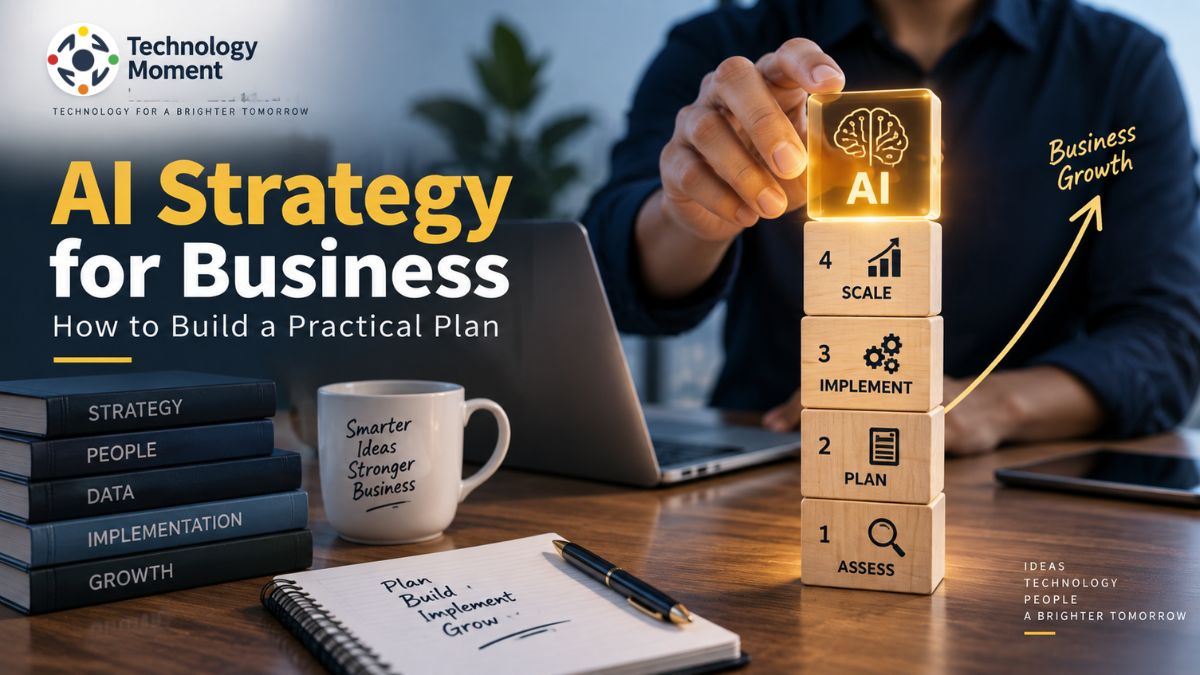
Building an effective AI strategy starts with business needs rather than technology. The following process provides a practical starting point for organizations developing their AI strategy for business.
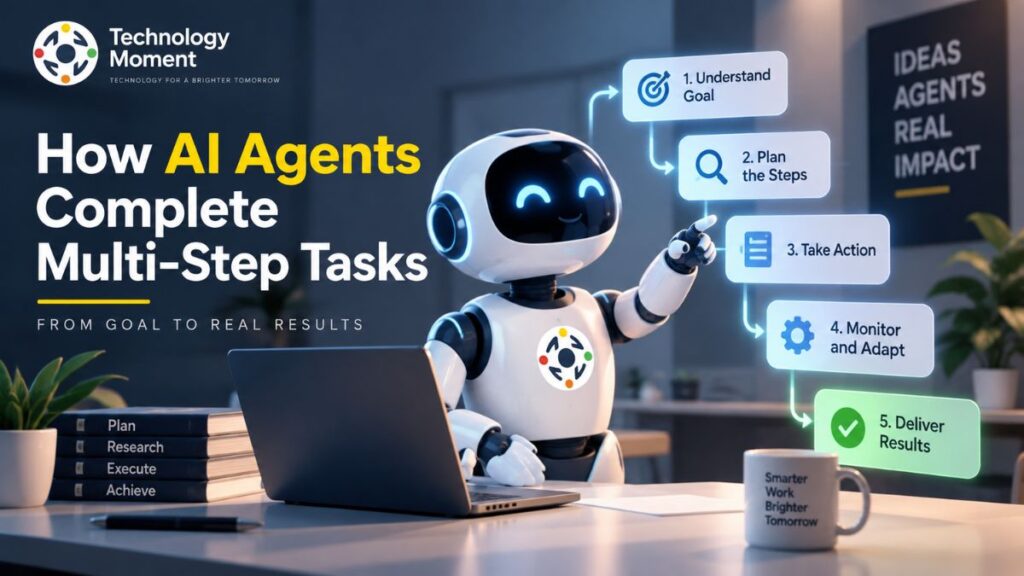
1. Define Your Business Goals: Start by identifying the organization’s most important objectives. These might include improving productivity, reducing costs, increasing revenue, improving customer service, or strengthening operational efficiency. Clear AI business goals make it easier to evaluate whether a potential initiative is worth pursuing.
2. Assess Your AI Readiness: Evaluate current data, infrastructure, processes, workforce capabilities, and technology. An AI readiness assessment can reveal gaps in data readiness, AI skills, security, infrastructure, and organizational capability that could affect implementation.
3. Identify AI Opportunities: Review important business processes and identify areas where AI could solve meaningful problems. Look for opportunities involving repetitive work, complex decision-making, prediction, personalization, information processing, or business process automation.
4. Prioritize AI Use Cases: Not every opportunity deserves immediate investment. Prioritize potential initiatives based on business impact, feasibility, cost, data availability, implementation complexity, and risk. This creates a focused AI adoption strategy rather than an unstructured collection of experiments.
5. Select the Right AI Solutions: Determine which technology is appropriate for each priority use case. Depending on the problem, this could involve generative AI, machine learning, automation platforms, existing AI tools, or custom AI solutions.
6. Establish Governance: Define how AI will be used responsibly. Your strategy should address privacy, security, risk management, human oversight, transparency, and other relevant governance requirements.
7. Create an AI Roadmap: Organize initiatives into practical phases. An AI strategy roadmap for business can separate immediate opportunities from medium- and long-term initiatives while identifying dependencies, resources, milestones, and expected outcomes.
8. Measure and Improve: Define performance metrics before implementation. Track business impact, adoption, operational performance, costs, risks, and AI ROI. Use these results to improve the strategy and determine which successful initiatives should be scaled. This approach turns AI strategy planning into an ongoing business capability rather than a one-time technology project.
AI Strategy Framework for Businesses
An AI strategy framework gives businesses a structured way to move from AI experimentation to measurable business outcomes. Instead of treating every new AI tool as an opportunity, the framework helps organizations decide where AI can provide meaningful value and how those initiatives should be managed. A practical business AI strategy framework can be organized into several connected stages: business goals, AI readiness, opportunity identification, use case prioritization, technology selection, data strategy, governance, implementation, measurement, and continuous improvement.
The process begins with business objectives. Once the organization understands what it wants to improve, it can identify relevant AI opportunities. These may include customer service automation, operational optimization, forecasting, personalization, content workflows, or decision support. The next step is evaluating AI readiness. Businesses should consider their data quality, technology infrastructure, workforce capabilities, security requirements, and existing processes. This assessment helps determine whether an AI initiative is practical.
Organizations can then evaluate potential AI use cases according to factors such as business impact, feasibility, cost, risk, and expected time to value. High-priority initiatives can be incorporated into an AI roadmap with defined milestones and ownership. The framework should also include AI governance, responsible AI practices, data management, and performance measurement. These elements become increasingly important as AI initiatives move from individual pilots to organization-wide AI transformation.
A strong framework is not a rigid formula. It should evolve as business priorities, AI capabilities, regulations, and organizational experience change. Its purpose is to provide a consistent decision-making structure while allowing businesses to experiment, learn, and scale valuable AI initiatives responsibly.
How to Implement an AI Strategy
Creating an AI strategy is only the beginning. The next challenge is turning strategic priorities into practical initiatives. Successful AI implementation requires coordination between business objectives, technology, data, people, and processes. Start by selecting a limited number of high-value use cases rather than attempting to implement AI across the entire organization at once. Each initiative should have a clearly defined problem, expected outcome, responsible owner, and measurable success criteria. This makes it easier to determine whether the project is creating genuine value.
The next step is to prepare the required data and technology. Businesses should review data availability, integration requirements, security, infrastructure, and existing systems before deployment. Depending on the use case, an organization may use existing AI tools, third-party platforms, generative AI models, or custom AI solutions. Employee adoption is equally important. Teams need to understand how AI will affect their workflows and how human judgment should interact with AI-generated outputs. Training and clear operating procedures can help employees use AI effectively.
Implementation should generally follow an iterative approach. Organizations can launch a pilot, measure its performance, identify problems, improve the solution, and then decide whether to scale it. This reduces unnecessary investment while generating practical learning. An AI implementation roadmap can organize initiatives into short-, medium-, and long-term phases. Each phase should include resources, dependencies, milestones, and performance metrics.
Finally, organizations should continuously monitor business outcomes, costs, reliability, security, adoption, and AI ROI. This turns implementation into an ongoing improvement process rather than a one-time technology deployment.
AI Strategy for Small Businesses vs. Enterprises
The principles behind an AI strategy for small businesses and an enterprise AI strategy are similar, but their priorities, resources, and implementation requirements can be very different. Small businesses often operate with smaller budgets, fewer technical specialists, and limited internal infrastructure. Their AI adoption strategy may therefore focus on accessible AI tools that solve specific operational problems. Customer support, marketing workflows, administrative tasks, research, scheduling, and business process automation can provide practical starting points.
For a small business, the goal should not necessarily be building sophisticated AI infrastructure. Using reliable existing AI solutions can often be more practical than developing everything internally. The organization should focus on use cases with clear value, manageable implementation requirements, and measurable results.
Enterprise AI strategy typically involves greater organizational complexity. Large companies may have multiple departments, extensive data environments, legacy systems, regulatory requirements, and larger numbers of employees using AI. As a result, enterprises often need stronger AI governance, data governance, security controls, integration processes, and organizational ownership. An enterprise may also establish an AI center of excellence or similar structure to coordinate AI initiatives, develop internal capabilities, establish standards, and support business teams.
Regardless of company size, the fundamental principle remains the same: AI initiatives should support meaningful business objectives. Small businesses can prioritize simplicity, speed, and practical value, while enterprises may need to emphasize scalability, governance, integration, and long-term AI capabilities. The right strategy therefore depends less on adopting the most advanced technology and more on matching AI investments with the organization’s goals, resources, readiness, and operational environment.
Common AI Strategy Mistakes to Avoid
Developing an AI business strategy can become difficult when organizations focus more on technology adoption than business outcomes. Avoiding common mistakes can help businesses use their resources more effectively and create a stronger foundation for long-term AI adoption. One common mistake is choosing an AI tool first and then searching for a problem to solve. A better approach is to identify business challenges and evaluate whether AI is an appropriate solution.
Organizations may identify numerous AI use cases and attempt to launch them simultaneously. This can spread budgets, technical resources, and employee attention too thin. Prioritizing initiatives based on value, feasibility, cost, and risk creates a more manageable strategy. AI applications depend heavily on appropriate data. Poor-quality, inaccessible, fragmented, or improperly governed data can limit the effectiveness of an AI initiative. A strong data strategy should therefore be part of the overall AI plan.
Ignoring AI governance, privacy, security, responsible AI, and risk management can create significant problems as adoption grows. Governance should be considered during planning rather than added after deployment. Counting the number of AI tools purchased or pilots launched does not demonstrate strategic success. Businesses should define meaningful AI performance metrics, including productivity, cost reduction, revenue impact, adoption, quality, customer outcomes, and AI ROI.
A successful pilot does not automatically become a successful organization-wide solution. Businesses need an AI roadmap, appropriate infrastructure, ownership, workflows, and change-management processes before scaling. AI technology and business priorities continue to change. An effective strategy should therefore be reviewed regularly, using performance results and organizational learning to refine priorities and improve future AI initiatives.
How Businesses Can Measure AI Strategy Results
Measuring an AI strategy requires more than counting how many AI tools an organization has adopted. A meaningful measurement framework connects AI initiatives with measurable business outcomes and operational performance. The first area is business impact. Organizations can measure changes in revenue, operating costs, productivity, customer satisfaction, processing time, or other outcomes directly related to an AI initiative. The appropriate metric depends on the original business objective.
The second area is adoption. An AI solution may technically work but provide limited value if employees or customers do not use it effectively. Adoption rates, active usage, workflow completion, and user feedback can help identify whether an AI solution is being integrated successfully. Operational performance is another important area. Businesses can monitor accuracy, response time, automation rates, error rates, reliability, and quality. These AI performance metrics help teams understand whether the technology is delivering the expected operational results.
Organizations should also measure risk. Security incidents, privacy issues, inappropriate outputs, compliance concerns, and human-oversight requirements should be included within the measurement framework. Finally, businesses should evaluate AI ROI. A practical calculation can compare the measurable financial benefits of an AI initiative with its total costs, including technology, implementation, infrastructure, maintenance, training, and ongoing operations.
Measurement should not end after deployment. Performance should be reviewed continuously, allowing businesses to improve successful initiatives, modify underperforming solutions, and determine which projects are ready to scale. A strong measurement system therefore combines business outcomes, adoption, operational performance, risk, and ROI. This provides a more complete picture of whether an AI strategy is creating sustainable value.
Frequently Asked Questions About AI Strategy
What is an AI strategy for business?
An AI strategy for business is a structured plan for using artificial intelligence to achieve specific business goals. It covers AI opportunities, use cases, data, technology, talent, governance, implementation, investment, and performance measurement. The objective is to connect AI adoption with measurable business value rather than adopting technology without a clear purpose.
What should an AI strategy include?
An AI strategy should include business objectives, AI use cases, an AI readiness assessment, data strategy, technology requirements, AI talent and skills, governance, risk management, implementation priorities, an AI roadmap, investment planning, and performance metrics. Together, these components provide a framework for making AI adoption more coordinated, measurable, and aligned with organizational priorities.
How can businesses use AI strategically?
Businesses can use AI strategically by connecting specific AI initiatives to measurable business objectives. Potential areas include automation, customer service, marketing, forecasting, decision support, personalization, and productivity. Instead of implementing AI everywhere, organizations should identify high-value opportunities, evaluate feasibility and risk, and scale initiatives that demonstrate meaningful business results.
How do you identify AI use cases for a business?
Start by examining important business processes and identifying problems involving repetitive work, large amounts of information, prediction, personalization, or complex decision support. Then evaluate whether AI can address the problem effectively. Each potential use case should be assessed for business impact, data availability, feasibility, cost, risk, and expected time to value.
How do you align AI with business goals?
Begin with the organization’s strategic priorities rather than specific AI technologies. For each proposed initiative, define the business problem, desired outcome, relevant AI business goals, and measurable success criteria. This ensures technology decisions support broader objectives such as productivity, revenue growth, cost reduction, customer experience, or operational improvement.
How do you measure AI strategy success?
Measure AI strategy success using a combination of business impact, adoption, operational performance, risk, and financial outcomes. Relevant metrics may include productivity gains, cost savings, revenue impact, usage, accuracy, automation rates, customer outcomes, and AI ROI. Metrics should be defined before implementation so results can be compared against the original objectives.
What are the benefits of an AI strategy?
An effective AI strategy can help businesses prioritize valuable opportunities, coordinate investments, improve AI adoption, manage risks, develop internal capabilities, and measure outcomes. It can also provide a structured approach to AI transformation, helping organizations move from isolated experiments toward AI initiatives that support clearly defined business objectives.
How do businesses implement AI?
Businesses can implement AI by selecting priority use cases, preparing data and infrastructure, choosing appropriate AI solutions, developing workflows, training users, testing the solution, and measuring results. Starting with controlled pilots can help organizations identify technical and operational issues before scaling successful initiatives across departments or larger business processes.
How do you calculate AI ROI?
AI ROI can be evaluated by comparing the measurable financial benefits generated by an AI initiative with its total costs. Costs may include software, infrastructure, implementation, integration, training, maintenance, and ongoing operations. Businesses should also establish a baseline before deployment so improvements can be measured against the original business performance.