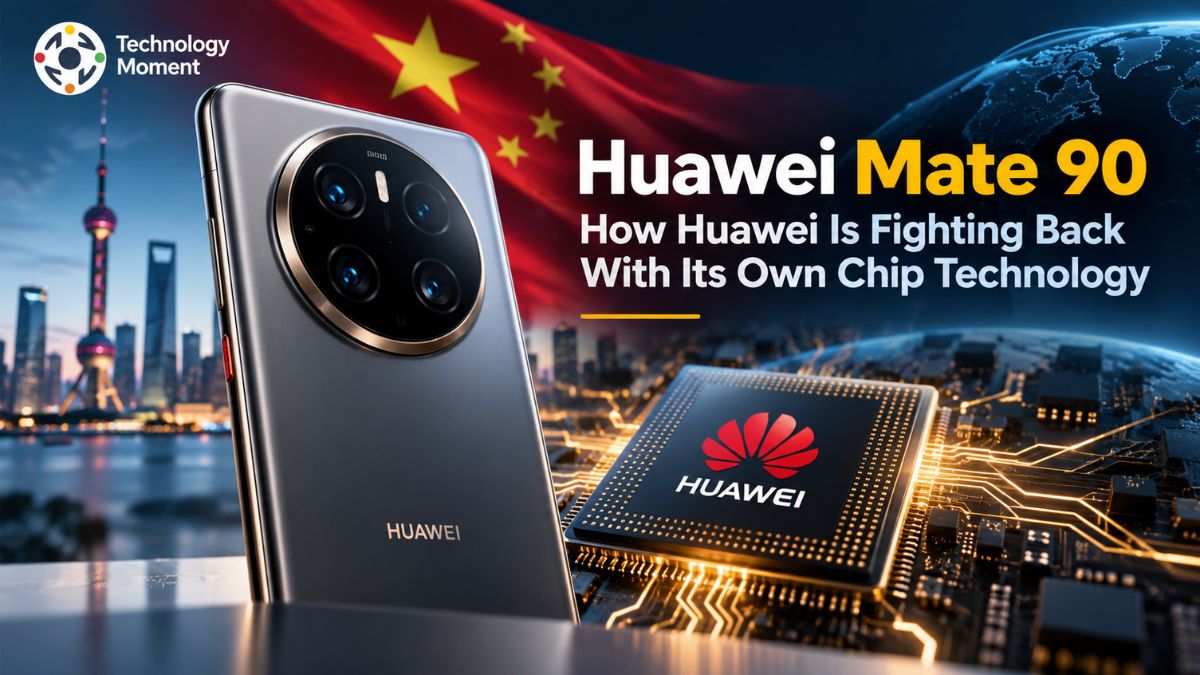
Huawei’s latest flagship smartphone launch is about more than a new device. With the Huawei Mate 90 series, the company is putting renewed attention on its own chip technology as it continues to operate under tight restrictions on access to advanced semiconductor technologies. The launch gives Huawei another opportunity to show how far its in-house hardware and software development has progressed.
At the center of the story is Huawei’s Kirin chip family, including the Kirin 9050 Pro used in the higher-end Mate 90 models. Huawei has also introduced a new chip architecture called LogicFolding, which restructures internal chip wiring in three dimensions to increase processing density and improve performance. The approach is particularly significant because Huawei has been forced to find alternative ways to improve chip capabilities while access to some advanced manufacturing technologies remains limited.
The Mate 90 series also runs on HarmonyOS 7, reinforcing Huawei’s broader strategy of developing more of its smartphone technology in-house. However, the company still faces important challenges, including limited advanced semiconductor manufacturing capacity and the complexity of producing newer chip designs at scale. For Technology Moment, the Mate 90 is therefore worth examining beyond its specifications. Its launch offers a closer look at how Huawei is responding to semiconductor restrictions, developing its own chip architecture, and competing in an increasingly strategic global smartphone market.
Huawei Mate 90 Launch: What Has Changed?
The Huawei Mate 90 launch marks a significant step in Huawei’s flagship smartphone strategy, with the company putting more emphasis on its own chip technology, semiconductor development, and software ecosystem. The new series was launched in China with five models, covering the standard Mate 90 through the higher-end Pro Max and RS Ultimate Design versions. Across the lineup, Huawei has introduced new-generation Kirin processors and HarmonyOS 7, making the chip platform one of the central changes from the previous Mate generation.
| Model | Chip |
|---|---|
| Huawei Mate 90 | Kirin 9030 |
| Huawei Mate 90 Pro | Kirin 9035 |
| Huawei Mate 90 Pro Max | Kirin 9050 Pro |
| Huawei Mate 90 RS | Kirin 9050 Pro |
The biggest change is not simply a faster smartphone processor. Huawei is increasingly using its own homegrown chip technology to improve performance while operating under continuing restrictions on access to advanced semiconductor technologies. The standard Mate 90 uses the Kirin 9030, while the Mate 90 Pro moves to the Kirin 9035. Higher-end models use chips from the Kirin 9050 family, including the Kirin 9050 Pro with Huawei’s new LogicFolding architecture.
Huawei says the new platform brings improvements in processing, graphics, artificial intelligence, and overall device performance. For example, the company claims a 27% overall performance increase for the standard Mate 90 and up to 31% for the highest-end models compared with the previous generation. These figures are Huawei’s own claims and should be distinguished from independent benchmark results.
The Mate 90 therefore represents more than a routine flagship upgrade. Its Kirin chip development, LogicFolding technology, HarmonyOS 7 integration, and focus on domestic semiconductor capabilities show how Huawei is trying to maintain smartphone competitiveness while building greater control over the technologies inside its devices.
What Chip Does the Huawei Mate 90 Use?
The question of what chip the Huawei Mate 90 uses is particularly important because Huawei has taken a different approach from many global smartphone manufacturers. Instead of relying on a single processor across the entire flagship family, Huawei has created different Kirin chip tiers for different Mate 90 models. This allows the company to separate performance levels while keeping its own semiconductor technology at the center of the lineup.
The standard Huawei Mate 90 uses the Kirin 9030, while the Mate 90 Pro is equipped with the Kirin 9035. Higher-end Mate 90 Pro Max configurations use either the Kirin 9050 or the more advanced Kirin 9050 Pro, depending on the configuration. The Kirin 9050 Pro is particularly important because it introduces Huawei’s LogicFolding chip architecture, which is designed to improve processing efficiency and reduce signal delays through a more three-dimensional approach to chip design.
Huawei says the Kirin 9030 provides a 27% overall performance improvement compared with its stated previous-generation comparison, while the Kirin 9035 is positioned as a balance between performance and power efficiency. The Kirin 9050 Pro sits at the top of the range, with Huawei claiming significant gains in CPU, graphics,s and AI processing for the Mate 90 Pro Max.
This chip strategy is important because the Mate 90 is not only competing on conventional smartphone specifications. Huawei is using the Kirin chip, HarmonyOS 7, and its own semiconductor research to create a more vertically integrated technology platform. That approach could become increasingly important as Huawei seeks to reduce its dependence on external technology suppliers.
However, the exact manufacturing arrangements remain less transparent. Huawei has not publicly confirmed who manufactures the Kirin 9050 Pro, although industry reporting has linked Huawei’s Kirin production to SMIC. Therefore, it is more accurate to describe the chips as Huawei-designed or Huawei-developed rather than automatically calling every manufacturing stage fully domestic.
What Is Huawei’s Kirin 9050 Pro Chip?
The Kirin 9050 Pro is the most advanced chip associated with the Huawei Mate 90 lineup and one of the most important components of Huawei’s current smartphone semiconductor strategy. It is a system-on-chip designed to combine processing, graphics, artificial intelligence,ce and other functions into a single mobile platform. Its importance goes beyond raw specifications because Huawei uses the chip to demonstrate how alternative chip-design techniques can improve performance even when access to the most advanced manufacturing technologies is constrained.
The headline feature is Huawei’s LogicFolding technology. According to Huawei, the architecture enables 5 million signal transmission bonds and up to 125 TB/s of inter-die bandwidth. The company also claims that the Kirin 9050 Pro can deliver a 31% overall performance increase in the Mate 90 Pro Max compared with the previous generation. Huawei further highlights improvements in AI processing and graphics capabilities.
Independent reporting indicates that the Kirin 9050 Pro has a nine-core CPU configuration with 16 threads and a Maleoon 955 GPU. Huawei has also disclosed performance figures for the Mate 90 implementation, including claimed improvements in multi-core CPU, graphics rendering, and NPU performance. However, these figures should not automatically be interpreted as equivalent real-world gains because actual performance depends on software optimization, thermal management, applications, and power limits.
What makes the Huawei Kirin 9050 Pro particularly interesting is the philosophy behind its development. Rather than depending solely on smaller manufacturing processes to increase transistor density, Huawei is attempting to improve chip performance through architecture and physical design. This is where LogicFolding, chip architecture,e and semiconductor engineering become central to the Mate 90 story. For Huawei, the Kirin 9050 Pro is therefore both a smartphone processor and a demonstration of its broader effort to strengthen homegrown semiconductor technology.
How Does Huawei’s LogicFolding Technology Work?
Huawei’s LogicFolding technology is one of the most technically interesting aspects of the Mate 90 launch. In simple terms, the approach changes how certain parts of a chip are physically arranged and connected. Traditional chip layouts generally organize circuitry across a largely two-dimensional plane, while Huawei’s LogicFolding approach uses a more three-dimensional structure to bring frequently communicating components closer together.
The idea is important because communication between different parts of a processor creates delays. When signals have to travel longer distances, the chip can face greater latency and efficiency challenges. Huawei’s approach attempts to shorten these paths by restructuring internal wiring and using vertical connections between layers. This can allow more logic to be concentrated into a given physical area and potentially improve how quickly different parts of the chip communicate.
Huawei says the Kirin 9050 Pro’s LogicFolding architecture supports 5 million signal transmission bonds and 125 TB/s of inter-die bandwidth. The company positions this architecture as a way to achieve greater performance and density without relying exclusively on further reductions in manufacturing dimensions.
There is, however, an important trade-off. LogicFolding does not eliminate the challenges associated with semiconductor manufacturing. Reporting indicates that the architecture requires more wafers, which can increase production complexity and put additional pressure on manufacturing capacity. China’s advanced semiconductor capacity also remains constrained, making efficient production an important challenge for Huawei.
This makes Huawei LogicFolding more than a marketing term. It represents an attempt to solve a difficult engineering problem through chip architecture rather than relying only on conventional semiconductor scaling. Whether that strategy can deliver sustained advantages at large production volumes will depend on manufacturing efficiency, yields, software optimization,n and future generations of Huawei’s Kirin chips.
Why Is Huawei Developing Its Own Chip Technology?
Huawei’s push into homegrown chip technology is closely connected to the company’s changing position in the global semiconductor industry. The goal is not simply to make another smartphone processor. Huawei is trying to gain greater control over the technologies that determine how its devices perform, especially as access to some advanced semiconductor tools and components remains restricted. The Huawei Mate 90 is a clear example of this strategy, combining new Kirin chips, HarmonyOS 7 and the company’s LogicFolding architecture into a more vertically integrated smartphone platform.
This strategy has developed over several years. Huawei has invested heavily in research and development across chips, operating systems, artificial intelligence, and other foundational technologies. For Huawei, developing its own semiconductor technology can reduce dependence on external suppliers and give the company more flexibility when designing future smartphones.
The Mate 90 also shows why chip architecture matters. Instead of relying only on conventional semiconductor scaling, Huawei is experimenting with LogicFolding, a three-dimensional approach intended to increase logic density and improve communication between different parts of a chip. The approach does not remove manufacturing challenges, but it gives Huawei another way to pursue better chip performance and efficiency.
Huawei’s strategy is therefore broader than smartphone independence. It is about building a stronger domestic technology ecosystem spanning chip design, semiconductor manufacturing, software, and cloud services. The company still faces production and supply constraints, but the Mate 90 demonstrates how Huawei is attempting to narrow those gaps through its own technological development.
How Is Huawei Fighting U.S. Chip Restrictions?
Huawei is responding to U.S. semiconductor restrictions through a combination of chip design, domestic manufacturing partnerships, software development, and system-level optimization. Restrictions on access to advanced semiconductor technologies have made it more difficult for Huawei to follow the same straightforward path used by leading global chip designers: moving to increasingly advanced manufacturing processes to gain more performance and efficiency. Instead, Huawei is exploring alternative engineering approaches that can extract more capability from available manufacturing resources.
The Huawei Mate 90 chip strategy illustrates this approach. Its higher-end models use the Kirin 9050 Pro, which incorporates LogicFolding architecture. The technology reorganizes chip wiring in three dimensions rather than relying entirely on traditional two-dimensional layouts. Huawei says this can increase density and improve processing performance, although reporting also notes that the design requires more wafers to manufacture.
Huawei is also reducing dependence on foreign technology through its software ecosystem. The Mate 90 series runs HarmonyOS 7, Huawei’s Android-free operating system, while the company is combining hardware, software, chips and cloud services more closely. Huawei says this vertical integration can improve overall device performance rather than treating the processor as an isolated component.
Manufacturing remains the harder part of the equation. Huawei consumer chief Richard Yu said China’s advanced semiconductor capacity remains limited and that smartphone chips compete for capacity with other advanced products such as Huawei’s Ascend AI processors. He also said China’s advanced chipmaking continues to rely on DUV lithography, while EUV remains an important technology that Chinese manufacturers are still working toward. So, Huawei is not simply trying to “beat” restrictions with one new processor.
Who Makes Huawei Mate 90 Chips?
The question of who makes Huawei Mate 90 chips requires some caution because Huawei has not publicly confirmed the manufacturer of the Kirin 9050 Pro. The chip is designed as part of Huawei’s semiconductor program, but chip design and chip manufacturing are different stages of the semiconductor supply chain. Huawei’s increasing control over chip architecture does not automatically mean that every manufacturing process is performed by Huawei itself.
The company has emphasized its work with China’s domestic semiconductor ecosystem. Recent reporting says Huawei resumed domestic production of smartphone chips in 2023 and has worked with domestic suppliers to manufacture advanced chips using homegrown technologies and capabilities. This represents an important part of Huawei’s broader chip independence strategy.
SMIC, China’s largest logic foundry, is widely believed to be involved in producing Huawei’s Kirin chips, including chips used in the Mate family. However, this should be described as industry reporting rather than confirmed information about the Kirin 9050 Pro. Reuters reported that Huawei did not disclose who manufactures the chip, while SMIC did not respond to a request for comment.
The distinction matters for international readers because “Huawei-made chip” can mean different things. Huawei develops the chip architecture and technology, while semiconductor foundries manufacture physical silicon wafers. Other companies and equipment suppliers can also be part of the manufacturing chain.
This makes the Huawei Mate 90 semiconductor strategy particularly interesting. Huawei is trying to control more of the technology stack while working within China’s available manufacturing capacity. LogicFolding may help the company improve performance without depending entirely on the newest conventional process nodes, but it also introduces additional manufacturing complexity and wafer requirements. As a result, the most accurate description is that the Mate 90 uses Huawei-developed Kirin chips manufactured through China’s domestic semiconductor ecosystem, while the specific foundry responsible for the Kirin 9050 Pro has not been officially confirmed.
Huawei Mate 90 vs Previous Generation: How Much Has Performance Improved?
The Huawei Mate 90 performance story is more nuanced than simply saying that the new phones are faster. Huawei has reported substantial improvements over the previous Mate generation, but the figures vary by model and component. The Mate 90 series succeeds the Mate 80 line, which launched in November 2025, and Huawei has focused its upgrades on processors, AI computing, battery efficiency, and overall system performance.
| Performance Area | Huawei Mate 90 / New Generation | Previous Generation | Reported Improvement | What It Means |
|---|---|---|---|---|
| Overall Mate 90 performance | Kirin 9030 platform | Mate 80 generation | Up to 27% | Huawei says the standard Mate 90 delivers a substantial overall performance increase |
| Mate 90 Pro battery life | Kirin 9035 platform | Previous Mate generation | 18% | Huawei claims improved endurance through better performance and power management |
| Premium overall performance | Kirin 9050 Pro + LogicFolding | Previous flagship generation | Up to 31% | The largest claimed overall improvement is associated with the premium Mate 90 models |
| CPU performance — Kirin 9030 | New Kirin 9030 | Kirin 9020 | 13% | Huawei-reported CPU improvement |
| GPU performance — Kirin 9030 | New Kirin 9030 | Kirin 9020 | 54% | Larger graphics improvement than the reported CPU gain |
| NPU performance — Kirin 9030 | New Kirin 9030 | Kirin 9020 | 13% | Improvement aimed at on-device AI workloads |
| CPU performance — Kirin 9035 | New Kirin 9035 | Previous generation | 11% | Focuses on balancing performance and power consumption |
| GPU performance — Kirin 9035 | New Kirin 9035 | Previous generation | 10% | More moderate graphics improvement |
| NPU performance — Kirin 9035 | New Kirin 9035 | Previous generation | 51% | Stronger emphasis on AI processing |
| Kirin 9050 Pro CPU | LogicFolding-based design | Kirin 9030 Pro-class predecessor | 52% multi-core | Reported benchmark data indicates a significant multi-core improvement, although the listing is not independently verified |
| Kirin 9050 Pro graphics | Maleoon 955 GPU | Earlier Kirin generation | Up to 142% rendering claim | Huawei-linked performance figures point to a major graphics increase |
| On-device AI | Kirin 9050 Pro | Previous generation | Up to 2× | Huawei says AI computing performance has doubled on the premium platform |
| Transistor density | LogicFolding architecture | Conventional design | 28% reported increase | Huawei says the architecture increases density without relying solely on conventional scaling |
Huawei’s published figures show that the Kirin 9030 brings a 27% overall performance improvement for the Mate 90, while the higher-end Kirin 9050 Pro platform is associated with a 31% overall improvement. Huawei also reports major gains in graphics and AI processing. However, these numbers should be treated as Huawei-reported figures, not universal benchmark results. An early Geekbench 7 listing for what appears to be the Kirin 9050 Pro showed 1,117 single-core and 5,076 multi-core points, but the listing was not officially confirmed as the Mate 90 Pro Max or the Kirin 9050 Pro.
The broader takeaway is that Huawei is pursuing performance improvements through a combination of new Kirin chips, LogicFolding, software optimization,n and hardware-software integration. The Mate 90 therefore represents an architectural and strategic upgrade, not merely a routine processor refresh.
Why the Mate 90 Chip Strategy Matters for the Global Smartphone Market
The Huawei Mate 90 chip strategy matters beyond Huawei because it reflects a broader shift in how smartphone companies may approach semiconductor development when access to the most advanced manufacturing technologies is limited. Huawei is using its own Kirin chips, LogicFolding architecture, HarmonyOS 7, and software-hardware integration to keep improving its flagship devices. The premium Mate 90 models use the Kirin 9050 Pro, while Huawei says its new architecture can deliver higher performance through changes to chip structure and signal transmission rather than relying only on smaller transistor sizes.
For the global smartphone market, this creates another important competitive dimension. The industry has traditionally depended heavily on a small number of leading semiconductor designers and manufacturers. Huawei’s approach suggests that chip performance can also be pursued through architecture innovation, 3D chip design, and system-level optimization. Its LogicFolding technology restructures internal wiring vertically, with the aim of creating denser and faster processing. However, this approach also requires more wafers, showing that architectural innovation does not completely remove manufacturing constraints.
The strategy could also increase competition among major smartphone ecosystems. Huawei is no longer depending solely on external processors and operating-system technologies; it is attempting to control more of the stack itself. That includes mobile chipsets, semiconductor technology, operating systems,ms and cloud integration. Huawei says the Mate 90 benefits from this vertical integration across hardware, software, chips and cloud services.
For international consumers and the wider semiconductor industry, the Mate 90 therefore represents an interesting test. If Huawei can continue improving performance despite manufacturing limitations, its strategy could influence how other companies think about chip efficiency, architecture,e and technological independence. It also highlights how smartphone competition is increasingly connected to the larger global semiconductor race.
What Are the Biggest Challenges for Huawei’s Homegrown Chip Strategy?
Huawei’s homegrown chip strategy has made significant progress, but developing competitive processors is only one part of becoming more independent from foreign semiconductor technology. The biggest challenge is manufacturing capacity. Huawei consumer chief Richard Yu has acknowledged that advanced semiconductor capacity in China remains limited, while Huawei’s smartphone chips and Ascend AI processors compete for that constrained capacity.
The second challenge is the manufacturing complexity associated with Huawei’s LogicFolding architecture. The technology is designed to increase chip density and shorten critical signal paths by restructuring circuitry in three dimensions. That gives Huawei another route to improve chip performance, but the design requires more wafers to produce. In a market where advanced semiconductor capacity is already tight, additional wafer requirements can become an important production constraint.
Heat, production yield, and cost are also important technical concerns. Earlier analysis of Huawei’s LogicFolding concept noted that stacking or folding circuitry can increase power density and create thermal-management challenges. Manufacturing yields and production costs can also become more difficult as chip structures become more complex. This means Huawei must prove that its chip architecture can work not only in engineering demonstrations but also at commercial scale.
Another challenge is access to advanced semiconductor equipment. China continues to face restrictions affecting access to leading-edge semiconductor manufacturing technologies. Huawei has acknowledged that Chinese advanced chipmaking still relies on DUV lithography, while EUV technology remains an important target.
There is also the question of global competitiveness. Huawei can improve its own Kirin chip performance, but competing against companies with access to highly advanced manufacturing ecosystems remains difficult. The Mate 90 demonstrates meaningful progress, yet independence should not be confused with complete self-sufficiency. The biggest test for Huawei will therefore be whether it can consistently design, manufacture, and scale increasingly capable chips while managing cost, yield, heat, wafer supply, and performance. Its progress is substantial, but the road toward semiconductor independence remains technically demanding.
Frequently Asked Questions About Huawei Mate 90 Chip Technology
What is the Kirin 9050 Pro?
The Kirin 9050 Pro is Huawei’s flagship smartphone chipset used in premium Mate 90 models. It combines CPU, graphics, and AI processing capabilities with Huawei’s LogicFolding architecture. Huawei says the architecture enables denser processing and contributes to substantial performance improvements over the previous generation. However, Huawei’s performance figures should be treated as company-reported claims rather than independent benchmark results.
Why is Huawei developing its own chips?
Huawei is developing homegrown chips to gain greater control over its technology stack and reduce dependence on external semiconductor suppliers. U.S. restrictions have limited Huawei’s access to certain advanced semiconductor technologies and manufacturing capabilities. Developing Kirin processors, LogicFolding, and other domestic technologies gives Huawei alternative ways to improve smartphone performance while strengthening its long-term semiconductor strategy.
Who manufactures Huawei Mate 90 chips?
Huawei has not publicly confirmed the manufacturer of the Kirin 9050 Pro. SMIC is widely believed to manufacture Huawei’s Kirin chips, but that specific relationship has not been officially confirmed for the Mate 90’s flagship processor. It is therefore more accurate to describe the Mate 90 chips as Huawei-developed chips produced within China’s domestic semiconductor ecosystem rather than definitively attributing every chip to a particular foundry.
Is the Huawei Mate 90 chip made in China?
Huawei has increasingly shifted smartphone-chip production toward China’s domestic semiconductor supply chain. Huawei executives have said the company resumed domestic smartphone-chip manufacturing in 2023. However, the exact manufacturing details for every Mate 90 processor are not publicly disclosed, so claims about a completely domestic manufacturing chain should be made carefully.
Can Huawei overcome semiconductor restrictions?
Huawei can continue reducing its dependence on foreign semiconductor technology, but completely overcoming the restrictions is considerably more difficult. Advanced manufacturing equipment, production capacity, design tools, and supply-chain capabilities remain important challenges. The Mate 90 demonstrates Huawei’s ability to innovate around some constraints, but long-term semiconductor independence will depend on whether China can expand advanced manufacturing capacity and improve the broader domestic chip ecosystem.