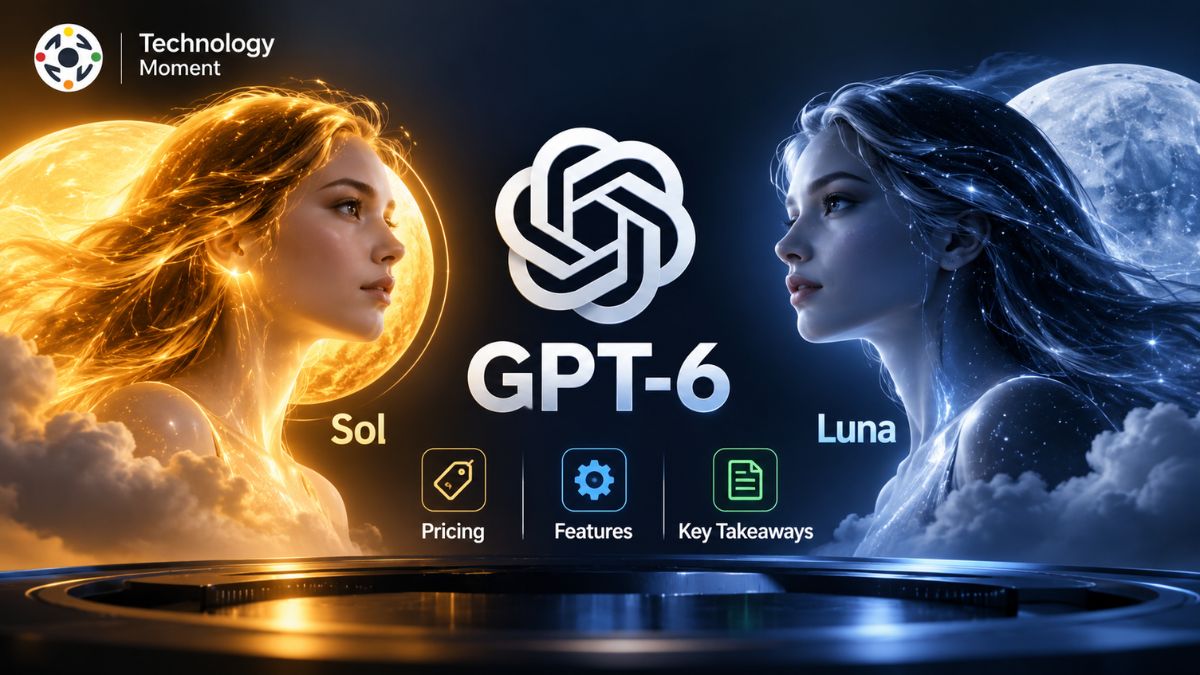
OpenAI has introduced its new GPT-6 AI model family with the release of GPT-6 Sol and GPT-6 Luna, adding two new models to its growing lineup of large language models. The announcement puts the focus on the capabilities, performance, and intended use cases of the two models, giving users and developers a new generation of AI technology to explore.
For anyone following the rapid evolution of artificial intelligence, understanding what GPT-6 Sol and Luna offer—and how the two models differ—is more useful than simply knowing that a new model has launched. Availability, capabilities, performance, developer access, and practical applications are all important factors when evaluating a new AI model.
In this guide, Technology Moment breaks down the GPT-6 announcement in clear, straightforward terms. We’ll look at what GPT-6 Sol and Luna are, their key features, how they compare, what they can be used for, and what users and developers need to know about availability and API access.
OpenAI GPT-6 Sol and Luna: What Are the New AI Models?
OpenAI has introduced GPT-6 Sol and GPT-6 Luna as part of its latest generation of artificial intelligence models. The release adds two new models to the GPT-6 family and gives users and developers another step forward in the evolution of large language models and generative AI. Rather than treating GPT-6 as a single model, the introduction of Sol and Luna suggests a model lineup designed around different capabilities and use cases.
GPT-6 Sol and GPT-6 Luna are therefore the two names users will encounter when looking at the new OpenAI GPT-6 models. For people following the latest OpenAI news, the important question is not simply what GPT-6 is called, but what each model is designed to do and where it fits into OpenAI’s broader model lineup. Understanding these differences can help users choose the appropriate AI model for their needs instead of assuming that the newest model is automatically the right option for every task.
The GPT-6 release is also relevant beyond individual AI users. Developers, businesses, researchers, and organizations increasingly depend on AI models for reasoning, software development, research, automation, and other workflows. As a result, changes in model capabilities can have practical implications across different areas of technology.
In this guide, Technology Moment examines GPT-6 Sol and Luna, their documented capabilities, performance information, and differences. The goal is to explain the new GPT-6 AI models clearly while separating confirmed information from assumptions, so readers can understand what OpenAI has actually announced and what the release could mean for the wider AI ecosystem.
GPT-6 Sol vs GPT-6 Luna: What’s the Difference?
The most important distinction for users is the difference between GPT-6 Sol and GPT-6 Luna. OpenAI has introduced the two models separately, so treating them as interchangeable would miss an important part of the GPT-6 release. However, model comparisons should be based only on specifications and capabilities that OpenAI has publicly documented rather than assumptions based on their names.
| Feature | GPT-6 Sol | GPT-6 Luna |
|---|---|---|
| Model family | GPT-6 | GPT-6 |
| Model type | OpenAI GPT-6 model | OpenAI GPT-6 model |
| Officially announced | Yes | Yes |
| Primary capabilities | See OpenAI’s documented specifications | See OpenAI’s documented specifications |
| Performance data | Use officially published benchmarks | Use officially published benchmarks |
| Availability | Based on OpenAI’s announced access | Based on OpenAI’s announced access |
| API access | Include only if officially confirmed | Include only if officially confirmed |
For users searching for GPT-6 Sol vs GPT-6 Luna, the key point is that the two models belong to the same GPT-6 generation but should be evaluated according to their documented capabilities rather than simply assuming that one is universally better. Different AI models can be optimized for different requirements, including reasoning, speed, efficiency, coding, or other workloads. This distinction is especially important for developers deciding which GPT-6 model to integrate into an application. Businesses may also need to consider availability, API access, performance, and cost before selecting a model. As more technical information becomes available, a direct comparison can become more detailed.
For now, the safest way to understand the GPT-6 Sol and Luna differences is to follow OpenAI’s official specifications and compare the models based on measurable capabilities rather than unsupported claims.
GPT-6 Sol and Luna Key Features
The GPT-6 Sol and Luna key features are central to understanding why OpenAI has introduced the new models. Modern large language models are evaluated across several dimensions, including reasoning, language understanding, coding, inference, response quality, and overall AI performance. The exact capabilities of each GPT-6 model should be considered alongside the use case for which it is being evaluated.
One important area is AI reasoning. Advanced reasoning capabilities can help AI models work through complex instructions, analyze information, solve multi-step problems, and produce more useful responses. For professional users, improvements in reasoning can be particularly relevant to research, programming, data analysis, and technical workflows.
Another important area is overall AI performance. Model performance is not determined by one characteristic alone. Developers and users may consider accuracy, latency, reliability, context handling, and performance on relevant benchmarks when evaluating a new language model. This makes the GPT-6 release relevant to both consumers and developers looking for the latest OpenAI model. The models may also have different practical applications. Depending on their documented capabilities, users could evaluate them for writing, research, coding, analysis, automation, and other generative AI tasks. Developers can similarly assess the models for AI assistants, software applications, and API-powered workflows.
It is important, however, to distinguish OpenAI’s documented capabilities from broader claims about what GPT-6 can theoretically accomplish. A new GPT-6 AI model may have impressive capabilities, but users should still evaluate its actual performance for their particular workflow. For Technology Moment readers, the most useful approach is to focus on measurable capabilities, documented features, and real-world applications rather than treating the GPT-6 announcement as a collection of marketing claims.
GPT-6 Performance and Benchmarks
GPT-6 performance and benchmarks are among the most important areas for anyone evaluating the new models. Benchmarks provide a standardized way to measure how an AI model performs on specific tasks, although they should not be treated as a complete representation of real-world performance. A model can perform strongly on a particular benchmark while producing different results in practical applications.
When evaluating GPT-6 Sol and GPT-6 Luna, users should therefore look at the benchmark methodology as well as the reported results. Relevant measurements may cover reasoning, coding, language understanding, mathematical problem solving, or other capabilities. The most meaningful comparison is one that uses the same benchmark, methodology, and testing conditions for each model.
Benchmark results are particularly useful for developers and technical teams choosing between AI models. If a model performs well on tasks similar to an application’s workload, that information can help inform model selection. However, factors such as API availability, latency, context requirements, reliability, and pricing can also influence the final decision.
The GPT-6 release should therefore be viewed as more than a race for the highest benchmark score. GPT-6 capabilities need to be considered in the context of what users actually want to accomplish. For example, a developer may care more about coding performance and API behavior, while a researcher may prioritize reasoning and analytical accuracy.
Technology Moment will focus on the measurable information provided by OpenAI when discussing GPT-6 benchmarks and performance. Where OpenAI publishes comparative results, those figures can be examined directly; where information is unavailable, it is better to acknowledge the gap than to fill it with speculation. This approach gives readers a clearer picture of what the latest GPT model can actually deliver.
GPT-6 Sol vs Previous OpenAI Models
GPT-6 Sol represents the next generation in OpenAI’s GPT model lineup, while previous OpenAI models belong to earlier generations of the company’s large language model family. For users searching for the latest GPT model, the important distinction is that GPT-6 Sol should be evaluated according to its documented capabilities rather than simply its model number. A newer generation can introduce changes in reasoning, performance, efficiency, or other areas, but each of those improvements needs to be supported by official technical information.
| Comparison | GPT-6 Sol | Previous OpenAI Models |
|---|---|---|
| Model generation | GPT-6 | Earlier GPT generations |
| Model family | GPT-6 | Previous GPT model families |
| Position in lineup | New GPT-6 model | Earlier OpenAI models |
| AI capabilities | Refer to officially documented GPT-6 capabilities | Depend on the specific previous model |
| Performance | Should be evaluated using published GPT-6 results | Depends on the model and benchmark |
| Developer use | Depends on officially announced access | Varies by model |
A meaningful comparison between GPT-6 Sol and previous OpenAI models requires looking at the same capabilities under comparable testing conditions. For example, reasoning, coding, language understanding, and other AI workloads can be measured separately rather than treating overall model performance as one number. This is particularly relevant for developers and businesses deciding whether a new OpenAI model is suitable for an existing workflow.
The GPT-6 release also does not automatically make every previous model obsolete. Different models can remain useful for different applications depending on performance requirements, availability, compatibility, and cost. Therefore, users considering the GPT-6 update should compare their actual workload with the documented characteristics of GPT-6 Sol rather than selecting a model based only on its generation number.
GPT-6 Availability
GPT-6 availability is one of the first questions users are likely to ask following the OpenAI announcement. A model release can involve several forms of access, including availability through consumer products, developer APIs, business services, or staged access. These should be treated separately because an announcement of a new AI model does not necessarily mean that every user can immediately access every capability. Availability can also depend on the specific OpenAI product through which the model is offered. Users should therefore check the official OpenAI documentation or product interface for the latest access information rather than relying on third-party claims.
The same principle applies to the GPT-6 release date and rollout information. The announcement establishes when OpenAI introduced the models, but access can change as OpenAI expands availability. Developers may also receive access through a different route from ordinary ChatGPT users. For international users, regional availability may be another consideration. OpenAI products can have different availability conditions depending on the service and region, so users should verify current access directly through OpenAI.
Technology Moment will treat availability as a separate part of the GPT-6 story because it answers a practical question that is different from model capability. Knowing that OpenAI GPT-6 exists is useful, but knowing whether a particular user can actually access GPT-6 Sol or Luna is what determines its immediate usefulness.
GPT-6 API Access for Developers
For developers, GPT-6 API access is potentially more important than consumer availability because API access determines whether the model can be integrated into software, applications, services, and automated workflows. Developers evaluating the new GPT-6 models should therefore distinguish between an OpenAI model announcement and confirmed API availability.
If GPT-6 Sol or GPT-6 Luna is made available through an OpenAI API, developers would need to consider the model documentation, supported endpoints, authentication requirements, usage limits, pricing, and technical capabilities before integrating it into a production application. These details should come directly from OpenAI’s developer documentation because API specifications can change as models move through different stages of availability.
The GPT-6 API can be particularly relevant for applications that depend on large language models for tasks such as content generation, coding assistance, research, customer support, analysis, or AI-powered workflows. However, developers should evaluate a model using their own workload rather than relying exclusively on general benchmark results.
For teams considering GPT-6 for developers, compatibility is another important factor. Existing applications may depend on specific model behaviors, context requirements, structured outputs, tool integrations, or other API features. Moving to a new GPT model may therefore require testing before production deployment.
Pricing should also be considered, but only after official GPT-6 API pricing has been published. It would be misleading to assume pricing from an older OpenAI model. The same applies to rate limits and availability. For now, developers should use OpenAI’s official API documentation as the authoritative source for GPT-6 API access, supported models, pricing, and implementation requirements. This keeps technical decisions based on confirmed information rather than speculation.
What Can GPT-6 Sol and Luna Do?
The capabilities of GPT-6 Sol and GPT-6 Luna should be understood through the tasks and use cases officially associated with the models. As advanced large language models, their potential applications can span a broad range of AI workloads, but individual capabilities should not be assumed simply because the models belong to the GPT-6 generation.
For everyday users, a modern GPT model can serve as an AI assistant for tasks such as understanding information, generating text, organizing ideas, and working through questions. For professional users, the more important applications can include research, analysis, software development, technical problem-solving, and workflow assistance, provided those capabilities are supported by the specific model.
Developers can also evaluate GPT-6 Sol and Luna for applications built around generative AI and language-model functionality. Potential categories include coding assistants, research tools, customer-facing AI assistants, content workflows, and productivity applications. The appropriate model depends on the actual requirements of each application. AI reasoning is another important area when evaluating a new generation of language models. Reasoning capability can influence how effectively a model handles complex instructions and multi-step problems. Similarly, AI performance should be evaluated using relevant benchmarks and real-world tests rather than a single headline figure.
Businesses may also examine GPT-6 models for automation and internal workflows. However, organizations should consider accuracy, reliability, security, privacy, cost, and human oversight before deploying an AI model in consequential processes. Its practical value depends on the specific model, available features, access method, and task. For users comparing GPT-6 Sol and Luna, the most useful approach is to match documented capabilities with real requirements instead of assuming that every GPT-6 model performs identically across every workload.
GPT-6 Pricing
GPT-6 pricing is an important consideration for both individual users and developers evaluating the new OpenAI GPT-6 models. For GPT-6 Sol and GPT-6 Luna, the actual cost should be based on the official pricing information published by OpenAI rather than assumptions about how the new models compare with earlier GPT models. Pricing can also differ depending on whether a model is accessed through a consumer product, an API, or a business-focused service.
For developers, GPT-6 API pricing is particularly important because API costs are generally connected to usage. Factors such as input and output processing, model selection, request volume, and application architecture can influence the total cost of operating an AI-powered product. A developer evaluating GPT-6 Sol or GPT-6 Luna should therefore look beyond the headline price and consider the cost of completing a specific task.
The difference between GPT-6 Sol pricing and GPT-6 Luna pricing, if OpenAI publishes separate rates, should also be evaluated alongside their capabilities. A model with a higher per-request cost may provide greater value for complex reasoning, coding, research, or analysis, while a lower-cost model may be more suitable for high-volume everyday workloads. This makes price-to-performance an important part of choosing an AI model.
For businesses, GPT-6 pricing should also be considered alongside reliability, scalability, security requirements, and expected usage. Instead of selecting a model solely because it has a lower price, organizations can compare the cost of achieving a defined business outcome. The final GPT-6 pricing structure, including API pricing and product availability, should always be checked against OpenAI’s latest official documentation before making purchasing or architecture decisions.
What GPT-6 Sol and Luna Mean for AI Users and Developers
The introduction of GPT-6 Sol and GPT-6 Luna represents another development in the evolution of OpenAI’s GPT model family. For AI users, newer models can create opportunities to perform more sophisticated tasks through natural-language interfaces, including research, writing, analysis, coding, planning, and other AI-assisted workflows. However, the practical value of a model depends on its documented capabilities and how reliably it performs the tasks users actually need.
For developers, GPT-6 models can be particularly relevant because increasingly capable large language models can become components inside software products rather than simply standalone chat assistants. Developers can potentially use AI models for application features such as intelligent search, content generation, coding assistance, document analysis, customer support, workflow automation, and natural-language interfaces. The suitability of GPT-6 Sol or GPT-6 Luna for a particular application should be determined through official documentation and application-specific testing.
The arrival of new AI models also changes how developers evaluate model performance. Benchmark scores can provide useful information, but real-world application testing is equally important. A model that performs well on a particular benchmark may not automatically be the most appropriate choice for every production workload. Developers should consider accuracy, latency, reliability, context requirements, cost, privacy, security, and integration complexity before adopting a model.
For everyday AI users, GPT-6 Sol and Luna may also make AI assistants more useful for increasingly complex tasks. At the same time, users should continue reviewing important AI-generated information rather than treating model output as automatically correct. The broader significance of GPT-6 is therefore not simply the arrival of another model generation, but how effectively these models translate AI capabilities into useful, dependable experiences for people and businesses.
GPT-6 Sol and Luna: Key Takeaways
GPT-6 Sol and GPT-6 Luna are part of OpenAI’s GPT-6 model family, making them relevant to users following the latest developments in artificial intelligence and large language models. Their significance should be evaluated using documented information about capabilities, performance, access, and intended use rather than assumptions based only on the GPT-6 name.
One important point is that GPT-6 Sol and GPT-6 Luna should not necessarily be treated as interchangeable models. If OpenAI positions them for different workloads, users and developers can evaluate the models according to the tasks they need to perform. This could include considerations such as AI reasoning, model performance, coding, research, analysis, everyday assistance, or high-volume application workloads. Exact differences should always be confirmed through official OpenAI documentation.
GPT-6 performance is another important area to watch. Benchmarks can help users understand how a new AI model performs against established tests, but benchmark results are only one part of model evaluation. Practical testing can reveal differences in accuracy, response quality, speed, consistency, and cost that may not be visible from benchmark numbers alone. GPT-6 availability and GPT-6 API access are equally important for adoption. A model announcement does not necessarily mean that every user, developer, region, or service receives access at the same time. Consumer access, developer access, business availability, and API availability can follow different rollout processes.
Overall, GPT-6 Sol and Luna add another chapter to the development of OpenAI’s AI model lineup. Users should focus on documented capabilities and real-world usefulness, while developers should evaluate performance, pricing, API access, reliability, security, and integration requirements before moving GPT-6 models into production.
Frequently Asked Questions About GPT-6
What is GPT-6?
GPT-6 is the next-generation GPT model family from OpenAI. GPT-6 Sol and GPT-6 Luna are the model names discussed in this release context. Their exact capabilities, availability, pricing, and technical specifications should be confirmed through official OpenAI documentation.
What is GPT-6 Sol?
GPT-6 Sol is one of the AI models in the GPT-6 family. It is designed as part of OpenAI’s latest model generation. Specific capabilities, performance characteristics, pricing, and access conditions should be evaluated using OpenAI’s published information.
What is GPT-6 Luna?
GPT-6 Luna is another model in the GPT-6 family. Its role and capabilities should be understood from OpenAI’s official model documentation. Users should not assume that GPT-6 Luna has identical performance, pricing, or availability to GPT-6 Sol.
What is the difference between GPT-6 Sol and GPT-6 Luna?
GPT-6 Sol and GPT-6 Luna are separate models within the GPT-6 family. Their exact differences should be determined from OpenAI’s documented specifications, intended use cases, performance information, pricing, and availability rather than assumptions based on their names.
Is GPT-6 available now?
GPT-6 availability depends on the access channel and OpenAI’s rollout. Consumer products, developer APIs, and business services can have different availability conditions. Users should check OpenAI’s official announcements and documentation for the latest access information.
Is GPT-6 available through the API?
GPT-6 API access depends on OpenAI’s official developer availability. Developers should check the current OpenAI API documentation for supported models, access requirements, pricing, limits, and integration details before building a production application.
How much does GPT-6 cost?
GPT-6 pricing depends on the specific model and access method. API costs can differ from consumer product pricing, and different GPT-6 models may have different rates. Always verify current pricing through OpenAI’s official pricing documentation.
What can GPT-6 do?
GPT-6 models can potentially support tasks such as AI assistance, writing, coding, research, analysis, and workflow automation. The exact capabilities of GPT-6 Sol and Luna should be determined from their official documentation and demonstrated performance.
Is GPT-6 better than previous GPT models?
GPT-6 represents a newer GPT model generation, but whether it is more suitable depends on the specific task, model, benchmark, cost, and performance requirements. Users should compare documented results under comparable conditions rather than assume that newer automatically means better.
Should developers use GPT-6 Sol or GPT-6 Luna?
Developers should select between GPT-6 Sol and GPT-6 Luna based on documented capabilities, application requirements, performance testing, API pricing, latency, reliability, and scalability. The appropriate choice depends on the specific workload rather than the model name alone.