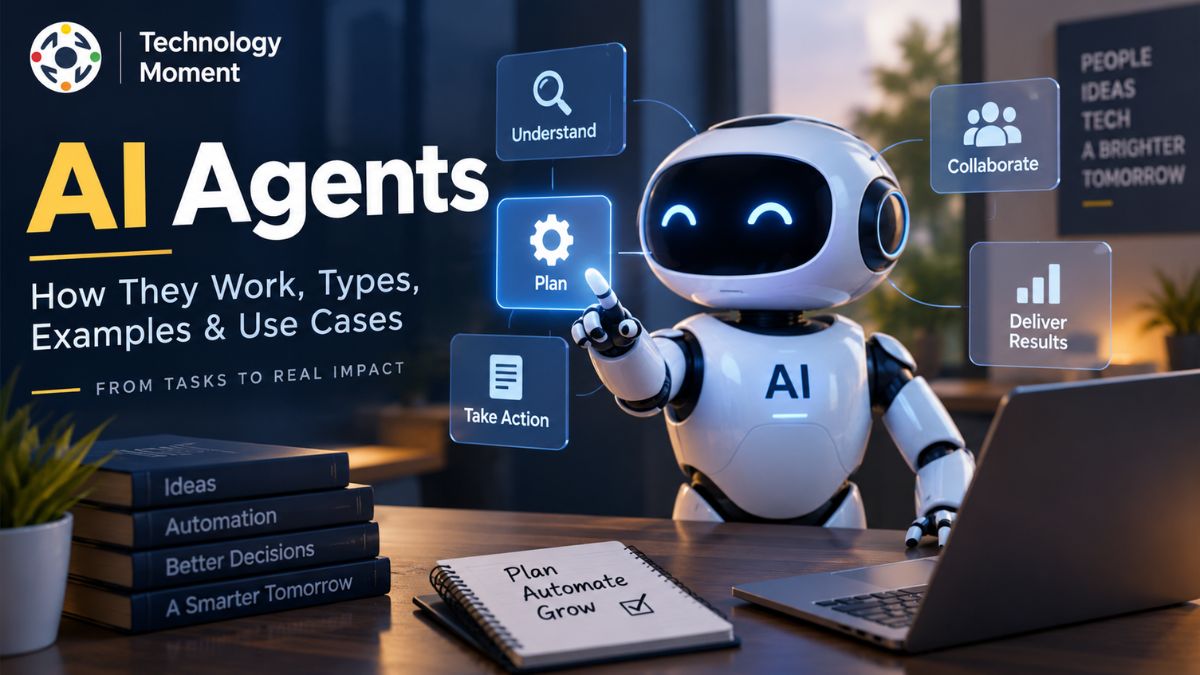
Artificial intelligence is moving beyond simply answering questions or generating content. A new generation of AI systems can understand a goal, plan the steps needed to achieve it, use different tools, and take action with limited human input. These systems are known as AI agents.
But what exactly are AI agents, and how are they different from chatbots or traditional AI assistants? The answer is more interesting than simply saying that they are “smarter AI.” AI agents are designed to work toward a goal by combining reasoning, planning, memory, tools, and actions to complete tasks.
At Technology Moment, we focus on making complex technology easier to understand without unnecessary jargon or hype. In this guide, we’ll break down what AI agents are, how AI agents work, the different types of AI agents, real-world examples, common use cases, benefits, limitations, and what their future could look like.
Whether you are discovering AI agents for the first time, exploring AI automation for work, or trying to understand where agentic AI fits into the rapidly changing technology landscape, this guide will give you a clear foundation to start with.
What Are AI Agents?
AI agents are software systems designed to work toward a specific goal by understanding information, making decisions, and taking actions. Unlike AI tools that simply respond to a single request, an AI agent can handle multiple steps to complete a task. It can analyze a situation, decide what needs to happen next, use available tools, and adjust its approach based on the results.
For example, a traditional AI system might answer a question about a flight. An AI agent could go further by searching available flights, comparing options based on your preferences, checking relevant information, and helping complete the booking process when authorized to do so. The key difference is its ability to move from providing information to performing actions.
AI agents can use technologies such as large language models (LLMs), machine learning, memory, external tools, APIs, and knowledge retrieval systems. These components allow an agent to understand instructions, process information, and interact with other software.
AI agents are increasingly being explored for research, software development, customer service, business operations, productivity, and workflow automation. Their growing importance comes from their ability to handle complex tasks that would otherwise require several manual steps.
What Is an AI Agent?
An AI agent is an artificial intelligence system that can perceive information, reason about a goal, decide what actions are appropriate, and execute those actions using available tools or systems. In simple terms, you can think of an AI agent as software that does more than generate an answer: it works toward an outcome.
The process usually begins with a goal or instruction from a user. The agent interprets what needs to be accomplished and determines the steps required. Depending on the task, it may retrieve information, analyze data, call an API, interact with another application, or use a specialized tool. It can then evaluate the result and determine whether another action is necessary.
Modern AI agents often use large language models as their reasoning or language-processing component. An agent typically combines the model with capabilities such as memory, tools, instructions, planning mechanisms, and an environment in which it can operate.
This distinction is important because AI agents are not defined simply by how intelligent their underlying model is. Their value comes from how effectively they combine intelligence with action.
As agentic AI develops, these systems are becoming increasingly useful for completing multi-step tasks rather than only responding to individual prompts.
What Makes an AI Agent “Autonomous”?
The word autonomous describes an AI agent’s ability to make decisions and continue working toward a goal without requiring a person to provide instructions for every individual step. However, autonomy does not necessarily mean that an AI agent operates completely independently.
Consider a task such as preparing a market research report. A basic AI tool may generate a report from information supplied by the user. An autonomous AI agent could potentially determine what information is needed, search approved sources, organize the findings, analyze relevant data, and produce a structured result. If something is missing, it may decide that another step is necessary.
Several capabilities contribute to this autonomy. These can include goal interpretation, reasoning, planning, memory, tool use, decision making, and feedback. Together, they allow an agent to determine what should happen next instead of following only a fixed sequence of instructions.
The level of autonomy can vary considerably. Some agents require human approval before important actions, while others can perform routine tasks automatically within predefined boundaries.
For this reason, autonomy should be viewed as a spectrum rather than an all-or-nothing capability. In practical applications, controlled autonomy—with permissions, monitoring, and human oversight—can be more useful and safer than unrestricted independence.
How Do AI Agents Work?
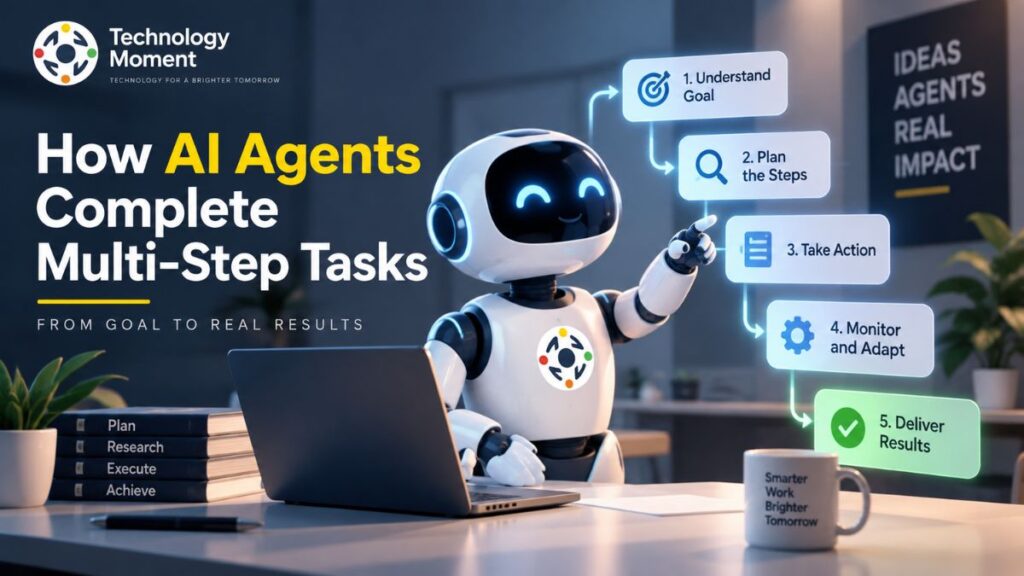
AI agents generally work through a cycle of understanding a goal, planning actions, using tools, observing results, and deciding what to do next. The exact architecture can differ depending on the application, but the basic idea is similar.
First, the agent receives a goal or task. It interprets the request and identifies the desired outcome. Next, it reasons about the problem and creates a plan. For a simple task, this may require only a few steps. More complex tasks may involve several decisions and actions.
The agent can then use tools such as APIs, databases, search systems, software applications, or other services. This tool use allows the agent to interact with information and systems beyond its underlying AI model.
After an action is performed, the agent can examine the result. If the result satisfies the goal, it may finish the task. If not, it can adjust its plan and continue. This creates an iterative workflow rather than a single question-and-answer interaction.
Memory and context can also help an agent maintain relevant information throughout a task. For example, an agent working through a long process may need to remember previous actions, decisions, or user preferences.
A simplified AI agent workflow looks like this:
Goal → Reason → Plan → Use Tools → Take Action → Evaluate Result → Repeat if Needed
What Can AI Agents Do?
AI agents can potentially perform a wide range of tasks that involve information, decisions, and actions. Their capabilities depend on the tools, permissions, data, and AI models available to them.
One major use is task automation. An agent can handle repetitive processes such as organizing information, processing requests, updating records, or coordinating steps across different applications. This can reduce the amount of manual work required from people.
AI agents can also support research and information retrieval. For example, an agent may gather information from approved sources, compare findings, organize relevant data, and create a useful summary. In software development, coding agents can assist with understanding code, writing changes, debugging problems, and working through development tasks.
Business teams can use AI agents for workflows such as customer support, data processing, scheduling, reporting, and internal knowledge retrieval. Productivity-focused agents may help users manage information, coordinate tasks, or interact with connected applications.
More advanced systems can combine several capabilities. An agent might interpret a request, retrieve information, make a decision, call an external service, and then evaluate the outcome.
However, what an AI agent can do should not be confused with what it should do without supervision. Access to sensitive information, financial systems, production software, or other critical resources requires appropriate permissions and safeguards.
The most useful AI agents are therefore not simply those that perform the most actions. They are systems designed to complete meaningful tasks reliably while operating within clear boundaries.
Types of AI Agents
AI agents can be classified into different types based on how they perceive information, make decisions, learn, and interact with their environment. Understanding these categories makes it easier to see why some agents are simple and reactive while others can handle complex, multi-step tasks.
Reactive agents are among the simplest types. They respond to the information currently available to them without maintaining a detailed history of previous interactions. They are useful for straightforward situations where immediate responses are more important than long-term planning.
Goal-based agents work toward a defined objective. Instead of simply reacting to an input, they consider which actions can help them reach a desired outcome.
Utility-based agents go a step further by evaluating different possible actions and selecting an option based on factors such as usefulness, efficiency, or expected results.
Learning agents can improve their behavior by using feedback or experience. Their performance can become better as they receive more information about what works and what does not.
Modern autonomous AI agents can combine reasoning, planning, memory, and tool use to complete multi-step tasks. Multi-agent systems take this concept further by allowing multiple specialized agents to cooperate on a larger objective.
AI Agents vs Chatbots vs AI Assistants
AI agents, chatbots, and AI assistants can appear similar because all three can interact with users through natural language. However, their capabilities and purposes can be quite different.
| Feature | AI Agents | Chatbots | AI Assistants |
|---|---|---|---|
| Conversation | ✓ | ✓ | ✓ |
| Reasoning | ✓ | Limited–✓ | ✓ |
| Tool use | ✓ | Limited | ✓ |
| Autonomous actions | ✓ | Usually limited | Limited–✓ |
| Multi-step tasks | ✓ | Limited | ✓ |
| Workflow automation | ✓ | Limited | ✓ |
For example, a chatbot might explain how to compare software products. An assistant might help create a comparison list. An AI agent could potentially gather information from authorized sources, organize the comparison, apply predefined criteria, and produce a recommendation.
The boundaries are not always absolute. Modern products can combine chatbot, assistant, and agent capabilities. The key distinction is the level of autonomy, tool use, planning, and task execution involved.
AI Agent Architecture
AI agent architecture describes the main components that work together to allow an agent to understand goals, reason about problems, use tools, and perform actions. The exact design varies by application, but several building blocks are common.
At the center of many modern AI agents is a large language model (LLM). It can interpret natural-language instructions, reason through information, and help determine appropriate responses or actions.
Memory and context allow an agent to retain relevant information during a task or, when designed to do so, across interactions. This can help the system maintain continuity instead of treating every step as completely independent.
A planning and reasoning layer helps break a larger objective into manageable steps. The agent can determine what needs to happen first, what information is missing, and which action should come next.
Tools and APIs give the agent access to capabilities beyond the AI model itself. These may include databases, search systems, calculators, business applications, software environments, or other services.
A knowledge retrieval layer can provide relevant information from approved sources, while an action layer allows the agent to interact with external systems.
Finally, evaluation and feedback mechanisms help determine whether an action produced the intended result.
A simplified architecture can be represented as:
User Goal → AI Agent → LLM → Planning & Reasoning → Memory/Knowledge → Tools & APIs → Action → Result → Evaluation
This combination turns an AI model into a system capable of completing structured tasks.
Real-World AI Agent Examples
AI agents are increasingly being explored in situations where people need software to handle several connected steps rather than provide a single response. Their real-world applications range from everyday productivity to complex business operations.
In customer service, an AI agent can potentially understand a customer’s request, retrieve relevant account or product information, check available options, and initiate an approved action. Human support can then handle cases that require judgment or escalation.
In software development, coding agents can assist with tasks such as examining a codebase, identifying potential problems, proposing changes, writing code, and testing modifications. Human developers can review important changes before they reach production.
Research agents can help gather information from permitted sources, organize findings, compare evidence, and create structured summaries. This can be useful when a research task involves multiple stages.
Businesses can also use agents for data analysis and workflow automation. An agent might collect information from connected systems, process it according to predefined instructions, and prepare a report.
For personal productivity, agents may help organize information, manage routine workflows, draft content, or coordinate tasks across connected applications.
Other examples include AI agents for sales operations, IT support, knowledge retrieval, scheduling, document processing, and business automation.
These examples demonstrate an important point: an AI agent is most useful when it has a clearly defined objective, appropriate tools, reliable information, and controlled permissions. The quality of the surrounding system matters just as much as the underlying AI model.
What Are AI Agents Used For?
AI agents are used primarily to automate or assist with tasks that require multiple steps, decisions, information sources, or interactions with software. Their usefulness comes from combining AI reasoning with the ability to perform actions.
One major application is business automation. Agents can support workflows involving customer requests, document processing, data entry, reporting, internal knowledge retrieval, and other repetitive processes. Instead of manually moving information between systems, an agent can potentially coordinate several steps.
AI agents are also useful for research and information retrieval. They can collect relevant information from authorized sources, organize it, identify useful patterns, and produce a structured result. In productivity, agents can help manage routine tasks, summarize information, prepare documents, organize workflows, and interact with connected applications. Their role is not necessarily to replace the user but to reduce the amount of repetitive work the user needs to perform.
Software teams can use AI agents for coding and development, including code analysis, debugging assistance, testing, documentation, and development workflows. Other applications include customer support, sales operations, data processing, IT operations, education, content workflows, and decision support.
The best use cases generally share three characteristics: the task has a clear objective, the agent has access to the necessary tools or information, and appropriate controls can be placed around its actions. As AI agents become more capable, their role is likely to expand from isolated automation toward broader agentic workflows, where AI systems coordinate several tasks while keeping humans involved when judgment, approval, or accountability is required.
Benefits of AI Agents
AI agents can provide value by combining artificial intelligence with the ability to perform tasks and interact with digital systems. Instead of using AI only to generate information, organizations can use agents to help move work forward from one step to the next. One major benefit is automation. AI agents can handle repetitive processes that normally require people to follow the same sequence of actions repeatedly. This can reduce manual effort and give employees more time for work that requires creativity, judgment, or human interaction.
AI agents can also improve productivity by helping users complete multi-step tasks. An agent may gather information, organize it, analyze it, and prepare an output without requiring the user to manage every individual step. Another benefit is workflow optimization. Agents can potentially connect different applications through APIs and tools, allowing information to move between systems as part of a larger workflow. This can be particularly useful for businesses managing complex digital processes.
AI agents can also support decision making by collecting relevant information and presenting it in a structured way. They may identify patterns or provide recommendations, while people remain responsible for important decisions. For organizations, agents can provide scalability by handling a larger volume of routine requests without increasing manual work at the same rate.
However, these benefits depend on implementation quality. Reliable data, appropriate permissions, clear objectives, monitoring, and human oversight are essential if AI agents are expected to deliver consistent results.
How to Build an AI Agent
Building an AI agent starts with defining the problem rather than choosing an AI model. A clear objective makes it easier to determine what the agent should do, what information it needs, and which actions it should be allowed to perform. The first step is to define the agent’s goal. For example, the objective could be researching a topic, processing support requests, analyzing data, or assisting with software development.
Next, choose an appropriate AI model. The model should match the complexity of the task, considering factors such as reasoning capability, speed, cost, and reliability. The agent then needs access to relevant tools and APIs. These tools might include databases, search systems, calculators, business applications, or software environments. Tool access allows the agent to perform actions beyond generating text.
Adding memory and context can help the agent maintain important information throughout a task. A planning mechanism can then determine which actions should happen and in what order. Testing is a critical stage. Developers should evaluate the agent using realistic scenarios, including unexpected inputs and failure cases. Important actions should be protected with permissions and human approval where necessary.
A simple development process is:
Define Goal → Choose Model → Add Tools → Add Memory → Build Workflow → Test → Add Safety Controls → Monitor
The best AI agent is not necessarily the most autonomous one. It is the one that reliably solves a clearly defined problem within appropriate boundaries.
AI Agents and Automation
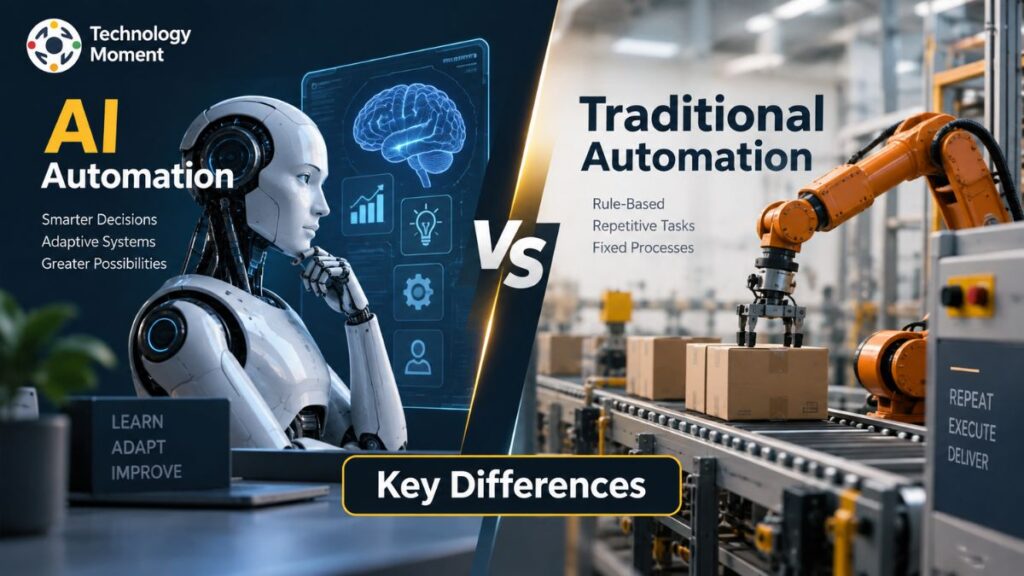
AI agents and automation are closely connected, but they are not exactly the same thing. Traditional automation generally follows predefined rules and workflows. If a specific condition occurs, the system performs a predetermined action. AI agents introduce greater flexibility because they can interpret information, reason about a goal, select tools, and determine what action may be appropriate. Instead of following only a fixed sequence, an agent can adapt its workflow based on the situation.
For example, traditional automation might send a standard email whenever a form is submitted. An AI-powered workflow could analyze the request, classify its purpose, retrieve relevant information, draft a response, and route unusual cases to a human.
This creates a progression from rule-based automation to AI-assisted automation and eventually more autonomous workflows. Agentic workflows can be particularly useful when a process contains variable inputs or requires decisions between multiple possible actions. However, adding AI does not automatically make an automation better. If a task is predictable and well-defined, conventional automation may be faster, cheaper, and easier to control.
AI agents are most valuable when workflows involve interpretation, reasoning, changing conditions, or multiple connected tools. The long-term opportunity lies in combining deterministic software with AI capabilities. Traditional code can handle predictable operations, while AI agents can manage areas that require flexibility. This hybrid approach can deliver useful automation without giving AI unnecessary control over systems where fixed rules are more reliable.
Frequently Asked Questions About AI Agents
What are AI agents in simple terms?
AI agents are AI-powered software systems that can work toward a goal by understanding instructions, making decisions, using tools, and performing actions. Unlike a basic AI chatbot that primarily responds to questions, an AI agent can potentially complete multiple steps to achieve an intended outcome.
How do AI agents work?
AI agents typically receive a goal, interpret the task, create a plan, use available tools, perform actions, and evaluate the results. If the task is not complete, the agent may continue with another step or adjust its approach. Modern agents can use large language models, memory, external APIs, knowledge retrieval, and other software tools.
What can AI agents do?
AI agents can perform many different tasks depending on their design and permissions. Common applications include research, customer support, data processing, coding assistance, productivity, workflow automation, information retrieval, and business operations. Some agents can interact with multiple applications to complete a larger task.
What is the difference between an AI agent and a chatbot?
A chatbot is primarily designed for conversation and responding to user requests. An AI agent is generally designed to accomplish a goal by reasoning about tasks, using tools, and taking actions. Modern chatbots can have agent-like capabilities, so the distinction often depends on how much autonomy and task execution the system provides.
What is the difference between an AI agent and an AI assistant?
An AI assistant usually helps users with tasks such as answering questions, generating content, organizing information, or interacting with selected services. An AI agent can take this further by independently planning and executing multiple steps toward a specific objective. However, the capabilities of assistants and agents can overlap considerably.
Are AI agents fully autonomous?
Not necessarily. Autonomy exists on a spectrum. Some AI agents can perform several actions independently, while others require human approval for specific steps. In high-risk environments, controlled autonomy with clear permissions and human oversight is often more appropriate than unrestricted independent action.
Are AI agents safe?
AI agents can be designed with safety controls, but they are not automatically safe. Risks can include inaccurate information, hallucinations, unauthorized actions, privacy problems, and security vulnerabilities. Appropriate permissions, monitoring, testing, human approval, and clear operational boundaries can help reduce these risks.
How are AI agents used in business?
Businesses can use AI agents for customer support, research, data processing, workflow automation, internal knowledge retrieval, software development, reporting, and other operational tasks. Their greatest value can come from handling multi-step workflows that would otherwise require employees to move information between several systems manually.
Can I build my own AI agent?
Yes. Building an AI agent generally involves defining a goal, selecting an appropriate AI model, connecting tools or APIs, adding relevant context or memory, creating the workflow, testing its behavior, and implementing safety controls. The complexity depends on what the agent needs to accomplish and which systems it must interact with.
What is the future of AI agents?
AI agents are likely to become more capable of handling complex, multi-step workflows across different applications. Developments in reasoning, tool use, memory, and AI orchestration could make agents more useful for both individuals and organizations. At the same time, reliability, security, transparency, and human oversight will remain important as their capabilities increase.