Artificial intelligence is moving beyond simple conversations. Today, AI chatbots can answer questions, explain complex topics, and assist with everyday tasks, while AI agents are being designed to take a more active role by planning actions, using tools, and completing multi-step tasks.
This shift has created an important question: what is the actual difference between AI agents and AI chatbots? Although the two technologies can look similar on the surface, they differ significantly in how they operate, what they can accomplish, and how much autonomy they have.
At Technology Moment, we focus on making fast-changing technology easier to understand without adding unnecessary complexity or hype. In this guide, we’ll break down AI agents and AI chatbots, compare their capabilities, explore real-world use cases, and explain when each approach makes the most sense.
By the end, you’ll have a clearer understanding of AI agents vs AI chatbots and how this distinction is shaping the next generation of AI-powered tools and workflows.
What Are AI Chatbots?
AI chatbots are software systems designed to communicate with people through natural language. They use technologies such as artificial intelligence, natural language processing (NLP), machine learning, generative AI, and large language models (LLMs) to understand user input and generate relevant responses. Unlike traditional rule-based chatbots, modern AI chatbots can handle more flexible conversations and respond to a wider range of questions.
A typical AI chatbot works by receiving a message, interpreting its meaning and context, and generating a response based on its trained knowledge or connected information sources. Some systems can also use knowledge retrieval or retrieval-augmented generation (RAG) to provide responses using external information.
AI chatbots are commonly used for customer support, answering frequently asked questions, providing product information, assisting users, and supporting everyday productivity. Conversational AI makes these interactions feel more natural because users can communicate using ordinary language rather than predefined commands.
However, AI chatbots generally remain focused on conversation and response generation. Their ability to independently make decisions or complete complex tasks depends on the tools and integrations available to them. This distinction becomes especially important when comparing traditional AI assistants and virtual assistants with newer autonomous AI systems.
What Are AI Agents?
AI agents are AI-powered systems designed to work toward a specific goal rather than simply respond to individual questions. An AI agent can combine reasoning, planning, decision-making, memory, tool calling, and task execution to complete a series of actions. This makes AI agents an important part of the broader movement toward agentic AI and autonomous AI.
Instead of only generating a response, an AI agent can potentially determine what steps are necessary to accomplish a task. For example, an agent may break a complex objective into smaller tasks, retrieve information, interact with external tools, use APIs, evaluate results, and continue working until the defined objective is completed or human intervention is required.
The exact level of autonomy varies between systems. Some intelligent agents may require approval before taking important actions, while others can execute predefined workflows with minimal supervision. Features such as AI reasoning, AI planning, context awareness, persistent memory, API integrations, and external tools can significantly expand an agent’s capabilities.
AI agents are particularly useful for workflow automation, business process automation, productivity automation, research, customer service automation, and enterprise AI. Their value comes not simply from producing intelligent answers, but from connecting those answers to actions and measurable outcomes.
AI Agents vs AI Chatbots: What’s the Difference?
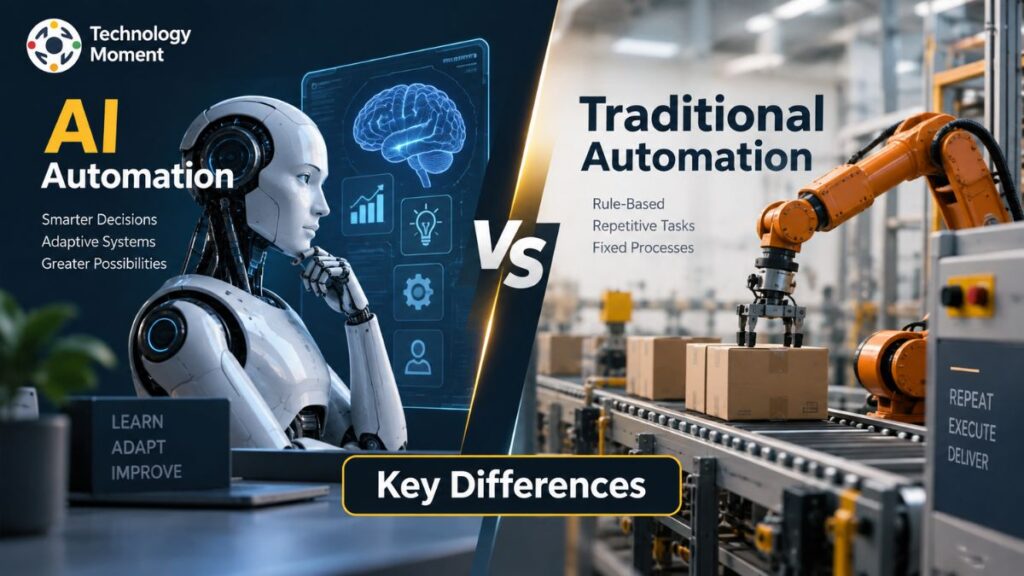
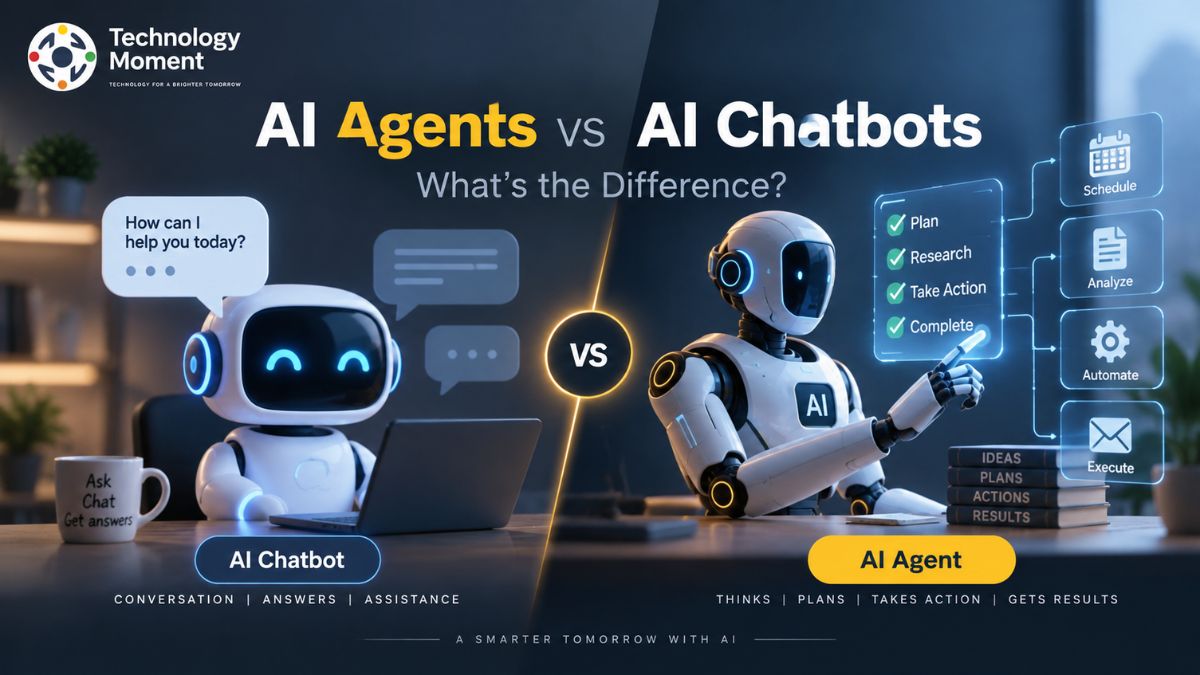
The main difference between AI agents and AI chatbots is their primary purpose. AI chatbots are generally built to communicate, understand requests, and provide responses. AI agents are designed to pursue goals and perform tasks, often across multiple steps. While both can use generative AI and large language models, their operational capabilities can be very different.
| Feature | AI Chatbots | AI Agents |
|---|---|---|
| Primary purpose | Conversation | Goal/task completion |
| Autonomy | Limited | Higher |
| Reasoning | Usually response-focused | Goal-oriented |
| Task execution | Limited | Multi-step |
| Tool use | Limited/optional | Core capability |
| API integrations | Limited | Common |
| Memory | Varies | Can be persistent |
| Decision making | Limited | More autonomous |
| Workflow automation | Limited | Strong |
| Human oversight | Often required | Can be reduced but remains important |
An AI chatbot might answer a question such as, “What is the best way to organize my weekly schedule?” An AI agent could potentially go further by analyzing a user’s requirements, checking connected calendars, identifying conflicts, creating a proposed schedule, and carrying out approved changes.
Another important distinction is autonomy. Chatbots are commonly reactive: they wait for a user message and respond. AI agents can be designed to plan and execute actions based on a defined objective. They may also use tool calling, API integrations, real-time data, knowledge retrieval, and AI workflow orchestration.
However, this does not mean every AI agent is completely autonomous or every chatbot is limited to simple conversations. Modern systems can combine chatbot interfaces with agentic capabilities. Therefore, the distinction is better understood as a spectrum of capabilities rather than two completely separate technologies.
AI Agents vs AI Chatbots: Key Differences Explained
Several characteristics help explain the practical difference between AI agents and chatbots. The first is task execution. A chatbot typically handles a conversation one interaction at a time, while an AI agent can be designed to manage multi-step tasks and coordinate several actions. The second difference is reasoning and planning. AI chatbots can generate sophisticated answers, but AI agents may use AI reasoning, AI planning, and autonomous decision-making to determine what should happen next. Their behavior depends heavily on how the underlying system is designed.
Tool usage is another major distinction. An AI agent can be connected to external tools, APIs, databases, software applications, and real-time data sources. These integrations allow the system to move beyond information delivery toward actual task completion. Memory and context can also play an important role. Some agents maintain information across interactions through memory systems, enabling more personalized or continuous workflows. Chatbots may also have memory, so this feature alone does not define an agent.
Finally, there is the question of human oversight. Both technologies can require human supervision, particularly when actions involve sensitive information, money, security, or important business decisions. The goal of agentic systems is not necessarily to eliminate humans, but to automate appropriate parts of a workflow while keeping meaningful human-in-the-loop controls where they matter.
AI Agents and AI Chatbots: Real-World Examples
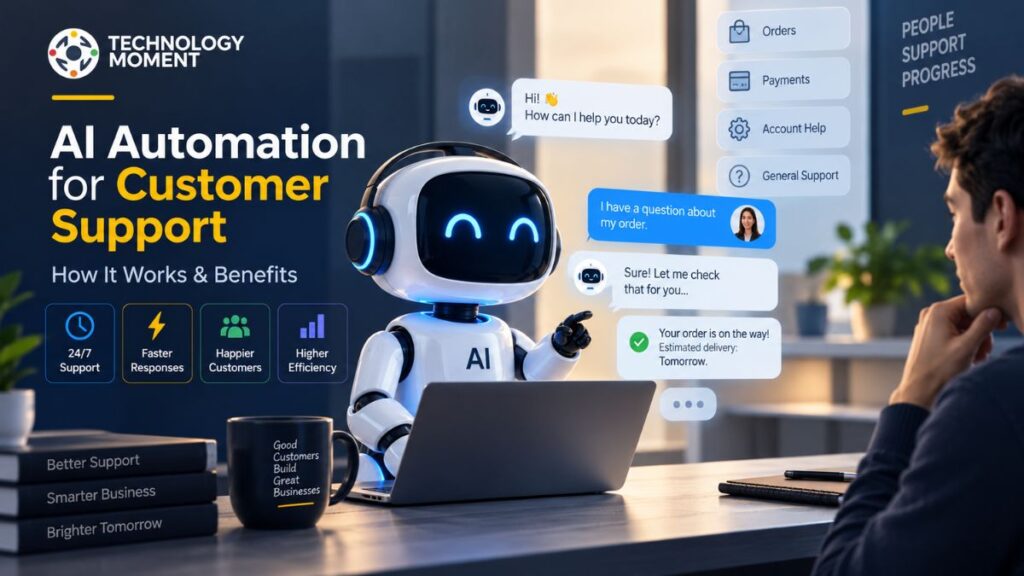
The easiest way to understand AI agents and chatbots is to look at how they might be used in real situations. Consider customer support. An AI chatbot can answer common questions about pricing, features, account access, or product policies. It can provide immediate assistance through a conversational interface without requiring a human representative for every basic request.
An AI agent can potentially handle a broader workflow. For example, after receiving a customer request, an agent could identify the issue, retrieve relevant account information, check connected systems, perform approved actions, and escalate the case when human assistance is necessary. The exact capabilities depend on its permissions and integrations.
In productivity, an AI chatbot might help a user draft an email, summarize information, or explain a document. An AI agent could potentially coordinate several related tasks, such as gathering information, organizing it, interacting with connected applications, and producing a completed workflow.
For businesses, AI agents for business automation can support repetitive processes involving multiple systems, while AI chatbots remain useful for communication and information access. Developers can also use software agents for coding, testing, research, or other structured workflows.
These examples show why the comparison is not simply about which technology is more advanced. AI chatbots are valuable when conversation is the primary requirement, while AI agents become more useful when the objective involves planning, tool use, decision-making, and multi-step task execution.
AI Agents vs AI Chatbots: Use Cases
The practical difference between AI agents vs AI chatbots becomes clearer when looking at their use cases. AI chatbots are particularly useful when the primary requirement is communication, information access, or conversational assistance. Businesses commonly use AI chatbots for customer support, frequently asked questions, product guidance, lead qualification, and basic troubleshooting. They can also support users with writing, research, summarization, and everyday productivity.
AI agents are better suited to workflows that involve multiple steps or require interaction with other systems. AI agents for business automation can potentially collect information, analyze it, make decisions based on predefined objectives, and execute approved actions. They can support workflow automation, task automation, business process automation, and enterprise automation across connected applications.
For example, a chatbot could explain a company’s refund policy, while an AI agent could potentially inspect an eligible request, retrieve relevant order information, initiate an approved refund, and update the appropriate system. AI agents can also support research, software development, data processing, customer service, and productivity workflows. However, their usefulness depends on available tools, permissions, data quality, and system design.
In short, choose a chatbot when conversation is the main task and consider an AI agent when the requirement involves goals, actions, tools, and multi-step task execution.
Are AI Agents Better Than AI Chatbots?
Whether AI agents are better than AI chatbots depends on the problem being solved. It is tempting to view AI agents as a more advanced replacement for chatbots, but that comparison can be misleading. Each technology serves different requirements.
An AI chatbot can be the better option when users primarily need quick answers, conversational assistance, customer support, or access to information. A simpler system can also be easier to deploy, maintain, monitor, and control. For many businesses, adding unnecessary autonomous behavior could increase complexity without providing meaningful benefits.
AI agents become more valuable when a task requires AI reasoning, planning, decision-making, tool calling, API integrations, and multi-step execution. Instead of stopping after generating an answer, an agent can potentially continue through a workflow to achieve a defined objective. However, greater autonomy can introduce additional risks. AI agents may make incorrect decisions, misuse connected tools, encounter API failures, or require stronger security controls. Sensitive workflows may therefore need human oversight and human-in-the-loop approval.
The better question is not “Are AI agents better?” but “Which technology is appropriate for this task?” A well-designed chatbot can outperform an unnecessarily complex agent for simple conversational needs, while an agent can provide significantly greater value for complex, action-oriented workflows.
Advantages and Limitations of AI Agents
One of the biggest advantages of AI agents is their ability to support multi-step tasks. Rather than responding to one instruction and stopping, an agent can potentially break a goal into smaller actions, execute those actions, evaluate results, and continue through a workflow.
This makes AI agents useful for AI workflow automation, business process automation, productivity automation, and enterprise AI. With suitable integrations, an agent can interact with external tools, APIs, databases, and other software systems. This can reduce repetitive manual work and create more efficient AI-powered workflows.
Another advantage is flexibility. An AI agent can potentially combine reasoning, planning, knowledge retrieval, context awareness, and tool calling to address tasks that are difficult to handle through simple conversational systems. However, these capabilities also introduce limitations. AI agents can be more complicated to build and maintain than conventional chatbots. They may require reliable integrations, strong permission systems, monitoring, testing, and clear boundaries around autonomous decision-making.
There are also risks related to incorrect reasoning, unreliable outputs, security, privacy, and unintended actions. Real-world systems therefore often benefit from human oversight for high-impact operations. AI agents should not be treated as completely independent digital employees by default. Their reliability depends on the model, tools, data, workflow design, safeguards, and level of autonomy provided by the system.
Advantages and Limitations of AI Chatbots
AI chatbots offer an accessible way for people to interact with artificial intelligence through natural language. Their conversational interface makes them useful for customer support, information retrieval, content assistance, education, and everyday productivity. One major advantage is simplicity. Users can describe what they need in ordinary language without learning complicated software commands. Modern chatbots powered by generative AI and large language models (LLMs) can also handle a broad range of questions and generate natural responses.
Businesses can use AI chatbots to provide around-the-clock support, answer repetitive questions, guide customers through products, and reduce the workload associated with basic support requests. They can also function as AI-powered assistants, virtual agents, or digital assistants for specific use cases.
However, chatbots have limitations. A chatbot primarily designed for conversation may not be capable of independently completing complex workflows. Its ability to perform actions depends on whether it has access to appropriate tools, APIs, databases, and permissions.
Other challenges include inaccurate responses, limited context, knowledge gaps, and potential hallucinations. Even advanced AI chatbots require appropriate evaluation and safeguards, particularly when used for important decisions. For simple communication and information-based tasks, these limitations may be acceptable. When the objective requires autonomous planning, external tool use, and continuous task execution, an AI agent may be a more appropriate architecture.
AI Agents, Chatbots, and Agentic AI
AI agents, chatbots, and agentic AI are closely connected but should not be treated as identical concepts. A chatbot describes an interaction-oriented system, while an AI agent describes a system capable of pursuing goals and performing actions. Agentic AI is the broader approach of creating AI systems that can reason, plan, adapt, and take actions with varying degrees of autonomy.
Conversational AI provides the interface through which users can communicate with these systems. This means a single product can combine chatbot-style conversations with agentic capabilities. A user may type a request into a familiar chat interface while an underlying agent handles planning, tool calling, information retrieval, and task execution.
This distinction is important because not every system that appears conversational is simply a chatbot, and not every AI agent needs to communicate through a traditional chat interface. Autonomous AI systems can operate with greater independence, but autonomy exists on a spectrum. Some systems may require approval before every important action, while others can complete predefined workflows with minimal intervention.
The development of agentic systems is closely associated with AI orchestration, AI workflow orchestration, intelligent automation, AI decision support, and autonomous workflows. As these technologies mature, the boundary between conversational assistants and action-oriented AI systems may become less visible to users.
The important distinction remains the underlying capability: chatbots primarily facilitate interaction, while agentic systems can use AI to pursue objectives and take actions within defined boundaries.
AI Agents vs AI Chatbots: Which One Should You Use?
Choosing between AI agents vs AI chatbots depends primarily on what you want the system to accomplish. If your main requirement is answering questions, supporting conversations, providing information, or helping users through a conversational interface, an AI chatbot may be the more practical choice. Chatbots are relatively straightforward for many customer support, FAQ, and information-based applications.
An AI agent becomes more appropriate when the objective involves task execution, workflow automation, planning, decision-making, or interaction with external tools. For example, an agent may be designed to gather information from multiple sources, process it, use APIs, and complete several connected steps toward a defined goal.
Consider four questions before choosing a solution. First, does the system mainly need to talk or act? Second, does the task require a single response or multiple steps? Third, does it need access to external tools or real-time data? Finally, how much autonomy can safely be provided? For simple conversational requirements, adding agentic capabilities may introduce unnecessary complexity and cost. For sophisticated workflows, however, a basic chatbot may not provide enough functionality.
The right choice is therefore based on the problem, risk, integrations, and desired level of autonomy, rather than simply choosing the technology that appears more advanced.
The Future of AI Agents and Chatbots
The future of AI agents and chatbots is likely to involve increasingly capable systems that combine conversation, reasoning, automation, and action. Instead of treating chatbots and agents as completely separate technologies, software developers are increasingly able to combine conversational interfaces with agentic AI capabilities.
This could make AI assistants more useful across everyday and professional workflows. A user may interact with an AI through a familiar chat interface while the underlying system performs research, retrieves information, coordinates applications, or completes approved tasks. AI workflow automation, autonomous workflows, AI orchestration, and intelligent automation are likely to remain important areas of development. Businesses are particularly interested in systems that can reduce repetitive work while maintaining appropriate controls and accountability.
However, greater autonomy will not automatically mean better AI. Reliability, security, privacy, transparency, and human oversight will remain critical. Systems that can access external tools or make decisions need clearly defined permissions and safeguards. The evolution of autonomous AI will therefore likely be less about giving AI unlimited control and more about creating dependable systems that can operate within well-defined boundaries.
As AI technology develops, the distinction between an AI chatbot and an AI agent may become less obvious from the user’s perspective. What will matter most is whether the system can safely and reliably help users achieve meaningful outcomes.
Conclusion: AI Agents vs AI Chatbots
The difference between AI agents and AI chatbots becomes easier to understand when their core purposes are separated. AI chatbots are primarily designed for conversation. They can understand natural language, answer questions, retrieve information, and assist users through conversational interactions.
AI agents are designed for a broader role. Depending on their architecture and permissions, they can use AI reasoning, planning, tool calling, API integrations, memory, knowledge retrieval, and task execution to work toward specific objectives. This makes them particularly useful for complex workflows and automation.
Neither technology is universally better. A chatbot can be the ideal solution for customer support, FAQs, information access, and straightforward conversational assistance. An AI agent can be more suitable when a task requires multiple steps, external tools, workflow automation, or a greater degree of autonomous action.
It is also important to remember that “AI agent” does not automatically mean fully autonomous. Real-world systems can operate at different levels of independence and may require human-in-the-loop approval for important actions. Ultimately, the best technology is the one that matches the user’s actual needs. Understanding the distinction between conversational AI and agentic systems helps businesses and individuals choose AI tools more thoughtfully and avoid adding unnecessary complexity to their workflows.
Frequently Asked Questions About AI Agents vs AI Chatbots
What is the difference between AI agents and chatbots?
AI chatbots primarily focus on conversation, answering questions, and providing information. AI agents can go further by planning tasks, using tools, accessing connected systems, making decisions, and completing multiple steps toward a goal. However, their actual capabilities depend on their architecture, integrations, permissions, and level of autonomy.
Are AI agents better than AI chatbots?
AI agents are not always better than AI chatbots. Chatbots are often ideal for customer support, FAQs, and conversational assistance, while AI agents are more suitable for complex workflows, automation, and multi-step tasks. The right choice depends on the user’s requirements, system complexity, risk level, integrations, and desired outcome.
Can AI chatbots become AI agents?
Yes, a chatbot can be extended with capabilities such as planning, memory, tool calling, API integrations, decision-making, and task execution. When these capabilities allow the system to pursue defined goals and perform actions, it can function more like an AI agent rather than a traditional conversational chatbot.
What are AI agents used for?
AI agents can support many tasks, including business automation, workflow automation, research, customer service, productivity, software development, and data processing. Their capabilities depend on connected tools, information sources, permissions, and workflow design. Organizations can use them to automate repetitive multi-step processes while maintaining appropriate human oversight.
What are AI chatbots used for?
AI chatbots are commonly used for customer support, frequently asked questions, information retrieval, conversational assistance, education, and productivity. Modern chatbots powered by generative AI can understand natural language and provide flexible responses, making them useful for organizations that primarily need communication and information-based assistance.