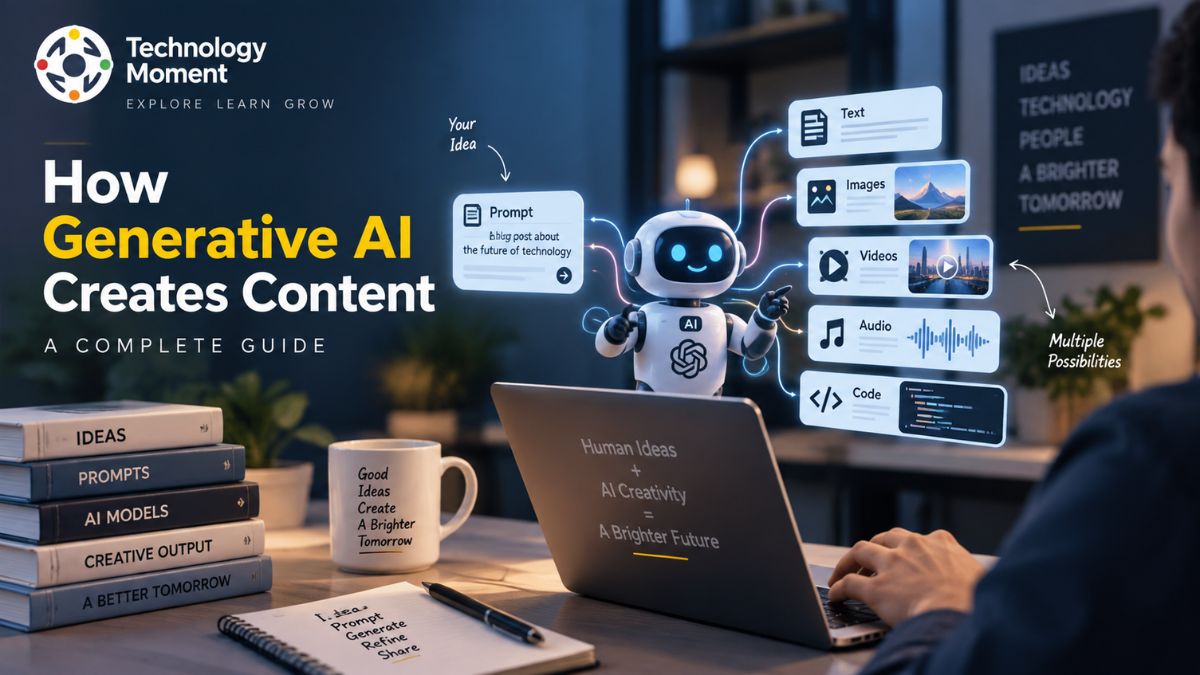
Generative AI is changing the way people create content. From writing articles and generating images to producing videos, audio, and code, AI systems can now turn simple instructions into useful digital content within seconds. But how does this actually happen?
Behind every AI-generated result is a combination of training data, machine learning, neural networks, large language models, and sophisticated algorithms that recognize patterns and generate new outputs based on a user’s prompt. Understanding this process can help you use generative AI more effectively and recognize both its capabilities and limitations.
At Technology Moment, we explore emerging technologies in a clear, practical, and easy-to-understand way, helping readers make sense of the technologies shaping the future. In this guide, we’ll break down how generative AI creates content, from the initial prompt and AI processing to the generation of text, images, and videos.
Whether you are a curious beginner, content creator, marketer, developer, or technology professional, this guide will give you a clear understanding of what happens behind the scenes when generative AI creates content.
How Does Generative AI Create Content?
Generative AI creates content by learning patterns from large amounts of training data and using those patterns to produce new outputs in response to a user’s instructions. Unlike traditional software that follows a fixed set of rules, generative AI models can generate text, images, videos, audio, code, and other forms of digital content.
The process generally begins with AI training. During training, machine learning models analyze large datasets and learn relationships between words, images, concepts, structures, and other patterns. Large language models (LLMs), for example, learn how language is commonly structured and how different pieces of information relate to one another.
When a user provides a prompt, the AI model processes the request and determines what kind of output is most appropriate. It then uses its learned patterns to generate content step by step. For text, this can involve predicting the next token based on the context that came before it. For images, generative models interpret descriptions and create visual patterns that correspond to the prompt.
This is why how generative AI creates content is best understood as a combination of training, pattern recognition, prompt processing, and probabilistic generation. The final output is generated dynamically rather than simply retrieved from a database.
How AI Turns a Prompt Into Content
A prompt is the starting point for many generative AI systems. It tells the model what the user wants and can include instructions, context, questions, examples, or specific formatting requirements. The clearer the prompt, the easier it is for an AI system to understand the intended task.
When a prompt is submitted, the model first processes the input. In language-based systems, the text is divided into smaller units called tokens. These tokens are represented in a form the model can mathematically process. Embeddings help represent relationships between words, concepts, and other pieces of information within the model.
The AI then considers the context of the prompt and applies patterns learned during training. This is where prompt engineering can make a significant difference. A detailed prompt can specify the audience, tone, subject, format, length, and desired outcome, giving the model more useful context.
The model then performs inference and generates an output. In text generation, it typically predicts likely next tokens one after another until the response is complete. This process is probabilistic, meaning the model does not simply select one predetermined answer. As a result, how AI generates content from prompts depends on both the capabilities of the underlying model and the quality of the instructions provided by the user. Human review is still important because generated content can contain errors, omissions, or AI hallucinations.
What Technology Powers Generative AI?
Several technologies work together to make modern generative AI possible. At the foundation are machine learning and deep learning, which allow models to learn complex patterns from large datasets. Neural networks provide the computational structure used to recognize and represent these patterns.
For language-based applications, natural language processing (NLP) helps AI systems process and work with human language. Modern large language models rely heavily on transformer architecture, which allows models to analyze relationships between different parts of an input and understand context more effectively.
Large language models (LLMs) are a major example of generative AI technology. They are trained on extensive collections of text and learn statistical relationships within language. During inference, an LLM uses those learned relationships to generate text based on an input prompt.
Other generative models are designed for different types of content. Image-generation systems learn visual patterns, while video-generation models work with sequences of visual information and movement. Increasingly, multimodal AI systems can work across several content types, such as text, images, audio, and video.
Foundation models provide a broader technological base for many of these applications. Algorithms, neural networks, training data, model inference, and increasingly sophisticated AI models all contribute to the final generation process. Understanding these technologies explains why generative AI can perform tasks that previously required specialized software and significant manual effort.
How Generative AI Creates Text
Generative AI creates text primarily by using language models that have learned patterns from large amounts of textual training data. These models do not write in exactly the same way a human does. Instead, they use statistical relationships learned during training to determine what sequence of tokens is likely to follow a given context.
When you enter a prompt, the model analyzes the words and surrounding context. It then begins text generation by predicting a suitable next token. After selecting a token, the model considers the expanded sequence and predicts another. This process continues until the requested response is produced.
This next-token prediction mechanism allows LLMs to generate many forms of content, including articles, explanations, summaries, emails, stories, product descriptions, and code. Because the model has learned patterns across different writing styles and subjects, it can produce text that often appears natural and coherent.
However, fluent language does not guarantee accuracy. AI-generated text may contain incorrect facts, outdated information, unsupported claims, or fabricated details. These are commonly referred to as AI hallucinations. For this reason, AI-assisted writing works best when humans remain involved in the process. A writer can use AI to develop ideas, create an initial draft, restructure information, or accelerate repetitive tasks, while applying human judgment for accuracy, originality, expertise, and context.
How Generative AI Creates Images
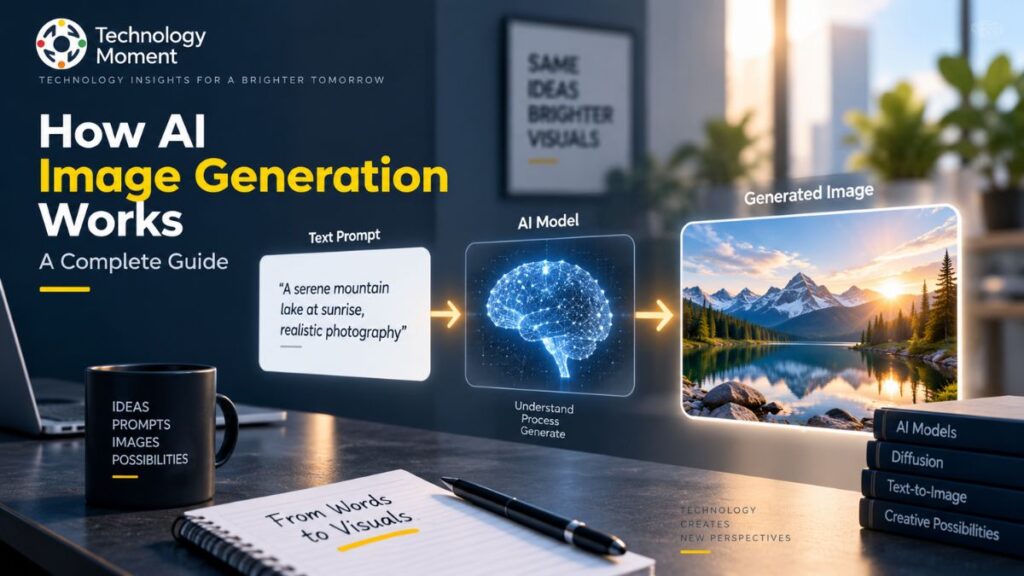
Generative AI can create images by learning visual patterns from large collections of training data and using those learned relationships to produce new visual outputs. Instead of manually drawing every element, users can describe what they want through a text prompt, and an image-generation model attempts to translate that description into a visual result.
The process begins when the model interprets the prompt. It identifies concepts such as objects, environments, subjects, styles, composition, and relationships between different elements. The model then uses its learned representation of visual patterns to construct an image that corresponds to those instructions.
Modern image-generation systems use different generative techniques and model architectures, but the underlying principle is similar: the system has learned statistical relationships between language and visual information and uses those relationships during inference. For example, a prompt describing a futuristic technology laboratory can provide information about the environment, objects, lighting, composition, and visual style. The model uses that information to generate an image rather than simply searching for an existing picture.
The quality of the result depends on factors such as the model, training data, prompt quality, and the complexity of the requested scene. AI-generated images can also contain mistakes, particularly with fine details, text, hands, proportions, or unusual objects. As generative image technology develops, it is becoming an important part of AI content creation, allowing creators, designers, marketers, publishers, and businesses to produce visual assets faster while still benefiting from human creative direction.
How Generative AI Creates Videos
Generative AI has expanded beyond text and images into video generation, allowing users to create moving visual content from written instructions, images, or existing media. Although the technology is more complex than generating a single image, the basic idea is similar: an AI model learns patterns from large amounts of visual and temporal training data and uses those patterns to produce new content.
When a user provides a prompt, the system interprets important elements such as the subject, environment, movement, camera perspective, visual style, and duration. The model then attempts to generate a sequence of frames that remain visually consistent while representing the requested action or scene.
Modern AI-generated videos may combine several technologies, including generative models, computer vision, language understanding, and multimodal AI. Some systems can also use an existing image as a starting point and transform it into an animated sequence. However, video generation presents unique challenges. The AI must maintain consistency between frames, preserve the appearance of objects, and represent realistic movement over time. Errors can therefore become more noticeable than they are in a single image.
Despite these limitations, AI-generated videos are becoming useful for marketing, education, storytelling, product demonstrations, social media, and creative experimentation. As the technology improves, AI content creation is likely to become increasingly multimodal, combining generated text, images, video, and audio within the same workflow.
How AI Generates Different Types of Content
Generative AI can produce different forms of digital content because specialized models are designed to understand and generate different types of information. Some systems focus on language, while others specialize in images, video, audio, or code. Increasingly, multimodal systems can work with several of these formats together.
| Content Type | How AI Generates It |
|---|---|
| Text | Language models predict and generate sequences of tokens based on context. |
| Images | Generative image models transform prompts or other inputs into visual content. |
| Videos | Video-generation models create sequences of frames representing movement and scenes. |
| Audio | Generative audio models create speech, music, sound effects, or other audio patterns. |
| Code | AI coding models generate programming code based on instructions and contextual patterns. |
For text, large language models are commonly used for writing, summarization, translation, and AI copywriting. Image-generation systems can create illustrations, designs, and realistic scenes. Video-generation models extend these capabilities into moving content, while audio models can generate speech and music.
This broad range of capabilities makes generative AI useful for many applications. Instead of relying on one tool for every task, organizations can combine multiple AI models within connected content workflows. The important distinction is that each content type has different technical requirements and limitations. The quality of AI-generated content depends on the model, training data, prompt, context, and human review applied to the final output.
What Is Multimodal Generative AI?
Multimodal AI refers to artificial intelligence systems that can understand, process, or generate information across multiple formats, such as text, images, audio, video, and sometimes code. Traditional AI applications often focus on one type of data, while multimodal generative AI brings several forms of information together.
For example, a multimodal system might receive a product image and a written instruction, analyze both inputs, and generate a detailed description. Another system could accept text and images and produce a response that considers information from both. This ability makes AI systems more flexible when handling complex real-world tasks.
Multimodal generative AI relies on models and architectures capable of connecting different types of information. Instead of treating text, visual information, and audio as completely separate domains, these systems can learn relationships between them. This has important implications for AI content creation. A content workflow could begin with a written idea, generate an article, create supporting images, produce a short video, and prepare related social media content. Human creators can then review and refine each output.
However, multimodal AI does not eliminate the need for human judgment. Different media formats can introduce different errors, and generated information still needs appropriate verification. As these systems mature, multimodal AI could make content workflows more integrated, allowing creators and businesses to move from an idea to multiple forms of digital content with fewer manual steps.
How AI Content Generation Works in Real-World Applications
In real-world environments, AI content generation is usually part of a broader workflow rather than a completely automated process. A business may begin with a goal, provide relevant information to an AI model, generate an initial output, and then have a person review, edit, and approve the result.
For example, marketing teams can use generative AI to develop campaign ideas, draft social media posts, create product descriptions, or adapt existing content for different audiences. Publishers can use AI-assisted writing to organize research or create initial drafts, while designers can use image-generation tools to explore visual concepts.
AI can also support content automation. Repetitive tasks such as creating variations of product copy, summarizing information, or transforming one piece of content into different formats can be handled more efficiently with AI tools. The real value comes from integrating these capabilities into structured content workflows. Instead of asking AI to create everything independently, organizations can define where AI should assist and where human expertise is required.
This approach can improve speed and scalability while maintaining quality. For example, AI may generate a first draft, but an editor can verify facts, improve clarity, add original insights, and ensure the content matches the intended audience. The result is not simply automated content. It is a form of human-AI collaboration in which AI handles certain computational and repetitive tasks while people provide judgment, expertise, creativity, and accountability.
What Makes AI-Generated Content Different From Human-Created Content?
AI-generated content and human-created content can sometimes appear similar, but the processes behind them are fundamentally different. Human creators draw on personal experience, knowledge, emotions, intentions, observations, and creative judgment. Generative AI, by contrast, produces outputs by processing inputs and generating patterns learned from its training data.
One major difference is speed and scalability. AI can generate large amounts of content quickly, making it useful for repetitive or high-volume tasks. A human creator generally needs more time to research, write, design, or produce each individual piece. AI can also recognize and reproduce patterns across different formats. This makes it effective for generating drafts, variations, summaries, and structured content. However, pattern generation does not necessarily equal genuine understanding, personal experience, or independent judgment.
Another important difference is AI content quality. AI-generated material can be fluent and well-structured while still containing inaccurate information or missing important context. Human-created content can also contain mistakes, but human expertise and firsthand experience can provide perspectives that a model may not possess.
The strongest approach is therefore often human-AI collaboration. AI can accelerate research, drafting, ideation, personalization, and content production, while humans provide verification, originality, expertise, and final editorial judgment. Rather than viewing AI as a complete replacement for human creators, it is more useful to see generative AI as a powerful technology that can extend what people are able to create.
Limitations of Generative AI Content
Generative AI can make content creation faster and more efficient, but it has important limitations. One of the biggest concerns is AI hallucinations, where an AI system produces information that sounds convincing but is inaccurate, incomplete, or entirely fabricated. This is especially important when creating content that depends on factual or current information.
Another limitation is content accuracy. Generative AI models generate outputs based on patterns learned during training and the information available in their current context. They do not automatically guarantee that every statement is correct. Important claims, statistics, technical details, and references should therefore be independently verified before publication.
AI systems can also struggle with context, nuance, and specialized expertise. A response may appear well written while overlooking an important qualification or misunderstanding the user’s actual intention. This can affect overall AI content quality. There are also broader concerns involving bias, privacy, intellectual property, and copyright and AI. The appropriate use of AI-generated material depends on the content, model, jurisdiction, and applicable rules.
For these reasons, responsible AI use requires human oversight. AI can assist with research, drafting, ideation, and content automation, but people should remain responsible for reviewing important outputs. Treating generative AI as an assistant rather than an unquestionable authority can reduce risks and produce more reliable content.
Is AI-Generated Content Original?
Whether AI-generated content is considered original is more complicated than simply asking whether an AI created it. Generative AI produces new outputs by applying patterns learned from its training data to a user’s instructions. The resulting output may be different from anything previously generated, but that does not automatically answer questions about originality, authorship, or copyright.
For example, an AI system can generate a completely new article based on a prompt. However, the model’s ability to produce that article comes from patterns learned during AI training. This is one reason copyright and AI remain important areas of discussion. AI-generated content can also vary significantly depending on the prompt, model, settings, and context. Two users can provide similar instructions and receive different results because generative models use probabilistic generation rather than retrieving one fixed response.
For publishers and creators, originality should therefore involve more than simply generating new text. Adding original research, firsthand experience, expert analysis, unique examples, and meaningful editorial judgment can significantly improve the value of the final content. The strongest approach is human-AI collaboration. AI can assist with brainstorming, structure, drafting, and transformation, while humans contribute expertise, verification, perspective, and creativity.
Before publishing AI-generated content, creators should review its accuracy, originality, sources, and potential intellectual-property concerns rather than assuming that every generated output is automatically original or unrestricted.
How to Create Better Content With Generative AI
Creating better content with generative AI starts with treating the technology as a tool for collaboration rather than a replacement for human judgment. The first step is to provide a clear objective. Instead of using a vague instruction, explain the topic, audience, purpose, tone, format, and important requirements.
Prompt engineering can improve results by giving the AI model useful context. For example, a content creator can specify the intended audience, key questions to answer, information to include, and the desired structure. Providing relevant source material can also help the model produce a more focused response.
After generating an initial output, review it carefully. Check factual claims, statistics, technical information, quotations, and other important details. AI-generated content should not be considered accurate simply because it sounds professional. Human editing is equally important. Add original insights, examples, experience, expert opinions, and context that make the content genuinely useful. This improves AI content quality and prevents the final result from feeling generic.
Generative AI can also support AI-assisted writing, content personalization, content optimization, and repetitive production tasks. However, automation should be combined with appropriate editorial controls.
A practical workflow is:
Define the goal → Write a detailed prompt → Generate a draft → Verify information → Add human expertise → Edit and improve → Final review → Publish.
This approach allows creators to benefit from AI’s speed while maintaining accuracy, usefulness, originality, and editorial responsibility.
Conclusion — How Generative AI Creates Content
Generative AI creates content by combining large-scale training, machine learning, pattern recognition, model inference, and user instructions. Depending on the model, it can generate text, images, videos, audio, code, and other forms of digital content.
The process generally starts with a prompt or another form of input. The AI system processes that information, identifies relevant patterns, and generates an output based on what it has learned. For language models, this often involves next-token prediction. Other generative models use different approaches to create images, videos, audio, or multimodal content.
This technology has made AI content creation faster and more accessible. Businesses, marketers, publishers, developers, designers, and individual creators can use AI tools to support research, ideation, writing, design, automation, and content workflows.
However, generative AI also has limitations. AI hallucinations, content accuracy problems, bias, copyright concerns, and inconsistent outputs mean that human oversight remains essential. The most effective approach is therefore human-AI collaboration. AI can handle many repetitive and computational tasks, while people provide expertise, creativity, critical thinking, verification, and accountability.
At Technology Moment, the goal is to make emerging technology easier to understand so readers can evaluate both its opportunities and limitations. Understanding how generative AI works is the first step toward using it responsibly and effectively.
Frequently Asked Questions About Generative AI Content
Can generative AI create images and videos?
Yes. Generative AI systems can create images and videos from text prompts or other inputs. Image and video generation models analyze learned visual patterns to produce new visual content.
What technology powers generative AI?
Generative AI relies on technologies including machine learning, deep learning, neural networks, transformer architecture, natural language processing, generative models, and large language models.
Is AI-generated content original?
AI-generated content can be newly generated, but originality, authorship, and copyright are separate questions. Human review, original research, expert input, and meaningful editorial contribution can add significant value.
What are the limitations of generative AI?
Common AI limitations include hallucinations, inaccurate information, bias, limited contextual understanding, inconsistent outputs, and potential copyright or intellectual-property concerns.
Can AI replace human content creators?
AI can automate or accelerate many content tasks, but it does not eliminate the need for human expertise, judgment, creativity, and fact-checking. Human-AI collaboration is generally a more reliable approach than complete automation.