Automation has become an important part of how modern businesses operate. From sending automated emails and moving data between systems to handling customer requests and analyzing information, automation can reduce repetitive work and help teams work more efficiently. But not every automation system works in the same way.
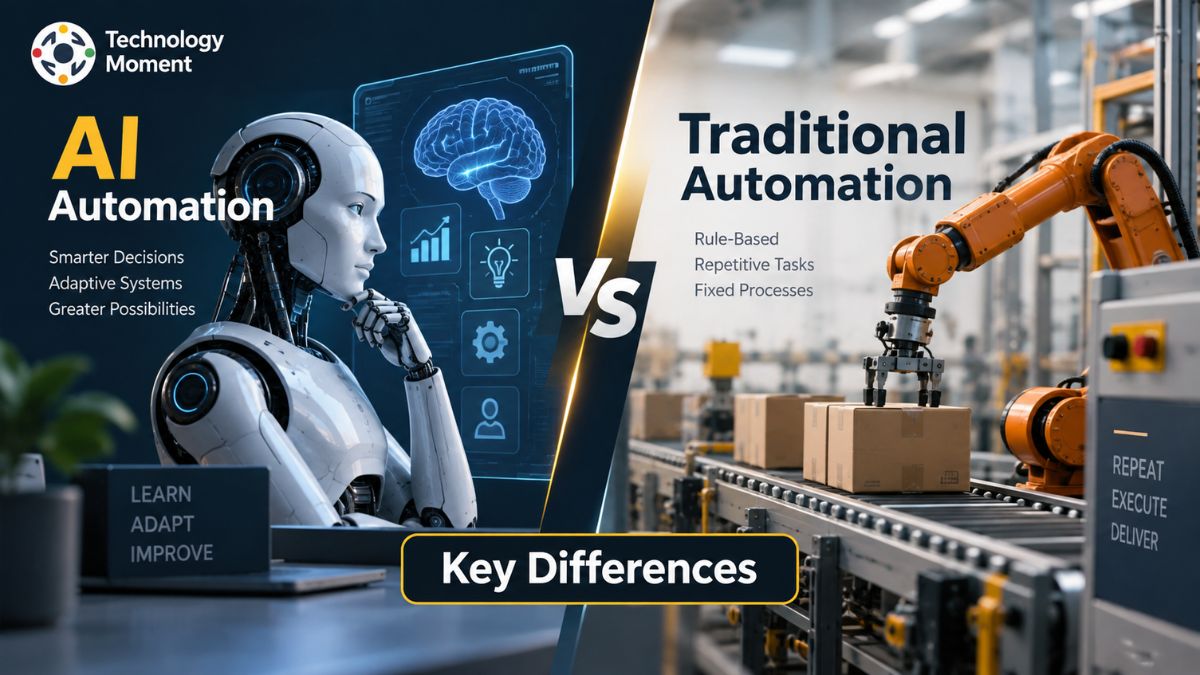
Traditional automation generally follows predefined rules and fixed workflows. It performs a task when specific conditions are met, making it highly predictable and reliable for structured, repetitive processes. AI automation takes a different approach by using technologies such as machine learning, natural language processing, generative AI, and AI agents to handle more complex and changing tasks.
This difference raises an important question: AI automation vs traditional automation—which approach is better for a business? The answer depends on the process, data, level of complexity, cost, and desired outcome. In some situations, traditional automation may be the smarter choice, while AI automation can provide greater flexibility for tasks that require context or decision-making. Many organizations may also benefit from combining both approaches.
At Technology Moment, we focus on making complex technology easier to understand so readers can make informed decisions about the tools and technologies they use. In this guide, we’ll compare AI automation and traditional automation, explore their benefits and limitations, examine real-world use cases, and explain how to choose the right approach for different business needs.
What Is Traditional Automation?
Traditional automation is a technology approach that uses predefined rules, fixed workflows, and business logic to perform tasks with limited human intervention. Instead of making decisions independently, a traditional automation system follows instructions created in advance. When a specific condition is met, the system performs the corresponding action.
This approach is commonly used for repetitive and predictable processes. For example, a business can automatically send an email after a customer submits a form, move data between applications, generate scheduled reports, or route an approval request based on predefined business rules. Rule-based automation and robotic process automation (RPA) are common examples.
One of the biggest advantages of traditional automation is predictability. Because the workflow is deterministic, businesses can usually anticipate how the system will respond to a particular input. This makes it useful for processes where accuracy, reliability, and consistency are more important than flexibility.
However, traditional automation can struggle when processes become unpredictable. A fixed workflow may not understand unstructured data, changing customer requests, or unusual situations without additional rules. As processes become more complex, maintaining large numbers of predefined rules can also increase automation complexity and maintenance costs.
What Is AI Automation?
AI automation combines automation technology with artificial intelligence to perform tasks that may require understanding, prediction, classification, or decision-making. Instead of relying entirely on predefined instructions, AI-powered systems can analyze information and respond according to context.
Modern AI automation can use technologies such as machine learning, natural language processing, generative AI, and large language models (LLMs). AI agents can also be used to perform multiple steps within a workflow, making AI workflows more flexible than many conventional automation systems.
For example, an AI-powered workflow could receive a customer message, understand its intent, identify the relevant information, determine the appropriate response, and then trigger another automated process. This type of workflow can be useful when inputs are not always structured or predictable. A major advantage of AI automation is its ability to work with structured and unstructured data. Traditional systems may require clearly defined fields and rules, while AI systems can process documents, text, conversations, and other information that is harder to handle with fixed logic.
However, AI automation also introduces challenges. Implementation can be more complex, and businesses need to consider accuracy, security, integration, monitoring, maintenance, and human oversight. AI decisions may also require validation, particularly in sensitive business processes. Therefore, AI automation is best viewed as an intelligent extension of automation rather than a universal replacement for traditional automation.
How AI Automation and Traditional Automation Differ
The main difference between AI automation and traditional automation is how each system handles information and decisions. Traditional automation generally follows predefined rules, while AI automation can analyze data, interpret context, and support more dynamic decisions.
| Factor | Traditional Automation | AI Automation |
|---|---|---|
| Decision-making | Predefined rules | AI and data-driven |
| Workflow | Fixed workflows | Dynamic or adaptive workflows |
| Data | Primarily structured | Structured and unstructured |
| Tasks | Repetitive tasks | Repetitive and complex tasks |
| Flexibility | Limited | Higher |
| Learning | Does not typically learn | Can adapt through AI models |
| Exceptions | Predefined handling | Can interpret some exceptions |
| Human intervention | Often required for exceptions | Can reduce intervention |
| Predictability | Highly predictable | Depends on data and model |
| Implementation | Usually simpler | Often more complex |
Traditional automation is particularly effective when a process has clear inputs, outputs, and business rules. Rule-based automation, for example, can reliably process thousands of transactions according to the same conditions. AI automation becomes more useful when workflows involve natural language, unstructured data, changing conditions, or intelligent decision support. AI agents, machine learning automation, and intelligent workflows can help manage processes that would otherwise require numerous predefined rules.
The comparison is therefore not simply about which technology is newer. The right choice depends on process complexity, flexibility, data requirements, implementation cost, accuracy expectations, security needs, and the amount of human oversight required. For many organizations, combining both approaches may provide the strongest result.
AI Automation vs Traditional Automation: Benefits and Trade-Offs
Both approaches can improve productivity and process efficiency, but they offer different advantages and trade-offs. Traditional automation provides consistency and reliability, while AI automation offers greater flexibility for complex or changing workflows.
Traditional automation is often easier to design when business processes are stable. A company can define specific conditions and actions, creating a predictable workflow with measurable outcomes. This can make implementation, testing, and monitoring relatively straightforward. It is particularly valuable for repetitive tasks where intelligent decision-making is unnecessary.
AI automation can provide additional benefits when processes require interpretation or adaptation. It can work with unstructured information, support automated decision-making, and create context-aware automation. Businesses may use AI-powered workflows to improve customer service, analyze documents, classify information, or support employees with complex tasks.
However, AI automation may require greater investment in integration, testing, monitoring, security, and maintenance. AI systems can also produce incorrect or inconsistent results, making human oversight important for higher-risk applications. Traditional automation has its own limitation: fixed workflows can become difficult to maintain when business requirements change. Adding new exceptions may require additional rules and workflow modifications.
The best solution depends on the business objective. Traditional automation may deliver better value for predictable processes, while AI automation can be more suitable for dynamic workflows. A hybrid automation strategy can combine deterministic automation with AI capabilities, allowing businesses to use each technology where it provides the greatest value.
AI Automation Use Cases
AI automation use cases are expanding as businesses adopt AI-powered workflows, intelligent process automation, and AI agents. Unlike traditional automation, which is generally designed around predictable rules, AI automation can be applied to processes where information needs to be interpreted before an action is taken.
One common use case is customer service automation. AI systems can understand customer questions, identify intent, summarize conversations, retrieve relevant information, and suggest or generate responses. Human employees can remain involved when a request requires judgment or escalation. Another important area is document and information processing. AI automation can analyze invoices, contracts, emails, reports, and other unstructured data, helping organizations extract useful information and route it into appropriate business processes.
Businesses can also use AI automation for decision support. For example, an AI system can analyze large amounts of information, identify patterns, and provide recommendations that help employees make faster decisions. AI-powered workflows can then connect those insights with existing enterprise systems. AI automation is also useful for workflow optimization, business process automation, and productivity automation. AI agents may coordinate multiple steps across different applications, while LLM automation can help process natural-language information.
Other potential applications include sales qualification, content analysis, employee support, IT operations, knowledge management, and automated research. The key is to match the technology with the problem. AI automation creates the most value when a process involves changing inputs, complex information, or decisions that cannot be handled efficiently through simple predefined rules.
Traditional Automation Use Cases
Traditional automation remains highly useful for business processes that are repetitive, predictable, and governed by clear rules. Although AI automation receives considerable attention, many organizations do not need artificial intelligence for every workflow. Rule-based automation can often complete routine operations faster and more consistently than a more complex AI system.
One common use case is data entry and transfer. Automation tools can move information between spreadsheets, databases, CRM platforms, and other business applications without requiring employees to perform the same task repeatedly. Scheduled reporting is another practical example, where systems automatically collect predefined data and generate reports at specific intervals.
Robotic process automation (RPA) is frequently used for repetitive tasks such as copying information between systems, processing standardized forms, validating predefined fields, and updating records. Businesses can also use traditional automation for email notifications, invoice routing, approval workflows, inventory updates, and appointment reminders.
Traditional automation works particularly well when the process has structured data and clearly defined business rules. For example, an organization might automatically approve a request when a specific value falls below a predetermined threshold. Other applications include payroll workflows, order processing, system backups, alerts, and routine administrative operations.
The main advantage is predictability. When the rules remain stable, traditional automation can deliver reliable results with relatively low automation complexity. For straightforward workflows, adding AI may provide little additional value.
AI Automation vs Traditional Automation: Cost and ROI
Cost is an important consideration when comparing AI automation vs traditional automation, but there is no universal answer to which option is cheaper. The right choice depends on process complexity, implementation requirements, operating volume, integration needs, and expected business outcomes.
Traditional automation can have a relatively straightforward implementation when workflows are clearly defined. Businesses may need to invest in automation software, development, API integration, system integration, and ongoing maintenance. Once deployed, predictable workflows can operate with limited intervention.
AI automation can involve additional expenses related to AI models, data preparation, API usage, infrastructure, monitoring, security, and model evaluation. AI-powered workflows may also require more sophisticated integration and human oversight. However, these additional costs can be justified when AI enables processes that traditional automation cannot efficiently handle.
ROI should therefore be evaluated beyond initial implementation cost. Businesses can consider labor savings, reduced processing time, fewer errors, improved productivity, increased operational efficiency, and the ability to scale workflows. For example, a simple data-transfer process may achieve better ROI through traditional automation, while processing thousands of unstructured customer documents could justify an AI-based approach.
AI automation ROI is strongest when intelligent processing creates measurable value that exceeds its additional costs. Similarly, traditional automation can deliver excellent ROI when repetitive workflows are stable and high-volume. The best strategy is to compare total cost of ownership, expected savings, scalability, maintenance requirements, and business impact rather than choosing technology based solely on its novelty.
How Automation Performance Changes at Scale
Scalability, accuracy, and maintenance are three important factors when evaluating AI automation vs traditional automation. Both approaches can scale, but they behave differently as workflows become more complex or business requirements change.
Traditional automation can scale efficiently when the underlying process remains predictable. A fixed workflow can process a large number of transactions without changing its logic. This makes it highly reliable for structured operations. However, scaling across increasingly complex processes may require additional rules, integrations, and exception handling, which can increase maintenance costs.
AI automation offers greater flexibility for workflows involving changing inputs, unstructured data, and context-dependent decisions. Adaptive automation, intelligent workflows, and AI agents can support processes that would otherwise require numerous predefined rules. However, AI performance depends on model quality, data quality, system design, and appropriate monitoring.
Accuracy also needs to be evaluated differently. Traditional automation generally follows deterministic instructions, so its output is highly predictable when inputs meet expected conditions. AI systems can interpret information and make predictions, but they may produce incorrect results. For high-impact workflows, human oversight and validation remain important.
Maintenance presents another trade-off. Traditional automation may require frequent rule updates when business processes change. AI automation may require model monitoring, prompt or workflow updates, integration maintenance, and performance evaluation. Therefore, the most scalable solution is not necessarily the most advanced one. Businesses should select the architecture that can handle expected growth while maintaining acceptable accuracy, reliability, security, and operational efficiency.
Which Automation Approach Is Right for Your Business?
Choosing between AI automation and traditional automation should begin with the business problem rather than the technology itself. The first question should be whether the process is predictable and rule-driven or whether it requires interpretation, adaptation, or decision-making.
Traditional automation is usually a strong choice when tasks are repetitive, inputs are structured, and business rules are clearly defined. Processes such as scheduled reports, data transfers, standard approvals, notifications, and routine administrative workflows can often be automated efficiently without AI.
AI automation becomes more attractive when workflows involve unstructured data, natural language, complex decisions, changing conditions, or context-aware processing. Businesses handling documents, customer conversations, research, classification, or intelligent decision support may benefit from AI-powered workflows.
Cost and complexity should also be considered. If a simple rule can solve the problem reliably, adding an AI system may create unnecessary implementation and maintenance overhead. Conversely, trying to force a highly variable process into a fixed workflow can result in excessive rules and poor flexibility.
A hybrid automation strategy can be the most practical option for many organizations. Traditional automation can handle deterministic steps while AI manages interpretation or complex decisions. For example, AI could classify an incoming request, while a rule-based system executes the resulting workflow. Before choosing, evaluate process complexity, data type, accuracy requirements, security, integration, human intervention, scalability, maintenance, and expected ROI.
AI Automation vs Traditional Automation: Future of Business Automation
The future of business automation is unlikely to be about completely replacing traditional automation with artificial intelligence. Instead, organizations are likely to combine AI automation, traditional automation, intelligent process automation, and workflow orchestration according to the requirements of each process.
Traditional automation will continue to play an important role in predictable operations. Processes based on clear business rules, structured data, and fixed workflows can still benefit from deterministic automation. These systems are often easier to test, monitor, and control, particularly when businesses require highly consistent outcomes.
At the same time, AI is making automation more capable of handling complex information. Generative AI, machine learning, natural language processing, AI agents, and large language models (LLMs) can help automation systems understand text, classify information, summarize documents, and support decision-making. This creates opportunities for more flexible and context-aware workflows.
Another important development is the growth of autonomous workflows. Instead of automating only one predefined task, AI agents may coordinate several actions across different applications. However, businesses will still need appropriate controls, security measures, human oversight, and monitoring. Hyperautomation is also expected to remain important as organizations connect multiple automation technologies into broader business processes. Rather than treating AI and traditional automation as competing technologies, companies can use them together.
The future therefore points toward hybrid automation: deterministic systems handling predictable operations while AI manages tasks that require interpretation, adaptability, and intelligent decision support.
AI Automation vs Traditional Automation — Which One Is Better?
There is no universal winner in the AI automation vs traditional automation comparison. The better option depends on what a business needs to automate, how predictable the process is, what type of data it uses, and how much flexibility the workflow requires. Traditional automation is usually the better choice for straightforward, repetitive processes. If a workflow follows clearly defined business rules and produces predictable outcomes, a rule-based system can provide excellent accuracy, reliability, and operational efficiency without the additional complexity of an AI solution.
AI automation becomes more useful when a process involves changing inputs, natural language, unstructured data, or complex decision-making. For example, an AI-powered workflow can analyze a customer message, identify its meaning, extract relevant information, and recommend the next action. These capabilities can be difficult to reproduce with large collections of fixed rules.
Cost is another consideration. Businesses should compare AI automation ROI, implementation costs, integration requirements, maintenance, security, and expected productivity gains rather than assuming that newer technology automatically provides better value. For many organizations, the strongest approach may be a combination of both. Traditional automation can execute predictable actions, while AI handles interpretation and decision support. This hybrid model can provide flexibility without replacing reliable existing systems unnecessarily.
In simple terms, choose traditional automation when the process is stable and rule-driven. Consider AI automation when the process is complex, variable, or information-intensive. If a workflow contains both characteristics, a hybrid strategy may be the most practical solution. The goal should not be to automate with the most advanced technology available. The goal should be to select the technology that solves the business problem effectively, securely, and sustainably.
Frequently Asked Questions About AI Automation vs Traditional Automation
What are examples of traditional automation?
Traditional automation use cases include scheduled reports, data transfers, email notifications, rule-based approvals, standardized invoice processing, database updates, system alerts, and repetitive administrative tasks. RPA is another common approach for automating structured and repetitive operations across existing software systems.
What are examples of AI automation?
AI automation use cases include customer service automation, document analysis, intelligent data processing, AI-powered workflows, automated research, content classification, decision support, sales qualification, and knowledge management. AI agents can also coordinate multiple tasks across different applications.
Is AI automation more expensive than traditional automation?
It can be, but not in every situation. AI automation may involve additional costs for AI models, data preparation, integrations, monitoring, security, and maintenance. However, it can produce stronger ROI when it solves complex tasks that traditional automation cannot handle efficiently. Businesses should compare total cost and expected value rather than implementation cost alone.
Can AI automation and traditional automation work together?
Yes. Combining both approaches is often practical. Traditional automation can handle deterministic tasks, while AI can interpret information or support decisions. This creates a hybrid automation strategy that can improve flexibility while retaining the reliability of rule-based workflows.
What is the future of business automation?
Business automation is moving toward more intelligent and connected workflows. AI agents, generative AI, intelligent process automation, workflow orchestration, and hyperautomation are likely to expand the range of tasks that organizations can automate. However, traditional rule-based systems will remain valuable for predictable operations. The future will likely involve humans, AI, and conventional automation working together rather than one technology completely replacing the others.
Should businesses replace traditional automation with AI?
Not necessarily. Replacing a reliable rule-based workflow simply because AI is available can introduce unnecessary cost and complexity. Businesses should first identify the limitations of their existing automation. If a process requires better interpretation, flexibility, or decision support, AI may be an appropriate enhancement. Otherwise, traditional automation may continue to provide the best balance of reliability, cost, and maintenance.
How should a business start with AI automation?
Businesses should begin with a specific process and measurable objective rather than adopting AI broadly. Identify repetitive or time-consuming workflows, evaluate the data involved, estimate potential savings, assess security and accuracy requirements, and select a low-risk use case for an initial implementation. Performance can then be measured using productivity, processing time, error rates, operational efficiency, and ROI before expanding AI automation to additional workflows.
Is AI automation the same as RPA?
No. RPA primarily automates structured, repetitive actions by following predefined instructions. AI automation can add capabilities such as language understanding, classification, prediction, and intelligent decision support. RPA and AI can also be combined, allowing AI to interpret information while RPA executes predictable actions within existing applications.