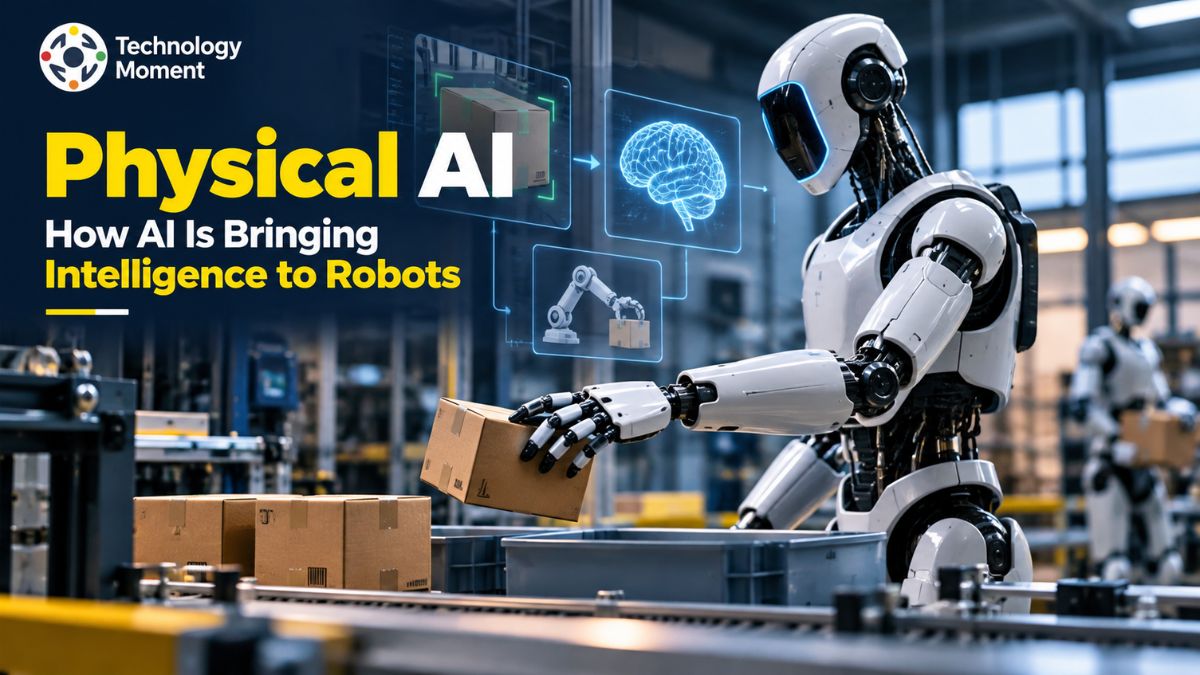
Artificial intelligence is no longer confined to screens, software, and digital conversations. A new phase is emerging—one where intelligence can sense the physical environment, make decisions, and take action in the real world. This shift is bringing AI into factories, warehouses, vehicles, homes, and other physical spaces through robots and autonomous machines.
At the center of this transformation is Physical AI. Unlike traditional AI systems that primarily generate text, images, or predictions, Physical AI combines intelligent software with sensors, cameras, robotics, edge computing, and advanced control systems. The result is machines that can perceive their surroundings, understand what is happening, and respond to changing conditions in real time.
From humanoid robots learning to perform practical tasks to industrial robots adapting to complex manufacturing environments, physical AI is opening a broader chapter in robotics. Advances in computer vision, sensor fusion, robot learning, simulation, and AI models are helping machines move beyond fixed instructions toward more flexible and intelligent behavior.
But this technology is still developing. Challenges around safety, reliability, training data, computing power, cost, and real-world deployment remain important questions for the industry. At Technology Moment, we explore the technologies shaping how people and businesses will interact with the digital and physical worlds. In this article, we examine what Physical AI means, how it works, where it is being used, and why it could become one of the defining technology trends of the coming years.
What Is Physical AI?
Physical AI refers to artificial intelligence systems designed to perceive, understand, and act in the physical world. Unlike AI systems that mainly produce text, images, recommendations, or other digital outputs, physical AI connects intelligence with a physical machine such as a robot, autonomous vehicle, drone, or industrial system. These machines use sensors to collect information about their surroundings and AI models to interpret that information before taking an action. In simple terms, physical AI gives machines the ability to use intelligence while operating in the real world.
The concept is closely related to embodied AI, robot intelligence, and real-world AI, although the terms are not always used in exactly the same way. Embodied AI focuses on intelligence that is connected to a body and environment, while physical AI is increasingly used to describe practical AI systems that can perceive and act through physical machines. This distinction matters because a robot does not become intelligent simply because it contains an AI model. It needs the ability to understand its environment, respond to changing conditions, and translate decisions into physical movement.
For example, a conventional industrial robot may follow a fixed sequence of programmed movements. A physical AI system can potentially use computer vision, sensor fusion, machine learning, and real-time decision-making to respond when objects, people, lighting, or surroundings change. That makes physical AI particularly relevant to humanoid robots, industrial robots, autonomous machines, warehouses, manufacturing facilities, and other environments where conditions cannot always be perfectly predicted.
The broader idea is a shift from AI that simply processes information to AI that can interact with the world. As sensors, computing hardware, robotics, and AI models continue to improve, physical AI is becoming an important area of development across robotics and autonomous systems.
How Does Physical AI Work?
Physical AI works through a continuous interaction between sensing, perception, reasoning, decision-making, action, and feedback. This is different from a traditional software application where an AI model may receive a dataset and return an answer. A physical AI system must continuously respond to an environment that can change from one moment to the next. Sensors first collect information from the surroundings, while AI models process that information to estimate what is happening and determine what the machine should do.
The first stage is perception. Robots and autonomous machines can use cameras, LiDAR, tactile sensors, microphones, force sensors, and other devices to gather information. Computer vision can help identify objects, people, obstacles, surfaces, and movement, while sensor fusion combines information from multiple sources to create a more useful representation of the environment. This is particularly important because no single sensor can provide a complete understanding of a complex physical environment.
The next stage involves reasoning and decision-making. AI models interpret the available information and determine what action could achieve a particular objective. Modern approaches increasingly explore multimodal AI, spatial intelligence, world models, and vision-language-action models that connect perception, instructions, and physical actions.
The final stages are action and feedback. The AI’s decision is translated into commands for actuators, motors, wheels, robotic arms, or other mechanisms. After the machine moves, its sensors collect new information. The system can then compare the new situation with its objective and adjust its next action. This creates a continuous perception-to-action loop: the machine senses the environment, interprets it, decides what to do, acts, observes the result, and responds again. That feedback loop is one of the defining characteristics of physical AI.
The Technologies Powering Physical AI
Physical AI is not a single technology. It is an ecosystem that brings together AI models, sensors, robotics, computing infrastructure, software, simulation, and control systems. Gartner’s 2026 analysis similarly describes physical AI as a coordinated set of technologies rather than one isolated breakthrough. At the perception layer, computer vision, cameras, LiDAR sensors, tactile sensors, and sensor fusion help machines understand their surroundings. These technologies provide information about objects, distances, movement, surfaces, and the machine’s own position. Reliable perception is especially important for autonomous systems because decisions depend on the quality and timing of sensor information.
AI models provide the reasoning and action layer. Multimodal AI, robot foundation models, world models, and vision-language-action (VLA) models are being explored to help machines connect what they see with instructions and appropriate actions. A VLA model, for example, can connect visual observations and language instructions with robot actions, although it still operates within a larger robotics system containing control, calibration, and safety mechanisms.
Another important component is edge AI and on-device AI. Physical machines often need fast responses, so sending every sensor reading to a remote cloud server may introduce latency or connectivity constraints. Local inference can allow robots and autonomous machines to process information closer to where it is generated. Edge computing can therefore become an important part of real-time robotic systems. Express Computer
Training and testing also depend on robot simulation, synthetic data, digital twins, physics-based simulation, reinforcement learning, imitation learning, and sim-to-real transfer. Simulation can expose robots to many situations before deployment in the physical world, while real-world data helps reveal problems that simulations may not fully capture. Together, these technologies form the foundation of physical AI: sensors provide perception, AI provides intelligence, computing enables inference, robotics provides physical action, and feedback connects everything into a real-world system.
Physical AI Is Transforming Humanoid Robots
Humanoid robots are one of the most visible applications of physical AI because they combine many difficult robotics challenges in a single machine. A humanoid must be able to perceive its surroundings, maintain balance, move through space, manipulate objects, understand instructions, and respond safely to people and changing environments. Physical AI is helping researchers and companies explore ways to make these machines more adaptive rather than relying entirely on fixed instructions.
Traditional robotics has often focused on carefully controlled environments where machines perform specific tasks with predefined movements. Humanoid robots operating in human environments face a different challenge. Floors, objects, lighting, people, and obstacles can vary continuously. This makes computer vision, spatial intelligence, sensor fusion, robot learning, and real-time decision-making particularly important. Current research also explores how foundation models and VLA models can connect visual observations and human instructions with physical actions.
A physical AI-powered humanoid could, for example, receive an instruction, identify relevant objects using cameras and other sensors, determine an appropriate sequence of movements, and use actuators to complete the task. If an object is moved or the environment changes, the system needs to recognize that change and adjust rather than simply repeat a pre-programmed sequence.
The potential applications extend across manufacturing, warehouses, logistics, inspection, healthcare, and human-robot collaboration. However, humanoid robotics still faces significant engineering challenges. Reliable actuators, battery capacity, sensing, control, safety, training data, computing requirements, and production costs all influence how useful and scalable these machines can become. Recent industry reporting, for example, highlights actuators as a significant hardware challenge for humanoid production.
The significance of physical AI in humanoid robotics is therefore not simply about making robots look more human. The larger goal is to create machines that can understand physical environments, learn useful behaviors, and adapt their actions to real-world situations. That shift could make humanoid robots more flexible, but their long-term impact will depend on how reliably and economically these capabilities can be deployed.
Physical AI Beyond Humanoids
Physical AI is often associated with humanoid robots, but its scope is much broader. The technology can be embedded into industrial robots, autonomous mobile robots (AMRs), autonomous vehicles, drones, robotic arms, quadruped robots, and other autonomous machines that operate in physical environments. In these systems, AI combines with sensors, computer vision, machine learning, and control software to help machines perceive their surroundings and respond to changing conditions. This makes physical AI less about a particular robot shape and more about giving machines the ability to interpret and act within the real world.
Industrial robots are an important example. Traditional robotic systems often perform predefined movements in highly controlled environments, while AI-powered industrial robots can increasingly use perception and machine learning to handle variation in objects, positions, and operating conditions. In warehouses, autonomous mobile robots can combine cameras, sensors, mapping, and autonomous navigation to move materials through changing layouts. Drones can use computer vision and autonomous systems for inspection, mapping, and monitoring, while autonomous vehicles combine multiple sensors with real-time AI inference to understand roads and surrounding traffic.
Physical AI also extends beyond robots themselves. AI-enabled buildings, industrial equipment, infrastructure, and connected machines can use real-world sensor data to detect conditions and make operational decisions. This broader view is important because physical AI is increasingly being treated as a systems technology, bringing together software, hardware, sensing, simulation, edge computing, and physical infrastructure rather than representing a single category of robot.
The result is a wider ecosystem of intelligent machines designed for environments where conditions can change and fixed automation may not be sufficient. Humanoids may receive much of the public attention, but autonomous systems across factories, warehouses, transportation, infrastructure, and other industries are equally important to the development of physical AI.
Why Edge AI Matters for Physical AI
Physical AI systems often need to make decisions within fractions of a second. A robot avoiding an obstacle, an autonomous vehicle responding to another road user, or an industrial machine detecting a dangerous condition cannot always wait for sensor data to travel to a distant cloud server and return with a response. This is where edge AI, on-device AI, and edge computing become important. By processing information closer to where it is generated, physical AI systems can reduce communication delays and support faster real-time decisions.
The basic idea is straightforward. Cameras, LiDAR sensors, microphones, tactile sensors, and other devices continuously generate information. Instead of sending every piece of data to the cloud, an edge computing system can process some of that information locally on the robot, vehicle, machine, or nearby gateway. AI inference can then happen closer to the physical action. This architecture can be particularly valuable when connectivity is unreliable or when immediate responses are important for safety and control.
Edge AI can also reduce the amount of raw sensor data that needs to be transmitted. A machine may process video locally and send only relevant events, measurements, or summaries to a central system. That can reduce network requirements while supporting greater privacy in some applications. Local processing can also help autonomous machines continue operating when cloud connectivity is temporarily unavailable.
However, edge AI does not necessarily mean that cloud computing becomes irrelevant. Physical AI systems can use a hybrid architecture in which real-time control and inference happen locally, while larger workloads such as model training, fleet analytics, simulation, and software updates remain connected to centralized infrastructure. This combination of edge and cloud computing is becoming an important part of the physical AI technology stack. As robots and autonomous machines become more capable, the ability to process sensor information quickly and reliably at the point of action will become increasingly important.
The Biggest Challenges Facing Physical AI
Physical AI faces a different set of challenges from software-only AI because mistakes can produce physical consequences. A chatbot generating an incorrect answer is one type of failure; an autonomous machine making the wrong movement can damage equipment, interrupt production, or create a safety risk. As a result, safety, reliability, data, computing, hardware, cybersecurity, and real-world testing all matter when deploying physical AI.
One major challenge is training data. Robots need information about physical environments, objects, movements, and interactions. Collecting high-quality real-world robotics data can be expensive and time-consuming. Simulation, synthetic data, digital twins, imitation learning, and reinforcement learning can help expand training opportunities, but simulated environments do not always perfectly represent reality. The difference between simulation and real-world performance is commonly known as the sim-to-real gap.
Hardware is another limitation. Physical AI depends on cameras, LiDAR, tactile sensors, actuators, processors, batteries, motors, and other components working together. These components must meet demanding requirements for reliability, energy efficiency, cost, and performance. Current industry reporting also points to specialized actuators as an important manufacturing and supply-chain challenge for humanoid robotics.
Real-time computing creates another challenge. AI models may require substantial computational resources, while robots need fast responses under limited power and space. Edge AI can address some latency issues, but deploying capable models on constrained hardware remains an engineering problem.
Cybersecurity and governance are equally important. Connected robots and autonomous machines can become part of operational technology networks, creating new security considerations. Organizations also need clear processes for testing, monitoring, updating, and responding to failures. Gartner’s 2026 analysis emphasizes that physical AI is not one isolated technology; successful deployment requires coordination across AI models, robotics, edge infrastructure, data, simulation, and operational systems.
Physical AI vs Conventional AI: How Are They Different?
Physical AI and traditional AI both use artificial intelligence to process information and make decisions, but they operate in fundamentally different environments. Traditional AI generally works inside digital systems, where its outputs may include predictions, recommendations, classifications, text, images, or automated software actions. Physical AI extends intelligence into the real world, where machines can use sensors to perceive their surroundings and actuators to produce physical actions. IBM describes physical AI as AI systems that interact with the physical world through combinations of models, sensors, actuators, and control systems.
| Aspect | Traditional AI | Physical AI |
|---|---|---|
| Primary purpose | Analyze information and generate digital outputs | Perceive, reason, and act in physical environments |
| Environment | Software, websites, databases, digital platforms | Factories, warehouses, roads, buildings, homes, outdoor spaces |
| Input | Text, images, documents, databases, user commands | Cameras, LiDAR, tactile sensors, microphones, GPS, machine sensors |
| Output | Text, predictions, recommendations, classifications | Movement, navigation, manipulation, machine control |
| Physical interaction | Usually limited or indirect | Direct interaction with the physical environment |
| Core technologies | Machine learning, generative AI, NLP, computer vision | Robotics, embodied AI, computer vision, sensor fusion, edge AI |
| Decision speed | Often seconds or longer can be acceptable | Frequently requires real-time or low-latency decisions |
| Feedback | User responses, datasets, software events | Continuous sensor feedback from the physical environment |
| Hardware dependence | Can operate primarily on cloud or standard computing infrastructure | Requires sensors, processors, actuators, motors, or other physical hardware |
| Failure impact | Incorrect information or digital errors | Possible equipment damage, operational disruption, or safety risks |
| Learning environment | Primarily digital datasets | Digital data plus simulations and real-world interactions |
| Examples | Chatbots, recommendation engines, fraud detection | Humanoid robots, AMRs, autonomous vehicles, intelligent industrial robots |
The distinction is therefore not simply AI versus robotics. Physical AI combines intelligence with perception and physical action. A warehouse robot, for example, may need to recognize an obstacle, understand its location, calculate an alternative route, and change its movement immediately. Cisco similarly describes physical AI as systems that sense, interpret, and act in real-world environments.
This difference also changes how AI systems must be designed. Physical AI needs reliable sensors, robot control systems, real-time AI inference, edge computing, safety mechanisms, and continuous feedback. A digital AI system can sometimes tolerate a delayed response or allow a human to correct an output before anything happens. A physical AI system may have only milliseconds to react when a machine, vehicle, or robot is moving.
What Is Driving the Rise of Physical AI in 2026?
The rise of physical AI in 2026 is being driven by the convergence of several technologies that were previously developing more independently. Improvements in AI models, robotics, computer vision, sensors, edge computing, simulation, synthetic data, and robot learning are making it increasingly practical to connect digital intelligence with physical machines. Gartner’s September 2026 Hype Cycle describes physical AI as a combination of coordinated capabilities rather than a single technological breakthrough.
One major driver is the development of multimodal AI and vision-language-action models (VLA models). These systems aim to connect what a robot sees with instructions and physical actions. Instead of programming every movement separately, researchers are developing models that can help robots interpret visual information, understand tasks, plan actions, and execute them. This is particularly important for humanoid robots and other machines expected to operate in less predictable environments.
Another driver is better robot hardware and sensing. Cameras, LiDAR, tactile sensors, actuators, processors, and other components are becoming increasingly integrated with intelligent software. At the same time, edge AI allows more processing to happen closer to the machine, supporting low-latency decisions without requiring every operation to depend on a distant cloud server. Gartner identifies edge-heavy, sensor-rich architectures as important to physical AI deployment because perception, decision-making, and control often need to remain close to the operating environment.
Simulation is another important factor. Digital twins, physics-based simulation, synthetic data, reinforcement learning, and imitation learning can help train and test robotic systems before they are deployed in the physical world. This can reduce the amount of expensive real-world experimentation required, although the sim-to-real gap remains a challenge.
Finally, businesses are looking for automation that can operate beyond highly structured environments. Manufacturing, warehousing, logistics, infrastructure, and other industries increasingly require machines that can respond to variation rather than simply repeat fixed instructions. IDC reported in 2026 that physical AI had become a significant investment priority among surveyed organizations, reflecting growing interest beyond experimental robotics projects.
Together, these developments are moving physical AI from a concept centered mainly on research and prototypes toward a broader technology ecosystem involving intelligent machines, autonomous systems, robotics, edge computing, simulation, and operational software.
What Is the Future of Physical AI?
The future of physical AI is likely to involve a broader range of intelligent machines rather than only humanoid robots. Autonomous mobile robots, industrial robots, drones, autonomous vehicles, polyfunctional robots, smart infrastructure, and humanoids can all become part of the physical AI ecosystem. Gartner’s 2026 research emphasizes that physical AI should be understood as an interconnected system spanning physical machines, intelligence models, data and simulation, compute and control infrastructure, and operational safety.
One important direction is the development of robots that can perform multiple tasks rather than being designed for only one narrowly defined operation. Today’s industrial automation often works extremely well when the environment and task are predictable. Future physical AI systems are being developed with greater adaptability, allowing machines to respond to new objects, layouts, instructions, and environmental conditions. However, this does not mean that general-purpose robots are already ready for every real-world task. Current systems still face challenges involving dexterity, reliability, energy consumption, training, safety, cost, and integration.
Humanoid robots may eventually become useful in environments designed around humans because their physical form can potentially interact with existing doors, shelves, tools, workstations, and other infrastructure. But alternative designs may also prove more practical for specific applications. Gartner’s 2026 analysis notes that polyfunctional robots can provide flexibility without necessarily copying the human body, particularly in supply-chain environments.
Another major development will be the growth of robot foundation models, VLA models, world models, simulation platforms, and edge AI. These technologies could help machines understand their surroundings and translate high-level instructions into physical actions. At the same time, simulation and digital twins can become increasingly important for testing robot behavior before deployment. The future may also be less about individual robots and more about orchestrated fleets of intelligent machines. Gartner’s October 2026 analysis argues that coordination, governance, command-and-control, and interoperability will become increasingly important as physical AI scales across facilities and workflows.
Ultimately, the future of physical AI will depend on more than better AI models. Progress will require improvements across hardware, sensors, computing, data, simulation, safety, cybersecurity, and deployment economics. The most significant shift may be the gradual transition from machines that simply execute programmed tasks toward systems capable of perceiving, adapting, and acting within changing physical environments.
Frequently Asked Questions About Physical AI
How does physical AI work?
Physical AI generally works through a continuous sense–understand–decide–act–learn process. Sensors collect information from the environment, AI models interpret that information, and control systems determine an appropriate action. Motors, robotic arms, wheels, or other actuators then execute the decision. New sensor information provides feedback, allowing the system to respond to changes. Edge AI can support low-latency processing when rapid physical responses are required.
What is the difference between physical AI and traditional AI?
Traditional AI primarily operates within digital environments and produces outputs such as predictions, classifications, recommendations, text, or images. It uses sensors to perceive physical environments and actuators to perform actions. Physical AI therefore has to account for movement, timing, uncertainty, hardware limitations, safety, and continuous environmental feedback, making its engineering requirements different from those of many software-based AI systems.
What is the difference between physical AI and embodied AI?
The terms are closely related, but they can emphasize different aspects. Embodied AI generally focuses on intelligence connected to an agent or body that can perceive and interact with its environment. Physical AI is a broader industry term increasingly used for AI systems operating in the physical world, including robots, autonomous vehicles, industrial automation, and other intelligent machines. The terminology is still evolving, so definitions can vary between researchers and technology companies.
How do humanoid robots use physical AI?
Humanoid robots can use physical AI to combine cameras and other sensors with AI models, motion planning, control systems, and actuators. A robot can perceive objects and people, interpret an instruction, plan movements, and use its arms or legs to perform a task. VLA models are being explored as a way to connect visual information, language instructions, and robot actions, although reliable real-world operation still requires substantial robotics engineering and safety systems.
How does edge AI help physical AI?
Edge AI allows physical AI systems to process information close to where it is generated, such as directly on a robot or through a nearby computing device. This can reduce communication latency and help machines make real-time decisions when connectivity to the cloud is limited or when immediate responses are important. Edge processing can also reduce the amount of raw sensor data that needs to be continuously transmitted to centralized infrastructure.
What sensors do physical AI robots use?
Physical AI robots can use a combination of cameras, LiDAR, depth sensors, tactile sensors, force sensors, microphones, encoders, and other specialized sensors. Cameras can support visual perception, LiDAR can help estimate distances and surroundings, while tactile and force sensors can provide information about physical contact. Sensor fusion combines multiple sources to create a more useful representation of the robot’s environment.