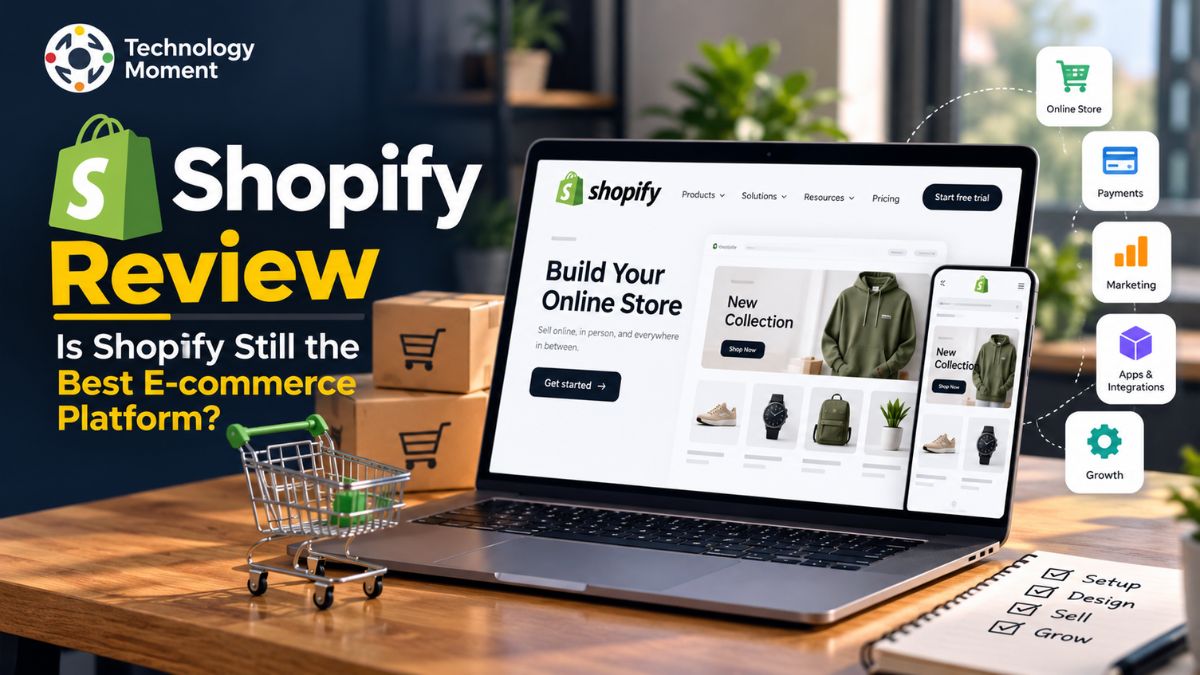
Choosing the right e-commerce platform can make a significant difference to how you build, manage, and grow an online business. Shopify has become a popular choice for entrepreneurs, small businesses, and established brands that want to sell products online without managing complex technical infrastructure. But with so many e-commerce platforms available today, is Shopify still the best option for your business?
In this Shopify review, Technology Moment takes a closer look at what the platform offers, where it performs well, and what you should consider before investing in it. We’ll explore Shopify’s key features, pricing plans, website customization options, payment processing, built-in SEO tools, and integrations. We’ll also examine its advantages and disadvantages to help you understand the potential benefits and limitations of running an online store with Shopify.
Whether you’re building your first online store, starting a dropshipping business, offering digital products, or taking an established brand into global markets, choosing the right e-commerce platform can make a significant difference. Shopify provides a range of features for managing products, processing orders, promoting your store, and selling across multiple channels. However, before committing to a subscription, it’s important to consider the complete cost of running your business. Payment processing fees, premium themes, third-party apps, and additional services can increase your expenses beyond the advertised plan price.
At Technology Moment, we help readers understand technology products and make smarter decisions through straightforward, practical reviews. In this Shopify review, we’ll explore its key features, ease of use, pricing structure, customization options, and overall value for money. We’ll also consider how well it serves different business models, from beginners launching their first store to experienced merchants looking to scale. By the end, you’ll have a better idea of whether Shopify meets your business goals or if another e-commerce platform offers a more suitable combination of features, flexibility, and affordability.
Shopify Review: Quick Verdict
Shopify remains a strong option for businesses that want to build, manage, and expand an online store from one platform. In this Shopify review, the platform stands out for its combination of website building, product management, payment processing, marketing tools, and sales channel integrations. Instead of arranging separate hosting and installing multiple systems to handle everyday store operations, merchants can manage many essential tasks through Shopify’s centralized dashboard. This makes it particularly attractive to entrepreneurs, startups, and small businesses that want to focus on selling rather than dealing with technical maintenance.
One of Shopify’s biggest advantages is its ease of use. Beginners can choose a theme, add products, configure payment methods, and customize their storefront without needing advanced coding skills. Its app marketplace also allows businesses to add capabilities as their requirements change. Merchants can sell through their online stores and supported social or marketplace channels, while eligible businesses can also combine online and in-person sales.
However, Shopify is not necessarily the best choice for every business. Subscription costs, payment processing fees, paid themes, and third-party apps can increase the total cost of running a store. Businesses that need extensive customization may also encounter limitations depending on their plan and technical requirements. Compared with alternatives such as WooCommerce, Shopify offers a more managed experience, while WooCommerce can provide greater control over hosting and customization.
Our verdict: Shopify is worth considering if you value convenience, integrated ecommerce features, and room to grow. Before choosing a plan, evaluate your budget, expected sales volume, payment options, and customization needs. The best ecommerce platform is ultimately the one that supports your business goals without creating unnecessary costs.
Shopify for Beginners: How It Works and What It Offers
Shopify is an ecommerce platform that enables individuals and businesses to create an online store, sell products, accept payments, and manage orders through a centralized system. It supports businesses ranging from individual entrepreneurs to established brands with international customers. Rather than purchasing separate hosting and assembling different tools to manage a storefront, users can access website building, inventory management, checkout, and other commerce features through a Shopify subscription. According to Shopify’s official overview, the platform supports both online and in-person selling. Shopify’s official website provides further details about its capabilities.
Getting started generally involves creating an account, selecting a suitable theme, adding products, and configuring essential store settings. Merchants can organize product categories, upload images, write descriptions, set prices, and establish shipping options. They can also connect a custom domain, configure available payment methods, and customize the storefront to reflect their brand identity. Once the necessary settings are complete, the store can be launched and promoted to potential customers.
After launch, Shopify helps merchants manage day-to-day operations, including inventory updates, incoming orders, customer information, and sales reporting. Available integrations can extend the platform with email marketing, accounting, customer support, product sourcing, and other business tools. Depending on the merchant’s location, plan, and configuration, Shopify can also support international selling through localized storefronts, currency presentation, and supported payment options.
Shopify is particularly useful for entrepreneurs who want a managed ecommerce solution without maintaining their own server infrastructure. Nevertheless, it does not automatically generate sales or guarantee profitability. Store owners still need suitable products, reliable suppliers, effective marketing, competitive pricing, and good customer service. Understanding these responsibilities is important when deciding whether Shopify is appropriate for a new business or an existing online store.
Shopify Pricing Review: How Much Does Shopify Cost?
When evaluating ecommerce platforms, Shopify pricing is a key factor to consider before choosing a plan. The overall expense varies based on the subscription tier, payment processing fees, billing frequency, paid apps, and any additional services required to run an online store. According to Shopify’s official US pricing page, the Basic plan costs $39 per month with monthly payments or an equivalent of $29 per month with annual billing. The Grow plan is priced at $105 monthly or $79 per month when billed annually, while the Advanced plan costs $399 per month on monthly billing or $299 per month with an annual subscription.
Shopify Plus is intended for more complex, higher-volume businesses and has substantially higher pricing. These are US-listed prices and may change, so check the official pricing page before purchasing. View Shopify’s current pricing plans. The Basic plan may suit individual entrepreneurs and smaller stores that need a full-featured online storefront. Growing businesses may consider higher-tier plans when they need additional staff accounts, more advanced reporting, or different payment-processing rates. However, paying for a more expensive plan does not automatically make a business more profitable.
Beyond the monthly subscription, Shopify transaction fees and payment processing costs deserve careful attention. Card processing charges vary according to the plan, payment method, and applicable conditions. Additional third-party transaction fees may apply when merchants use an external payment provider instead of Shopify Payments. Availability and exact charges depend on the country and the store’s configuration.
Other potential expenses include a custom domain, premium Shopify themes, paid apps, marketing services, and shipping-related costs. Some stores can operate with free themes and a limited number of applications, while others require additional tools. For an accurate budget, calculate the subscription, estimated processing fees, recurring app charges, and other business expenses together. Shopify can offer good value when its integrated features save time, but businesses with limited budgets should compare the total cost against their expected revenue before committing.
Shopify Features Review: What Do You Get?
Shopify offers a collection of ecommerce features designed to help merchants manage an online business without relying on multiple disconnected systems. One of its central features is the website builder, which lets users create a storefront using customizable themes and templates. Merchants can display products, organize collections, adjust brand elements, and build a shopping experience that works across desktop and mobile devices. The available level of customization depends on the theme, apps, plan, and technical approach used.
Product inventory and order management are also important parts of the platform. Store owners can add product variants, update stock information, track orders, and manage fulfillment workflows. Shipping settings and integrations provide additional ways to coordinate deliveries, although the available services, rates, and options depend on the merchant’s location and chosen providers.
Shopify Payments, where available, enables eligible merchants to accept supported payment methods through the platform. Shopify also provides checkout functionality and integrations with other payment providers. Merchants should review processing rates, supported currencies, and transaction fees before deciding which payment setup suits their business. Payment availability is not identical in every country.
For marketing and growth, Shopify includes tools for discounts, customer communications, sales reporting, and integrations with external services. Its app marketplace allows businesses to extend functionality for email marketing, reviews, subscriptions, dropshipping, analytics, and search engine optimization. However, some third-party applications require separate subscriptions, so adding more tools can increase operating expenses.
International selling is another useful capability. Eligible stores can use supported features for localized storefronts, translated content, local currencies, and international markets. Shopify also offers point-of-sale capabilities for businesses that sell in person, although advanced retail functions may involve additional costs. Overall, Shopify combines many essential ecommerce features in one system. Its main advantage is convenience, while its practical value depends on the merchant’s location, business model, required integrations, and total budget.
Shopify Ease of Use: Is It Good for Beginners?
Shopify is designed to make online store creation more accessible, even for people without previous website development experience. Its dashboard brings essential ecommerce activities, including product management, order tracking, inventory updates, and store customization, into one place. This makes Shopify a practical option for entrepreneurs who want to launch an online business without managing complicated hosting or server configurations. For beginners comparing ecommerce website builders, one of Shopify’s main advantages is that users can start with a theme and gradually customize their storefront as their business develops.
Setting up a Shopify store generally involves creating an account, selecting a theme, adding products, configuring payment methods, and establishing shipping settings. Users can edit product titles, descriptions, images, prices, and categories through the administrative interface. Responsive themes help create a shopping experience suitable for different screen sizes. However, building a professional online store still requires attention to product presentation, navigation, branding, and checkout usability. Shopify simplifies the technical process but does not eliminate the work involved in creating a trustworthy shopping experience.
Another advantage is the Shopify app marketplace, which offers integrations for email marketing, customer reviews, inventory management, and other business requirements. These applications can extend store functionality without requiring extensive coding knowledge. Nevertheless, installing too many apps may increase monthly expenses and affect website performance.
Overall, Shopify is good for beginners who value convenience and guided setup. Its learning curve is manageable for basic store operations, although advanced customization, international selling, and detailed SEO optimization may require additional learning. Before choosing a plan, beginners should consider their budget, technical comfort, and business goals.
Shopify Pros and Cons
Before choosing Shopify for your online business, it is important to evaluate its strengths and limitations. One of its biggest benefits is that it brings essential ecommerce operations together in one place. Store owners can organize product listings, process orders and payments, customize their storefronts, and monitor sales through a single dashboard. This centralized approach makes managing an online store more convenient and reduces reliance on multiple standalone tools. Shopify also provides a selection of customizable themes, inventory management features, built-in checkout capabilities, and third-party integrations, allowing businesses to adjust their stores as they grow and their operational requirements evolve.
Another benefit is its suitability for different business models. Entrepreneurs can use Shopify for traditional retail, dropshipping, print-on-demand products, and certain digital products. Supported integrations and sales channels can help merchants reach customers through different online and in-person touchpoints. For businesses that prefer a managed ecommerce solution, Shopify can also reduce the technical maintenance associated with independently hosting a website.
However, Shopify has disadvantages that deserve consideration. Subscription fees are ongoing expenses, and the total cost may increase when merchants purchase premium themes, paid applications, or additional services. Payment processing charges and possible third-party transaction fees can also affect profitability. Businesses operating with limited budgets should calculate these expenses before committing.
Customization is another consideration. Although Shopify supports extensive theme customization and developer tools, merchants may encounter limitations when implementing highly specialized functionality without additional development work. Compared with WooCommerce, which offers greater control over a self-hosted setup, Shopify prioritizes a more managed experience. Website performance can also be affected by heavy themes, oversized images, and unnecessary applications.
In conclusion, Shopify provides an accessible and flexible solution for building and expanding an online store, although it may not suit every business. Before choosing this platform, entrepreneurs should evaluate its pricing, available features, customization options, and future growth needs to determine whether it aligns with their specific goals.
Is Shopify Good for Different Types of Businesses?
Shopify can support several types of businesses, but its suitability depends on what you sell, how you operate, and how much you can invest in your online store. For small businesses and startups, Shopify provides a practical way to establish an online presence without building an e-commerce system from scratch. Its store management tools can help owners organize products, process orders, and monitor sales while concentrating on customer acquisition. However, early-stage businesses should account for recurring subscriptions and additional app expenses when calculating their budgets.
For dropshipping businesses, Shopify can integrate with compatible product sourcing and order fulfillment applications. These tools may help merchants import product listings and coordinate orders with suppliers. However, Shopify does not guarantee profitable dropshipping operations. Supplier reliability, delivery times, product quality, advertising expenses, and customer support remain important responsibilities. Entrepreneurs should research suppliers carefully rather than assuming that launching a store will automatically generate sales.
Print-on-demand businesses can also benefit from integrations that connect online storefronts with printing and fulfillment providers. This model can reduce the need to purchase inventory in advance, although production, shipping, and platform costs still influence profit margins. Shopify may also suit businesses selling eligible digital products, such as downloadable resources, when the appropriate delivery tools and configurations are in place.
For international businesses, Shopify offers features and integrations that can support selling across eligible markets. Depending on the merchant’s location and setup, these may include localized storefront experiences, supported currencies, and international payment options. Merchants must still consider taxes, customs duties, shipping restrictions, local consumer laws, and payment availability. Larger businesses may value Shopify’s integrations and expansion capabilities, while businesses requiring extensive control over their technical infrastructure might prefer alternative platforms. In short, Shopify is versatile, but the best setup depends on your business model, operational complexity, target market, and available budget.
Shopify SEO Review: Can You Rank on Google?
Shopify includes built-in search engine optimization features that help merchants make their online stores easier for search engines to discover and understand. These capabilities make Shopify SEO a useful starting point for businesses that want to attract organic traffic without building every technical feature themselves. Shopify automatically generates important technical elements, including XML sitemaps, robots.txt files, and canonical tags. Merchants can also edit page titles, meta descriptions, product descriptions, collection content, URLs, and image alt text to improve the relevance of their pages for specific search queries. Shopify’s SEO documentation explains these features in detail.
Search visibility depends on several factors, including content quality, keyword relevance, website structure, competition, backlinks, and the usefulness of the shopping experience. Merchants should research what potential customers actually search for and incorporate relevant terms naturally into product pages, category descriptions, and supporting blog articles. For example, a store selling running shoes should provide detailed product information and useful buying guidance rather than repeatedly inserting the same keyword into every paragraph.
Website performance also matters. Shopify stores can become slower when they use oversized images, complex themes, or excessive third-party applications. Optimizing images, reviewing app usage, and testing mobile usability can help create a better experience for shoppers. Merchants should also connect their websites to Google Search Console to monitor indexing, identify search queries, and investigate technical issues.
Shopify’s SEO capabilities are generally sufficient for many small and medium-sized ecommerce businesses. Nevertheless, specialized SEO applications or professional assistance may be useful when a store has complex requirements. The key is to focus on useful content, clear navigation, technically sound pages, and a trustworthy website. Shopify provides the foundation, but consistent optimization and a well-planned content strategy are necessary to compete for organic search traffic.
Shopify Customer Support and User Reviews
Customer support can make a significant difference when running an online store, particularly for beginners who may need help with payments, shipping settings, technical problems, or account configuration. Shopify provides support resources through its Help Center, including setup guides, troubleshooting instructions, and documentation covering store management. Merchants can also explore available support options through their Shopify accounts. The type of assistance and its availability may depend on the issue, account, and current support policies.
One advantage of Shopify is that its documentation covers many common ecommerce tasks, allowing store owners to resolve straightforward problems without waiting for assistance. Its ecosystem of themes, apps, and integrations also gives merchants access to additional resources when they need specialized functionality. However, third-party app developers may have separate support processes, so resolving an issue involving an external application could require contacting another provider.
When evaluating Shopify user reviews, prospective customers should look beyond overall ratings and examine recurring feedback. Reviews may discuss ease of use, checkout functionality, store customization, billing, app compatibility, and customer support experiences. Independent review platforms such as Trustpilot and G2 can provide additional perspectives, although reviewers’ experiences may differ depending on their business size and requirements.
Common concerns worth investigating include unexpected app expenses, difficulties with account configuration, payment-related questions, and limitations encountered during customization. These issues do not affect every merchant equally, which is why individual reviews should be considered alongside official documentation.
Overall, Shopify offers a substantial support resource ecosystem, but businesses should confirm which support channels are available before subscribing. Reading recent, detailed reviews can help you understand potential strengths and weaknesses. For a fair Shopify review, consider both positive experiences and recurring complaints instead of relying on isolated testimonials.
Shopify Alternatives: How Does It Compare With Competitors?
Shopify is a popular ecommerce platform, but alternatives such as WooCommerce, Wix, Squarespace, and BigCommerce offer different combinations of pricing, flexibility, design tools, and store management features. The best choice depends on whether you prioritize convenience, customization, content publishing, or advanced ecommerce functionality.
| Feature | Shopify | WooCommerce | Wix | Squarespace | BigCommerce |
|---|---|---|---|---|---|
| Platform type | Hosted ecommerce platform | WordPress ecommerce plugin | Hosted website builder | Hosted website builder | Hosted ecommerce platform |
| Starting cost | Paid subscription | Core plugin is free; hosting costs extra | Paid ecommerce plan | Paid plan with ecommerce features | Paid subscription |
| Ease of use | Beginner-friendly | Requires more setup and maintenance | Beginner-friendly | Beginner-friendly | Moderate learning curve |
| Customization | Themes, apps, and developer tools | Extensive WordPress customization | Visual design flexibility | Design-focused templates | Themes and integrations |
| Hosting | Included | Arranged separately | Included | Included | Included |
| Ecommerce features | Extensive | Expandable through plugins | Integrated selling tools | Suitable for many small stores | Strong built-in commerce capabilities |
| SEO | Built-in SEO controls | Flexible with WordPress tools | Built-in SEO tools | Built-in SEO tools | Built-in SEO features |
| Best suited for | Businesses focused on selling | Users wanting control and flexibility | Small businesses wanting design flexibility | Design-led brands | Growing stores needing advanced commerce tools |
Shopify vs WooCommerce: Shopify suits merchants who prefer managed hosting and centralized store administration. WooCommerce is attractive to WordPress users who want more control over hosting, plugins, and technical customization, but they must manage maintenance and related costs.
Shopify vs Wix: Wix combines visual website design with ecommerce functionality and may suit smaller stores that prioritize website flexibility. Shopify generally places greater emphasis on dedicated commerce workflows.
Shopify vs Squarespace: Squarespace is appealing for design-led websites, portfolios, and boutique stores. Shopify is often a stronger fit when ecommerce operations are the main priority.
Shopify vs BigCommerce: Both support serious online selling. BigCommerce may appeal to businesses seeking extensive built-in commerce features, while Shopify offers a broad app ecosystem and a managed selling environment.
Pricing, payment fees, and feature availability vary by plan and region. Compare current official plans before deciding.
Is Shopify Still the Best E-commerce Platform?
Shopify remains a strong contender for businesses seeking a managed e-commerce platform with integrated store-building tools, product management, checkout functionality, and a broad ecosystem of applications. Its main appeal is the ability to handle many essential selling activities without requiring merchants to maintain their own hosting infrastructure. For entrepreneurs who want to launch quickly and concentrate on products, customer acquisition, and operations, this convenience can be valuable.
However, asking whether Shopify is the best ecommerce platform does not have a universal answer. A small business selling a limited number of products may prioritize affordability and simple website design. A content-focused business may prefer WooCommerce because of its WordPress integration and customization options. A growing retailer with complex product catalogs or business-to-business requirements may also want to compare BigCommerce and other specialized platforms.
The cost of running a Shopify store deserves particular attention. Subscription fees are only one expense; payment processing, third-party applications, premium themes, marketing tools, and fulfillment services can increase the total budget. Merchants should calculate their expected monthly costs and profit margins rather than selecting a platform based on its advertised starting price alone.
Shopify’s built-in SEO tools can support organic visibility, but choosing the platform does not guarantee high Google rankings. Businesses still need useful product descriptions, relevant content, good mobile usability, and a consistent marketing strategy. International sellers should additionally investigate supported payment methods, currencies, taxes, shipping arrangements, and local requirements.
Final verdict: Shopify is worth considering if you value ease of use, integrated commerce features, and a platform that can support business growth. It may not be the most economical or flexible option for every seller. Compare the alternatives against your actual needs, review the total cost of ownership, and choose the ecommerce solution that best fits your business model.
Frequently Asked Questions About Shopify
Is Shopify good for beginners?
Yes, Shopify is generally suitable for beginners because it provides a guided store setup process, customizable themes, and a centralized dashboard. Users can add products and configure essential settings without advanced coding knowledge. However, beginners still need to learn product sourcing, marketing, shipping, customer service, and basic SEO to operate a successful online business.
How much does Shopify cost per month?
Shopify’s monthly cost depends on the selected plan, billing cycle, and country. Additional expenses may include payment processing, premium themes, third-party apps, and domain registration. Annual billing can reduce the effective monthly subscription price on eligible plans. Check Shopify’s official pricing page for current rates in your region and calculate the total expected operating cost before subscribing.
Does Shopify charge transaction fees?
Shopify payment costs depend on the payment provider, subscription plan, country, and transaction type. Merchants using Shopify Payments may avoid additional third-party transaction fees on eligible transactions, but standard payment processing charges still apply. Stores using external payment providers may incur additional platform transaction fees. Review the current pricing terms and payment options available in your country.
Is Shopify better than WooCommerce?
Shopify is often more convenient for merchants who prefer managed hosting, centralized store administration, and integrated ecommerce tools. WooCommerce offers greater control over hosting and customization through WordPress, but requires more responsibility for maintenance and technical decisions. Neither platform is universally better. Your budget, technical experience, customization needs, and preferred workflow should guide the decision.
Can Shopify handle international sales?
Shopify supports international selling through features and integrations that vary by plan, country, and configuration. Eligible merchants may be able to offer localized storefronts, supported currencies, and international payment options. However, sellers must also consider shipping, customs duties, taxes, payment availability, and local consumer regulations. Verify the features available in your target markets before launching internationally.
Does Shopify have good SEO?
Shopify includes useful SEO features, such as editable page titles, meta descriptions, image alt text, XML sitemaps, and canonical tags. These tools provide a foundation for optimizing an online store. However, rankings depend on content quality, competition, technical performance, and other factors. Businesses must consistently improve product pages, publish useful content, and monitor search performance.
What are the disadvantages of Shopify?
The main disadvantages of Shopify can include recurring subscription costs, payment processing expenses, additional charges for certain third-party integrations, and limitations affecting specialized customization. Businesses may also become dependent on particular apps for some functions. These drawbacks vary by store and plan. Reviewing total costs and comparing alternative e-commerce platforms can help determine whether Shopify is the right fit.