Finding the right business customers is one of the biggest challenges for B2B companies. Whether you run a startup, a small business, or an established enterprise, reaching potential buyers who genuinely need your products or services requires the right information and a well-planned sales approach. Traditional prospecting methods can take considerable time, especially when sales teams have to research companies, identify decision-makers, collect contact details, and qualify potential leads manually.
This is where B2B lead generation platforms become valuable. These platforms help businesses discover potential customers, access company databases, identify relevant decision-makers, find business contact information, and organise their prospecting activities. Depending on the platform, they may also offer email verification, lead qualification, sales intelligence, contact enrichment, and CRM integrations. However, not every solution offers the same capabilities, and choosing one without understanding your requirements can lead to unnecessary expenses and less effective prospecting.
With several B2B lead generation tools available in the market, finding the right option can be confusing. Some platforms are designed for small businesses and startups, while others focus on enterprise sales teams, international databases, or advanced prospecting workflows. Factors such as data accuracy, industry coverage, pricing, integration options, and ease of use all deserve attention before making a decision.
At Technology Moment, we help readers understand technology and business tools through practical, informative guides. In this article, we explore some of the best B2B lead generation platforms for finding business customers, compare their key features, and explain what to consider when selecting a solution. Whether your goal is to discover qualified leads, connect with decision-makers, or build a stronger sales pipeline, this guide will help you make a more informed choice.
What Are B2B Lead Generation Platforms?
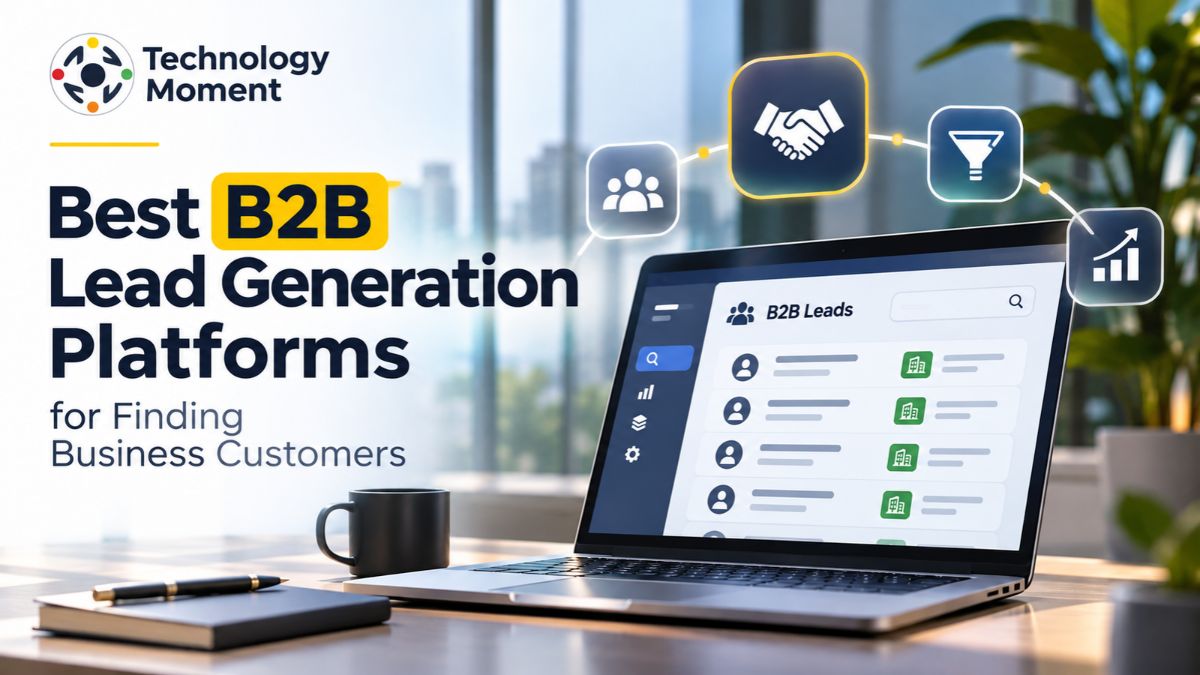
B2B lead generation platforms are software solutions that help businesses identify, research, and connect with other companies that may be interested in their products or services. Instead of spending hours searching company websites, professional networks, and online directories, sales and marketing teams can use these platforms to discover potential customers from organised business databases. They make it easier to find relevant companies, identify decision-makers, access business contact information, and build targeted prospect lists. For organisations that depend on business-to-business sales, these tools can support a more structured and repeatable customer acquisition process.
Most B2B lead generation platforms combine several capabilities, although their features vary depending on the provider. Some focus primarily on B2B contact databases, offering information such as company names, industries, employee counts, job titles, business email addresses, and phone numbers. Others provide advanced sales intelligence, helping users understand company characteristics, identify potential buying signals, and prioritise accounts. Certain platforms also include email finding, contact enrichment, lead qualification, and sales engagement features. These capabilities allow sales professionals to move from identifying potential customers to organising and managing their prospecting activities.
The typical process starts with defining an ideal customer profile (ICP). A business can search for companies based on industry, location, organisation size, revenue range, or other available filters. After identifying suitable accounts, users can explore relevant decision-maker contacts, such as founders, marketing directors, procurement managers, and sales executives. Depending on the platform, they may then verify contact information, export prospect records, or connect them with a customer relationship management (CRM) system. This helps businesses organise their sales leads and manage communication more efficiently.
However, B2B lead generation software does not automatically guarantee qualified customers or successful sales. Database accuracy, regional coverage, targeting criteria, and the relevance of the offer all influence results. Businesses should also consider data privacy requirements before collecting or contacting prospects. Ultimately, these platforms provide information and prospecting capabilities that help sales teams find potential business customers more systematically.
Best B2B Lead Generation Platforms for Finding Business Customers
Choosing the best B2B lead generation platforms depends on the type of customers a business wants to reach, its sales process, available budget, and the level of contact information it needs. Some solutions combine prospect databases with outreach capabilities, while others specialise in professional networking, contact discovery, or data enrichment. The following platforms serve different prospecting requirements and offer useful options for businesses targeting customers across international markets.
Apollo.io brings prospect discovery, contact information, and sales engagement together in a single workspace. Sales professionals can explore potential customers, narrow down searches using different criteria, and organise leads for future campaigns. Its combination of prospecting and outreach features makes it a practical option for startups and growing sales teams that want to manage several activities from one platform.
ZoomInfo is designed for businesses that depend on extensive B2B intelligence to identify and evaluate potential customers. Alongside professional contact information, it provides company-level insights that can help sales teams understand target accounts and identify relevant decision-makers. Its broader intelligence capabilities make it a consideration for established organisations with substantial sales operations and larger data requirements.
Cognism supports B2B sales prospecting with business contact information and company intelligence. It is particularly relevant for organisations targeting customers across multiple countries, including European markets. Before choosing the platform, businesses should examine the availability, accuracy, and suitability of its data for the specific regions and industries they intend to reach.
Lusha offers a relatively straightforward approach to discovering professional contact details and researching businesses. Sales representatives can use it to identify people associated with target organisations and gather information that supports their prospecting activities. It may suit individual professionals and smaller teams that prefer a focused contact discovery solution rather than a broader sales intelligence environment.
UpLead centres its offering on helping businesses find relevant B2B contacts and company records. Its emphasis on contact verification makes it worth examining for sales teams that want to improve the reliability of their prospect lists before beginning outreach. Organisations can assess its database coverage, available search filters, and verification approach against their particular prospecting requirements.
LinkedIn Sales Navigator uses LinkedIn’s professional network as the foundation for finding potential customers and researching business relationships. Its prospecting features allow sales professionals to explore organisations, identify relevant decision-makers, and follow developments involving target accounts. It is a useful choice for teams that prioritise professional connections, relationship building, and account-based prospecting.
Clay takes a workflow-oriented approach to prospect research and data enrichment. Rather than serving only as a contact discovery platform, it allows teams to bring information from different sources into customised prospecting processes. This flexibility can benefit sales operations professionals who need to enrich lead records, organise research, and develop tailored workflows for specific sales objectives.
Hunter.io helps businesses find professional email addresses linked to specific companies and websites. It also offers email verification capabilities, allowing sales and marketing teams to check contact details before using them in outreach campaigns. Its focused approach makes it a suitable option for organisations that primarily need reliable email discovery for B2B communication.
LeadIQ supports sales teams with prospect capture, contact data, and sales workflow integration. It can be useful for representatives who want to move prospect information into their existing sales systems.
Dealfront focuses on B2B sales intelligence and account identification, including capabilities designed to help businesses understand potential company customers and website activity.
Before choosing one, compare database coverage, contact accuracy, available integrations, pricing structure, and the features included in each subscription.
B2B Lead Generation Platforms Comparison
Comparing B2B lead generation platforms side by side makes it easier to understand which solution matches a company’s prospecting requirements. Although many platforms help businesses find potential customers, their main capabilities can differ considerably. Some provide extensive business contact databases, while others focus on professional networking, email discovery, sales intelligence, or data enrichment. Therefore, businesses should compare platforms according to their actual requirements rather than choosing one simply because it offers more features. The following comparison highlights the primary strengths, suitable users, and important considerations for each solution.
| Platform | Best For | Main Features | Key Strength | Potential Limitation |
|---|---|---|---|---|
| Apollo.io | Startups and sales teams | Contact database, prospecting, email sequences, CRM integration | Combines prospecting and outreach | Credit limits and data coverage need evaluation |
| ZoomInfo | Enterprise businesses | Company intelligence, contact database, intent data | Extensive sales intelligence capabilities | Pricing may require a custom quote |
| Cognism | International sales teams | B2B contact data, phone-verified contacts, sales intelligence | Particularly relevant for European prospecting | Availability and coverage vary by market |
| Lusha | Individual sales professionals and small teams | Contact discovery, company information, prospecting | Straightforward contact discovery | Credit restrictions may affect usage |
| UpLead | B2B sales teams | Contact search, email verification, company filters | Focus on verified contact information | Database coverage should be checked |
| LinkedIn Sales Navigator | Relationship-based prospecting | Lead search, account research, professional profiles | Access to professional network insights | Not a complete standalone email database |
| Clay | Sales operations and data teams | Data enrichment, workflow automation, multiple data sources | Flexible prospect research workflows | Requires time to configure workflows |
| Hunter.io | Email-based prospecting | Domain search, email finder, email verification | Specialised business email discovery | Limited broader sales intelligence |
| LeadIQ | Sales development representatives | Prospect capture, contact information, CRM workflows | Supports prospect capture and sales processes | Feature availability depends on subscription |
| Dealfront | B2B account identification | Company intelligence, website visitor insights, prospecting | Helps identify potential business accounts | Regional coverage and feature fit require evaluation |
The comparison shows that these platforms do not all perform the same function. Apollo.io may suit businesses looking for an integrated prospecting and outreach solution, whereas ZoomInfo is worth evaluating for enterprise-level sales intelligence. Cognism can be considered by organisations targeting European markets, while LinkedIn Sales Navigator is useful for researching professional profiles and building business relationships. Hunter.io is more specialised in email discovery, and Clay is relevant when teams need flexible contact enrichment workflows.
Pricing is another important consideration. Some providers offer free plans or limited trials, while others use subscription-based, credit-based, or custom enterprise pricing. The advertised subscription cost may not represent the complete expense because additional users, contact credits, phone number access, and integrations can affect the total cost. Businesses should also check whether their preferred CRM and outreach systems are supported.
Before purchasing, test the platform using a small sample of companies from your target market. Check whether the contact information is accurate, whether relevant decision-makers can be identified, and whether the available data meets your regional requirements. This practical comparison can help businesses select suitable B2B lead generation software without paying for unnecessary features.
Comparison note: Feature descriptions are based on publicly available product information. Plans, integrations, and capabilities can change. Verify details directly with each provider before purchasing.
Different Types of B2B Lead Generation Tools
B2B lead generation tools are available in different categories, and each category supports a specific stage of the customer acquisition process. Some help businesses discover potential companies, while others provide decision-maker contacts, verify email addresses, enrich existing records, or manage sales outreach. Understanding these differences is important because a single platform may not cover every prospecting requirement. Businesses should identify their main sales challenges before investing in lead generation software or combining multiple tools.
B2B contact database platforms help sales teams find companies and professionals using filters such as industry, job title, location, company size, and revenue. These databases make it easier to build targeted prospect lists instead of researching every business manually. B2B prospecting platforms focus on discovering potential customers and identifying relevant decision-makers within target organisations. They are particularly useful for sales professionals who need to connect with specific departments or business roles.
Email finder and verification tools help users discover professional email addresses associated with individuals or company domains and check whether those addresses are deliverable. This can reduce unnecessary outreach to invalid contacts. Sales intelligence platforms provide additional information about companies, industries, technology usage, and potential buying signals. They help sales teams understand which accounts may be relevant to their products or services.
Lead enrichment tools add missing information to existing prospect records, such as company details, job positions, and contact information. Meanwhile, sales engagement and outreach platforms support communication through email sequences, follow-ups, and other sales activities. CRM systems help organise these interactions and track prospects throughout the sales pipeline. Some modern B2B lead generation solutions combine several of these capabilities, while specialised tools focus on individual tasks. Selecting the right category depends on whether a business needs better contact discovery, more accurate data, improved prospect qualification, or a more organised sales workflow.
Key Features to Look for in a B2B Lead Generation Platform
Choosing a B2B lead generation platform requires more than comparing the size of its contact database. Businesses should examine whether its features can help them identify relevant prospects, access reliable business contact information, and manage sales activities effectively. A large database may appear attractive, but its value depends on how accurately it represents the companies and decision-makers a business wants to reach.
One of the most important features is verified business contact information. Look for platforms that provide professional email addresses, phone numbers, company names, and job titles, along with information about verification and data freshness. Advanced search and filtering capabilities are equally important because they allow users to narrow down prospects by industry, location, employee count, seniority, department, and other firmographic attributes. These filters make it easier to identify potential customers that match an ideal customer profile.
Another useful capability is lead qualification and scoring. It helps sales teams prioritise prospects according to their relevance, company characteristics, and available engagement or buying-intent signals. Some platforms also provide technographic data, which identifies the technologies used by a business. This information can be valuable when selling software, digital services, or technology-related products.
CRM integration and contact enrichment should also be considered. A platform that connects with existing CRM software can help transfer prospect information, update records, and reduce repetitive data entry. Email verification, automated outreach, reporting, and sales pipeline tracking can further support prospecting activities. For businesses targeting international customers, regional database coverage and language availability deserve attention.
Finally, evaluate data privacy and compliance controls. Check how the provider sources and updates information, handles opt-out requests, and supports applicable regulations such as GDPR and CCPA. The most useful platform is one that combines relevant data, practical features, reliable integrations, and appropriate privacy controls.
How to Choose the Right B2B Lead Generation Platform
Selecting the right B2B lead generation platform starts with understanding your business goals and the type of customers you want to reach. A solution that works well for a large enterprise may not be suitable for a startup with a limited budget or a small sales team. Before comparing providers, define your ideal customer profile (ICP), including the industries, company sizes, geographical locations, and decision-maker roles that are most relevant to your products or services. A clear ICP helps you avoid collecting large volumes of irrelevant business leads.
Next, evaluate the platform’s database quality and coverage. Check whether it provides useful business contact information for your target industries and countries. If your company sells internationally, do not assume that a provider with strong US coverage will offer equally useful data in Europe, Asia-Pacific, or other regions. Review its email verification process, contact update frequency, and available company information. Testing a small sample of prospects can help you assess whether the data meets your expectations.
Budget is another important consideration. Compare subscription plans, user limits, contact credits, export restrictions, and additional charges before making a purchase. A free plan may be sufficient for basic prospect research, whereas growing sales teams may need advanced search filters, enrichment, or automation. You should also examine CRM integration, API availability, and compatibility with your existing sales tools. Poor integration can create disconnected records and unnecessary manual work.
Finally, consider ease of use, customer support, scalability, and data privacy. Ask providers how they manage personal information, regional compliance requirements, and opt-out requests. If possible, use a trial or product demonstration to test the complete workflow, from finding a company to adding a qualified prospect to your CRM. The right B2B lead generation software should fit your sales process, provide relevant information, and support long-term customer acquisition without introducing unnecessary costs or complexity.
Best B2B Lead Generation Platforms for Different Business Needs
The best B2B lead generation platforms can vary depending on business size, sales objectives, target market, and available resources. Startups, small businesses, and enterprise organisations often have different prospecting requirements, so choosing a platform based on popularity alone may not deliver the expected results. Understanding which tools are suitable for particular business needs can help companies build a more effective prospecting strategy.
For small businesses, platforms such as Apollo.io and Lusha are worth exploring because they offer business contact discovery and prospecting capabilities. Smaller sales teams should prioritise ease of use, affordable plans, useful search filters, and manageable contact limits. A platform that combines several essential functions may help reduce the need for multiple subscriptions.
For startups, the main priority is often finding potential customers without committing to expensive software. Apollo.io, Hunter.io, and LinkedIn Sales Navigator can be considered for different prospecting tasks. These tools can help founders research companies, identify relevant professionals, and discover business email addresses. Startups should compare free access, usage restrictions, and upgrade costs before selecting a solution.
Enterprise businesses may require more extensive company databases, advanced sales intelligence, account research, and integrations across multiple sales teams. ZoomInfo and Cognism are options worth evaluating for these requirements. Larger organisations should also examine user permissions, data governance, regional coverage, and integration capabilities.
For finding business decision-makers, LinkedIn Sales Navigator can support professional research and account discovery, while Apollo.io and Lusha can help identify available contact information. Businesses looking for verified business email addresses may consider Hunter.io or UpLead, depending on their verification and coverage requirements. For international B2B prospecting, Cognism, ZoomInfo, and Apollo.io deserve consideration, but their actual coverage should be tested in the countries being targeted. Ultimately, the best solution is the one that matches the company’s sales workflow, target customers, and budget.
How to Find Qualified B2B Leads Using These Platforms
Finding qualified B2B leads requires more than collecting business email addresses or downloading large contact lists. The real objective is to identify companies that have a genuine need for your products or services and connect with the people who influence purchasing decisions. B2B lead generation platforms make this process easier by providing access to company databases, business contact information, prospecting filters, and sales intelligence. However, businesses need a clear qualification process to turn these resources into meaningful sales opportunities.
Identify the industries, company sizes, geographical locations, annual revenue ranges, and business characteristics that match your offering. For example, a company selling accounting software may focus on small and medium-sized businesses that need better financial management systems. Once your target market is clear, use B2B prospecting platforms to search for relevant organisations. Apply available filters to narrow results and avoid adding companies that do not match your requirements.
After identifying suitable businesses, find the right decision-makers within those organisations. Depending on your product, relevant contacts may include founders, finance managers, procurement directors, marketing heads, or IT managers. Platforms such as LinkedIn Sales Navigator, Apollo.io, and ZoomInfo can help with different aspects of company and professional research. Check their job titles, departments, responsibilities, and available contact details before adding them to your prospect list.
Use email verification features where available, check company websites, and confirm that the contact still works in the listed organisation. You can also examine firmographic information and available buyer intent signals to understand whether an account deserves priority. A qualified prospect should match your target market, have a relevant business requirement, and include an appropriate contact person.
Finally, organise qualified prospects in your CRM or sales management system. Record the company name, contact details, industry, location, qualification notes, and next follow-up action. Segment prospects according to their relevance and sales readiness. Personalised communication based on a company’s actual business needs is generally more useful than sending identical messages to a large audience. By combining accurate data, clear qualification criteria, and consistent follow-up, businesses can use lead generation platforms to build a more relevant sales pipeline.
Benefits and Limitations of B2B Lead Generation Platforms
B2B lead generation platforms offer several advantages for businesses that want to find potential customers, improve prospecting activities, and build a stronger sales pipeline. One of their biggest benefits is reducing the time spent on manual research. Instead of searching multiple websites and collecting company information individually, sales teams can use searchable business databases to identify organisations that match their target market. This makes prospect discovery more organised and helps sales professionals focus on relevant opportunities.
Another important advantage is improved audience targeting. Most B2B lead generation tools provide filters based on industry, company size, location, job title, department, and other business characteristics. These options help companies identify potential buyers and decision-makers rather than approaching unrelated contacts. Some sales intelligence platforms also provide firmographic data, technology information, and buyer intent signals that can support account prioritisation. Access to verified business contact information and email discovery features can further improve prospect research when the information is accurate and up to date.
These platforms can also support better sales team productivity. CRM integration, contact enrichment, prospect list management, and automated outreach features help reduce repetitive administrative tasks. Businesses can organise sales leads, track communication, and manage follow-ups through connected workflows. For growing companies, these capabilities can make it easier to manage larger prospect lists without relying entirely on manual spreadsheets.
However, B2B lead generation platforms also have limitations. First, database information is not always completely accurate or current. Employees change jobs, companies update their contact details, and email addresses can become inactive. Second, subscription costs, contact credits, export limits, and additional features may increase the overall expense. Smaller businesses should carefully evaluate pricing before purchasing a plan.
Another limitation is that access to contact information does not guarantee customer interest. A prospect may match your company filters but have no immediate requirement, purchasing authority, or available budget. Automated outreach can also become ineffective when messages are poorly targeted or excessively repetitive. International businesses must additionally consider applicable privacy regulations, data sourcing practices, and communication requirements in their target markets.
Therefore, these platforms should be treated as prospecting and research solutions rather than automatic customer acquisition systems. Their effectiveness depends on accurate targeting, reliable data, relevant communication, and a well-managed sales process.
Frequently Asked Questions About B2B Lead Generation Platforms
What Are the Best B2B Lead Generation Platforms?
Some popular B2B lead generation platforms include Apollo.io, ZoomInfo, Cognism, Lusha, UpLead, and LinkedIn Sales Navigator. Each offers different capabilities for finding business customers, researching companies, and identifying decision-makers. The best option depends on your target market, database requirements, budget, and sales workflow. Compare their features, contact accuracy, integrations, and pricing before choosing a platform for your business.
How Do B2B Lead Generation Platforms Work?
B2B lead generation platforms use business databases, search filters, and contact information to help companies identify potential customers. Users typically search by industry, company size, location, or job title to find relevant prospects. Depending on the software, they can access contact details, verify email addresses, enrich prospect records, and connect information with CRM systems for organised sales follow-ups.
How Can I Find Qualified B2B Leads Online?
Start by defining your ideal customer profile, including target industries, company sizes, locations, and relevant decision-maker roles. Use B2B prospecting platforms and professional networks to discover matching companies. Review their business requirements, verify available contact information, and prioritise prospects based on relevance. Organising qualified contacts in a CRM can also help manage communication and track potential sales opportunities.
Are There Free B2B Lead Generation Tools?
Yes, some B2B lead generation platforms offer free plans, limited credits, or trial access. Apollo.io, Hunter.io, and other prospecting tools may provide entry-level options, although features and usage limits vary. Free plans can help startups and small businesses explore contact discovery and prospect research. Review current restrictions, available integrations, and upgrade costs before depending on a free solution.
What Features Should a B2B Lead Generation Platform Have?
A useful B2B lead generation platform should provide accurate business contact information, company databases, advanced search filters, and decision-maker identification. Email verification, contact enrichment, CRM integration, and lead qualification features are also valuable. Businesses targeting international customers should evaluate geographical coverage and data privacy controls. The right combination depends on the company’s prospecting requirements, sales process, and available budget.
Are B2B Lead Generation Platforms Worth It?
B2B lead generation platforms can be worthwhile when businesses regularly research potential customers and need organised prospecting workflows. They can reduce manual research, improve targeting, and support sales productivity. However, purchasing software does not guarantee qualified leads or conversions. Evaluate database accuracy, pricing, regional coverage, and integration capabilities. A trial using your actual target market can help determine its value.