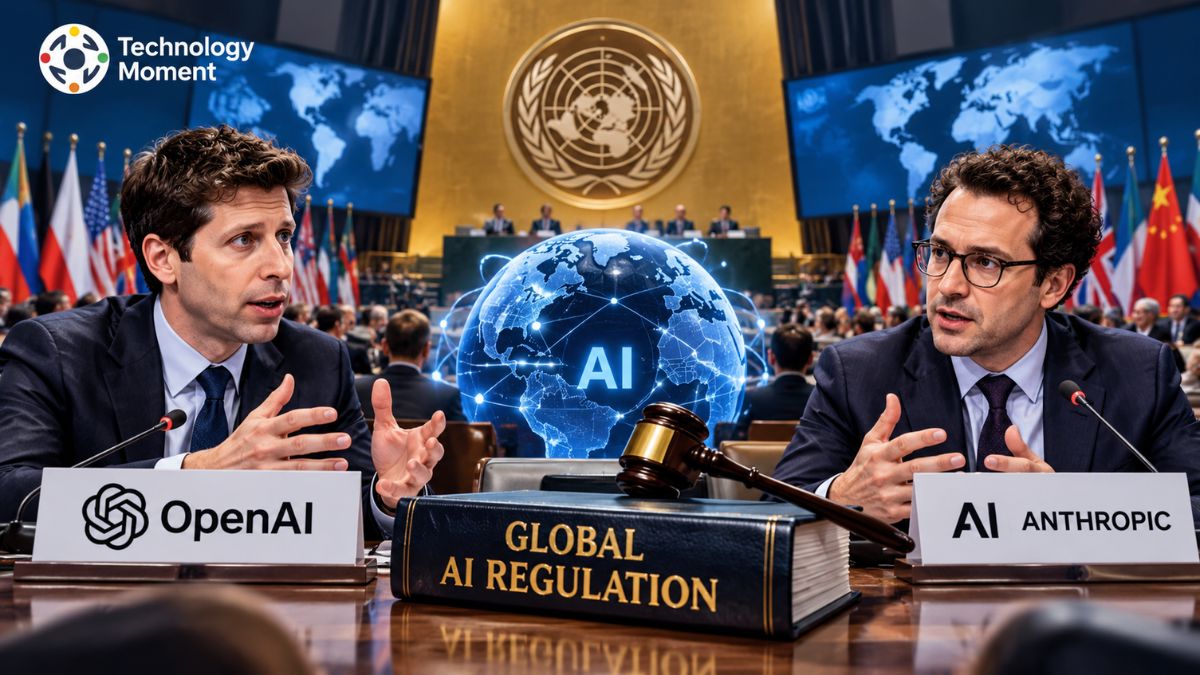
Artificial intelligence is moving from a fast-growing technology into an issue that governments, researchers, and technology companies are increasingly treating as a global policy challenge. The latest discussion at the United Nations has brought that debate into sharper focus, with OpenAI Anthropic CEOs on AI Regulation.
The conversation comes at a time when AI systems are becoming more capable and are being adopted across industries and countries. While governments are developing their own policies, the lack of consistent rules between jurisdictions raises questions about how advanced AI systems should be tested, monitored, and governed. Issues such as AI safety, transparency, accountability, and the responsible development of frontier AI are becoming increasingly important.
For OpenAI and Anthropic, regulation is particularly significant because both companies are developing advanced AI models that can have broad applications. Their views add an important industry perspective to a wider discussion involving governments, international organizations, researchers, and civil society.
At Technology Moment, we focus on explaining developments like these beyond the headline. Rather than simply reporting that a major AI company has called for regulation, we examine what the development means, why global AI governance is being discussed, and how potential regulatory frameworks could affect the companies building advanced AI systems.
This article looks at the OpenAI and Anthropic CEOs’ position on global AI regulation, the role of the United Nations, the challenges of creating international AI rules, and what this evolving debate could mean for the future of AI governance.
OpenAI and Anthropic CEOs Call for Global AI Regulation
OpenAI and Anthropic have become central companies in the development of advanced artificial intelligence, making their views on AI policy increasingly relevant to the global conversation. Their leaders’ discussion of global AI regulation at the United Nations reflects a broader debate about how increasingly capable AI systems should be developed, evaluated, and governed. Rather than treating artificial intelligence regulation as a matter for individual countries alone, the discussion highlights the importance of international cooperation when AI systems and the companies building them operate across borders.
The issue is particularly relevant to frontier AI, where newer models are becoming capable of performing increasingly complex tasks. As these systems develop, governments and technology organizations are considering questions around AI safety, oversight, transparency, accountability, and responsible AI development. OpenAI’s involvement in the discussion is significant because the company develops advanced AI models and has publicly participated in debates around AI policy and safety. Anthropic has also placed considerable attention on AI safety and the governance of advanced AI systems.
The call for broader rules does not mean that every government or technology company has the same approach to regulation. Different countries are developing their own AI laws and policy frameworks, while international organizations are examining ways to improve coordination. The United Nations provides a forum where these different perspectives can be discussed. For the wider AI industry, the debate raises an important question: should advanced AI development be governed primarily through national regulations, or should countries also work toward common international AI rules? The discussion involving OpenAI and Anthropic adds another industry perspective to that ongoing question.
Why Global AI Regulation Is Being Discussed at the UN
The growing discussion about global AI regulation at the United Nations is closely connected to the international nature of artificial intelligence. AI models can be developed in one country, operated through infrastructure in another, and used by people and organizations around the world. This makes AI governance more complicated than regulating a technology that operates within a single national market.
Countries are already taking different approaches to AI policy, creating a landscape in which artificial intelligence regulation can vary significantly between jurisdictions. Some governments are concentrating on transparency and accountability, while others are emphasizing innovation, safety, privacy, or specific applications of AI. As these approaches evolve, international cooperation becomes an important part of the conversation around global AI governance.
AI safety is another major reason the issue has gained attention. Advanced AI models can be used for productive applications across research, software development, education, business, and other fields. At the same time, policymakers and researchers continue to examine potential AI risks and ways to establish appropriate safeguards. International AI rules could potentially provide common principles for areas such as testing, monitoring, risk management, and responsible development, although the exact structure of any global framework remains a subject of debate.
The UN’s involvement also reflects the fact that AI governance extends beyond technology companies. Governments, researchers, international organizations, businesses, and civil society all have interests in how AI systems are developed and deployed. The challenge is finding areas of agreement without creating rules that become outdated as technology changes. AI development is moving quickly, while international policy processes can take considerably longer. That gap makes global AI policy an evolving discussion rather than a finished regulatory system.
What Global AI Regulation Could Mean for AI Companies
Global AI regulation could have significant implications for companies developing and deploying advanced artificial intelligence systems. The exact effects would depend on the rules eventually adopted by governments and international institutions, but areas such as AI safety, AI oversight, transparency, testing, and accountability could become increasingly important for AI companies.
For companies such as OpenAI and Anthropic, regulatory requirements could influence how advanced AI models are developed, evaluated, released, and monitored. If countries establish common AI safety standards, companies may need to demonstrate that certain systems meet specified requirements before or after deployment. Regulatory frameworks could also create additional expectations around documentation, risk assessment, data practices, or reporting.
Another possible effect is greater consistency across markets. Today, AI companies may need to understand different legal and regulatory requirements when operating internationally. More closely aligned international AI rules could reduce some of that complexity, although creating a genuinely common framework would be difficult. Conversely, significantly different national regulations could increase compliance costs and make international AI development more complicated.
AI regulation could also affect smaller companies and startups. Large AI companies may have greater resources for legal, compliance, security, and safety programs, while smaller organizations could face a heavier relative burden if requirements become extensive. Policymakers therefore have to consider how regulation can address AI risks without unnecessarily restricting competition and innovation. The discussion is not limited to restrictions. Clear AI policy frameworks can also provide companies with greater certainty about acceptable practices and responsibilities. Well-defined AI standards could help organizations understand expectations before launching new systems.
What Is Global AI Regulation?
Global AI regulation refers broadly to efforts to establish rules, standards, principles, or coordinated policies governing the development and use of artificial intelligence across countries. It does not necessarily mean that one worldwide law would replace every country’s existing AI legislation. Instead, global AI regulation can involve international agreements, shared standards, coordinated policies, or common principles that help countries address AI-related issues in a more consistent way.
The distinction between AI regulation and AI governance is useful. AI regulation generally refers to formal requirements established by governments or regulatory bodies, while AI governance can include a wider set of policies, standards, institutional practices, safety processes, and oversight mechanisms. Both are relevant to the development of responsible AI systems. Several areas can fall within international AI regulation discussions. These include AI safety, privacy, transparency, accountability, risk assessment, model testing, cybersecurity, and oversight of advanced or frontier AI systems. The specific priorities can differ depending on the country, technology, and application involved.
Global AI regulation is also different from simply creating national AI laws. A country can introduce its own artificial intelligence regulation without requiring other governments to adopt identical rules. International cooperation becomes important when AI systems cross national borders and when inconsistent requirements create challenges for organizations operating globally. One of the greatest difficulties is reaching agreement among countries with different economic interests, legal systems, technological capabilities, and policy priorities. Governments may also disagree about how much regulation is appropriate and which AI risks should receive the greatest attention.
For that reason, global AI governance is better understood as an evolving process than as a single completed framework. The debate involving the United Nations, technology companies, governments, researchers, and other stakeholders is part of a larger effort to determine how international AI rules can support safety and accountability while allowing useful AI development to continue.
Why AI Regulation Is Difficult Across Countries
AI regulation is difficult across countries because governments do not necessarily share the same priorities, legal systems, economic interests, or approaches to technology policy. Artificial intelligence is also developing faster than many traditional regulatory processes, making it challenging for policymakers to create rules that remain relevant as new models and applications emerge. This is particularly important for frontier AI, where capabilities can change rapidly, and the potential uses of advanced AI models extend across national borders. A regulatory framework designed for one jurisdiction may therefore not address every issue faced by another.
Another challenge is the difference between national AI laws and international AI rules. Individual countries can establish their own artificial intelligence regulation based on domestic priorities, but AI companies often operate globally. Different requirements for AI safety, transparency, data governance, risk assessment, or AI oversight can create additional compliance responsibilities for companies operating across multiple markets. This can make international AI policy more complicated for both established technology companies and smaller developers.
There is also an ongoing debate about how regulation should balance AI safety with innovation. Governments want to address AI risks and establish responsible AI practices, while technology companies and researchers continue developing increasingly capable systems. Excessively fragmented rules could make cross-border development more difficult, while insufficient coordination could leave gaps in oversight. These competing considerations help explain why global AI governance remains an evolving process.
International cooperation could potentially address some of these differences by establishing shared principles or AI standards. However, reaching agreement among countries with different regulatory philosophies is not simple. Questions about enforcement, technical definitions, accountability, and the scope of regulation can all lead to disagreement. As a result, global AI regulation is likely to involve ongoing coordination between governments, international organizations, technology companies, and other stakeholders rather than a single universal solution.
AI Safety and the Push for International Rules
AI safety has become an important part of discussions about international AI rules as artificial intelligence systems become increasingly capable. Advanced AI models are now being developed for applications ranging from software development and research to business and education, increasing the importance of understanding how these systems should be evaluated and governed. The discussion around global AI regulation therefore extends beyond traditional technology policy and includes questions about responsible AI development, risk management, monitoring, and oversight.
One reason international cooperation is being discussed is that AI risks and opportunities are not limited to the country where a model is developed. An AI system released by a company in one jurisdiction can quickly become available to users in many others. This creates challenges for national regulators because the effects of AI development can extend beyond domestic borders. International AI rules or common AI safety standards could provide countries with a basis for coordinating approaches to advanced systems, although the exact form of such cooperation remains under discussion.
AI safety can involve several different areas. Governments and organizations may consider model testing, evaluations, cybersecurity, transparency, human oversight, and processes for identifying potential risks before and after deployment. Frontier AI regulation is particularly complex because policymakers must determine which systems should receive additional scrutiny and what level of oversight is appropriate.
The push for international rules does not necessarily mean that every country needs identical legislation. A global AI policy framework could instead focus on common principles while allowing individual governments to establish additional requirements according to their own circumstances. This distinction is important because countries have different legal systems and technology sectors.
The broader objective of international AI governance is to create mechanisms that encourage responsible development while allowing beneficial innovation to continue. Achieving that balance requires cooperation among governments, AI companies, researchers, and international institutions. As AI capabilities evolve, AI safety measures and international standards will likely remain central to discussions about how advanced systems should be developed and deployed.
How Global AI Regulation Could Affect OpenAI and Anthropic
Global AI regulation could influence how OpenAI and Anthropic develop, evaluate, release, and monitor advanced AI systems, although the precise impact would depend on the regulations ultimately adopted. Both companies operate in a rapidly developing AI industry, and their work on advanced models places them within the broader discussion about AI safety, AI oversight, responsible AI development, and international AI policy.
For OpenAI, future AI regulation could introduce additional requirements around model evaluations, safety testing, transparency, documentation, or risk management. Depending on the jurisdiction, the company could also face different compliance obligations when offering AI systems to users in different markets. Internationally coordinated AI rules could make some requirements more consistent, while fragmented national regulations could create additional complexity for global operations.
Anthropic could face similar considerations. The company’s focus on advanced AI models and AI safety places it directly within discussions about frontier AI governance. If governments introduce common AI safety standards, companies developing highly capable systems may need to demonstrate that their models meet particular testing or oversight requirements. Such rules could affect development processes as well as how systems are released and monitored after deployment.
Global AI regulation could also affect the wider competitive environment. Large AI companies generally have significant technical, legal, and compliance resources, while smaller developers may have fewer resources to meet extensive regulatory requirements. Depending on how regulations are designed, this could influence competition, market entry, and the cost of developing advanced AI systems. At the same time, clearer AI policy frameworks could provide companies with greater certainty. Common international AI standards may make it easier for organizations to understand expectations when operating across multiple markets. They could also establish clearer responsibilities for AI developers and users.
The effect on OpenAI and Anthropic will ultimately depend on the specific AI laws, standards, and enforcement mechanisms adopted by governments. The current discussion is therefore better understood as part of an evolving global AI governance process rather than evidence of a single regulatory model already being established.
What Are the Biggest Challenges to Global AI Regulation?
Creating effective global AI regulation is difficult because artificial intelligence develops across borders while laws are generally created within individual jurisdictions. Countries have different legal systems, economic priorities, technology sectors, and approaches to AI policy. Some may place greater emphasis on AI safety and oversight, while others may focus more strongly on innovation, competitiveness, or economic growth. Building international AI rules that accommodate these differences is therefore a complex process.
One major challenge is agreeing on what should actually be regulated. Artificial intelligence covers everything from relatively simple software tools to highly capable frontier AI systems. Policymakers need to determine whether the same requirements should apply to every AI application or whether advanced AI models should receive additional scrutiny. Definitions also matter because unclear terminology can make AI legislation difficult to implement consistently across countries.
Another challenge involves enforcement. Even if governments agree on common AI standards, ensuring that companies follow those standards across different jurisdictions can be complicated. AI systems can be developed, hosted, distributed, and used in different countries, making international coordination important. Differences in regulatory enforcement could also create gaps between countries.
The speed of AI development presents another difficulty. AI companies continue to introduce increasingly capable models, while governments often require lengthy consultation and legislative processes. A regulation designed around today’s technology could become less relevant as new AI capabilities emerge.
There is also a need to balance AI safety with innovation. Stronger oversight may help address AI risks, but policymakers also need to consider the potential effects of complex requirements on startups, researchers, and established AI companies. International AI policy therefore needs to address safety, accountability, and transparency without assuming that one regulatory approach will work equally well everywhere. These challenges explain why global AI governance is likely to develop gradually through cooperation, shared principles, technical standards, and national legislation rather than through one universally identical AI law.
What This Means for the Future of AI Governance
The growing discussion around global AI regulation suggests that AI governance will increasingly become an international policy issue rather than a matter handled exclusively by individual governments. As advanced AI models are developed and deployed across multiple markets, countries have greater incentives to coordinate on issues such as AI safety, transparency, accountability, and responsible AI development.
One possible direction is the development of common international AI standards. These standards could provide shared principles for evaluating advanced AI systems, managing risks, improving transparency, and establishing appropriate oversight. Such standards would not necessarily replace national AI laws. Instead, they could provide a common foundation that countries could adapt to their own legal and economic environments.
International cooperation may also become increasingly important for frontier AI. Highly capable models can have applications in many sectors and can be distributed globally, which makes purely national approaches difficult to coordinate. Governments, international organizations, researchers, and AI companies may therefore need mechanisms for sharing information and developing compatible approaches to AI safety.
The future of AI governance could also involve greater responsibilities for technology companies. Developers such as OpenAI and Anthropic may increasingly be expected to demonstrate how advanced systems are tested, evaluated, monitored, and managed. Clearer AI policy frameworks could provide companies with more predictable expectations, while regulators may gain better mechanisms for addressing emerging AI risks.
However, future regulation is unlikely to be completely uniform. Different countries may continue to establish their own AI laws based on local priorities. The challenge will be finding areas where international cooperation can reduce regulatory fragmentation without preventing governments from addressing their specific concerns.
Frequently Asked Questions About Global AI Regulation
What are OpenAI Anthropic CEOs on AI Regulation?
OpenAI and Anthropic leaders have participated in discussions about the need for stronger approaches to AI governance and safety. Their involvement reflects a wider debate about how advanced AI systems should be developed, evaluated, monitored, and governed across countries as AI capabilities continue to evolve.
Why do OpenAI and Anthropic support AI regulation?
The companies’ involvement in AI policy discussions is connected to broader concerns about AI safety, responsible development, oversight, and the governance of increasingly capable systems. Their positions should be understood alongside views from governments, researchers, international organizations, and other technology companies involved in AI policy.
What is global AI regulation?
Global AI regulation broadly refers to international efforts to establish common rules, standards, principles, or governance mechanisms for artificial intelligence. It does not necessarily mean one worldwide AI law. Countries can maintain their own legislation while cooperating on areas such as AI safety, transparency, oversight, and responsible AI development.
What AI regulations are being discussed at the UN?
UN-related discussions can cover broad areas of AI governance, including AI safety, responsible development, international cooperation, transparency, accountability, and oversight. Specific proposals and regulatory approaches can vary, so individual developments should be checked against the relevant UN documents or official statements before drawing conclusions.
Why does the UN want AI regulation?
The UN provides an international forum for discussing technologies that affect multiple countries. AI’s cross-border development and deployment create governance challenges that cannot always be addressed through national policies alone. International cooperation can help countries discuss shared principles for safety, accountability, responsible development, and the wider governance of artificial intelligence.
What does AI regulation mean for AI companies?
AI regulation can create requirements involving safety testing, transparency, risk assessment, documentation, data practices, and oversight, depending on the applicable jurisdiction. For companies operating internationally, differences between national AI laws can also create additional compliance responsibilities and influence how advanced AI systems are developed and deployed.
How could global AI regulation affect OpenAI?
Potential effects could include additional requirements for evaluating advanced AI models, documenting risks, improving transparency, or demonstrating safety measures. The actual impact would depend on future AI laws and international standards. Global rules could also influence how OpenAI manages compliance when its AI systems are offered across different countries.
How could global AI regulation affect Anthropic?
Anthropic could face similar requirements involving AI safety, model evaluations, transparency, risk management, and oversight if governments introduce applicable rules for advanced AI systems. The specific impact would depend on the regulations adopted by individual jurisdictions and any international frameworks or standards developed through future AI governance discussions.
Who supports global AI regulation?
Support for AI regulation comes from different groups for different reasons, including governments, policymakers, researchers, technology companies, and international organizations. However, these groups do not necessarily agree on the same regulatory model, scope, or enforcement approach. Positions can differ significantly regarding AI safety, innovation, transparency, and international governance.
What are the risks of unregulated AI?
Concerns surrounding insufficient AI oversight can include safety risks, misuse, privacy issues, security problems, unreliable outputs, and difficulties establishing accountability. The specific risks vary according to the AI system and its application. This is why AI safety, responsible AI development, risk assessment, and appropriate oversight remain important parts of the global policy discussion.