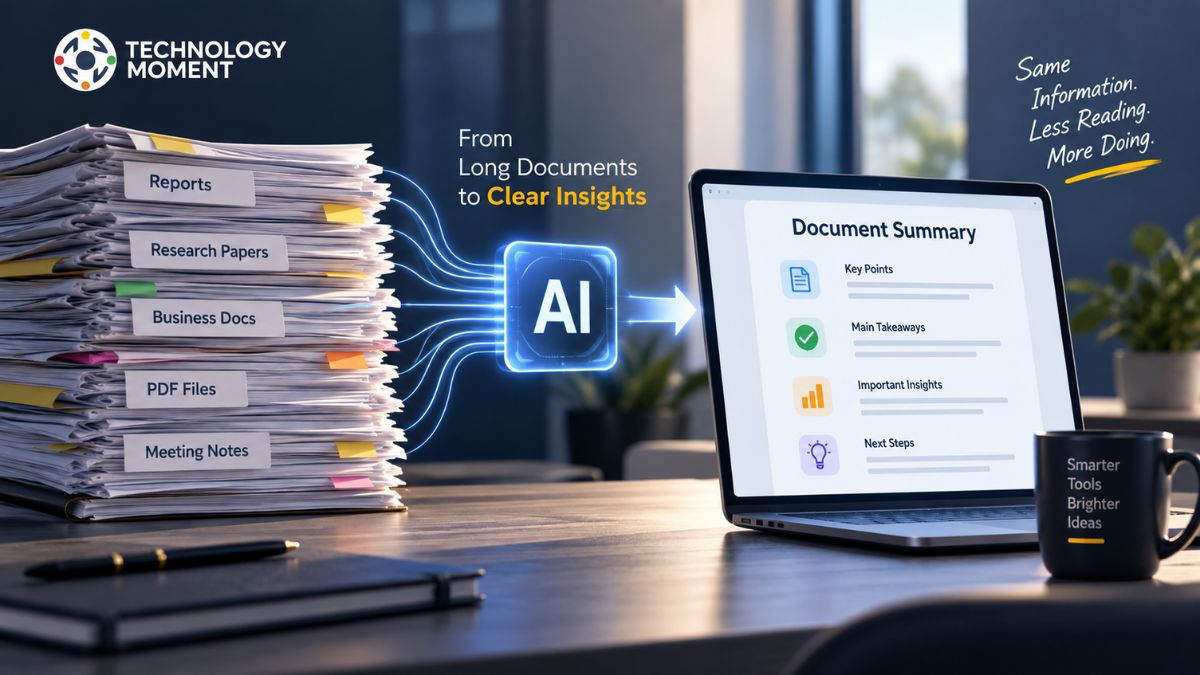
Long documents can contain valuable information, but finding the information that actually matters can take hours. Research papers, business reports, technical documentation, legal files, and lengthy PDFs often require readers to work through dozens or even hundreds of pages before reaching the most important points.
AI is changing how people approach this problem. Instead of reading every sentence manually, AI-powered document summarization can analyze large amounts of text, identify important ideas, and turn lengthy documents into concise, structured summaries. This can make research, learning, and everyday information gathering significantly more efficient.
But getting a useful summary is not simply about asking an AI tool to “summarize this document.” The quality of the result depends on how the document is processed, what information you ask the AI to focus on, and how carefully you verify the final output. At Technology Moment, our goal is to make complex technology easier to understand and use in practical situations. In this guide, we’ll explain how AI summarizes long documents, how to summarize PDFs and other document types, how tools such as ChatGPT can help, and how to get more accurate and useful results while avoiding common mistakes.
What Is AI Document Summarization?
AI document summarization is the process of using artificial intelligence to analyze a document and create a shorter version that preserves its most important information. Instead of manually reading every paragraph, an AI document summarizer can identify the main ideas, important points, findings, arguments, and conclusions and present them in a more concise format.
Modern AI summarization tools use natural language processing (NLP) and large language models (LLMs) to understand the relationships between different parts of a document. Depending on the tool and the type of document, the system may analyze headings, paragraphs, keywords, context, and other relevant information before generating a summary.
There are two common approaches to automatic summarization: extractive and abstractive summarization. Extractive summarization selects important sentences or phrases directly from the original document. Abstractive summarization, on the other hand, generates new sentences that explain the document’s main ideas in a shorter form.
AI document summarization can be useful for many types of content, including research papers, business reports, technical documentation, meeting notes, books, and PDFs. For example, a professional could use AI to quickly understand a lengthy report before a meeting, while a student could use it to identify the main arguments in a research paper. A useful AI summary should help the reader understand the original material more efficiently while retaining the information needed for the intended purpose. Because AI-generated summaries can sometimes miss context or important details, the original document should still be consulted when accuracy is critical.
How Does AI Summarize Long Documents?
AI summarizes long documents through several stages of document processing and text analysis. Although the exact process differs between AI tools, the general goal is to identify the most relevant information and transform it into a concise, understandable summary. First, the AI system processes the document. This may involve analyzing text from a Word file, PDF, web page, or another supported format. The system breaks the content into manageable sections and examines the relationship between different parts of the document.
Next, the AI identifies important information. It looks for main ideas, supporting details, conclusions, repeated concepts, and other signals that help determine what information is relevant. For example, when analyzing a research paper, the system may identify the research question, methodology, findings, and conclusion.
The next stage involves understanding context. Simply identifying frequently used words is not enough to produce a useful summary. AI needs to determine how different statements relate to one another so that the final summary reflects the document’s overall meaning rather than a collection of disconnected sentences.
After analyzing the content, the AI generates the summary. Depending on the request, it can produce a short overview, detailed summary, bullet-point notes, executive summary, or list of key findings. Finally, the output should be reviewed. AI text analysis can occasionally omit important details, misunderstand specialized terminology, or produce information that is not fully supported by the source. Reviewing the summary against the original document is particularly important for legal, medical, financial, academic, and technical content.
This process allows AI to turn large amounts of information into a more accessible format while helping readers focus on the main ideas instead of processing every sentence manually.
How to Summarize Long Documents With AI
Learning how to summarize long documents with AI is relatively straightforward, but the quality of the result depends heavily on the instructions you provide. A clear objective helps an AI document summarization tool understand what information should receive the most attention. Start by uploading or importing the document into an AI tool that supports the file format. Depending on the platform, you may be able to work with PDFs, text documents, presentations, or other supported files.
Next, explain what kind of summary you need. Instead of simply asking the AI to “summarize this,” provide specific instructions. For example, you could ask it to summarize the document in 500 words, identify the five most important findings, explain the main arguments, or create an executive summary for a business audience. You can also specify the structure of the output. Bullet points can work well for quickly reviewing important information, while paragraphs may be more appropriate when you need a coherent overview. For research or professional documents, you can ask the AI to separate the main findings, evidence, limitations, and conclusions.
For particularly long documents, consider working section by section if the AI tool cannot reliably process the entire document at once. You can summarize individual sections first and then ask the AI to combine those summaries into a broader overview. After generating the summary, review it against the original document. Check important numbers, names, dates, conclusions, and technical claims. If something appears unclear, ask the AI to explain where the information came from or revisit the relevant section of the source.
You can also use follow-up prompts to refine the result. For example, you might ask for a shorter version, a beginner-friendly explanation, key takeaways, or action items. The best results come from treating AI as a document analysis assistant rather than an unquestionable replacement for the original material.
How AI Helps You Summarize Lengthy PDF Documents
PDFs are among the most common document types people want to summarize because they are frequently used for research papers, reports, manuals, white papers, and other long-form content. An AI PDF summarizer can make these documents easier to review by extracting important information and presenting it in a shorter format. The tool needs to be able to read the text contained in the file. Text-based PDFs are generally easier for AI systems to process, while scanned documents may require optical character recognition (OCR) before their content can be analyzed accurately.
Once the PDF is available, describe the type of summary you want. A general prompt might ask the AI to summarize the document and identify its main ideas. For a research paper, you could request the research objective, methodology, major findings, limitations, and conclusion. For a business report, you might focus on key metrics, risks, recommendations, and action items.
After reviewing the individual sections, you can request a combined summary that connects the main points across the document. It is also useful to ask the AI to distinguish between key findings and supporting details. This can prevent the final summary from becoming unnecessarily long. However, an AI PDF summary should not automatically be treated as a complete substitute for the source. Tables, charts, footnotes, citations, scanned pages, and highly specialized information may require additional verification.
For important documents, compare the AI-generated summary with the original PDF and confirm critical information before using it for research, business decisions, or other high-stakes purposes.
A Practical Guide to Summarizing Documents With ChatGPT
ChatGPT can be used to summarize long documents when the relevant file or text is provided, and the model supports the document format and size. The process begins by uploading the document and clearly explaining what you want the summary to accomplish. A simple request such as “summarize this document” may produce a useful overview, but a more specific instruction can provide a result that better matches your needs. You can ask ChatGPT to identify the main ideas, extract key findings, explain difficult sections, or create a structured summary.
For example, instead of requesting only a general summary, you could ask for the document’s purpose, major arguments, important findings, limitations, and conclusion. You can also specify the intended audience, desired length, and preferred format. ChatGPT can also be useful for asking follow-up questions after the initial summary. You might ask it to explain a particular section in simpler language, compare two arguments, identify important evidence, or turn the summary into a list of actionable points.
When working with a very large document, processing limitations may affect how much content can be analyzed at once. If necessary, divide the document into logical sections and summarize them individually before asking ChatGPT to create an overall summary. Accuracy should remain a priority. A generated summary may occasionally misunderstand context, omit details, or produce an inaccurate interpretation. For academic research, business analysis, technical documentation, or any situation where specific facts matter, verify important claims against the original document.
Used thoughtfully, ChatGPT can function as an AI reading and document analysis assistant, helping readers move from lengthy source material to a clearer understanding of the information that matters most.
Types of Documents You Can Summarize With AI
Long-form documents often require significant time and attention to review. From academic papers and business reports to technical documentation, AI tools can quickly process lengthy material, highlight the most relevant information, and provide a clear overview of the content.
Research papers often contain dense information that can take considerable time to review. AI can condense complex studies by highlighting their research objectives, methods, key results, evidence, and conclusions. This gives students and researchers a quicker way to assess multiple studies and identify which ones deserve a more detailed examination.
Business reports can also benefit from AI document analysis. A long report may contain financial information, performance data, recommendations, risks, and supporting details. AI can turn this information into an executive summary or a structured list of key points for faster review.
Books and other lengthy materials can be analyzed with AI to highlight chapter summaries, central themes, key arguments, and significant ideas. This gives readers a quick understanding of the content while allowing them to return to the full text when deeper context is needed.
AI can also summarize PDFs, technical documentation, manuals, and white papers. Other useful applications include meeting notes, project documents, academic assignments, policy documents, product documentation, and lengthy articles. The quality of the result depends on the document’s format, complexity, length, and the AI system being used. Text-based documents are generally easier to process than poorly scanned files or documents containing complex visual information.
For specialized material, it is also important to provide clear instructions about what information matters. Asking an AI to focus on findings, risks, action items, or technical explanations can produce a more useful summary than requesting only a general overview.
Extractive vs. Abstractive Summarization
AI document summarization generally uses two major approaches: extractive summarization and abstractive summarization. Understanding the difference can help you choose the right approach for different types of documents. Extractive summarization identifies important sentences, phrases, or passages from the original document and combines them to create a shorter version. The wording generally comes directly from the source. This approach can be useful when preserving the original language is important.
Abstractive summarization works differently. Instead of simply selecting existing sentences, an AI system interprets the document and generates new sentences that communicate the main ideas. This can produce a more natural and readable summary, although the generated wording needs to be checked for accuracy.
| Feature | Extractive Summarization | Abstractive Summarization |
|---|---|---|
| Basic approach | Selects important text from the source | Generates a new summary |
| Wording | Usually taken directly from the document | Rephrased in new language |
| Main strength | Preserves source wording | Produces natural, concise explanations |
| Risk | May feel disconnected or repetitive | Can introduce interpretation errors |
| Best suited for | Fact-focused documents and references | Explanations, overviews, and general summaries |
What Information Can AI Extract From Long Documents?
AI can extract and organize many types of information from long documents, making document analysis more efficient. Instead of treating every sentence as equally important, an AI system can be instructed to focus on specific information that matters to the reader. One of the most common uses is identifying main ideas and key points. For example, when analyzing a long report, AI can identify the central topic, major arguments, conclusions, and supporting information.
AI can also extract important findings from research papers and reports. Users can ask for major results, evidence supporting those results, limitations, and conclusions. This can make it easier to compare multiple documents without immediately reading every page in full. Another useful application is extracting specific facts and details. Depending on the document and AI tool, users may ask for dates, names, figures, recommendations, requirements, action items, or other structured information.
AI can also create executive summaries for business documents. Instead of reproducing every detail, an executive summary can focus on information that decision-makers need to understand the document’s overall significance. For technical documents, AI may help identify important concepts, procedures, definitions, dependencies, or implementation requirements. However, highly specialized terminology can sometimes be misunderstood, so technical information should be verified.
The ability to extract information is especially useful when dealing with large collections of documents. Researchers, professionals, and students can use AI to organize document insights and identify which sections deserve closer attention. However, extraction is not always perfect. Important information can be missed, especially when it appears in tables, images, footnotes, or complex layouts. For that reason, AI should be treated as an information-processing assistant rather than an infallible source.
Clear prompts also matter. Telling the AI exactly what information to extract—such as “list the five main findings” or “identify all recommendations”—usually produces more useful results than a vague request.
Benefits of Using AI to Summarize Long Documents
Using AI to summarize long documents can significantly reduce the effort required to process large amounts of information. One of the biggest advantages is time savings. Instead of spending hours reading an entire report before understanding its basic message, users can begin with an AI-generated overview and then investigate the most relevant sections.
AI document summarization can also make complex material easier to understand. A long technical or academic document can be transformed into concise explanations, bullet points, or structured notes. This can be particularly useful for students, researchers, professionals, and people who regularly work with large amounts of information. Another benefit is faster identification of important information. AI can highlight main ideas, findings, conclusions, risks, recommendations, and action items based on the user’s instructions.
AI can also support research workflows. Researchers may use an AI research assistant to create preliminary summaries of multiple papers before deciding which sources deserve detailed examination. Similarly, businesses can use document analysis to quickly review reports and identify information relevant to a specific project or decision. Summarization can also improve information accessibility. Someone unfamiliar with a technical subject can request a simpler explanation before returning to the original document for deeper study.
For organizations working with large volumes of documents, AI-powered summarization can help make information easier to search, review, and organize. AI-generated summaries should not automatically replace the source document, especially when the information involves important decisions, legal requirements, financial details, or specialized research. The most practical approach is to use AI as a first-pass reading assistant: generate a summary, identify relevant sections, review the original material, and verify important details.
How Accurate Are AI Document Summaries?
AI document summaries can be useful, but their accuracy is not guaranteed. The quality of an AI-generated summary depends on factors such as the document’s complexity, the quality of the source material, the AI model, the instructions provided, and the amount of context available to the system. One common issue is omission. An AI summary may leave out information that appears less important to the model but is actually significant to the reader. This is particularly relevant when a document contains technical qualifications, exceptions, footnotes, or detailed supporting evidence.
Another concern is misinterpretation. Specialized terminology, ambiguous statements, tables, or complex arguments can sometimes be understood incorrectly. In some cases, generative AI may also produce information that is not accurately supported by the original document. The requested summary length can affect the result as well. A very short summary has less space to preserve context, while a longer summary can retain more supporting information but may take more time to review.
For these reasons, AI document summaries should be treated as a convenient interpretation of the source rather than a perfect replacement for it. Accuracy is especially important for academic research, legal documents, financial reports, medical information, and technical documentation. In these situations, verify important claims against the original document before using them. A practical workflow is to ask the AI to identify where important claims came from, review the corresponding sections, and confirm critical numbers, dates, names, conclusions, and recommendations.
AI document summarization is therefore most effective when it combines machine-assisted analysis with human verification. Used this way, AI can help readers process long documents much faster while keeping the original source as the final reference.
Best Practices for AI Document Summarization
Getting useful results from AI document summarization depends on more than uploading a file and asking for a summary. Clear instructions, an appropriate output format, and careful verification can make AI-powered summarization considerably more useful. Start by defining what you want to learn from the document. Instead of using a generic request, explain whether you need the main ideas, key findings, important arguments, action items, or an executive summary. A specific objective gives the AI document summarizer a clearer direction.
Next, specify the desired summary length and format. You can request a short overview, detailed explanation, bullet points, or a section-by-section summary. For business reports, an executive summary may be useful, while research papers may benefit from separate sections for methodology, findings, limitations, and conclusions. When working with extremely long documents, consider processing them in logical sections. This can make it easier to review the output and reduce the possibility of important information being overlooked.
It is also useful to ask AI to preserve important details such as numbers, dates, terminology, conclusions, and supporting evidence. If the document contains specialized information, tell the AI what audience the summary is intended for. After receiving the summary, compare important information with the original document. AI document analysis can sometimes omit context or misunderstand complex material. Verification is particularly important for academic, financial, legal, medical, and technical documents.
Finally, use follow-up prompts when necessary. You can ask the AI to clarify a section, identify missing information, explain an unfamiliar concept, or create a shorter version. The best workflow is simple: define the goal, provide clear instructions, generate the summary, review the result, and verify important information.
Frequently Asked Questions About AI Document Summarization
How can AI summarize long documents?
AI analyzes a document, identifies its main ideas and important information, and generates a shorter version. Depending on the tool, it can produce concise summaries, bullet points, executive summaries, or detailed explanations. The result should be reviewed against the original document when accuracy and context are important.
How do I summarize a long document with AI?
Upload the document to a compatible AI tool and provide a specific instruction. Explain the desired summary length, format, audience, and information you want extracted. Asking for key findings, main ideas, conclusions, or action items usually produces a more useful result than using a generic summarization request.
What is the best AI tool for summarizing documents?
The appropriate AI document summarizer depends on the document type, file size, required features, privacy requirements, and desired output. Some tools focus on PDFs, while others support multiple document formats and follow-up questions. Compare their capabilities and data policies before choosing one for regular or sensitive documents.
What is an AI document summarizer?
An AI document summarizer is a tool that uses artificial intelligence to analyze documents and create shorter versions containing important information. Depending on the system, it can summarize PDFs, reports, research papers, articles, and other supported files while allowing users to specify length, format, or focus.
How accurate are AI document summaries?
AI document summaries can be useful but are not guaranteed to be completely accurate. Errors may occur through omissions, misunderstood context, or incorrect interpretations. Accuracy can vary according to the document and AI system. Verify important facts, numbers, conclusions, and technical details against the original source.
How can I summarize multiple documents with AI?
You can provide multiple supported documents to an AI system and ask it to summarize each one separately or compare their contents. For research, you can request common findings, differences, and key conclusions. Make sure the tool supports multiple-file analysis and verify important comparisons against the sources.
What are the benefits of AI document summarization?
The main benefits include saving reading time, identifying important information quickly, simplifying complex material, supporting research, and making lengthy documents easier to review. AI can act as a first-pass reading assistant, helping users decide which sections require deeper attention while keeping the original document available for verification.