Artificial intelligence is changing the way we create and interact with visual content. Today, a simple text prompt can produce a detailed illustration, realistic scene, product concept, or creative artwork within seconds. But what actually happens behind the scenes when an AI turns words into an image?
Understanding how AI image generation works means looking beyond the final picture. Modern AI image generators combine machine learning, neural networks, large datasets, text understanding, and image-generation techniques to transform a written prompt into visual content. Many of today’s systems use diffusion-based approaches, gradually refining random noise into an image that matches the user’s instructions.
In this guide, Technology Moment explores the technology behind AI image generation in a clear and practical way. We’ll break down the process step by step—from understanding a text prompt and converting it into useful information to denoising and producing the final image. We’ll also look at diffusion models, training data, latent space, and popular text-to-image systems such as Stable Diffusion, DALL-E, Midjourney, and Imagen.
Whether you are simply curious about generative AI or want to understand the technology powering modern AI image tools, this guide will help you see what happens behind the screen when AI creates an image from text.
What Is AI Image Generation?
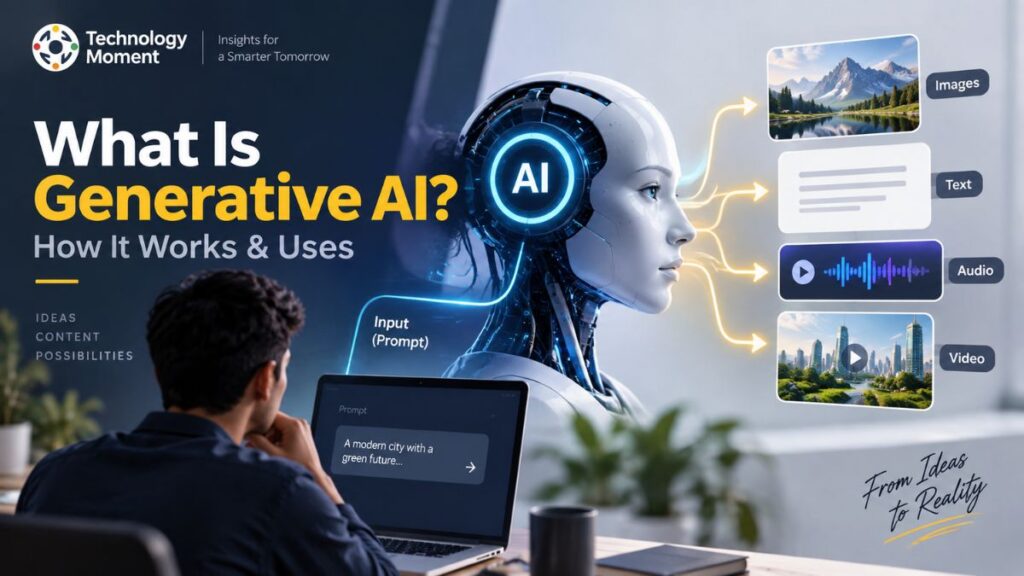
AI image generation is the process of using artificial intelligence to create visual content from instructions such as text prompts, reference images, or other forms of input. Instead of manually drawing every element, an AI image generator uses a trained model to interpret the user’s request and produce a new image that matches the requested concepts, appearance, style, and composition.
Modern AI image generation is a branch of generative AI. These systems learn visual patterns from large collections of images and associated information during training. They do not simply copy one image from their training data. Instead, the model learns statistical relationships between visual features and language, allowing it to generate new combinations based on an input. For example, a user might enter a prompt such as “a futuristic city at sunset with flying vehicles.” The system interprets concepts such as city, sunset, futuristic, and flying vehicles, then uses its learned representation of these concepts to generate an image.
Many modern systems rely on diffusion models or related image-generation architectures. The technology can be used for digital artwork, advertising concepts, product visualization, education, entertainment, social media content, and creative experimentation. Popular AI image tools include systems associated with DALL-E, Midjourney, Stable Diffusion, and Imagen. Although their architectures and implementations can differ, their fundamental purpose is similar: transforming a user’s instructions into visual output.
Understanding AI-generated images therefore requires looking at more than the final picture. The important question is what happens between the user’s prompt and the finished image—and that process involves several sophisticated machine-learning techniques.
How AI Image Generation Works
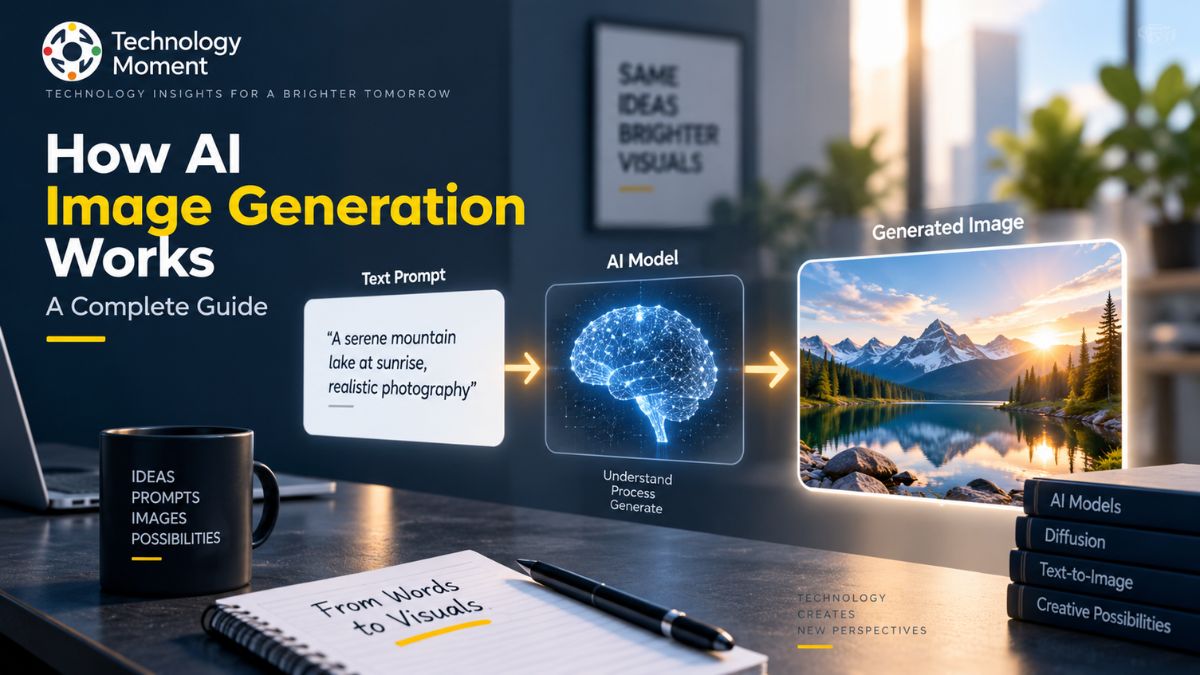
To understand how AI image generation works, it helps to divide the process into several stages. Although different AI image generators use different architectures and technical implementations, a simplified workflow can be described as prompt → text representation → generation → refinement → final image. The process begins when a user provides a prompt. The system analyzes the text and identifies meaningful information such as objects, actions, colors, environments, styles, and relationships between different elements. A text encoder or another language-processing component may convert the prompt into numerical representations called embeddings.
These representations provide information that the image-generation model can use while creating the visual content. In many diffusion-based systems, the generation process starts from random noise rather than from a finished picture. The model then repeatedly predicts and removes portions of this noise. This process is known as denoising. With each step, the random pattern becomes increasingly structured and begins to represent the concepts described in the prompt.
For example, if the prompt asks for “a red sports car on a mountain road,” the model gradually develops visual patterns corresponding to a vehicle, road, mountains, colors, lighting, and composition. The exact process can involve a latent space, where the model works with a compressed representation instead of directly processing every pixel. After the generation process is complete, a decoder can transform this representation into the final visible image.
This is why how AI image generators work is not simply a matter of searching for an existing picture. The model uses learned patterns, mathematical representations, and iterative generation to construct a new visual result based on the supplied instructions.
How Do Diffusion Models Generate Images?
Diffusion models are one of the most important technologies behind modern AI image generation. To understand how they work, imagine starting with a clear image and gradually adding random noise until the original content becomes almost impossible to recognize. During training, a model learns how this process changes images and, more importantly, how to reverse it. The generation process works in the opposite direction. Instead of starting with a clear image, the system can begin with random noise and progressively remove that noise to create meaningful visual content.
This reverse process is called denoising. At each generation step, the model estimates what part of the noise should be removed while considering information from the user’s prompt. Repeating this process gradually transforms the initial random pattern into an image. Many modern systems use latent diffusion, where the generation process takes place in a compressed mathematical representation known as latent space. Working in this space can make image generation more computationally practical than performing every operation directly on full-resolution pixels.
A simplified example looks like this:
Random Noise → Denoising Step → More Structure → More Detail → Final Image
The number of steps, sampling approach, model architecture, and other settings can influence the generated result. The system does not necessarily create the entire image in one operation. Instead, it repeatedly refines the representation until it reaches an output that corresponds closely to the conditioning information. This explains how diffusion models generate images from apparently random data. The model has learned patterns that allow it to estimate how visual information can emerge from noise. When combined with text conditioning, those learned patterns can be directed toward the concepts described in a prompt.
Diffusion models are therefore a major foundation of contemporary text-to-image generation, although not every AI image-generation system necessarily uses the exact same architecture.
How AI Image Models Are Trained
Before an AI image generator can create useful images, its underlying model needs to be trained. AI model training involves exposing a machine-learning system to large amounts of data so it can learn relationships and patterns rather than relying on manually programmed rules for every possible image. For image-generation models, training data can include images together with text descriptions, labels, captions, or other information. The model gradually learns relationships between visual features and language. For example, repeated exposure to images associated with concepts such as “tree,” “car,” “night,” or “portrait” helps the system develop mathematical representations related to those concepts.
A neural network contains many parameters, often called model weights. During training, these weights are repeatedly adjusted as the model learns from examples. The objective is to reduce errors in the model’s predictions and improve its ability to represent useful relationships within the training data. In diffusion-based systems, training can involve adding controlled amounts of noise to images and teaching the model to predict or remove that noise. Over many training examples, the model learns patterns that help it reconstruct meaningful visual information.
The scale and quality of the image dataset can significantly influence what a model learns. Data can affect its understanding of objects, artistic styles, compositions, languages, and visual concepts. However, training also introduces challenges involving data quality, bias, copyright, representation, and licensing. It is important to distinguish training from generation. Training is the computational process through which the model learns its parameters. Inference is what happens later when a user provides a prompt, and the trained model produces an image.
How Text-to-Image AI Works
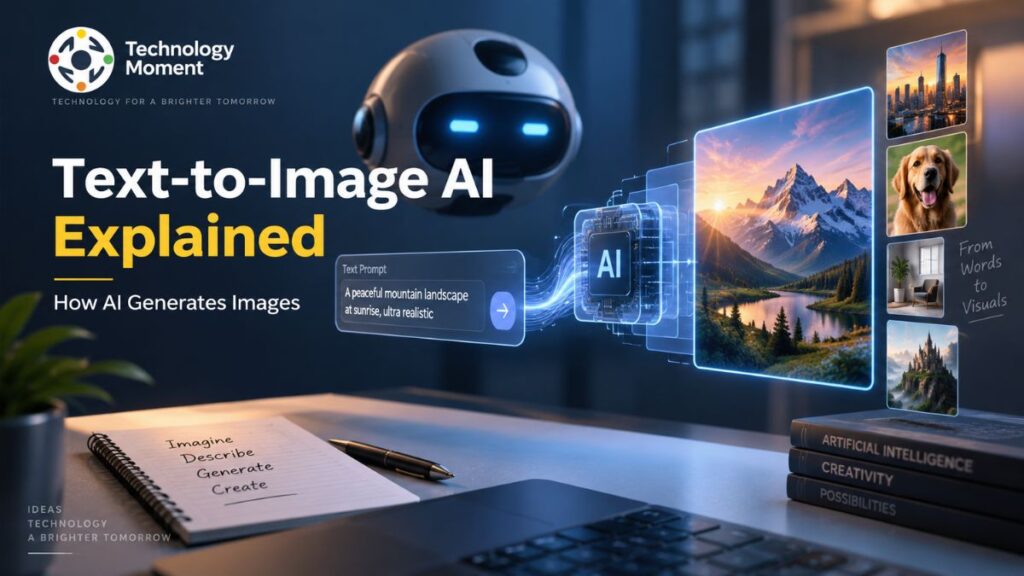
Text-to-image AI allows users to describe an image with natural language and receive a generated visual result. The technology connects language understanding with image-generation capabilities, allowing instructions such as “a minimalist wooden cabin beside a snowy lake at sunrise” to guide the generation process.
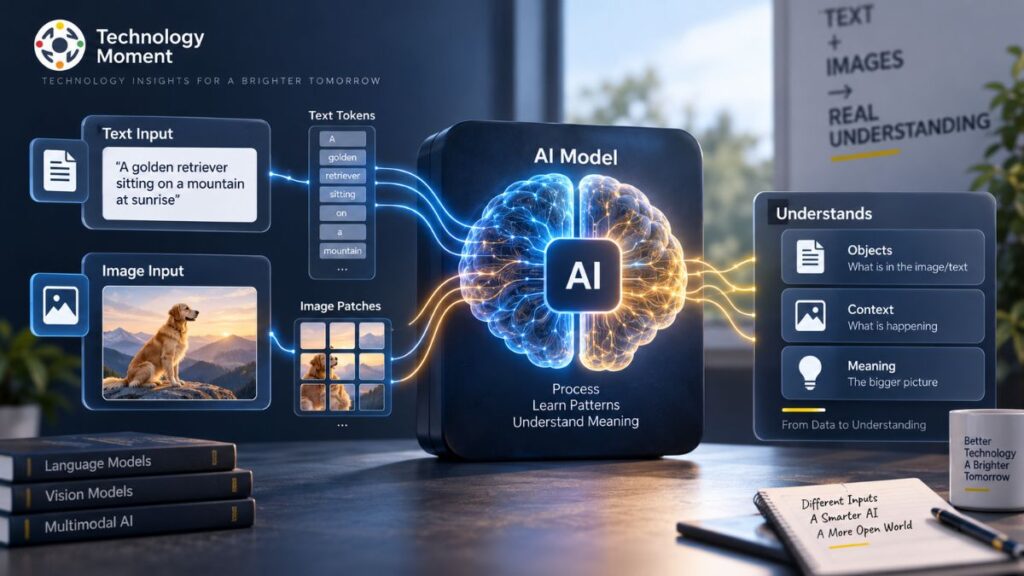
The workflow can be simplified into several stages. First, the system receives the text prompt. A text-processing component analyzes the words and converts their meaning into numerical information, often represented through embeddings. These embeddings provide the image-generation model with information about the concepts and relationships contained in the prompt.
The generation model then uses this information as conditioning. In diffusion-based systems, the model starts with noise and repeatedly performs denoising steps while being guided by the prompt representation. During this process, concepts from the prompt influence what visual structures emerge. Words describing objects can influence shapes and subjects, while terms related to colors, environments, lighting, or artistic styles can influence other visual characteristics.
For example:
Prompt → Text Encoding → Embeddings → Noise → Guided Denoising → Image Representation → Final Image
The exact architecture varies between different text-to-image models, so this simplified pipeline should not be treated as a universal implementation. Some systems use different model components, training techniques, or generation methods. Prompt quality can also influence the output. A detailed prompt can provide more information about the desired subject, setting, composition, and visual characteristics, although adding more words does not automatically guarantee a better image.
Ultimately, how text-to-image AI works can be summarized as a combination of language understanding and learned visual generation. The system converts human instructions into representations that a trained model can use to guide the creation of visual content. This connection between language and images is what makes modern generative AI tools capable of turning relatively simple descriptions into complex visual results.
Key Technologies Behind AI Image Generation
Modern AI image generation is powered by several technologies working together rather than a single algorithm. At the center of these systems are artificial intelligence, machine learning, deep learning, neural networks, and generative AI. Together, they allow an AI model to learn patterns from large amounts of visual and textual data and use those patterns to create new images.
One of the most important technologies is the diffusion model. Many modern text-to-image systems use diffusion-based approaches that learn how to transform noisy data into meaningful visual information. During image generation, the model progressively refines an initial noisy representation until it becomes an image that matches the user’s instructions.
Another important component is the text encoder. When someone enters a prompt, the system needs to understand what the words mean before it can generate an image. The text encoder converts language into numerical representations called embeddings. These representations capture information about concepts, objects, attributes, and relationships within the prompt.
The model may also work in a latent space, which is a compressed mathematical representation of visual information. Instead of processing every image pixel directly throughout the entire process, some systems perform important computations within this smaller representation. Other concepts include conditioning, sampling, inference, model weights, and image synthesis. Conditioning helps guide generation according to the user’s prompt, while sampling determines how the model moves through the generation process.
Transformers and other neural-network architectures can also contribute to language and multimodal understanding. The exact technology stack varies between AI image-generation systems, but the overall objective remains similar: connect human instructions with learned visual patterns and produce a coherent image.
Popular AI Image Generation Models and Tools
The rapid development of AI image generation has produced a wide range of models and tools. Although they can appear similar from a user’s perspective, different systems can use different architectures, training approaches, interfaces, and generation workflows.
Stable Diffusion is a well-known family of image-generation models associated with diffusion-based techniques. It has become particularly notable for its flexible ecosystem and the wide range of applications built around its models. Users and developers can work with different checkpoints, interfaces, extensions, and workflows depending on the implementation.
DALL-E is another prominent name in text-to-image AI. It is designed to interpret natural-language descriptions and generate corresponding images. Its development has contributed to the broader adoption of prompt-based image creation, where users can describe visual concepts without needing traditional design software.
Midjourney is widely associated with AI-assisted artistic image creation. Its systems can generate visually detailed images from text instructions and have been used for creative experimentation, concept development, and visual storytelling.
Imagen represents Google’s work in text-to-image generation. Like other advanced systems, it focuses on connecting language understanding with visual generation.
These tools should not necessarily be treated as identical. Their models, interfaces, capabilities, training methods, and available controls can differ significantly. The broader category includes many other AI image generation tools, from consumer applications to developer-focused platforms and research systems. Some provide simple prompt boxes, while others expose advanced settings for sampling, image-to-image generation, reference images, or model customization.
For anyone exploring AI image generators, understanding the underlying technology is often more useful than focusing only on the interface. The tools may change quickly, but concepts such as diffusion models, text conditioning, embeddings, and inference remain important for understanding how modern systems work.
What Happens Inside an AI Image Generator?
When a user enters a prompt into an AI image generator, several computational steps can occur before the final image appears. The exact workflow differs between models, but a simplified version helps explain what happens behind the interface. The process begins with the prompt. Suppose someone enters: “A futuristic city at night with glowing buildings and flying cars.” The system first processes the text to identify the concepts and relationships contained within the instruction.
A text encoder can convert the prompt into numerical representations called embeddings. These representations provide the generation model with information that can be used to guide the image-generation process. In a diffusion-based workflow, the system may then begin with a representation containing random noise. The model performs a series of denoising operations, using the prompt information as conditioning. With each step, the representation becomes more organized and visually meaningful.
A simplified pipeline looks like this:
Prompt → Text Encoder → Embeddings → Noise → Conditioning → Denoising → Sampling → Image Representation → Final Image
The model does not necessarily perform these operations in exactly this order or with exactly these components. Different architectures can use different mechanisms. During inference, the trained model uses its learned weights to make predictions about the visual structure that should emerge. Sampling controls how the system moves through possible outputs during generation. If the system operates in latent space, a decoder may eventually transform the generated representation into a visible image.
This entire process can happen in seconds or longer depending on the model, hardware, resolution, number of generation steps, and service infrastructure. Understanding how AI image generators work therefore means looking at the complete pipeline rather than imagining that the system simply searches a database and retrieves an existing image. The model uses learned mathematical representations to construct an output based on the user’s instructions.
What Affects AI Image Generation Quality?
The quality of an AI-generated image depends on several factors, and the AI image generation process involves more than simply writing a good prompt. The model itself, prompt information, generation settings, computational resources, and other factors can all influence the final result. The first major factor is the AI model. Different models are trained on different datasets and optimized for different types of visual output. Their ability to understand subjects, styles, composition, and fine details can therefore vary.
The prompt also matters. A clear description can provide the model with useful information about the subject, environment, composition, lighting, colors, and desired visual characteristics. Unclear or contradictory instructions can sometimes make generation less predictable. Another important factor is sampling. During inference, sampling methods determine how the model moves through possible outputs. Different sampling approaches and settings can influence details, variation, and consistency.
The number of generation or denoising steps can also affect the result. In some systems, additional steps can provide more refinement, although increasing the number indefinitely does not guarantee better quality. Resolution is another consideration. Generating a larger image requires additional computational resources and can introduce different challenges compared with producing a smaller image.
Other settings may include conditioning strength, guidance-related controls, aspect ratio, seed values, and image-to-image parameters. A seed can help reproduce or explore variations of a generation, depending on the tool. Hardware and infrastructure can influence generation speed, but speed and visual quality are not always directly connected. Finally, the model’s training data matters. The breadth, quality, diversity, and characteristics of the data used during training influence what the model can learn.
How Long Does AI Image Generation Take?
The time required for AI image generation can vary considerably depending on the AI image generator, model, image resolution, hardware, generation settings, and the service being used. A simple image may appear within seconds, while more complex workflows can take considerably longer. One important factor is the model itself. Different AI image generation tools use different architectures and computational requirements. Lightweight models may generate an image relatively quickly, while larger or more sophisticated models can require additional processing.
Image resolution also affects generation time. Creating a small image generally requires fewer computational resources than generating a high-resolution image. Some platforms first generate a base image and then use an additional upscaling or refinement process, which adds to the overall time.
The number of diffusion or denoising steps can also influence how long an image takes to generate. In a diffusion-based system, the model may progressively refine an initial noisy representation through multiple steps. More processing can sometimes provide additional refinement, although more steps do not automatically guarantee a better result. Hardware is another major factor. When generation takes place on a powerful GPU, processing can be significantly faster than on less capable hardware. Cloud-based AI image generators also depend on their server infrastructure and current demand.
Prompt complexity can affect the overall workflow indirectly, particularly when users request multiple images, variations, editing, or higher-quality outputs. Therefore, there is no single answer to how long AI image generation takes. For a basic generation, users may see results quickly, while high-resolution generation, multiple variations, or additional enhancement stages can increase processing time. The practical speed depends on the complete generation pipeline rather than the prompt alone.
AI Image Generation vs Traditional Image Creation
AI image generation and traditional image creation use very different workflows. Traditional digital creation generally depends on a person manually drawing, editing, arranging, or modifying visual elements using tools such as illustration, photo-editing, or 3D software. AI image generation, by contrast, allows users to describe or provide visual instructions that a trained model can use to produce an image.
The distinction does not mean that one approach completely replaces the other. Designers, artists, photographers, and creative professionals can use both methods depending on the project.
| AI Image Generation | Traditional Image Creation |
|---|---|
| Can begin with a text prompt | Usually begins with manual design or source material |
| Uses trained AI models | Relies primarily on human-controlled tools |
| Generates visual variations quickly | Variations generally require additional manual work |
| Can interpret natural-language instructions | Requires direct manipulation of visual elements |
| Useful for concept exploration | Useful for precise manual control |
| Output depends on the model and prompt | Output depends heavily on the creator’s technique |
| Can automate parts of the creative workflow | Provides detailed hands-on control |
| May produce unexpected visual details | Creator can directly control individual elements |
Limitations and Challenges of AI Image Generation
Although AI image generation has developed rapidly, current systems still have important limitations. Understanding these challenges is essential for using AI-generated images responsibly and evaluating their results critically. One common problem is visual accuracy. An AI model can produce an image that appears convincing overall while containing incorrect details. Hands, facial features, objects, text, reflections, and complex interactions between multiple elements can sometimes be inconsistent.
Text rendering has historically been another challenge. Although newer systems have improved considerably, generated typography, spelling, logos, and long written content may still require careful checking. Another limitation is consistency. Generating one image of a character or product does not necessarily guarantee that the same subject will look identical across many different images. Maintaining consistent appearance, proportions, lighting, and composition can require specialized workflows or additional controls.
Training data also creates important considerations. The quality and characteristics of the data used to train an AI model can influence its outputs. Questions surrounding copyright, licensing, consent, privacy, representation, and dataset transparency remain important parts of the broader discussion around generative AI. Bias is another potential issue. If certain concepts, people, environments, or visual styles are underrepresented or represented unevenly in training data, the generated output may reflect those patterns.
There are also technical limitations. High-quality AI image generation can require substantial computational resources, particularly when producing large images or multiple variations. Finally, AI-generated content should not automatically be treated as factual. An image can look realistic while depicting something that never happened. For these reasons, AI image generation works best when users evaluate outputs carefully, verify important visual information, review usage rights, and understand the limitations of the particular model or tool they are using.
Frequently Asked Questions About AI Image Generation
How does AI image generation work?
AI image generation uses trained machine-learning models to transform instructions into visual content. In many modern systems, a text prompt is converted into numerical representations, which guide a generation model. Diffusion-based systems can progressively remove noise while following this information until a recognizable image is produced.
How do AI image generators create images?
AI image generators learn visual patterns from training data and use those learned patterns during inference. A user’s prompt provides conditioning information, while the model generates and refines a visual representation. In diffusion systems, repeated denoising gradually transforms an initial noisy representation into an image.
How does AI generate images from text?
Text-to-image AI first processes the user’s words using language-related components such as a text encoder. The resulting representation provides information about the requested concepts. A trained image-generation model then uses that information to guide image synthesis, producing visual elements that correspond to the prompt.
What is a diffusion model?
A diffusion model is a type of generative model commonly used for image generation. During training, it learns relationships between images and progressively corrupted versions of those images. During generation, the process is reversed: the model starts with noise and repeatedly predicts how to remove it to create meaningful visual content.
How do diffusion models generate images?
Diffusion models typically begin generation with random noise and perform multiple denoising steps. At each step, the model predicts how the representation should change while using available conditioning information, such as a text prompt. Repeating this process gradually creates increasingly structured visual information until the final image emerges.