AI can now work with both written language and visual information, but it does not understand them in the same way humans do. When you type a question, upload a photograph, or combine text with an image, an AI model must first transform that information into representations it can process. It then identifies patterns, relationships, and context before producing an output.
How AI Models Understand Text and Images: Text is made up of words and symbols arranged in a particular sequence, while images contain pixels, shapes, colors, objects, and visual relationships. Understanding both requires different processing techniques, including tokenization, embeddings, neural networks, computer vision, and transformer-based architectures.
This becomes even more interesting with multimodal AI models, which can work with multiple types of information at once. Instead of treating text and images as completely separate inputs, these models can connect information across them—for example, answering a question about an object shown in an uploaded image.
At Technology Moment, we focus on making complex technology easier to understand without unnecessary jargon. In this guide, we’ll break down how AI models process text and images, how embeddings and transformers contribute to that process, how multimodal AI connects different types of information, and where these systems still have limitations. By the end, you’ll have a clearer picture of what happens between an AI receiving an input and generating its response.
How Do AI Models Understand Text?
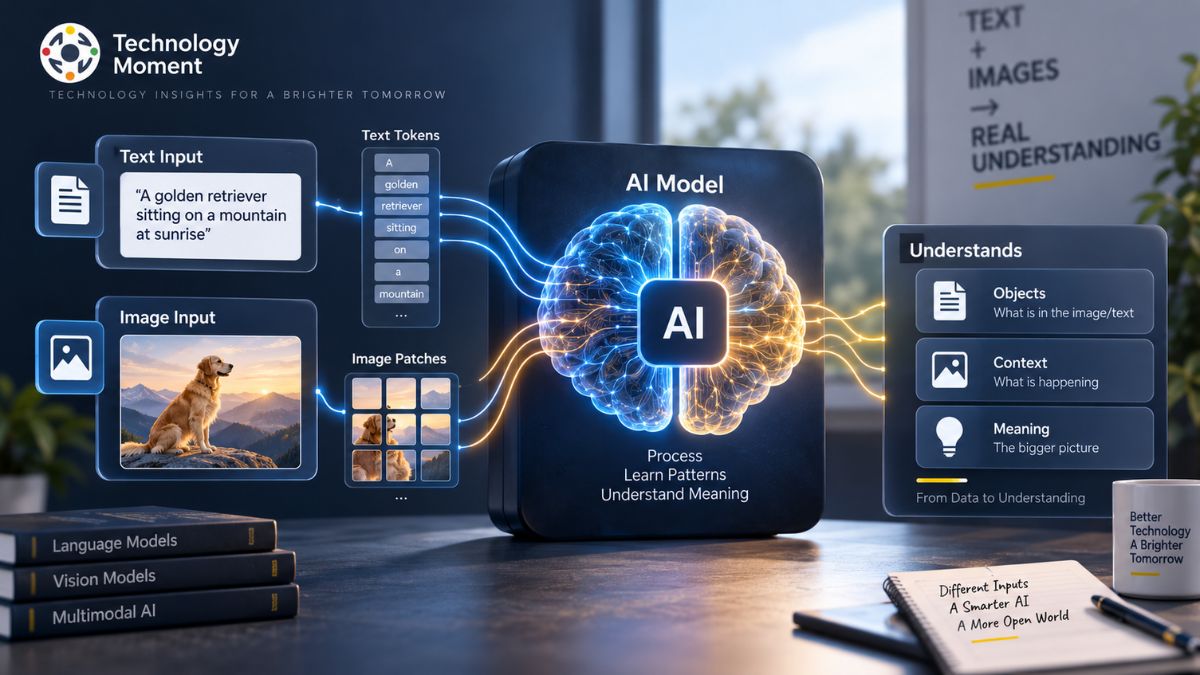
When people read a sentence, they can usually understand its meaning by considering the words, their order, and the surrounding context. AI models approach this problem differently. They process text by converting language into numerical representations that neural networks can analyze. This allows the model to identify patterns and relationships within the information it receives. One of the first steps is tokenization. Instead of treating an entire sentence as a single unit, an AI model divides text into smaller pieces called tokens. A token can represent a complete word, part of a word, punctuation, or another text element. These tokens are then converted into numerical representations that a model can process.
This is where text embeddings become important. Embeddings represent words or pieces of text as numerical patterns that capture aspects of their meaning and relationships. Similar concepts can have related representations, allowing AI systems to perform tasks involving semantic understanding rather than simply matching identical words. Modern large language models (LLMs) use transformer-based architectures to process these representations. The attention mechanism helps the model examine relationships between different parts of the input. For example, when a sentence contains several references to a person or object, attention helps the model determine which words are relevant to one another.
Through these processes, AI models can analyze language, recognize context, summarize information, answer questions, and generate new text. However, this does not mean an AI model understands language exactly as a human does. Its capabilities come from learned patterns and numerical representations developed during training.
How Do AI Models Understand Images?
Images contain information in a very different form from written language. A photograph is made up of pixels containing visual information such as color, brightness, shapes, textures, and spatial relationships. To analyze an image, AI systems need to transform this visual information into representations that a model can process. AI models can learn visual patterns that help them identify objects, recognize features, classify images, and analyze relationships between different elements in a scene. For example, an image recognition system may learn to distinguish between a car, a bicycle, and a person based on patterns found across many examples.
During processing, an AI model can extract different types of visual features. Simple patterns such as edges and shapes can contribute to more complex representations of objects and scenes. These representations can eventually be converted into image embeddings, which provide a numerical way of representing visual information. Modern vision systems can also use transformer-based architectures, including Vision Transformers, to analyze visual information. Instead of relying only on traditional image-processing techniques, these models can examine relationships between different parts of an image.
This enables AI to perform tasks such as image classification, object detection, visual search, document analysis, and image-based question answering. However, image understanding has limitations. Poor image quality, unusual perspectives, hidden objects, ambiguous scenes, or missing context can make interpretation difficult. Therefore, when we say that AI models “understand” images, it is more accurate to say that they learn and process complex visual patterns and representations that allow them to produce useful interpretations.
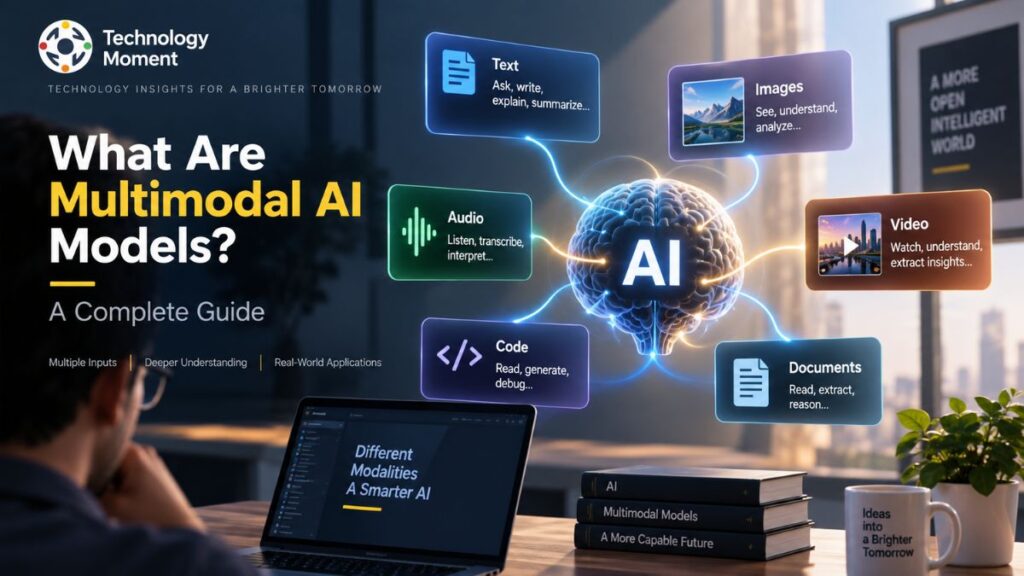
What Are Multimodal AI Models?
Traditional AI systems are often designed around a particular type of information. A language model primarily works with text, while a computer vision system focuses on images. Multimodal AI models are designed to work with multiple types of information and connect them within a single task. For example, imagine uploading a photograph of a laptop and asking, “What ports are visible on this device?” Understanding the image alone is not enough, and understanding the text alone cannot provide the answer.
This is where multimodal machine learning becomes useful. Text can be transformed into text embeddings, while visual information can be represented through image embeddings or other visual representations. The model can then learn relationships between these different forms of information. Vision-language models are an important example of this approach. They are designed to connect visual information with natural language, allowing AI systems to perform tasks such as image captioning, visual question answering, document analysis, and image-based search.
Multimodal AI can also combine other forms of information, including audio, video, and structured data. This makes the technology useful for applications where information does not exist in only one format. The key idea is not simply putting different inputs together. The model needs to identify meaningful relationships between them. This ability allows multimodal systems to interpret a question in the context of an image, connect a description with a visual object, or use information from several modalities to generate a response.
As multimodal AI develops, these systems are becoming an important part of modern AI applications because real-world information rarely exists in a single format.
How Do AI Models Analyze Text and Images Together?
When an AI model receives both text and an image, the process becomes more complex than analyzing either input independently. The system must first represent the different types of information in a form that can be processed and then determine how those representations relate to one another.
The text may be processed through tokenization and text embeddings, creating a representation of the user’s question. At the same time, the image is processed by a vision component that extracts relevant visual information and produces a representation of the image. The multimodal system then needs to connect these representations. This is where concepts such as cross-modal learning, attention, and semantic understanding become important. The model can examine which parts of the visual information are relevant to the words in the question.
For example, if the question asks about a camera, the model does not need to treat every visible part of the smartphone as equally important. It needs to associate the language in the question with relevant visual regions or learned visual concepts. After processing these relationships, the model generates an output based on the combined information. Depending on the system, that output could be an answer, description, classification, summary, or another form of generated content.
This ability to connect textual information and visual information is one of the defining characteristics of multimodal AI. It allows AI systems to handle tasks that require both language and vision rather than treating them as completely separate problems.
The Role of Transformers in Text and Image Understanding
Transformers have become a fundamental part of modern AI because they provide a flexible way to process relationships within complex information. They were initially widely adopted for language tasks, but their architecture is now also used for images and multimodal systems. Understanding transformers helps explain how AI models process both textual and visual information.
A key component is the attention mechanism. Instead of treating every part of an input as equally important, attention allows a model to determine which pieces of information are more relevant to one another. In a sentence, this can help an AI model identify relationships between words that may be separated by several other words.
For images, a similar concept can be applied by dividing an image into smaller sections or patches. A Vision Transformer (ViT) can process these visual patches and examine relationships between them. Rather than looking at each part of an image completely independently, the model can learn how different visual regions contribute to the overall scene. Transformers can also become part of multimodal architectures. In these systems, text and visual information can be represented and processed in ways that allow relationships between the two modalities to be identified.
This flexibility is one reason transformer architecture is important across natural language processing, computer vision, and multimodal AI. However, transformers do not provide human-like understanding by themselves. Their behavior depends on model architecture, training data, learned representations, and the task they are designed to perform.
How AI Understands the Relationship Between Words and Images
Understanding an image and understanding a sentence are separate challenges, but many real-world tasks require both. The AI needs to connect the words in the question with a specific visual element. AI systems can represent language using text embeddings and visual information using image embeddings or related visual representations. These representations convert different types of information into numerical forms that machine learning models can process.
The important step is connecting these representations. Through cross-modal learning, an AI system can learn relationships between concepts expressed through language and patterns found in images. During training, models can encounter examples where text describes visual content. Over time, the system can learn associations between words, objects, attributes, and visual patterns.
For instance, the phrase “a red sports car” contains information about an object and an attribute. A multimodal model needs to associate “car” with the relevant visual object and “red” with its visual characteristic. This involves more than simply recognizing individual words or objects; it requires understanding their relationship within the given context. Semantic understanding helps connect concepts with meaning, while contextual understanding helps determine what information is relevant to a particular question or task.
This process does not mean the model experiences or perceives an image like a human. Instead, it uses learned numerical representations and relationships to produce an interpretation. The effectiveness of that interpretation depends on the quality of the model, its training, the input, and the complexity of the visual and linguistic context.
How Vision-Language Models Work
Vision-language models are AI systems designed to connect visual information with natural language. Instead of building a system that only recognizes images or another system that only processes text, a vision-language model can work with both types of information for tasks that require them together. A typical workflow begins with two forms of input. The visual component processes an image and creates a representation of its visual information. The language component processes the user’s text, often using techniques associated with natural language processing and language models. These representations can then be brought together so the system can identify relevant relationships.
For example, a user might upload an image of a computer and ask, “What components can you identify?” The model needs to interpret the question and examine the visual information at the same time. It may identify objects or visual features and then use the language input to determine what the user wants to know about them. This process can involve embeddings, attention mechanisms, transformers, and cross-modal learning. Different vision-language architectures organize these components in different ways, so there is no single universal method used by every model.
Vision-language models can support tasks such as image captioning, visual question answering, document analysis, visual search, and image-based assistance. They can also work with screenshots, diagrams, charts, and other forms of visual information when the model has been designed and trained for those tasks. Their capabilities still have boundaries. A model may misinterpret an unclear image, overlook important details, or produce an answer that is not supported by the visual information. Therefore, vision-language models should be viewed as systems that learn relationships between visual and linguistic representations rather than as machines possessing human-like visual understanding.
How Does ChatGPT Understand Images?
When users ask how ChatGPT understands images, it is useful to think of the process at a high level rather than assuming that the system examines a picture exactly as a person does. A multimodal AI system must process the visual input and the user’s language together to determine what information is relevant to the request. The system needs to process both inputs and establish a relationship between them.
The visual input is converted into representations that the model can work with, while the question is processed as language. The system can then use learned relationships between visual and textual information to focus on relevant parts of the input and generate an answer. This process is closely related to vision-language models, image understanding, text embeddings, image representations, transformers, and attention mechanisms. The exact internal architecture and processing pipeline can differ between AI models, so it is important not to assume that every version of ChatGPT uses the same implementation.
ChatGPT can use image information for tasks such as describing visual content, answering questions about an uploaded image, interpreting certain documents or diagrams, and identifying visible objects or patterns. However, image analysis is not infallible. Low resolution, unusual viewpoints, obscured details, ambiguous visual information, or context that is not present in the image can lead to incorrect interpretations. Therefore, when ChatGPT appears to “understand” an image, the practical explanation is that its multimodal capabilities allow it to process visual and linguistic representations together and generate a response based on learned patterns and relationships.
Text AI vs Image AI vs Multimodal AI
Text AI, image AI, and multimodal AI all process information differently because each is designed to work with particular types of input. Text AI primarily works with language. It can process written questions, documents, and conversations using techniques associated with natural language processing, language models, tokenization, embeddings, and transformer architectures.
Image AI focuses on visual information. It can analyze images by identifying patterns, shapes, objects, colors, and other visual features. Computer vision systems can perform tasks such as image classification, object detection, image recognition, and visual analysis.
Multimodal AI combines multiple types of information. Instead of processing text and images independently, multimodal models can connect information across modalities. This allows a system to answer questions about an image, analyze a document containing text and graphics, or relate a written description to visual content.
| Feature | Text AI | Image AI | Multimodal AI |
|---|---|---|---|
| Primary input | Text and language | Images and visual information | Text, images, and other modalities |
| Main technology | NLP and language models | Computer vision and vision models | Multimodal machine learning |
| Common representations | Text embeddings | Image embeddings | Combined or aligned representations |
| Typical tasks | Writing, summarization, Q&A | Recognition, classification, detection | Visual Q&A, image analysis, document understanding |
| Context used | Linguistic context | Visual context | Textual and visual context |
| Example | Answering a written question | Identifying an object | Answering a question about an image |
What Can Multimodal AI Understand?
Multimodal AI can process relationships between different forms of information, particularly when text and images need to be considered together. Its capabilities depend on the model, training data, architecture, and type of input, so it is better to think of multimodal AI as a system for connecting representations rather than as an AI that understands everything perfectly.
For visual information, multimodal models can identify objects, scenes, colors, shapes, and other visible characteristics. They can also interpret relationships between objects when the model has the appropriate capabilities. For example, an image may contain a person holding a smartphone, and a model can potentially connect the visual relationship between the person and the device.
Language provides another layer of context. A user can ask a specific question about an image, and the model can use the wording of that question to determine which visual information is relevant. This combines text understanding, image understanding, semantic understanding, and contextual understanding.
Multimodal AI can also work with text that appears inside images. Depending on the model and input quality, it may process screenshots, documents, charts, diagrams, or photographs containing written information. This makes the technology useful for tasks that require both visual and textual analysis. However, multimodal AI has limitations. An unclear image, missing context, unusual perspective, small text, or a visually ambiguous situation can make interpretation difficult. A model can also generate an answer that sounds plausible but does not accurately reflect the input.
Real-World Applications of Text and Image Understanding
Text and image understanding are increasingly used together because many real-world tasks involve more than one form of information. Multimodal AI can connect written instructions with visual content, making it useful across consumer, professional, educational, and technical applications.
AI Assistants
AI assistants can use text and images together to answer questions about screenshots, products, documents, or photographs. A user can provide an image and ask a natural-language question instead of describing every visual detail manually.
Document Analysis
Documents often contain paragraphs, tables, diagrams, forms, and other visual elements. AI image analysis combined with text processing can help extract information from these different components and make complex documents easier to work with.
E-Commerce and Product Search
Multimodal systems can connect product photographs with written descriptions and user queries. Someone might provide an image of a particular style of product and ask for similar items or specific characteristics.
Education
Students can use AI to ask questions about diagrams, charts, screenshots, or textbook pages. Combining visual information with natural language can make technical concepts easier to explore interactively.
Accessibility
Text and image understanding can support tools that describe visual content or provide additional information about images. This can help make digital content more accessible when implemented carefully.
Software and Technical Support
Developers and users can share screenshots of errors, interfaces, or configuration pages and describe the problem using text. A multimodal system can use both inputs to help identify relevant information.
Healthcare and Scientific Work
Specialized AI systems can analyze visual data alongside accompanying textual information in certain professional settings. These applications require appropriate validation, domain expertise, privacy protections, and human oversight.
The broader value of multimodal AI comes from reducing the need to separate information into isolated formats. Instead of asking users to translate an image into words first, the system can potentially process the visual and textual context together.
Frequently Asked Questions
How do AI models understand text?
AI models process text by converting language into tokens and numerical representations such as embeddings. Transformer-based architectures and attention mechanisms help identify relationships between different parts of the input, allowing models to perform tasks involving language, context, semantic relationships, and text generation.
How do AI models understand images?
AI models process images as visual information and learn patterns involving pixels, shapes, colors, textures, objects, and spatial relationships. Computer vision and vision models can transform these patterns into representations that support tasks such as image recognition, object detection, classification, and visual analysis.
How AI Models Understand Text and Images
AI uses different processing methods to represent text and visual information, then connects those representations within a multimodal system. Text embeddings and image representations can be analyzed together so the model can identify relationships between language and visual content and produce a response based on both.
How does AI process images?
AI processes images as visual data containing patterns such as edges, shapes, colors, textures, and objects. Vision models transform this information into representations that can be analyzed by neural networks. Depending on the system, this can support image classification, object detection, recognition, and other visual tasks.
How do multimodal AI models work?
Multimodal AI models process more than one type of information, such as text and images. They create representations of different inputs and use learned relationships between them to perform a task. This enables applications such as visual question answering, image analysis, document understanding, and image-based search.
How do LLMs understand text?
LLMs process text through tokens and learned numerical representations. Transformer architectures use attention mechanisms to examine relationships among tokens and their context. Through training, the model learns statistical patterns in language that enable it to predict, transform, summarize, and generate text based on an input.
How do AI models interpret images?
AI models interpret images by analyzing learned visual patterns and representations. Depending on the model, these may include objects, shapes, colors, textures, spatial relationships, or text within an image. The resulting interpretation is based on patterns learned during training rather than human-like visual perception.
How does computer vision understand images?
Computer vision systems analyze visual information by extracting and representing patterns within images. These can include edges, shapes, textures, objects, and spatial relationships. Neural networks and vision models use these representations for tasks such as classification, object detection, recognition, segmentation, and other forms of image analysis.