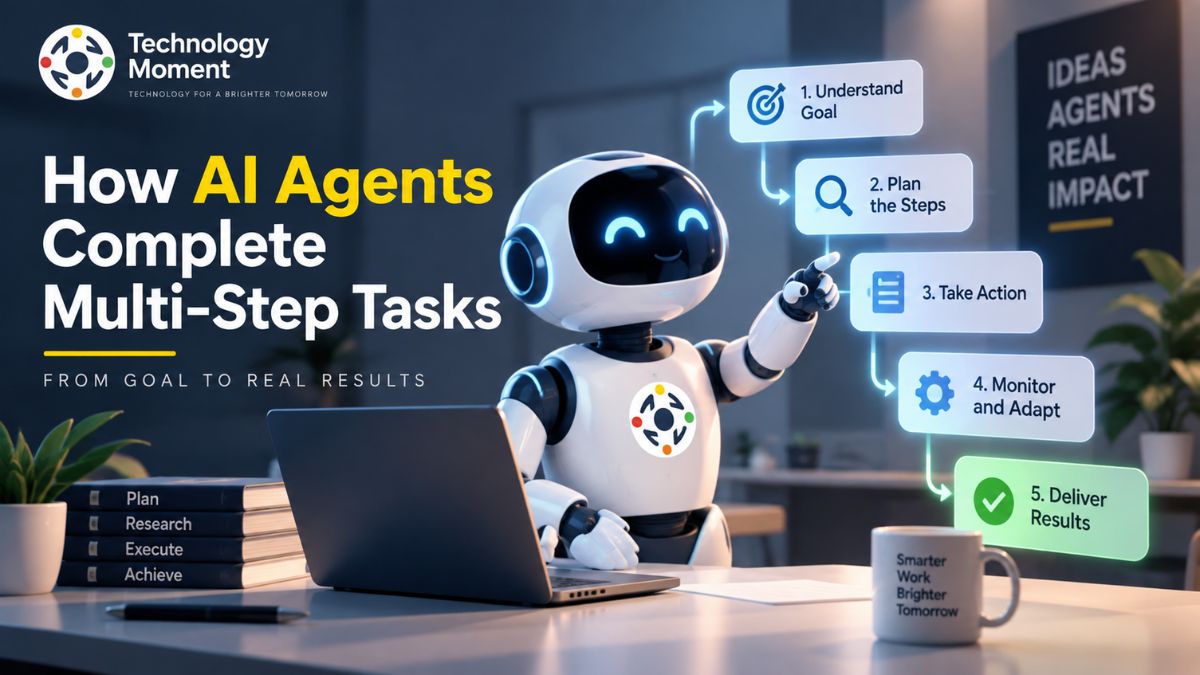
Artificial intelligence is moving beyond simply answering questions. Today, How AI Agents Complete Multi-Step Tasks, break it into smaller steps, use different tools, evaluate results, and continue working until a task is completed. This ability to handle multiple connected actions is changing how people think about AI automation and digital workflows.
But how do AI agents actually complete these multi-step tasks? What happens between a user giving an instruction and an agent producing a final result? Understanding the process becomes increasingly important as AI systems take on more complex work across research, productivity, business operations, software development, and automation.
At Technology Moment, we focus on making emerging technology easier to understand through clear, practical explanations. In this guide, we’ll walk through how AI agents work step by step, including task decomposition, planning, tool calling, API integration, memory, decision-making, and the agent loop. You’ll also see how these components work together to turn a simple instruction into a multi-step workflow.
Whether you’re exploring agentic AI for the first time, evaluating AI automation for your work, or simply trying to understand where AI agents fit beyond traditional chatbots, this guide will give you a practical foundation for understanding how they operate.
How Do AI Agents Work?
Understanding how AI agents work becomes easier when you think of an agent as a system that repeatedly moves from understanding a goal to planning, acting, observing results, and deciding what to do next. First, the AI agent receives an instruction and identifies the intended outcome. It analyzes the request, available context, constraints, and information required to complete the task. For a simple request, this may require only one action. A more complex request may require several connected steps.
Next, the agent can perform task decomposition. It breaks the larger objective into smaller tasks that can be completed in a logical order. It then creates a plan and determines which actions or tools are necessary. This planning process is an important part of AI agent workflows because the system needs to decide not only what to do but also what should happen next.
The agent can then use tools to execute those actions. Depending on its design, these tools might include search systems, databases, calculators, code execution environments, business applications, or external APIs. After an action is performed, the agent can observe the result. If the result is incomplete or an error occurs, the system may adjust its plan and attempt another action. This creates an agent loop that can be represented as:
Understand → Plan → Act → Observe → Evaluate → Repeat
This process allows AI systems to handle multi-step reasoning and autonomous task execution more effectively than a single-response workflow. However, AI agents are not necessarily fully autonomous. Their behavior depends on the model, tools, permissions, instructions, memory, and safeguards built into the system. Human-in-the-loop AI workflows can require approval before important actions are taken.
How AI Agents Complete Multi-Step Tasks
The ability to complete multi-step tasks is one of the defining characteristics of modern AI agents. Instead of treating a complex request as one large action, an agent can divide the objective into smaller operations and coordinate them toward a final result.
Consider a request such as: “Research several cloud storage services, compare their features and pricing, and summarize the differences.” An AI agent could begin by identifying the required information. It might determine that it needs to research several providers, collect current feature and pricing details, organize the results, and then create a comparison.
The next stage involves task planning. The agent determines which subtasks should be performed first. It may search for information about the first provider, collect relevant details, then repeat the process for the remaining providers. If important information is missing, it can perform additional research rather than immediately producing an incomplete answer.
Tools play an important role during this process. The agent may use search tools to gather information, APIs to retrieve structured data, or other software to process and organize the results. After each action, the system can evaluate what it received and decide whether another step is necessary.
This is how AI agents can automate complex tasks and workflows that contain multiple dependencies. They can move from one action to another while maintaining the context of the overall objective.
The process can be summarized as:
Goal → Task Decomposition → Planning → Tool Selection → Action → Result Evaluation → Replanning → Final Output
This does not mean every AI agent performs these steps perfectly or independently. Agents can encounter incorrect information, failed tools, ambiguous instructions, or unexpected results. For that reason, reliable AI agent systems need appropriate permissions, validation, monitoring, and human oversight.
AI Agent Architecture
AI agent architecture describes the major components that allow an AI agent to understand goals, make decisions, use tools, and execute workflows. While implementations differ, several building blocks commonly appear in an AI agent system. The first component is the AI model, which processes instructions and helps the system reason about what should happen next. Around the model, the system can include planning and orchestration components that manage the sequence of tasks.
Task planning is another important layer. It helps transform a high-level objective into smaller actions. For complex workflows, an orchestration layer can coordinate those actions and manage dependencies between them. Memory and context management can also influence how an agent works. Context allows the system to retain relevant information during a workflow, while memory mechanisms may provide access to information from previous interactions when the system supports them. The exact capabilities depend on the architecture.
Tools form another major part of AI agent architecture. An agent may connect to search services, databases, APIs, software applications, or specialized functions. These connections allow the system to move beyond generating information and actually perform permitted actions. An execution layer carries out those actions, while evaluation or feedback mechanisms can help determine whether the result was successful. If something goes wrong, the agent may need to adjust its plan and try another step.
A simplified architecture looks like this:
User Goal → AI Model → Planning → Tool Selection → Execution → Observation → Evaluation → Memory/Context → Next Action
Together, these components create an AI workflow orchestration system capable of coordinating multiple operations. The architecture also determines how much autonomy an agent has, what information it can access, which actions it can perform, and where human approval is required.
How AI Agents Leverage Tools for Task Execution
Tools allow AI agents to interact with systems and information outside the model itself. This capability is essential when an agent needs to perform actions rather than simply generate a response. Tool calling allows an AI agent to select an available function based on the task it is trying to accomplish. For example, an agent might have access to a web search function, calculator, database query, or calendar system. When the agent determines that a particular tool is required, it can request that tool with the necessary information.
Function calling is a related mechanism that allows an AI model to produce structured requests for predefined functions. The application then executes the function and returns the result to the agent. APIs are particularly useful because they allow AI agents to communicate with external software and services. An agent could, depending on its permissions, retrieve information from a database, check information through an API, create a record in another application, or trigger a workflow.
For example, imagine an AI agent responsible for preparing a weekly business report. It could retrieve data from an analytics API, calculate relevant metrics, identify significant changes, organize the findings, and generate a report. Each action can become one part of a larger AI automation workflow. The important distinction is that the AI model itself does not magically access every external system. The application must provide the appropriate tools, permissions, interfaces, and security controls.
Tool use therefore extends an AI agent’s capabilities from reasoning to action. When combined with planning, context management, task orchestration, and result evaluation, tools enable AI agents to coordinate multi-step workflows. At the same time, tool access introduces risks. Incorrect tool selection, faulty API responses, excessive permissions, or unintended actions can create problems. Well-designed AI agent systems therefore use controlled permissions, validation, logging, and human approval where appropriate.
How AI Agents Make Decisions During a Task
AI agents need to make decisions continuously when working on a complex task. Unlike a basic chatbot that may generate an answer from a single prompt, an agent has to determine what action should happen next, which information is needed, and whether the previous action produced a useful result.
The process generally begins with a goal. The AI agent analyzes the objective and available context before deciding how to approach it. Through reasoning and planning, the agent can identify smaller tasks and determine an appropriate sequence. This is sometimes described as goal-oriented AI because the system is working toward a defined outcome rather than simply responding to individual instructions.
During execution, the agent may encounter new information that changes what should happen next. For example, a requested API might return incomplete data. Instead of immediately producing a final answer, the agent could recognize the missing information, select another available tool, or modify its approach.
This creates an iterative decision-making process. The agent considers the current state, available tools, previous results, and remaining objective before selecting its next action. In more advanced systems, evaluation mechanisms can also check whether the action achieved its intended purpose.
However, AI agent decision-making is not equivalent to human judgment. Agents can misunderstand instructions, rely on inaccurate information, select inappropriate tools, or make incorrect assumptions. Their decisions are constrained by the model, instructions, context, tools, and permissions provided by the system.
For sensitive workflows, human-in-the-loop AI can add an approval step before consequential actions occur. This allows organizations to benefit from autonomous task execution while keeping people involved where oversight is important.
The AI Agent Workflow: Observe, Plan, Act
A useful way to understand an AI agent workflow is through the observe, plan, act cycle. This pattern describes how an agent can repeatedly examine its current situation, decide what to do, perform an action, and then evaluate the result.
Observe
The process starts by observing the available information. The agent considers the user’s request, previous actions, tool results, and relevant context. This gives the system a current view of the task.
Plan
The agent then creates or updates a plan. It may perform task decomposition, identify dependencies, and determine which action should come next. For a simple task, planning may involve only one or two steps. A complex workflow may require a longer sequence.
Act
Next, the agent takes an action. This could involve calling a function, searching for information, querying a database, interacting with an API, or using another connected tool.
Evaluate and Repeat
If the objective has not been achieved, it can continue through another cycle. If something failed, it may modify the plan and try a different approach. This is different from a traditional one-shot AI interaction, where a model receives a prompt and immediately generates an answer. The workflow can also support AI workflow orchestration, where multiple actions and tools are coordinated as part of a larger process. For example, an automation agent could collect information from several sources, analyze it, create structured output, and send the result to another application.
The exact workflow varies between AI systems. Not every agent uses the same planning method or operates with the same level of autonomy. Some systems use predefined workflows, while others dynamically determine their next action.
How AI Agents Remember Previous Tasks
Memory and context management can play an important role when AI agents need to work across multiple steps. Without relevant context, an agent may lose information gathered earlier in a workflow and make inconsistent decisions. During a single task, an AI agent can use its available context to keep track of instructions, intermediate results, tool responses, and actions that have already been performed. This allows the agent to understand what has happened and determine what should happen next.
For example, imagine an agent asked to research five software products and compare them. After researching the first product, it needs to retain the relevant findings while processing the remaining products. Context management helps keep those details available so the final comparison can be assembled coherently.
AI agent memory can also refer to mechanisms that allow information to persist beyond the immediate interaction. Depending on the system’s architecture, this might include user preferences, previous interactions, stored information, or other relevant data. The exact meaning of “memory” therefore differs between implementations.
It is useful to distinguish working context from persistent memory. Working context supports the current task, while persistent memory can allow information to be reused later when the system is designed to support it. Memory does not mean that an AI agent automatically remembers everything. Systems can have limits involving context size, storage, retrieval accuracy, relevance, privacy, and data retention. Poorly managed memory can even introduce outdated or irrelevant information into a workflow.
For that reason, effective AI agent systems need careful context management. They should determine which information is relevant, retrieve it when needed, and avoid unnecessarily carrying unrelated data through a task. When designed appropriately, memory can make multi-step AI workflows more consistent and personalized while still requiring appropriate privacy, security, and data-management controls.
AI Agents vs Chatbots vs AI Assistants
AI agents, chatbots, and AI assistants can overlap in their capabilities, but they are commonly designed around different interaction models. A chatbot generally focuses on conversation and response generation, while an AI assistant may provide broader support for users. AI agents typically emphasize goal-oriented, multi-step execution and the ability to use tools or take actions.
| Capability | Chatbots | AI Assistants | AI Agents |
|---|---|---|---|
| Answer questions | Yes | Yes | Yes |
| Understand conversation context | Varies | Generally supported | Generally supported |
| Perform multi-step planning | Limited in many systems | Varies | Core capability |
| Use external tools | Varies | Often supported | Commonly supported |
| Call APIs or functions | Sometimes | Often | Commonly |
| Take actions | Limited or system-dependent | System-dependent | Often a central capability |
| Replan based on results | Limited | Varies | Commonly supported |
| Autonomous task execution | Usually limited | Varies | Can be supported |
| Human approval workflows | Possible | Possible | Commonly useful for sensitive actions |
The distinction is not absolute. Modern chatbots can include tools, assistants can perform multi-step workflows, and AI agents can also communicate conversationally. The terminology often reflects the system’s primary design rather than a strict technical boundary. For example, a chatbot may answer a question about a flight, while an assistant could help organize travel information. An AI agent might be designed to research available options, use permitted tools, compare results, and carry out selected steps toward a travel-related goal.
This is why comparing AI agents vs chatbots vs AI assistants should focus on actual capabilities rather than labels alone. Tool access, planning, memory, permissions, autonomy, and workflow design provide a more useful way to understand what a particular AI system can actually do. For anyone evaluating agentic AI, the important question is therefore not simply what the system is called, but how it reasons, what tools it can access, what actions it can take, and where human control remains in the workflow.
Are AI Agents Fully Autonomous?
AI agents are often described as autonomous systems because they can perform several actions without requiring a person to provide a new instruction after every step. However, are AI agents fully autonomous? In practice, the answer depends on how the particular agent is designed, what tools it can access, and what permissions it has.
An autonomous AI agent may receive a goal, create a plan, use available tools, evaluate the results, and continue working toward the objective. For example, an agent could research information, identify missing details, perform additional searches, organize the findings, and prepare a final report. This type of autonomous task execution is different from a traditional workflow where every individual action must be manually initiated.
However, autonomy exists on a spectrum. Some AI agents operate almost entirely within predefined workflows, while others can dynamically decide which actions to take. An agent may also require human approval before performing sensitive or irreversible actions. This is where human-in-the-loop AI becomes important. A system can handle routine steps independently but pause when it encounters a decision that requires human judgment. For example, an agent might prepare a business transaction but require a person to approve it before anything is submitted.
There are also practical limitations. AI agents can misunderstand instructions, make incorrect assumptions, encounter tool failures, or act on inaccurate information. Giving an agent more autonomy does not automatically make its decisions more reliable. Therefore, autonomous AI should be understood as the ability to independently coordinate actions within defined boundaries—not as unlimited independence. Effective AI agent systems combine automation with permissions, monitoring, validation, security controls, and appropriate human oversight.
What Can AI Agents Automate?
AI agents can automate workflows that involve multiple connected tasks, particularly when those tasks require information gathering, decision-making, tool use, and repeated actions. This makes AI task automation broader than simple rule-based automation in some applications. One common area is research. An AI agent can search for information, collect relevant details, organize findings, identify gaps, and produce a structured summary. Depending on the available tools, it may repeat parts of the process when additional information is required.
AI agents can also support business operations. For example, an agent could collect information from different systems, organize incoming requests, classify them, and prepare appropriate outputs. These workflows can reduce repetitive manual work while keeping people involved in important decisions. Productivity is another major area. AI agents for productivity can assist with tasks such as organizing information, preparing documents, summarizing data, coordinating workflows, and moving information between connected applications.
Software development is another potential use case. A development agent can inspect code, suggest changes, run tests, analyze errors, and iterate on a solution when the necessary tools are available. AI agents can also support customer service, data analysis, content workflows, reporting, and other operational processes. Their flexibility comes from combining AI automation, reasoning, tools, and workflow orchestration.
Benefits and Limitations of AI Agents
AI agents can provide several benefits when they are applied to well-defined workflows. One major advantage is their ability to coordinate multiple actions toward a single objective. Instead of requiring separate instructions for every step, an agent can manage a sequence of related operations. AI automation workflows can also reduce repetitive work. An agent may gather information, transfer data between supported systems, generate summaries, or perform other routine operations. This can allow people to spend more time on tasks requiring creativity, expertise, or judgment.
Another benefit is tool integration. Through tool calling, function calling, and API integration, an AI agent can interact with systems beyond the AI model itself. This can make the workflow more useful than a simple conversational response. AI agents can also adapt to changing conditions. If an expected result is unavailable, an agent may be able to evaluate the situation and select another permitted action.
However, these capabilities come with important limitations. AI agents can produce incorrect reasoning or inaccurate outputs. They may misunderstand the user’s objective, decompose a task incorrectly, select an inappropriate tool, or interpret tool results incorrectly. Multi-step workflows can also compound small errors because an incorrect early action may affect later steps.
Tool and API failures are another concern. External services can become unavailable, return incomplete information, or behave differently than expected. Security and permissions are equally important. An agent with access to sensitive systems should operate within carefully defined boundaries. Excessive permissions can increase the potential impact of an unintended action.
AI Agent Frameworks and Tools
AI agent frameworks provide developers with building blocks for creating systems that can reason, plan, use tools, maintain context, and coordinate multi-step workflows. Instead of developing every component from scratch, developers can use frameworks and supporting libraries to structure an agent’s behavior.
A typical framework may help manage an AI agent workflow, including the interaction between the model, tools, memory, and execution layer. Some frameworks focus on tool calling and orchestration, while others provide capabilities for agents, workflows, retrieval, evaluation, or application integration.
AI agent tools can include much more than frameworks. Depending on the use case, an agent may need access to search systems, databases, APIs, code execution environments, file systems, business applications, or specialized software. For example, an AI research agent might combine a language model with web search, document processing, a database, and an evaluation mechanism. A software development agent could require access to a code repository, development environment, testing tools, and issue-management systems.
When evaluating best AI agent tools, developers should look beyond the number of features. Important considerations include reliability, documentation, security, observability, integration capabilities, maintenance requirements, scalability, and how easily the system can be tested. Another consideration is whether a framework is actually necessary. For a simple workflow with a predictable sequence, a lightweight orchestration layer may be easier to maintain than a complex agent framework. More dynamic workflows may justify additional infrastructure.
Frequently Asked Questions About AI Agents
What are AI agents?
AI agents are AI systems designed to achieve specific goals by combining reasoning, planning, tool use, and action execution. Unlike basic chatbots, they can handle multiple connected steps, evaluate results, and continue working toward an objective. Their capabilities depend on the model, available tools, instructions, permissions, and workflow design.
How do AI agents work?
AI agents typically begin by understanding a user’s goal and available context. They then break the objective into smaller tasks, create a plan, select appropriate tools, execute actions, and evaluate the results. If the task is incomplete, the agent can continue, adjust its plan, and perform additional actions.
How do AI agents complete multi-step tasks?
AI agents complete multi-step tasks by breaking a larger objective into smaller, manageable actions. They can plan the required workflow, use tools or APIs, execute individual steps, evaluate results, and determine what should happen next. This process can continue through multiple cycles until the desired outcome is reached.
How do AI agents use tools?
AI agents use tools through mechanisms such as tool calling and function calling. A system provides the agent with approved tools, such as search, databases, calculators, or APIs. The agent can determine which tool is relevant, request an action, receive the result, and use that information during the workflow.
How do AI agents interact with APIs?
AI agents interact with APIs through tools or software interfaces made available by their underlying application. The agent can determine when an API is required, provide structured parameters, and receive the returned information. APIs allow agents to connect with external services and perform permitted actions as part of multi-step workflows.
How do AI agents remember previous tasks?
AI agents can use working context to retain relevant information during an ongoing task. Some systems also provide persistent memory that can store selected information for future interactions. Memory capabilities vary by architecture, and effective systems need appropriate context management to ensure information remains relevant, accurate, secure, and useful.
How is agentic AI different from chatbots?
Traditional chatbots primarily focus on conversational interactions and generating responses. Agentic AI can be designed to go further by planning tasks, using tools, taking permitted actions, evaluating results, and continuing through multiple steps. However, modern chatbots can also include advanced tools, so the distinction depends on system capabilities.