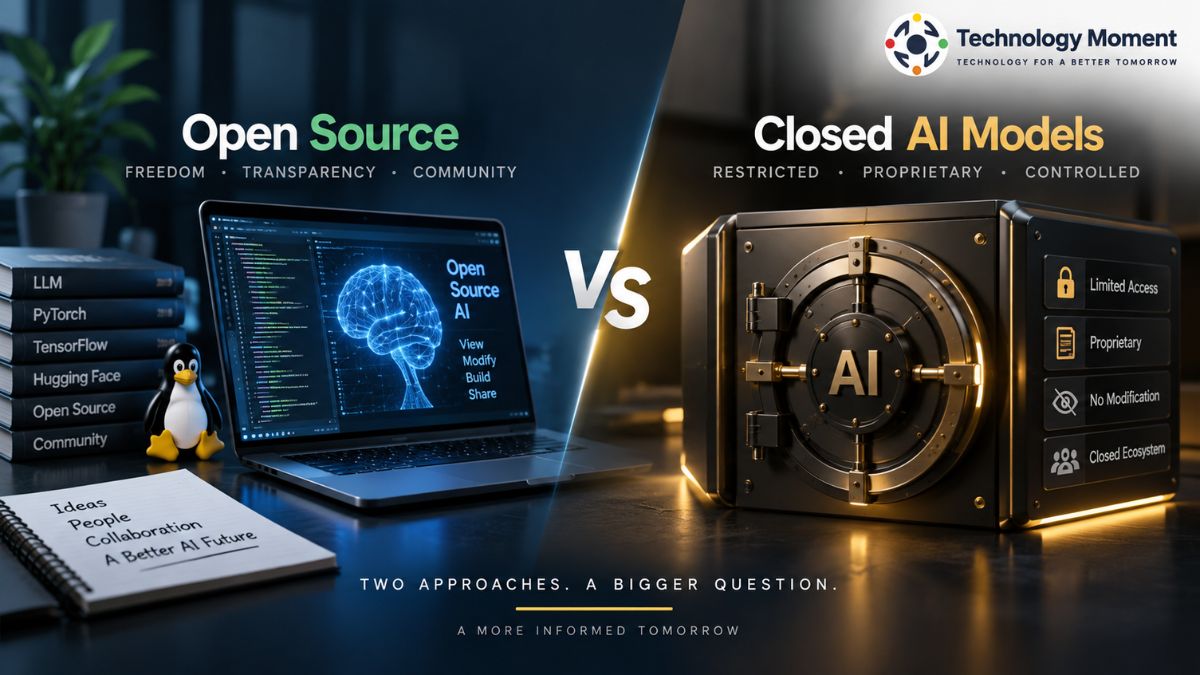
Artificial intelligence is evolving quickly, but choosing the right type of AI model is not always straightforward. Open Source vs Closed AI Models offer different levels of access, customization, transparency, control, cost, and deployment flexibility. Understanding these differences can help developers, businesses, and organizations make more informed decisions about the technologies they use.
At Technology Moment, we focus on making complex technology easier to understand by breaking down important developments, tools, and concepts into clear, practical insights. In this guide, we’ll compare open-source vs closed AI models, explain how they differ, and explore the advantages and limitations of each approach.
You’ll learn how these models compare in areas such as customization, privacy, security, fine-tuning, infrastructure, licensing, cost, and self-hosting. We’ll also explain the difference between open-source and open-weight models, since the terms are often used interchangeably even though they can have different meanings.
Whether you’re a developer experimenting with AI, a business evaluating AI solutions, or simply trying to understand how modern AI models work, this comparison will give you a clearer foundation for evaluating your options.
What Are Open-Source AI Models?
Open-source AI models are AI systems made available with a level of access that allows developers and organizations to inspect, use, modify, or deploy the model according to its license. Depending on the project, this may include access to model weights, source code, documentation, training information, or development tools. However, not every model described as “open” provides all of these components, so checking the specific license and terms is important.
One of the main attractions of open-source AI models is flexibility. Developers can often download a model, run it on their own infrastructure, fine-tune it for specific tasks, or integrate it into custom applications. This makes open-source LLMs particularly useful for teams that want greater control over how an AI system is deployed and configured.
Self-hosting can also provide organizations with more control over data flows. For certain workloads, running an AI model within a private environment may reduce the need to send sensitive information to an external AI service. However, privacy and security still depend heavily on how the system is configured and maintained.
Another important advantage is customization. Developers can adapt supported models to particular domains, workflows, or datasets through techniques such as AI fine-tuning. Open models can therefore be attractive for research, experimentation, and specialized applications.
However, openness also brings responsibility. Organizations may need to manage computing infrastructure, updates, security, monitoring, and ongoing maintenance. Licensing requirements can also differ between models. Therefore, “open-source” should not automatically be interpreted as free, unrestricted, or suitable for every commercial application.
What Are Closed AI Models?
Closed AI models, often called closed-source or proprietary AI models, are developed and controlled by an organization that does not generally provide public access to the underlying source code, model weights, or complete development process. Users typically interact with these systems through an application, API, or managed cloud service rather than directly operating the underlying model.
The main difference is the level of access and control available to users. With a proprietary AI model, the provider usually manages the underlying infrastructure, model updates, security systems, and technical operations. This can make deployment simpler for organizations that do not want to build and maintain their own AI infrastructure.
Closed AI models can also be convenient for developers. Instead of downloading a model and configuring GPUs or servers, a developer may connect an application to an API and begin using the model. This approach can reduce the operational work involved in deploying AI applications, particularly for teams with limited infrastructure resources.
Another characteristic of closed models is controlled development. The provider determines how the model is trained, updated, optimized, and distributed. Users may receive new capabilities automatically without having to manage model upgrades themselves.
However, this convenience can come with trade-offs. Developers generally have less direct model control, and customization options depend on what the provider makes available. Organizations may also become dependent on a particular vendor’s pricing, availability, API policies, and technical roadmap.
Privacy and security should also be evaluated based on the specific service rather than simply assuming that closed models are less private or secure. Data-handling policies, encryption, retention practices, access controls, compliance measures, and deployment architecture all matter. For businesses, closed AI models can therefore provide a managed approach to AI development, while open models can provide greater control in environments where customization and deployment flexibility are priorities.
Open-Source vs Closed AI Models: Key Differences
The difference between open-source vs closed AI models largely comes down to access, control, customization, deployment, and responsibility. Open models may give developers access to model components that can be inspected or modified under their licenses, while closed models generally provide access through controlled applications or APIs.
| Factor | Open-Source AI Models | Closed AI Models |
|---|---|---|
| Source code | May be available, depending on the project | Generally not publicly available |
| Model weights | Often available for supported models | Generally controlled by the provider |
| Customization | Often provides greater flexibility | Depends on provider-supported options |
| Fine-tuning | Often possible | Available only when supported |
| Deployment | Can support self-hosting | Usually provider-managed |
| Infrastructure | User or organization may manage it | Usually managed by provider |
| Transparency | Potentially greater | Generally more limited |
| Model control | Greater control may be possible | Provider retains primary control |
| Maintenance | Often user’s responsibility | Usually provider-managed |
| Cost structure | Infrastructure and licensing costs may apply | Often usage or subscription based |
| Vendor dependence | Potentially lower | Generally higher |
| Support | Community or commercial support | Usually provider support |
For developers, open-source AI models vs proprietary AI models can represent a choice between greater control and greater operational convenience. Open models may be attractive when teams need local deployment, customization, or direct access to model components. Closed models can simplify implementation because infrastructure and model operations are handled by the provider.
The distinction also matters for enterprises. Organizations evaluating open source vs closed AI models for enterprise use should consider data governance, security requirements, compliance, infrastructure capabilities, scalability, and long-term costs rather than focusing on the model category alone.
It is also important to distinguish open-source AI models from open-weight models. A model can make its weights available without providing all the components normally associated with an open-source project. Therefore, licensing and actual access should always be examined before making a technical or commercial decision.
Open-Source vs Closed AI Models: Advantages and Disadvantages
Both approaches have meaningful strengths and limitations. The right choice depends on the organization’s technical capabilities, budget, privacy requirements, customization needs, and deployment strategy. A major advantage of open models is flexibility. Developers can have greater control over deployment and, when permitted by the license, modify or fine-tune the model for specific requirements. Self-hosting can also allow organizations to keep certain workloads within their own infrastructure.
Open models can be useful for experimentation, research, custom applications, and organizations that want to reduce dependence on a single AI provider. Greater access to model components may also support transparency and independent evaluation. The additional control comes with responsibility. Running a model locally may require GPUs, storage, networking, monitoring, and specialized engineering skills. Organizations may also need to handle security updates, model maintenance, performance optimization, and infrastructure scaling.
Licensing is another consideration. Not every model has identical permissions for modification, redistribution, or commercial use, so organizations should review the applicable AI model licensing terms carefully. Closed AI models can make AI adoption easier because the provider typically manages infrastructure, model serving, updates, and operational systems. Developers can often access powerful capabilities through APIs without building a complete AI deployment environment.
This managed approach can be particularly useful for teams that prioritize rapid development and do not want to maintain complex AI infrastructure. The trade-off is reduced direct control. Users generally cannot inspect or modify the underlying model in the same way they might with an accessible model. Pricing, API limits, availability, updates, and product policies are also influenced by the provider.
For this reason, comparing open source AI benefits with proprietary AI advantages requires looking beyond the model itself. Infrastructure, security, privacy, performance, customization, licensing, support, and total cost can all influence the practical outcome. Ultimately, neither approach is universally suitable for every workload. The better fit depends on what an organization needs from its AI system and how much operational responsibility it is prepared to take on.
Open-Source vs Closed AI Models for Developers
For developers, the choice between open-source vs closed AI models often comes down to how much control they need over the technology and how quickly they want to build an application. Open-source AI models can provide access to model weights and deployment options that allow developers to experiment, modify supported models, and create specialized AI applications.
One of the biggest benefits of open-source AI models for developers is flexibility. A development team may be able to download a model, run it locally, deploy it on private infrastructure, or fine-tune it for a specific use case. This can be valuable when building applications that require specialized behavior or greater control over the underlying AI system.
Self-hosting, however, requires technical resources. Developers may need to manage GPUs, memory, storage, model serving, monitoring, security, and performance optimization. The responsibility for keeping the deployment reliable also falls more heavily on the development team.
Closed AI models offer a different development experience. Instead of managing the model and infrastructure directly, developers can typically access proprietary LLMs through APIs or hosted platforms. This can significantly simplify implementation because the provider handles much of the underlying infrastructure.
The trade-off is reduced direct model control. Developers generally depend on the provider for available features, customization options, pricing, model updates, and API policies.
For experimentation, local deployment, and highly customized applications, open models may provide useful flexibility. For teams focused on rapid application development without managing AI infrastructure, closed models can offer a more managed approach. The decision should therefore be based on technical requirements, available engineering resources, deployment needs, and long-term project goals.
Open-Source vs Closed AI Models for Businesses and Enterprises
For businesses and enterprises, comparing open source vs closed AI models involves more than model performance. Organizations also need to consider infrastructure, security, governance, scalability, licensing, support, privacy, and total cost of ownership.
Open-source AI can give organizations greater control over how models are deployed and integrated into internal systems. Depending on the license and model availability, businesses may be able to self-host an AI system, customize it, or fine-tune it for domain-specific workflows. This can be particularly relevant for organizations with specialized requirements or existing AI infrastructure.
However, greater control can also increase operational responsibility. Businesses may need dedicated engineering teams to manage servers, GPUs, monitoring, model updates, security controls, and system reliability. Infrastructure costs can become significant as usage grows, even when the model itself is available without an upfront license fee.
Closed AI models can reduce some of this operational complexity. A provider typically manages the model-serving infrastructure, updates, scaling, and much of the underlying platform. This can allow businesses to integrate AI capabilities more quickly without building an extensive internal AI infrastructure.
For enterprise AI, vendor dependence is another consideration. Organizations using proprietary AI services may need to evaluate API availability, pricing changes, service limitations, data policies, and migration options. Businesses should also review AI model licensing before commercial deployment. Different models can have different permissions and restrictions.
Ultimately, the decision between open and closed AI should reflect the organization’s resources and requirements. A startup may prioritize development speed, while an enterprise may place greater emphasis on governance, deployment control, compliance, and long-term operational sustainability.
Open-Source vs Closed AI Models for Privacy and Security
Privacy and security are important considerations when evaluating open source vs closed AI models for privacy and security. However, neither model category automatically guarantees better privacy or stronger security. The actual outcome depends on deployment architecture, data handling, access controls, infrastructure, software configuration, and the provider or organization operating the system.
Open-source AI models can support privacy-focused deployments because organizations may be able to run them on their own infrastructure. With self-hosted AI models, sensitive information can potentially remain within a controlled environment instead of being sent to an external AI provider. This can give organizations greater visibility into data flows and system configuration.
At the same time, self-hosting transfers security responsibility to the organization. Teams must protect servers, restrict access, monitor vulnerabilities, update dependencies, secure model endpoints, and maintain the surrounding infrastructure. An improperly configured deployment can introduce significant security risks.
Closed AI models generally rely on infrastructure managed by the provider. Established providers may offer security controls, encryption, access management, monitoring, and compliance features as part of their services. However, organizations still need to understand how submitted data is processed, retained, protected, and used.
The question “Are open-source AI models more secure?” therefore does not have a universal answer. Greater transparency can make independent inspection easier, but openness itself does not eliminate vulnerabilities. Similarly, asking whether closed-source AI models are more secure requires examining the provider’s actual security practices rather than assuming that proprietary technology is inherently safer.
For organizations handling sensitive information, the practical evaluation should include data residency, retention policies, encryption, access controls, compliance requirements, deployment architecture, and incident-response processes. Privacy and security should be treated as system-level considerations rather than determined solely by whether a model is open or closed.
Open-Source vs Closed AI Models for Customization and Fine-Tuning
Customization is one of the clearest areas where the differences between open-source AI models and proprietary AI models can become important. Developers and organizations often want AI systems that behave differently from general-purpose models or perform particularly well within a specific domain.
Open-source models can provide greater customization flexibility when their licenses and technical architecture permit modification. Developers may be able to access model weights, adjust supported components, run the model on private infrastructure, or perform AI fine-tuning using specialized datasets.
Fine-tuning can help adapt an AI model to particular terminology, workflows, writing styles, classification tasks, or domain-specific requirements. However, it requires appropriate datasets, computing resources, technical expertise, and ongoing evaluation. Fine-tuning does not automatically make a model more accurate for every task.
Closed AI models can also offer customization, but the available options are controlled by the provider. Some proprietary AI platforms may provide fine-tuning, custom instructions, retrieval features, tool integration, or other adaptation mechanisms. Other services may offer only limited customization.
This creates an important distinction: customization does not necessarily require direct access to model weights. A closed platform may provide sophisticated ways to adapt an AI system without allowing users to modify the underlying model itself. For developers who need deep control over deployment and model behavior, open-source or open-weight models may provide useful options. For organizations that want customization without taking responsibility for model infrastructure, a managed proprietary service may be more practical.
Before selecting a model, teams should examine model weights, licensing, fine-tuning support, deployment requirements, compute costs, performance, and maintenance obligations. The best approach depends on how much customization is actually required and whether the organization has the resources to operate and evaluate the resulting system.
Open-Source vs Closed AI Models: Cost and Infrastructure
Cost is an important factor when comparing open source vs closed AI models, but the price of the model itself is only one part of the equation. Organizations should also consider computing resources, storage, deployment, maintenance, engineering time, and scaling requirements when evaluating the total cost of an AI system.
With open-source AI models, the software or model may be available without a traditional subscription fee, depending on its license. However, running self-hosted AI models can require significant infrastructure. Organizations may need GPUs, cloud servers, storage, networking, monitoring tools, and technical staff. As usage increases, infrastructure and maintenance costs can grow accordingly.
Closed AI models usually follow a different cost structure. Users may pay through API usage, subscriptions, or enterprise agreements. The provider generally manages the underlying AI infrastructure, which can reduce the organization’s responsibility for hardware, deployment, maintenance, and scaling. This can make costs easier to estimate for some workloads, although high usage can result in substantial recurring expenses.
The right comparison therefore goes beyond asking whether open-source AI is free. Are open-source AI models free? The model may be available at no licensing cost, but operating it is not necessarily free.
Similarly, are closed AI models more expensive? Not always. A closed service may be more economical for a small application because the organization does not have to purchase or manage expensive infrastructure. When evaluating AI costs, businesses should compare licensing, compute, engineering, maintenance, support, security, and scaling. A total-cost-of-ownership approach provides a more realistic picture than comparing model prices alone.
Open-Source vs Open-Weight vs Closed AI Models
The terms open-source AI models, open-weight models, and closed AI models are often used interchangeably, but they describe different levels of access. Understanding the distinction is important when evaluating an AI model for development, research, or commercial use.
An open-source AI model generally refers to a project that provides meaningful access to components such as source code and other materials under an applicable license. However, the exact meaning of “open source” can vary in practice, so the project’s license and available components should always be checked.
An open-weight model makes its trained model weights available to users. Having access to the weights can allow developers to run or adapt the model in ways that are not possible with a fully closed system. However, open weights do not necessarily mean that the training data, source code, or every component of the development process is available.
A closed AI model generally keeps important model components under the provider’s control. Users may access the model through an API, application, or hosted platform without receiving the underlying weights or source code.
| Model Type | Typical Access | Customization | Self-Hosting |
|---|---|---|---|
| Open-source | Broader access to project components | Often higher | Often possible |
| Open-weight | Model weights available | Often possible | Often possible |
| Closed | Provider-controlled access | Depends on provider | Generally unavailable |
The distinction matters because access to model weights does not automatically grant unrestricted rights. Licensing terms may limit modification, redistribution, or commercial applications. Therefore, when comparing open-weight vs closed models, look beyond terminology. Check exactly what is available, what the license permits, and whether the model supports the deployment and customization requirements of your project.
Understanding AI Model Licensing and Usage Rights
AI model licensing determines what users are legally permitted to do with an AI model. This is particularly important for developers and businesses planning to modify, distribute, self-host, or commercially deploy an AI system.
An AI model’s license can define permissions related to commercial use, modification, redistribution, attribution, and deployment. Some models may permit broad usage, while others may impose specific conditions or restrictions. As a result, the phrase “open-source AI” should never be treated as a guarantee that every possible use is permitted.
Licensing can also be different from access. A model may provide downloadable weights while still placing conditions on how those weights can be used. This is one reason developers should review the original license and accompanying usage terms before integrating a model into a product.
For businesses considering commercial open source AI models, licensing review should happen before significant engineering work begins. Teams should understand whether the intended use is permitted and whether distributing the model or an application containing it creates additional obligations. It is also useful to distinguish between the model itself and other components surrounding it. A project may contain code, weights, datasets, documentation, and supporting software, each potentially subject to different terms.
Before deploying an AI model, organizations should check:
- What components are available?
- What license applies to each component?
- Is commercial use allowed?
- Can the model be modified?
- Can it be redistributed?
- Are attribution requirements applicable?
- Are there additional usage restrictions?
- Do the terms apply differently to hosted and self-hosted deployments?
If the licensing language is unclear or the deployment has significant legal or commercial consequences, organizations should obtain appropriate legal advice. Careful AI licensing review helps prevent technical decisions from creating avoidable compliance problems later.
Open-Source vs Closed AI Models: Which One Should You Choose?
There is no single answer to which is better, open source or closed source AI because the appropriate option depends on the requirements of the project. The decision should be based on factors such as customization, privacy, infrastructure, cost, security, deployment, licensing, and available technical resources.
Developers who need extensive customization, local deployment, or greater control over model infrastructure may consider open-source or open-weight models. These options can provide flexibility for experimentation and specialized applications, but they can also require more engineering and infrastructure management.
Organizations that prioritize rapid implementation and managed infrastructure may consider closed AI services. Providers can handle much of the model-serving infrastructure, updates, scaling, and operational maintenance, allowing teams to focus on building applications.
For businesses and enterprises, the decision should also account for governance, compliance, support, vendor dependence, and long-term costs. A company with a strong internal AI engineering team may have different requirements from a small business that wants to integrate AI without maintaining servers or GPUs.
A practical decision framework is:
| Priority | Factors to Consider |
|---|---|
| Customization | Model access, fine-tuning, model weights |
| Privacy | Data handling, deployment location, retention |
| Security | Infrastructure, access controls, monitoring |
| Cost | API fees, GPUs, cloud resources, engineering |
| Speed | Setup time and managed services |
| Control | Deployment and model-management requirements |
| Support | Community vs commercial provider support |
| Commercial use | License and usage restrictions |
Instead of asking “should businesses use open source or closed AI models?” as a universal question, organizations should identify their specific requirements first.
The most suitable choice is the one that provides the necessary capabilities while fitting the organization’s technical resources, risk tolerance, budget, and long-term product strategy.
Frequently Asked Questions
Are open-source AI models free?
Some open-source or open-weight models can be downloaded without a traditional model fee, but running them may require GPUs, cloud infrastructure, storage, maintenance, and engineering resources. Licensing terms may also impose specific conditions.
Are closed AI models more expensive?
Not necessarily. Closed models often charge through subscriptions or usage-based pricing, while open models can create infrastructure and maintenance costs. The overall cost depends on workload, scale, infrastructure, and operational requirements.
Can open-source AI models be used commercially?
Some can, but commercial use depends on the specific AI model licensing terms. Always review the applicable license and usage conditions before commercial deployment.
Can open-source AI models be self-hosted?
Many open-source and open-weight models support self-hosting, but the exact requirements depend on the model, license, hardware requirements, and deployment tools.
What is the difference between open-source and open-weight AI models?
Open-weight models provide access to trained model weights, while open-source projects may provide broader access to source code and other components. The exact distinction depends on what the project makes available and under which license.
Are open-source AI models more private?
They can support privacy-focused deployments when they are self-hosted and configured appropriately, but privacy depends on the complete system, including data handling, infrastructure, access controls, and security practices.
Are open-source AI models more secure?
Not automatically. Open models can allow greater inspection and control, but organizations operating them are responsible for securing the deployment. Security depends on implementation, configuration, maintenance, and monitoring.