Choosing the right platform to deploy an application can make a significant difference in development speed, performance, and hosting costs. Developers need a solution that simplifies deployment without sacrificing control over their applications or making infrastructure management unnecessarily complicated. This is where Railway has attracted attention as a modern cloud hosting platform designed to streamline the deployment process.
In this Railway Hosting Review, we will explore whether the platform is worth considering for personal projects, full-stack applications, backend APIs, and production workloads. Railway allows developers to deploy applications using sources such as GitHub repositories, local code, and Docker images. Its usage-based pricing model is another important factor, particularly for developers who want to understand how their hosting costs change as their applications grow.
However, convenient deployment does not automatically mean affordable or suitable hosting for every project. Resource consumption, database requirements, scalability, and the need for production-level reliability can all influence the overall experience. A platform that works well for a small side project may require a different budget or configuration when handling a growing user base.
At Technology Moment, our goal is to help readers make informed technology decisions through practical, straightforward reviews. In this guide, we will examine Railway’s deployment workflow, database capabilities, logs, resource usage, scalability, pricing, and key advantages and limitations. We will also compare Railway with alternatives such as Render, Vercel, and Heroku to help you understand where it fits best. By the end, you should have a clearer idea of whether Railway offers the right balance of convenience, flexibility, and cost for your next application.
Railway Hosting Review: How the Cloud Deployment Platform Works
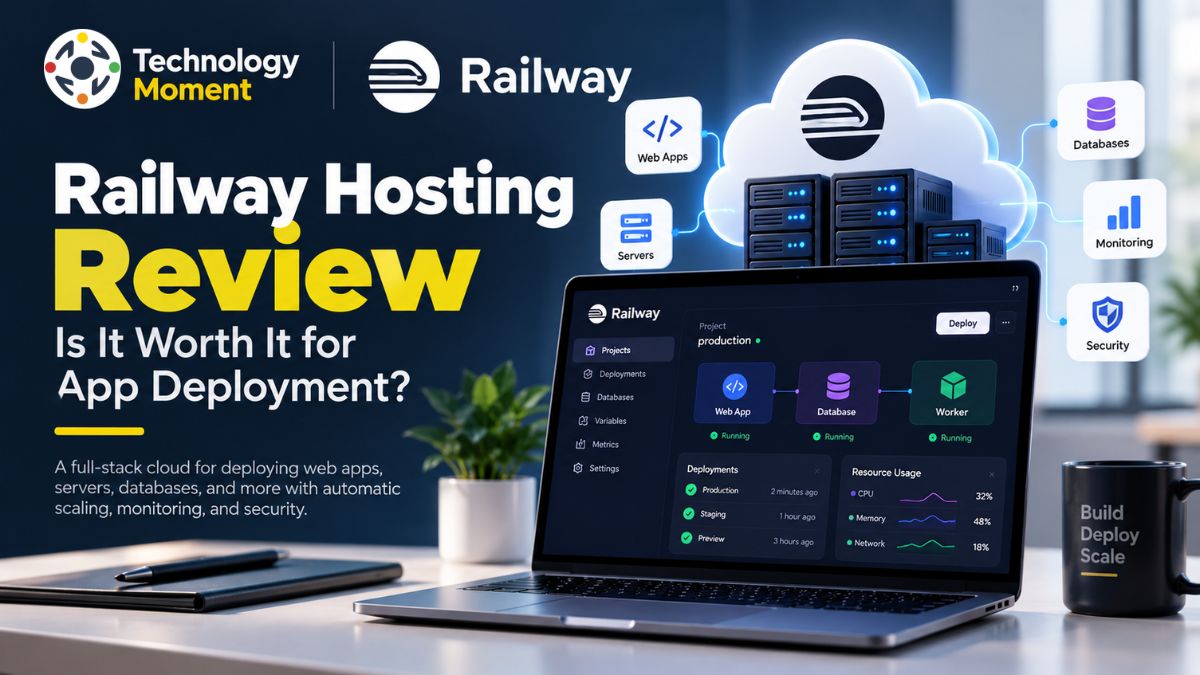
Railway is a cloud application hosting platform that helps developers deploy, manage, and scale applications without handling every aspect of server infrastructure manually. It is designed for developers who want a straightforward deployment workflow for web applications, backend APIs, scheduled jobs, and database services. Instead of configuring a traditional server from scratch, users can organize their applications into services and manage them through Railway’s project dashboard.
The Railway deployment platform supports several ways to launch an application, including GitHub repositories, local project directories, and Docker images. When a developer deploys source code, Railway builds the application into a container image and starts it using the detected or configured start command. This approach can simplify cloud deployment for developers working with Node.js, Python, and other supported application environments.
Another useful feature is the ability to manage multiple services within a single project. For example, a full-stack application may contain a frontend, a backend API, and a database. Railway also provides deployment logs, performance metrics, environment configuration, and networking options. These features help developers understand how their applications behave after deployment. However, Railway is not automatically the best choice for every workload.
Hosting costs depend on resource consumption, while production applications may require careful planning around reliability, backups, security, and scaling. Railway hosting is worth evaluating if you value a developer-friendly workflow and want to manage application infrastructure from one platform. Its suitability ultimately depends on your technical requirements, expected traffic, and hosting budget.
Railway App Deployment: Features and Workflow
One of the main attractions of Railway app deployment is its relatively straightforward workflow. Developers can connect a GitHub repository, configure a service, and deploy their application without manually provisioning a traditional server. When a linked repository receives a new commit on its configured branch, Railway can automatically build and deploy the updated application. This makes continuous deployment practical for projects that receive frequent code changes.
Railway also supports Docker-based deployment, which is useful when an application requires specific system dependencies or a customized runtime environment. If a repository contains a Dockerfile, Railway can use it to build the service image. Developers can also deploy existing container images or use the Railway CLI to deploy a local project directory. These options provide flexibility for different development workflows.
Environment variables are another important part of the deployment process. Applications commonly need database connection strings, API credentials, and environment-specific settings. Railway allows developers to configure service variables rather than hardcoding these values into application source code. Sensitive credentials should still be managed carefully, with appropriate access permissions and rotation practices.
For a full-stack application, developers can organize the frontend, backend, and database as separate services. Custom domains and service networking can help connect these components, while deployment settings allow developers to configure build and start commands when automatic detection is insufficient. Despite these conveniences, a successful deployment does not guarantee that an application is production-ready. Developers should test environment configuration, database connectivity, application health, and error handling before releasing changes. They should also verify persistent storage requirements because ordinary deployment filesystems may not retain data across deployments.
Railway Database Hosting Review
Database hosting is an important consideration when evaluating Railway for a complete application. Rather than managing an application server and database on entirely separate platforms, developers can deploy database services alongside their application components within a Railway project. This arrangement can simplify configuration and make communication between services easier.
Depending on the selected database image or template, developers may be able to run PostgreSQL, MySQL, or Redis for their application requirements. The exact setup, supported configuration, and maintenance responsibilities depend on the database deployment method. Users should check the relevant documentation before choosing a particular configuration.
For example, a Node.js application might use PostgreSQL to store user accounts and application records, while Redis could support caching or other temporary data needs. Connecting services through Railway’s private networking can reduce unnecessary public network exposure and help avoid network egress charges for internal communication. Developers should use the appropriate private connection details when connecting services within the same project.
Persistent storage deserves particular attention. Files written to a service’s ephemeral filesystem may disappear when a deployment is replaced. A database that needs to retain information must be configured with suitable persistent storage and a reliable backup strategy. Railway’s available storage options and backup features should be reviewed against the application’s recovery requirements.
Another consideration is database administration. Hosting a database does not remove the need to manage access credentials, schema migrations, query performance, backup retention, and recovery testing. Production workloads may also require additional monitoring and careful resource allocation. Railway database hosting can be convenient for developers who want application and database services in one environment. Before committing to it, compare storage needs, backup procedures, database performance, operational responsibilities, and total hosting costs with your project’s long-term requirements.
Railway Logs, Monitoring and Resource Usage
Monitoring is essential when an application moves from development to production. Railway provides built-in logs, resource metrics, and usage information that help developers investigate deployment problems and understand how their applications consume infrastructure resources. These tools are particularly useful when evaluating Railway hosting costs or diagnosing unexpected performance changes.
Deployment logs can help identify build failures, startup errors, and configuration problems. Application output written to standard output or standard error can also appear in Railway’s logging interface. By examining these records after a deployment, developers can investigate issues such as missing environment variables, failed database connections, and application startup exceptions. Railway also offers an observability dashboard that brings selected logs, metrics, and usage information into a configurable project view.
Resource monitoring provides another useful perspective. Railway exposes metrics for CPU usage, RAM consumption, disk utilization, and network traffic. Reviewing these metrics can help developers identify memory-intensive processes, unnecessary resource consumption, or changes in workload demand. However, built-in infrastructure metrics are not a complete substitute for application-level monitoring. Request latency, business KPIs, and detailed error rates may require additional instrumentation or third-party observability tools.
Resource usage also has a direct relationship with pricing. Railway bills for consumed resources in addition to the applicable subscription fee. An application that uses more CPU, memory, storage, or outbound network traffic than expected may therefore cost more than its base plan price suggests. Developers should regularly review their usage breakdown and configure appropriate usage limits where available.
For better cost control, optimize inefficient queries, investigate memory leaks, remove unnecessary running services, and use private networking for internal service communication. Review background jobs and scheduled tasks as well, since their resource consumption can contribute to the total bill. Railway’s logging and monitoring tools provide a useful starting point for troubleshooting and cost management, but consistent monitoring and sensible resource limits remain important for maintaining reliable, predictable hosting.
Railway Scalability and Production Performance
Railway’s scalability features make it possible to start with a small application and increase capacity as traffic and resource requirements grow. For developers evaluating Railway hosting for production applications, the important question is not simply whether the platform can scale, but whether its performance, reliability, and costs remain suitable as the workload expands.
Railway supports vertical scaling, allowing services to use additional CPU and memory within the limits of their selected plan. It also supports horizontal scaling through replicas, which run multiple instances of a service. This approach can help applications handle more requests and distribute workloads across instances. Railway can also deploy replicas across supported regions to bring services closer to users.
Regional deployments can help reduce network latency, particularly for applications serving an international audience. Private networking between services can also reduce unnecessary network hops when an application communicates with its database or backend components. However, performance depends on application architecture, database response times, network conditions, and the resources consumed by each service.
Production readiness requires more than increasing replica counts. Developers should configure suitable restart policies, monitor CPU and RAM consumption, test deployments under realistic traffic, and establish a reliable database backup strategy. Railway’s documentation also recommends considering multiple replicas for services where availability is important. Nevertheless, multiple application replicas alone do not guarantee high availability if the database or another critical dependency remains a single point of failure.
There are also practical limitations to consider. More replicas can increase resource consumption and hosting costs, while applications using in-memory sessions or local files may need architectural changes before they can scale reliably. Developers should verify their plan’s resource limits and the platform’s current regional capabilities before planning a large deployment. Railway can be a suitable deployment platform for growing applications, APIs, and startup projects. Its scalability features are useful, but production performance depends on sensible architecture, adequate resources, monitoring, and appropriate redundancy rather than the hosting platform alone.
Railway Pricing Review: How Much Does Railway Cost?
Railway uses usage-based pricing, combining a minimum monthly plan commitment with charges for resources consumed by your applications. Instead of paying only for a fixed server size, developers are billed according to measured CPU, memory, storage, and network egress usage. This can make Railway hosting attractive for projects with moderate resource requirements, although continuously running services can still generate costs when they receive little traffic.
| Subscription Tier | Starting Cost | Usage Allowance | Ideal For |
|---|---|---|---|
| Free | $0 per month | Access to selected free resources and trial credits, subject to applicable limits | Exploring features and running initial tests |
| Hobby | From $5 per month | Includes a $5 monthly usage allowance | Individual developers and small personal projects |
| Pro | From $20 per month | Provides $20 in monthly usage credits | Deploying production-ready applications and collaborating with teams |
| Enterprise | Customized pricing | Usage limits and benefits are determined by the contract | Businesses requiring tailored solutions and advanced capabilities |
Pricing checked against Railway’s published pricing information in October 2026. Confirm the latest terms before publishing, especially the Free plan’s trial credits and ongoing usage allowance.
Railway Resource Usage Costs
| Resource | Published rate | What it means |
|---|---|---|
| RAM | $10 per GB/month | Memory consumed while a service runs |
| CPU | $20 per vCPU/month | Processor usage |
| Network egress | $0.05 per GB | Outbound network traffic |
| Volume storage | $0.15 per GB/month | Persistent volume storage |
Railway calculates hosting charges according to the computing resources an application uses, with consumption tracked by the minute. For instance, a Hobby plan user who generates $3 in usage fees will typically pay the $5 minimum charge, whereas $8 in resource consumption would bring the total to $8. On the Pro plan, $30 worth of usage would generally result in a $30 bill instead of the $20 subscription price. Any usage credit included with a plan is applied toward resource charges rather than providing an extra discount on the subscription fee.
For a more reliable estimate of Railway’s monthly hosting expenses, monitor your application’s resource consumption over multiple days. Check CPU utilization, memory usage, storage requirements, and outgoing network traffic to understand the main cost drivers. Using Railway’s private networking for communication between supported services can help avoid unnecessary external data transfer charges. You can also configure usage limits to reduce the risk of unexpected bills. Although Railway offers a flexible pricing structure, your final hosting expenses will ultimately depend on your application’s actual resource demands and traffic patterns.
Railway Pros and Cons
Railway offers several advantages for developers who want a simpler way to deploy and manage applications. Its developer-focused workflow, GitHub integration, Docker support, and managed database options can reduce the amount of infrastructure setup required before a project goes live. Instead of managing every server configuration manually, developers can manage application services and deployment settings through a unified platform.
Another advantage is its usage-based billing model. Developers pay for measured resource consumption, with subscription credits covering an initial amount of usage on paid plans. This can be useful for personal projects, prototypes, and smaller applications that do not need a large amount of computing power. Railway also provides logs and resource metrics, helping users troubleshoot deployment errors and identify unnecessary resource consumption.
Scalability is another positive aspect. Horizontal replicas and regional deployment options give developers ways to expand capacity as application requirements change. For startups and independent developers, being able to begin with a relatively simple setup and adjust infrastructure later can make Railway worth considering. However, Railway also has limitations. Because billing depends on actual resource consumption, an application with persistent CPU or memory usage can generate costs even when traffic is low. Developers who need predictable fixed-price hosting may prefer comparing Railway with alternatives that offer clearly defined instance-based plans. The Free plan also has limited resources, making it more appropriate for experimentation than demanding production workloads.
Production applications require additional planning around database backups, security, monitoring, and availability. Running multiple replicas can improve resilience, but it may increase resource costs and does not automatically make every component highly available. Teams should also review plan limits, support requirements, and operational needs before committing to the platform. Railway is worth considering for developers who prioritize convenient deployment, integrated services, and flexible resource scaling. It may be less suitable for projects that require a tightly fixed hosting budget or specialized infrastructure controls. The best choice depends on application complexity, expected traffic, reliability requirements, and the total cost of running the workload.
Railway vs Render vs Vercel vs Heroku: Which Hosting Platform Is Better?
Choosing between Railway, Render, Vercel, and Heroku depends on the type of application you want to deploy, your preferred development workflow, and your hosting budget. Although all four platforms help developers deploy applications, they differ in their deployment experience, infrastructure options, pricing models, and suitability for particular workloads.
Railway is a flexible cloud deployment platform for developers who want to manage backend services, application containers, and databases within a unified project. Its GitHub integration and Docker support make it useful for full-stack applications and APIs. Render is another option for hosting web services, static sites, background workers, and databases. Vercel is particularly attractive for frontend applications, especially projects built with Next.js, although it also supports server-side functionality. Heroku is known for its managed application platform and developer-friendly deployment workflow.
| Feature | Railway | Render | Vercel | Heroku |
|---|---|---|---|---|
| Primary focus | General application and backend hosting | Web services, applications, and managed infrastructure | Frontend and web application deployment | Managed application hosting |
| GitHub integration | Yes | Yes | Yes | Supported through deployment workflows and integrations |
| Docker support | Yes | Yes, for supported services | Different container and runtime constraints; not a general-purpose Docker host | Supported through container-based deployment |
| Backend APIs | Well suited | Well suited | Supported, with serverless and runtime considerations | Well suited |
| Frontend hosting | Supported | Supported | A core strength | Supported through application services |
| Database hosting | Database services and templates | Managed database offerings | Usually paired with external databases | Managed data services and add-ons |
| Usage-based billing | Yes | Depends on service and plan | Depends on product and usage | Depends on dyno, database, and other resources |
| Scaling options | Vertical scaling and replicas | Depends on service type and plan | Managed scaling with platform-specific limits | Dyno scaling and plan-dependent options |
| Best fit | Full-stack apps and developer projects | Web apps and backend services | Frontend-heavy and Next.js projects | Managed application deployments |
These are high-level differences, not a guarantee that every feature is available on every plan. Confirm current service limits, database options, and pricing before selecting a provider.
Railway’s usage-based pricing can suit developers who want to pay according to measured resource consumption, while Render offers different service plans for web services and other workloads. Vercel’s value is often strongest when its frontend framework integrations and deployment workflow match the application. Heroku may appeal to teams that prefer a managed application platform and established deployment conventions.
Estimate monthly CPU, memory, storage, outbound traffic, database requirements, and any paid features you need. Also consider deployment reliability, logging, backups, support, and the effort required to maintain the application. For a backend-heavy full-stack project, Railway and Render are sensible options to evaluate first. For a frontend-focused Next.js application, Vercel deserves close consideration. For teams already using Heroku’s ecosystem, migration costs and operational familiarity may influence the decision. Ultimately, the best platform is the one that meets your application’s technical needs at a sustainable total cost.
Is Railway Worth It for App Deployment?
Railway can be worth it for app deployment if you want a developer-friendly platform that combines application hosting, database services, deployment automation, and resource monitoring. Its GitHub integration and Docker support help simplify the journey from source code to a running service, making it an appealing choice for independent developers, startup teams, and engineers building full-stack applications.
One of Railway’s biggest advantages is its unified project workflow. You can organize a frontend, backend API, and database in one project instead of manually coordinating every infrastructure component. Deployment logs and resource metrics also make it easier to investigate errors and understand application behavior. For developers who want to spend more time building product features and less time configuring servers, these capabilities can provide meaningful value.
Its usage-based pricing means that actual resource consumption matters more than the plan’s minimum monthly price alone. A small application with modest CPU and memory requirements may remain affordable, while a continuously running service with high resource consumption can produce a larger bill. Database storage, outbound network traffic, and additional replicas can also influence the total cost.
Railway is particularly worth evaluating for prototypes, side projects, APIs, internal tools, and startups that need a straightforward deployment workflow. It can also support production workloads, provided the team plans for backups, monitoring, security, capacity, and recovery procedures. The platform itself does not eliminate the need for production engineering.
Before committing, estimate your expected monthly usage and compare Railway with Render, Vercel, or Heroku based on your application architecture. Test the deployment process, measure performance, and review the available resource limits. Railway is a strong candidate when deployment convenience, integrated services, and flexible scaling matter. It is less compelling when your workload requires a strictly predictable bill or specialized infrastructure features that another platform provides more economically.
Frequently Asked Questions About Railway
Is Railway hosting free?
Railway offers a Free option for getting started, with a 30-day trial and $5 in credits according to its published pricing. After the trial, the listed Free plan costs $1 per month. Resource limits apply, so it is better suited to testing, experimentation, and small projects than demanding production workloads. Check the current plan details to understand service limits, included resources, and whether the free option meets your requirements.
Is Railway cheaper than Render?
Railway can be cheaper than Render for some workloads, but neither platform is automatically the least expensive option. Railway uses usage-based billing with included plan credits, while Render combines workspace plans, service compute charges, and other usage-based costs. Compare the same application architecture, CPU, memory, database, storage, and bandwidth requirements on both platforms. A realistic monthly cost estimate is more useful than comparing starting prices alone.
Can Railway handle production traffic?
Railway supports production applications and offers scaling features such as additional replicas and larger resource allocations. However, its ability to handle production traffic depends on application architecture, database performance, resource limits, and traffic patterns. Developers should conduct load testing, monitor CPU and memory consumption, configure appropriate health checks, and establish database backups. Multiple replicas can improve resilience, but they do not guarantee complete high availability when critical dependencies remain single points of failure.
How do you monitor resource usage on Railway?
Railway provides resource metrics and logging tools that help developers monitor CPU usage, memory consumption, disk utilization, and network activity. You can inspect deployment and application logs through the dashboard or Railway CLI to investigate errors and failed deployments. Regularly reviewing these metrics can reveal inefficient workloads and unexpected cost increases. For deeper application-level insights, such as request latency and business-specific error rates, you may need additional instrumentation or monitoring tools.
What are the main limitations of Railway hosting?
Railway’s main limitations can include usage-based cost variability, plan-specific resource limits, and the need to configure production safeguards carefully. Applications with continuously running services or high memory consumption can generate larger bills than expected. Developers must also plan database backups, persistent storage, access controls, and application reliability. Before deploying a business-critical application, review the available support, scaling limits, regional options, and recovery requirements against your project’s operational needs.
Is Railway better than Vercel for backend hosting?
Railway may be a better fit when you need persistent backend services, database hosting, Docker-based deployment, and control over application resources. Vercel is particularly strong for frontend projects and framework-focused workflows, including Next.js. Its server-side capabilities may also suit many backend use cases, but runtime constraints and pricing should be evaluated carefully. The best choice depends on your architecture, execution requirements, database strategy, and expected traffic rather than platform popularity alone.