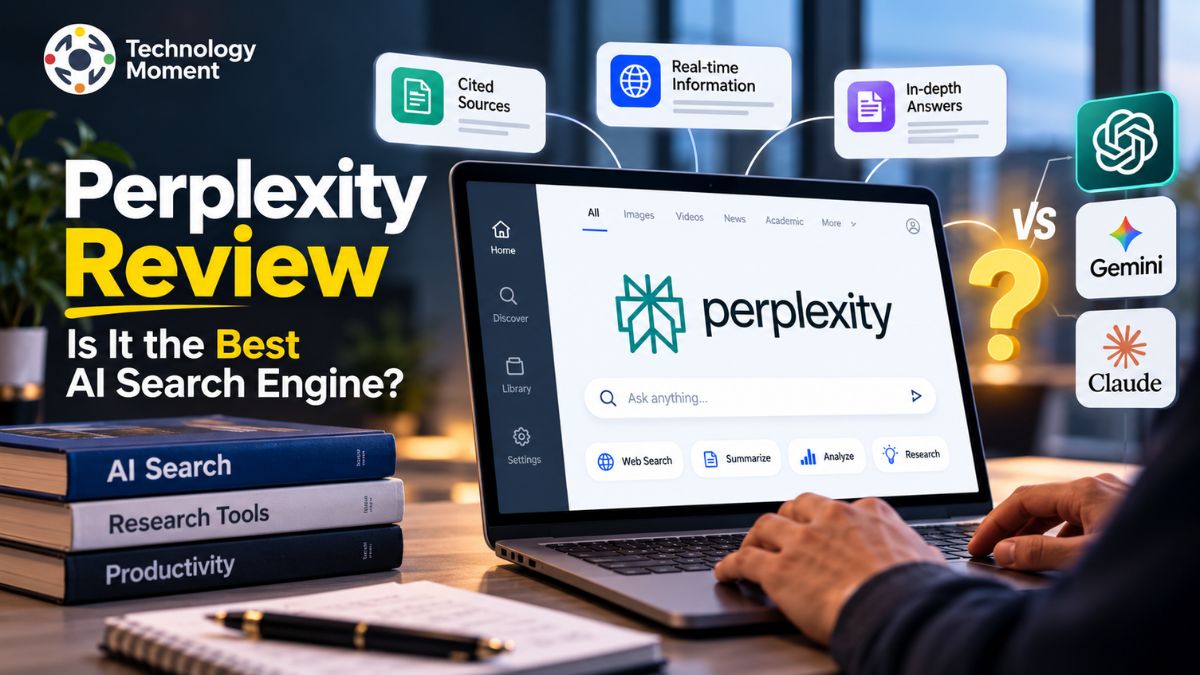
Traditional search engines often provide pages of links, requiring users to compare sources, verify facts, and piece together the information they need. AI-powered search tools are changing this experience by combining web search with conversational answers, summaries, and source citations. One platform attracting attention in this space is Perplexity AI. In this Perplexity AI review, Technology Moment explores whether Perplexity deserves its reputation as one of the leading AI search engines. Perplexity searches the web and generates responses supported by citations, allowing users to explore original sources rather than relying entirely on AI-generated summaries.
We will look at the key Perplexity AI features, its advantages and limitations, pricing options, and differences between the free and Pro plans. The review will also compare Perplexity with alternatives such as ChatGPT and Google Gemini to help readers understand which tool may suit their needs. Whether you are a student researching a topic, a professional gathering information, a content creator checking facts, or simply someone who wants quicker answers, understanding these differences can help you make a more informed choice.
At Technology Moment, our goal is to make technology easier to understand through practical reviews, clear comparisons, and useful insights. By the end of this article, you will have a clearer picture of what Perplexity AI offers, where it may fall short, and whether it is the right AI search engine for your everyday research needs.
What Is Perplexity AI Review?
Perplexity AI is an AI-powered search engine designed to help users find information through direct, conversational answers instead of browsing multiple search results manually. This approach makes it useful for people who want to understand a topic quickly while retaining access to the evidence behind an answer.
One of the main reasons Perplexity has attracted attention is its ability to combine real-time web search with AI-generated answers. Users can ask questions in natural language, explore a subject through follow-up prompts, and request explanations or comparisons without starting a completely new search each time. For example, a student researching climate technology can ask for an overview, explore the latest developments, and examine the cited reports to learn more about specific findings. Similarly, professionals can use the platform for market research, competitor discovery, and preliminary fact-checking.
Perplexity also offers advanced research capabilities through features such as Pro Search, which is designed to investigate more complex questions by drawing on multiple sources and synthesizing their findings. The precise features and usage limits available depend on the plan and product configuration.
However, an AI answer is not automatically a correct answer. Perplexity may overlook important context, misinterpret a source, or produce a summary that needs further verification. For readers exploring AI tools, Perplexity is best understood as a research assistant rather than a complete replacement for independent research. Whether it is the best AI search engine depends on the user’s needs, the quality of the sources available, and the accuracy required for the task.
Perplexity AI Features: What Does It Offer?
Perplexity AI combines several tools intended to make online research faster, more organized, and easier to verify. Its central feature is AI-powered search, which interprets a user’s question, retrieves relevant web information, and produces a summarized response with links to supporting sources. Rather than requiring users to open every result individually, the platform brings key information together in one place while allowing them to explore the original pages when more detail is needed.
Another important feature is source citations. Perplexity includes references alongside its answers, helping users identify where information originated. This is particularly useful for researching unfamiliar subjects, checking recent developments, and comparing information from different publications. Nevertheless, citations should be treated as starting points for verification because a linked page does not necessarily support every statement in an AI-generated response.
Pro Search is designed for questions that require deeper investigation than a straightforward search. This makes it useful for academic research, product comparisons, technical explanations, and professional information gathering. Deep Research provides a more extensive research workflow for users who need broader investigation and a structured report rather than a short answer.
Perplexity also supports conversational follow-ups, allowing users to develop an initial question into a more detailed investigation. Depending on the available plan and interface, users may have access to file analysis, research organization through Spaces or Projects, and different AI models or search modes. These capabilities can make the platform useful for both everyday searches and more demanding research tasks.
Overall, Perplexity’s main advantage is the combination of natural language search, summarized information, and accessible references. Its value depends on how effectively these features serve the user’s specific needs. Users looking for quick explanations may benefit from standard search, while researchers working on complex questions may find advanced research features more useful. Before choosing a paid plan, users should verify the current feature availability and limits on the official website.
Perplexity AI Pros and Cons
Perplexity AI offers several advantages for people who regularly search for information, but its limitations are important to understand before relying on it for everyday or professional research. Its biggest strength is the ability to turn a question into a readable summary supported by source links. This can reduce the time spent navigating search results and help users discover relevant articles, reports, and other material more efficiently. For students, content creators, and professionals, this approach can make preliminary research more convenient.
Another advantage is its conversational search experience. Users can ask follow-up questions, narrow the scope of an investigation, and explore related subjects without repeatedly rebuilding their search queries. Advanced features such as Pro Search can also help with complex research by gathering information from multiple sources and organizing the findings into a coherent response. These capabilities make Perplexity a useful AI research tool when users need more than a list of links.
However, Perplexity has disadvantages. AI-generated answers can contain factual mistakes, omit relevant details, or misrepresent information found in cited sources. A response may appear authoritative because it includes references, even when those references do not fully support the associated claims. Independent research has documented citation problems across AI search tools, reinforcing the need to verify important statements rather than accepting a generated summary at face value.
Another limitation is that answer quality depends on the question, available online evidence, and the research mode used. Niche topics with limited reliable sources may produce incomplete results, while rapidly changing information can become outdated. Users may also encounter plan restrictions when they need advanced features or higher usage limits. Perplexity AI is valuable for discovering information, summarizing sources, and beginning research quickly.
How Accurate Is Perplexity AI?
Perplexity AI is designed to provide factual, research-oriented answers by combining web search with AI-generated summaries and source citations. Its ability to retrieve information from online sources can make it particularly useful for questions involving current events, product information, technology developments, and general knowledge. However, Perplexity AI search accuracy is not determined by citations alone. The answer must also represent the source correctly, include relevant context, and distinguish verified facts from uncertain conclusions.
One important question is whether Perplexity AI provides reliable sources. Its citations give users a practical way to inspect the original material, compare different perspectives, and check the dates and credibility of published information. This is a meaningful advantage over answers that provide no accessible references. Nevertheless, research has shown that AI search systems can make citation errors. A Columbia Journalism Review and Tow Center study published in 2025 found that Perplexity incorrectly identified news sources in 37% of the tested cases. This result applied to a specific news-attribution task, not to every type of question or all Perplexity answers.
Users can improve the reliability of their research by following a few practical steps. First, open the cited sources instead of relying exclusively on the generated summary. Second, check important claims against official documentation, academic publications, or other authoritative sources. Third, compare multiple independent references when information is disputed or likely to change.
Perplexity AI can save time during information discovery, but it should not replace critical thinking or source verification. Its usefulness depends on the quality of the evidence it retrieves and how carefully users evaluate the results. For everyday research and preliminary fact-finding, it can be a helpful tool. For important decisions, independently verified information remains essential.
Perplexity AI Pricing: Free vs. Pro
Choosing between Perplexity Free and Pro depends on how frequently you use the platform, whether you need access to advanced AI models, and how much time you spend researching complex topics. The free version is suitable for basic questions, quick explanations, and occasional web research, while the paid plan is designed for users who need expanded search capabilities and additional productivity features.
The free plan includes basic searches with source citations, search history, limited file uploads, and restricted access to advanced research features. It can be a practical starting point for students, casual users, and anyone who wants to evaluate the AI search engine before paying for a subscription. However, users who frequently investigate complex subjects may encounter limits on advanced searches and other premium capabilities.
Perplexity Pro provides extended access to Pro Search, additional file and attachment analysis, advanced AI models, and image and video generation capabilities. Its official US pricing page currently lists the individual Pro subscription at $20 per month, although billing options and offers can vary by region.
| Feature | Perplexity Free | Perplexity Pro |
|---|---|---|
| Basic AI search | Available | Available |
| Source citations | Available | Available, with greater citation depth |
| Pro Search | Limited access | Expanded access |
| Advanced AI models | Restricted | Available |
| File uploads and analysis | Limited | Higher limits |
| Deep research | Limited availability | Expanded access |
| Image generation | Not included in the standard plan | Available |
| Best for | Everyday searches and beginners | Frequent research and productivity |
Feature availability and usage limits can change. Check the official Perplexity pricing page before subscribing.
For most casual users, the free plan is a sensible place to start. Perplexity Pro may be worth the price for researchers, professionals, and content creators who regularly need deeper investigations, more extensive source analysis, and additional AI capabilities. Before upgrading, consider whether these benefits will save enough time or improve your workflow enough to justify the recurring subscription cost.
Perplexity vs ChatGPT vs Google Gemini
Perplexity, ChatGPT, and Google Gemini are popular AI tools, but they serve somewhat different purposes. Perplexity focuses on AI-powered search and research, ChatGPT offers a broad conversational assistant for writing, analysis, coding, and problem-solving, while Gemini combines AI assistance with Google’s wider ecosystem of search and productivity tools. The best option depends on whether your priority is finding reliable sources, creating content, analyzing information, or working across connected applications.
It can help you discover relevant sources and investigate a topic through follow-up questions. ChatGPT is a strong option for drafting articles, brainstorming, explaining difficult concepts, coding, and working through multi-step tasks. Its available search and research capabilities depend on the plan and tools enabled. Gemini is worth considering if you use Google services regularly or want AI assistance integrated with Google’s productivity ecosystem. Paid subscriptions for all three services may offer additional capabilities, but their limits and features differ.
| Comparison factor | Perplexity AI | ChatGPT | Google Gemini |
|---|---|---|---|
| Primary purpose | AI search and research | General-purpose AI assistant | AI assistant and Google ecosystem integration |
| Web research | Core strength | Available through search and research tools | Available through Google Search-related capabilities |
| Source citations | Central to its search experience | Depends on the feature used | Depends on the feature used |
| Content writing | Research-backed drafts and summaries | Writing, editing, and brainstorming | Writing and productivity assistance |
| Coding | Available through supported models | Broad coding and problem-solving capabilities | Coding assistance and technical reasoning |
| Advanced research | Pro Search and Deep Research | Research tools, depending on plan | Deep Research, depending on access |
| File analysis | Available, with plan-dependent limits | Available, with plan-dependent limits | Available, with plan-dependent limits |
| Google integration | Not its primary advantage | Available integrations vary | Strong integration with Google services |
| Free access | Yes, with limits | Yes, with limits | Yes, with limits |
| Paid plans | Pro and other subscription options | Multiple subscription options | Google AI subscription options |
| Best suited for | Source-oriented web research | Versatile writing, reasoning, and productivity | Google-connected workflows and AI assistance |
This comparison describes general product positioning, not a controlled performance test. Features, model access, and limits may change. Choose Perplexity if your main goal is researching topics, discovering sources, and checking references. Choose ChatGPT if you need a flexible assistant for writing, coding, analysis, and everyday tasks. Consider Gemini if you regularly use Google services and want AI features within that ecosystem.
There is no universal winner. For research-heavy work, Perplexity may be the most convenient starting point, but users should verify its citations. For a broader workflow, ChatGPT or Gemini may provide better value depending on the tasks and subscriptions involved.
Is Perplexity AI Safe for Business Use?
Perplexity AI can be useful for business research, competitive analysis, market intelligence, and internal productivity, but its suitability depends on the subscription plan, the type of information being processed, and the organization’s security requirements. Businesses should evaluate not only the quality of AI-generated answers but also data privacy, access management, information retention, and the potential risks of sharing confidential material with an AI platform.
Perplexity offers enterprise products with security and administration features intended for organizational use. Its official enterprise information describes SOC 2 Type II certification, GDPR and HIPAA compliance, single sign-on (SSO), user management, audit logs, and configurable file-retention controls. Perplexity also states that enterprise customer data is not used to train its language models. These protections can help organizations manage access and establish clearer controls over how employees use the platform.
However, a platform’s security certifications do not automatically make every use case safe. Employees should avoid entering passwords, payment information, customer records, confidential contracts, proprietary source code, or sensitive business plans unless their organization has explicitly approved the relevant product and data-handling arrangements. Companies should also review applicable contractual terms, retention policies, connected applications, and the handling of information by third-party services.
Another consideration is the reliability of AI-generated research. Perplexity may summarize information incorrectly or overlook important context, even when citations are provided. Businesses should independently verify important findings before using them in financial reports, legal documents, customer communications, or strategic decisions. Appropriate human review is especially important when inaccurate information could create regulatory, financial, or reputational risks.
Larger organizations and regulated businesses should assess the appropriate enterprise plan, confirm the latest security documentation, and establish clear employee guidelines before deployment. Perplexity AI can be a practical business research tool when used with suitable safeguards. The safest approach is to use approved accounts, apply data-minimization principles, verify important answers, and ensure that the selected plan meets the organization’s security and compliance requirements.
Is Perplexity AI Worth It for Different Users?
Whether Perplexity AI is worth using depends on your research habits, budget, and expectations from an AI search engine. Its main advantage is the ability to combine web search, concise answers, and source citations in one interface. Instead of opening numerous pages to understand a topic, users can begin with a summarized answer and follow the references to investigate important details. This can be especially helpful when researching unfamiliar subjects or comparing information from multiple sources.
For students and researchers, Perplexity can simplify the early stages of academic research by helping identify relevant sources, explain unfamiliar concepts, and suggest related questions. However, students should consult original academic papers and follow their institution’s rules for AI-assisted work rather than citing an AI-generated summary as if it were an original source. Perplexity also offers an Education Pro option for eligible students and educators, subject to verification and current plan terms.
For content creators, journalists, and SEO professionals, the platform can help gather background information, investigate industry developments, and discover supporting references before drafting an article. It is particularly useful for initial research, but facts, statistics, quotations, and publication dates should be verified independently. For business professionals, Perplexity may accelerate competitor research, meeting preparation, market discovery, and the summarization of publicly available information. Organizations handling confidential data should assess appropriate enterprise controls before uploading internal documents.
Everyday users may find the free plan sufficient for general knowledge questions, recommendations, and quick explanations. Frequent researchers may benefit from Pro if advanced models, expanded research capabilities, and file analysis meaningfully improve their workflow. Heavy users should compare higher-tier plans against their actual usage instead of assuming the most expensive subscription is automatically the best choice. Perplexity AI is worth considering if source-oriented research is a regular part of your work. It may be less essential if you primarily need creative writing, coding, or a general-purpose assistant. The best decision is to test it on real tasks, assess the quality of its cited sources, and upgrade only when the additional features justify the cost.
Best Perplexity AI Alternatives
The best Perplexity AI alternatives depend on whether you prioritize source citations, writing quality, advanced reasoning, privacy, or integration with your existing tools. ChatGPT, Google Gemini, Claude, Microsoft Copilot, You.com, and Brave Search are worth considering for different workflows.
| AI tool | Best for | Main advantage | Potential limitation |
|---|---|---|---|
| ChatGPT | Writing, coding, and general productivity | Versatile conversational assistance and research tools | Features and usage limits depend on the plan |
| Google Gemini | Google-connected workflows | Integration with Google’s ecosystem | Some capabilities require eligible subscriptions |
| Claude | Long-form writing and document analysis | Detailed explanations and structured analysis | Search capabilities vary by plan and mode |
| Microsoft Copilot | Microsoft 365 users | Integration with supported Microsoft applications | Advanced features may require paid access |
| You.com | AI search and research | Search-oriented AI experiences and developer tools | Capabilities vary across products |
| Brave Search | Privacy-conscious web searching | Independent search index and privacy-focused browsing | AI answer features may differ from Perplexity |
| Kagi Search | Search customization | User-focused search controls and customizable results | Paid search access may be required for regular use |
Which Perplexity Alternative Should You Choose?
ChatGPT is a strong alternative if you need writing, coding, and general-purpose AI assistance alongside research. Google Gemini may suit users who work extensively with Google services. Claude is worth considering for detailed document analysis and long-form writing, while Microsoft Copilot may be more convenient for people working in Microsoft 365. You.com is another option for AI-powered search, and Brave Search is worth exploring if an independent search index and privacy-focused browsing are priorities.
Kagi can be a useful alternative for people who prefer customizable traditional search rather than relying primarily on AI-generated summaries. However, these tools should not be treated as identical products. Compare their current features, pricing, citation quality, and privacy policies before choosing a subscription.
For most research-focused users, start by testing Perplexity against one or two alternatives on the same questions. Compare the quality of the answers, the relevance of the cited sources, and the time required to verify the results. This practical approach will help you identify the best AI search engine for your needs.
Frequently Asked Questions About Perplexity AI
Is Perplexity AI Free to Use?
Yes, Perplexity AI offers a free Standard plan that supports basic searches, search history, and limited advanced search and file-upload capabilities. Users who need more advanced AI models, expanded research features, and additional productivity tools can consider a paid subscription. The free plan is suitable for occasional searches, while frequent researchers may benefit from upgrading depending on their requirements and budget.
Is Perplexity AI Better Than ChatGPT?
Perplexity AI may be more convenient for users who prioritize web research and source citations, while ChatGPT offers a broader range of conversational, writing, coding, and analytical capabilities. Both platforms provide features that can support research, but their strengths depend on the task and available tools. Compare them using the same questions and verify their answers against reliable sources before deciding which one suits your workflow.
How Accurate Is Perplexity AI?
Perplexity AI can deliver useful, source-supported answers, but it is not consistently accurate across every topic. It may misinterpret references, overlook relevant information, or generate unsupported statements. Its citations make verification easier, but they do not guarantee that every claim is correct. For important research, open the original sources, compare independent references, and check publication dates before relying on the information.
Is Perplexity AI Worth Paying For?
Perplexity Pro may be worthwhile for users who regularly conduct complex research, analyze files, or need expanded access to advanced AI models. Occasional users may find the free plan sufficient for everyday questions and basic web searches. Before subscribing, review the current pricing, usage limits, and included features. The best choice depends on whether the additional capabilities provide enough practical value to justify the recurring expense.
Does Perplexity AI Cite Its Sources?
Yes, Perplexity AI generally provides source citations alongside its web-search answers. These references allow users to open relevant webpages, investigate original claims, and compare information from different publishers. However, a citation does not automatically prove that an entire answer is correct. Users should confirm that each important claim is supported by the cited material, especially when researching sensitive or high-impact subjects.
Is Perplexity AI Safe for Business Use?
Perplexity can support business research, market analysis, and information discovery, but organizations should assess privacy settings, data-handling terms, and security controls before using it with confidential information. Enterprise plans offer additional administrative and privacy features. Employees should follow company policies, avoid uploading sensitive data without approval, and independently verify AI-generated findings before using them in important business decisions.
What Are the Best Perplexity AI Alternatives?
Popular Perplexity AI alternatives include ChatGPT, Google Gemini, Claude, Microsoft Copilot, You.com, and Brave Search. Each offers different strengths in research, writing, productivity, or web searching. ChatGPT is versatile for general tasks, Gemini suits many Google-connected workflows, and Brave Search emphasizes privacy-focused searching. Compare their current features, pricing, source quality, and privacy policies to identify the best alternative for your needs.
Is Perplexity AI Good for Academic Research?
Perplexity AI can help students and researchers discover relevant material, understand complex concepts, and identify potential sources for further investigation. However, it should support rather than replace academic research. Always read the original papers, verify authors and publication details, and cite the original sources according to your institution’s requirements. Researchers should also follow applicable academic-integrity policies when using AI-assisted tools.