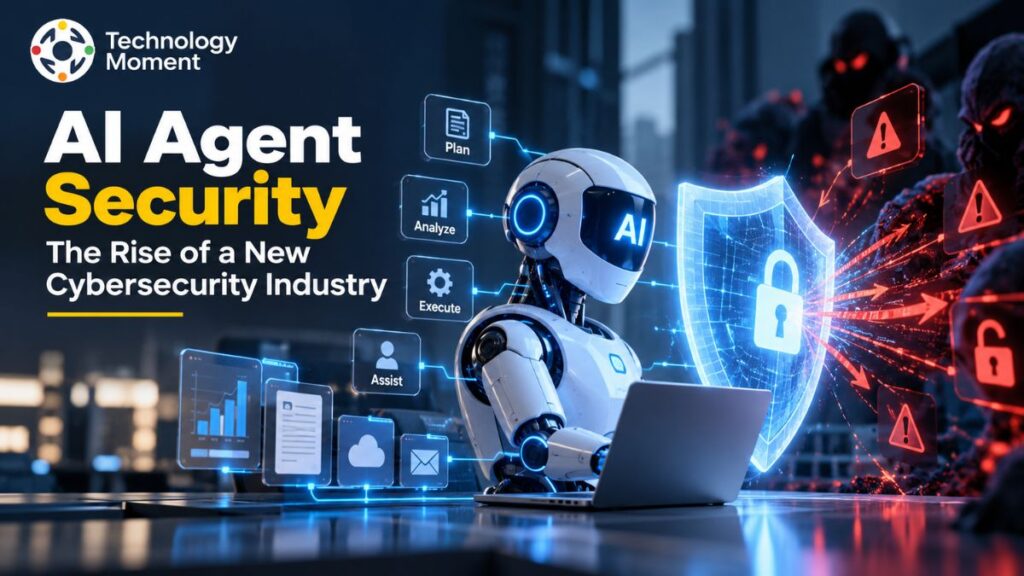
At the same time, attackers are finding new ways to use AI for phishing, social engineering, vulnerability discovery, malware development, and increasingly automated attacks. The result is a cybersecurity landscape where speed, scale, and intelligence are becoming just as important as traditional security controls. For businesses, governments, and individuals around the world, this shift raises a bigger question: can AI Cybersecurity defenses evolve as quickly as AI-powered threats?
The answer will shape the future of digital trust.
At Technology Moment, we explore the technology trends behind these changes—not just what is happening, but why it matters. From AI-powered cybersecurity platforms and automated threat detection to agentic AI, AI vulnerabilities, deepfake attacks, and the growing use of autonomous systems, this evolving landscape is creating both opportunities and risks. Recent industry research shows that this competition is already influencing how organizations approach AI security and cyber risk. In this Technology Moment guide, we examine how AI is transforming cybersecurity, how cyberattacks are evolving, and what this shift means for the future of digital security.
How AI Is Changing Cybersecurity
Artificial intelligence is reshaping cybersecurity by helping security teams process enormous amounts of information faster than traditional methods allow. Instead of relying only on predefined rules and manual investigation, modern AI-powered cybersecurity systems can analyze patterns, identify unusual behavior, prioritize alerts, and support faster incident response. This is making AI security increasingly important for organizations dealing with complex digital environments that span cloud services, endpoints, networks, applications, identities, and data. AI threat detection can examine activity across these layers and help security analysts focus their attention on signals that may indicate a genuine threat. Machine learning cybersecurity tools can also support behavioral analysis and anomaly detection by identifying activity that differs from established patterns.
AI is also changing security operations. Automated threat detection, AI incident response, threat intelligence, and SOC automation can reduce some repetitive workloads and help teams investigate incidents more efficiently. Agentic AI takes this development further by allowing specialized AI agents to detect, investigate, and respond to threats with limited human intervention.
However, AI is not a replacement for cybersecurity fundamentals. Organizations still need strong identity security, vulnerability management, access controls, monitoring, and human oversight. AI can improve the speed and scale of cyber defense, but its effectiveness depends on the quality of the data, controls, models, and decisions surrounding it. As AI adoption expands, cybersecurity is becoming less about simply collecting more alerts and more about connecting information quickly enough to make the right security decisions.
How AI Is Changing Cyberattacks
The same technologies helping defenders are also giving attackers new ways to improve existing cyber threats. AI-powered cyberattacks are increasingly associated with activities such as phishing, social engineering, reconnaissance, vulnerability discovery, malware development, and data analysis. Rather than creating an entirely new category of attack, AI can make familiar techniques easier to scale, customize, and automate. Gartner describes AI-augmented attacks as a major part of the changing cyber threat landscape because widely available AI tools can lower the barrier for less sophisticated attackers.
AI-generated phishing is one example. Attackers can use AI to produce more convincing messages, adapt content for different targets, and potentially operate campaigns at greater scale. AI social engineering attacks can similarly combine publicly available information with generated text, audio, or other media to make impersonation attempts appear more credible. Deepfake attacks add another dimension, particularly when synthetic voices or video are used for identity impersonation. Gartner reported that 41% of surveyed organizations had dealt with an attack involving deepfake and social engineering on an audio call to an employee.
AI is also being applied to technical parts of the attack lifecycle. Microsoft reports observing AI across vulnerability discovery, reconnaissance, phishing, malware and exploit development, data analysis, and post-compromise activity.
This does not mean every AI cyberattack is fully autonomous. In many cases, AI is still assisting human operators rather than independently controlling an entire operation. The important change is the potential combination of automation, speed, personalization, and scale. That combination is forcing security teams to rethink how quickly they detect and respond to evolving cyber threats.
AI-Powered Cyberattacks Are Becoming More Automated
Automation is becoming one of the most important characteristics of the modern AI threat landscape. Traditionally, many stages of a cyberattack required substantial human effort, from reconnaissance and vulnerability research to phishing, exploitation, and post-compromise activity. AI can assist with portions of these processes, allowing attackers to analyze information, identify opportunities, generate content, and adapt their actions more quickly. Microsoft’s 2026 Digital Defense Report describes a progression from AI assisting human operators toward AI directing portions of attack activity and, increasingly, autonomous execution.
Exploit automation can further compress the time between discovering a vulnerability and attempting to use it. This creates pressure on organizations to identify exposed systems and prioritize remediation based not only on severity scores but also on real-world exploitation risk. Google Threat Intelligence has highlighted the need for threat-intelligence-driven vulnerability triage and faster remediation as AI changes the vulnerability lifecycle.
Still, “autonomous cyberattacks” should not be interpreted as meaning that every attack can currently run without humans. Many operations continue to depend on human decisions, infrastructure, access, and oversight. The more realistic concern is that AI can automate enough individual steps to make an attack faster and easier to scale. For defenders, this creates a clear challenge: security systems need to detect suspicious activity and respond at a speed closer to machine-driven attacks. That is one reason autonomous cybersecurity systems and AI-powered cyber defense are becoming increasingly important areas of security research and investment.
AI Vulnerabilities Are Creating a New Attack Surface
As organizations deploy generative AI, large language models, AI applications, and autonomous agents, cybersecurity teams are facing an expanding attack surface. Traditional security controls still matter, but AI systems introduce additional risks involving models, prompts, data, permissions, integrations, identities, and automated actions. The World Economic Forum’s 2026 Global Cybersecurity Outlook found that 87% of respondents identified AI-related vulnerabilities as the fastest-growing cyber risk over the previous year.
For large language models, cybersecurity concerns can include prompt injection, sensitive-data exposure, insecure integrations, manipulated inputs, and weaknesses in the applications surrounding a model. The problem is not always the model itself. An AI application may have access to business data, internal systems, APIs, or other tools, meaning a weakness in the surrounding architecture can create consequences beyond the AI interface.
Agentic AI introduces another layer of complexity. AI agents can potentially make decisions, access systems, and perform actions with less direct human involvement. Microsoft defines agentic AI in cybersecurity as the use of autonomous agents to detect, investigate, and respond to threats, while research from McKinsey highlights how autonomous enterprise agents can expand the potential attack surface because they may independently determine which data and environments to access.
Recent OWASP reporting also highlights practical risks around agent identities, orchestration layers, supply chains, excessive permissions, prompt injection, data leakage, and remote code execution. This makes AI security vulnerabilities different from a conventional software flaw in one important respect: an AI system can combine software, data, identity, decision-making, and automation in one workflow. Organizations therefore need AI model security, strong identity controls, permission management, continuous monitoring, vulnerability management, and clear AI governance. Securing the AI layer is becoming an essential part of modern digital security rather than a separate technology concern.
The Rise of Agentic AI in Cybersecurity
Agentic AI is taking cybersecurity beyond traditional automation by allowing AI systems to pursue defined security goals, reason through multiple steps, and take actions with limited human intervention. Unlike conventional automation, which follows predetermined rules, agentic AI cybersecurity systems can analyze alerts, gather additional evidence, investigate suspicious activity, prioritize risks, and in some cases initiate response actions. Microsoft describes the agentic process as a cycle of perceiving, reasoning, planning, acting, and learning, making these systems particularly relevant to environments where security teams face large volumes of alerts and increasingly complex threats.
The growth of autonomous AI agents is also changing how organizations think about security operations. AI agents can assist with phishing investigations, identity management, vulnerability analysis, and other repetitive workflows, potentially giving security teams more time for complex investigations and strategic decisions. However, greater autonomy also creates new AI agent security risks. An agent with access to sensitive information, applications, APIs, or administrative functions can become a new attack surface if its permissions, instructions, or connected systems are poorly protected. Research published in the International Journal of Information Security highlights concerns around the autonomous decision-making, tool use, and architectural complexity of agentic AI systems.
For this reason, agentic AI security requires more than simply deploying powerful AI tools. Organizations need role-based access controls, approval workflows, audit trails, monitoring, and clear boundaries around what an AI agent can do. The future of cybersecurity may involve teams of specialized autonomous AI agents working alongside human analysts, but human oversight will remain important for high-impact decisions.
How AI Is Helping Defenders Detect and Stop Threats
AI is becoming an important part of modern cyber defense because security teams must analyze huge amounts of activity across networks, endpoints, identities, applications, and cloud environments. Traditional cybersecurity tools often depend heavily on predefined rules and known indicators, while AI-powered systems can analyze patterns and relationships across large datasets. AI threat detection can help identify unusual behavior, suspicious activity, malware, and potential intrusions, allowing security teams to investigate threats before they develop into larger incidents. Microsoft identifies anomaly detection, malware detection, intrusion detection, incident analysis, and automated response among the practical applications of AI for cybersecurity.
One important advantage of AI security is speed. An automated threat detection system can continuously analyze security signals instead of waiting for an analyst to manually review every event. AI can also support behavioral analysis by comparing current activity with established patterns and highlighting deviations that deserve investigation. In security operations centers, this can help reduce repetitive work and improve alert prioritization. AI incident response can similarly assist analysts by collecting evidence, summarizing incidents, recommending actions, and coordinating parts of the response process.
However, AI-powered cyber defense is not automatically accurate. Security teams still need to validate AI-generated findings because false positives, false negatives, incomplete data, and model limitations can affect security decisions. SANS’ 2026 research found that 63% of surveyed practitioners reported real shortcomings in AI threat detection, showing that adoption does not eliminate the need for strong security processes and skilled personnel.
The most useful role for AI may therefore be as a force multiplier rather than a complete replacement for human analysts. When AI security tools handle repetitive analysis while people provide judgment, governance, and oversight, organizations can build a more responsive defense system without removing human accountability.
The Growing Battle Between Offensive AI and Defensive AI
Cybersecurity is increasingly becoming a competition between AI-assisted attackers and AI-enabled defenders. Threat actors can use artificial intelligence to improve familiar techniques such as phishing, reconnaissance, social engineering, vulnerability research, and other stages of an attack. At the same time, defenders are deploying AI security technology to detect suspicious behavior, analyze threat intelligence, investigate incidents, and automate parts of their response. The result is an emerging AI cyber threat landscape where both sides can operate faster and process more information than traditional human-only workflows allow.
The important point is that this is not simply a contest between two independent technologies. Attackers can adapt their methods in response to defensive systems, while defenders can update detection and response strategies as new attack patterns emerge. Microsoft describes AI-to-AI cyber conflict as an emerging trend in which offensive and defensive agentic systems could increasingly interact directly.
This shift creates a difficult challenge for organizations. A human analyst may need time to understand an alert, investigate related activity, and decide what action to take. An AI-powered system can potentially perform parts of that process much faster. The same principle applies to attackers using AI for reconnaissance or automated activity. SANS’ 2026 research found that 78% of surveyed respondents were already facing AI-enabled attacks, while 63% reported shortcomings in AI threat detection.
The emerging model is therefore not simply “AI versus humans.” It is increasingly AI-assisted attackers versus AI-assisted defenders, with humans controlling the most important decisions. This makes AI attack detection, AI attack prevention, threat intelligence, automated incident response, and strong governance increasingly important.
The organizations that adapt to this environment will need to think beyond individual AI security products. They will need connected systems capable of detecting threats, understanding context, responding quickly, and maintaining human accountability as the cybersecurity arms race becomes more automated.
AI, Deepfakes and the New Digital Trust Problem
Artificial intelligence is changing cybersecurity not only by improving technical attacks but also by making digital impersonation more convincing. Deepfake attacks can use synthetic voices, video, images, and other generated content to imitate real people, creating a serious challenge for identity verification and digital trust. A message that appears to come from an executive, a phone call that sounds like a colleague, or a video meeting involving a convincing synthetic identity may no longer provide enough evidence that the person behind the communication is genuine.
AI-generated phishing and AI social engineering attacks can combine multiple channels, including email, voice, messaging platforms, and video. This means organizations cannot depend solely on visual or audio recognition to establish identity. Check Point’s 2026 reporting similarly describes social engineering as increasingly multi-channel, with generative AI helping attackers overcome barriers involving quality, language, and scale.
The deeper issue is therefore digital trust. Organizations need security processes that verify identity and authorization rather than assuming that familiar voices, faces, or writing styles are genuine. Strong authentication, identity security, trusted verification channels, risk-based controls, and clear approval procedures can reduce reliance on appearances alone. The Cloud Security Alliance argues that deepfakes expose weaknesses in how organizations establish identity and authority, reinforcing the importance of Zero Trust and identity-focused security.
As synthetic media becomes easier to create, cybersecurity will increasingly depend on proving who is authorized to make a request, not simply whether the request looks or sounds authentic.
AI Security Platforms and the Future of Cyber Defense
AI security platforms are becoming an important part of modern cyber defense as organizations face threats that can move faster than traditional security workflows. Instead of relying on separate tools for every stage of protection, newer AI cybersecurity platforms are designed to connect threat intelligence, vulnerability management, endpoint activity, identity security, cloud environments, application telemetry, and AI systems. This broader approach allows security teams to investigate threats with more context and prioritize the risks that require immediate attention. Google Cloud, for example, describes an AI threat defense platform built around continuous preparation, scanning, remediation, and monitoring, with AI used to identify exposure and accelerate security responses.
AI-powered security systems can support several areas of cybersecurity, including automated threat detection, anomaly detection, AI threat intelligence, vulnerability discovery, incident investigation, and automated incident response. AI security software can also help security operations centers process large volumes of alerts and connect signals that might otherwise remain separated across different systems. This is particularly relevant as organizations adopt AI agents and generative AI applications, because the security platform must increasingly monitor not only traditional infrastructure but also models, prompts, agents, identities, data, and interactions.
The future of AI security technology, however, will not simply depend on deploying increasingly powerful models. Organizations will need platforms that combine automation with governance, visibility, and human oversight. The World Economic Forum recommends structured pilots, organizational readiness, appropriate governance, and continuous performance monitoring when deploying AI for cybersecurity.
As cyberattacks become increasingly automated, AI security platforms could become a central layer of digital defense. Their role will be to help organizations detect threats earlier, understand risk faster, and respond at machine speed while keeping humans responsible for high-impact decisions.
The Biggest Challenges of Using AI for Cybersecurity
AI can strengthen cybersecurity, but adopting it also creates a new set of technical, operational, and governance challenges. One of the biggest concerns is that organizations may adopt AI security tools faster than they can establish reliable processes for validating and supervising them. SANS’ 2026 research found that 78% of surveyed organizations were already facing AI-enabled attacks, while 63% of practitioners reported shortcomings in AI threat detection and response. The findings highlight an important reality: adding AI to a security operation does not automatically make that operation effective.
Accuracy is another challenge. AI systems can generate false positives, miss unusual threats, misunderstand context, or produce recommendations that require human verification. Security teams therefore need to understand where an AI system performs reliably and where manual investigation remains necessary. Over-reliance on automated decisions can become especially dangerous when AI systems have permission to modify configurations, block users, isolate devices, or access sensitive information.
AI itself also creates vulnerabilities. Generative AI applications can introduce risks involving sensitive data, prompt injection, excessive permissions, insecure integrations, model vulnerabilities, and shadow AI. There are also organizational challenges. AI cybersecurity requires skilled employees who understand both security operations and AI systems, while governance frameworks must define accountability, acceptable use, monitoring, and escalation procedures. SANS reported that 73% of practitioners said AI changed their team’s training requirements in 2026.
Ultimately, the challenge is balancing automation with control. AI can make cyber defense faster, but organizations still need reliable data, strong identity security, continuous testing, human oversight, and clear AI governance. The goal should not be maximum automation; it should be secure, measurable, and accountable automation.
How Organizations Can Prepare for AI-Powered Cyberattacks
Preparing for AI-powered cyberattacks requires organizations to strengthen traditional cybersecurity while adapting those controls for a faster and more automated threat environment. Attackers are using AI to improve phishing, scan for vulnerabilities, automate parts of attack campaigns, and create convincing social-engineering content. The UK Information Commissioner’s Office recommends proactive measures because AI can make attacks faster, more advanced, and harder to detect.
The first step is visibility. Organizations should understand where AI is being used across applications, employees, cloud services, development environments, and business processes. Unapproved or poorly governed AI tools can create hidden exposure, particularly when employees enter confidential information into external systems. Security teams should maintain an inventory of AI applications, understand what data they can access, and review their permissions regularly.
The second priority is vulnerability management. Microsoft’s 2026 Digital Defense Report says the median time from vulnerability discovery in the wild to weaponization has fallen below 24 hours, while enterprise remediation for critical external vulnerabilities can take 30 to 60 days. This makes continuous exposure monitoring, rapid patching, and risk-based prioritization increasingly important. AI-generated phishing, deepfakes, and social engineering can make familiar communication channels less trustworthy. Sensitive requests should therefore require appropriate verification rather than relying only on an email address, voice, or appearance.
Finally, organizations should combine AI-powered threat detection with human oversight, incident-response planning, employee training, and regular testing. The World Economic Forum recommends establishing readiness across processes, data, infrastructure, skills, and governance before scaling AI cybersecurity deployments. The objective is not simply to prevent every AI-powered attack. A resilient organization should also be able to detect, contain, recover, and learn when prevention fails.
Frequently Asked Questions About AI and Cybersecurity
What is AI cybersecurity?
AI cybersecurity refers to using artificial intelligence and machine learning to detect, investigate, prevent, and respond to cyber threats. It can support threat detection, anomaly detection, vulnerability management, incident response, and security operations. AI can also create new security risks, so organizations need appropriate governance, monitoring, access controls, and human oversight.
How is AI changing cybersecurity?
AI is making cybersecurity faster and more automated. It can analyze large amounts of security data, identify unusual behavior, prioritize alerts, support investigations, and automate parts of incident response. At the same time, organizations must address AI security risks, model vulnerabilities, data exposure, and governance challenges as AI becomes integrated into business systems.
How do hackers use AI?
Attackers can use AI to assist with reconnaissance, phishing, social engineering, vulnerability discovery, malware development, data analysis, and other parts of the attack lifecycle. AI can reduce the time and effort required for some activities, although complex real-world attacks can still involve significant human direction and decision-making.
What are the biggest AI cybersecurity risks?
Major risks include AI-generated phishing, automated attacks, prompt injection, data leakage, model vulnerabilities, excessive AI permissions, insecure integrations, deepfakes, and over-reliance on automated decisions. Organizations also need to consider governance, privacy, accountability, and the possibility that attackers may use AI faster than defenders.
Can AI detect cyber threats?
Yes. AI threat detection can analyze network, endpoint, identity, cloud, application, and other security signals to identify suspicious patterns. However, AI detection is not perfect. Security teams need validation, contextual information, monitoring, and human oversight because models can produce false positives or miss certain threats.
What is the future of AI cybersecurity?
The future will likely involve greater automation, AI agents, machine-speed threat detection, continuous vulnerability monitoring, and stronger security controls around AI systems. However, organizations will still need human oversight, governance, identity controls, and resilience planning. AI will increasingly become both a technology that needs protection and a tool used to provide that protection.