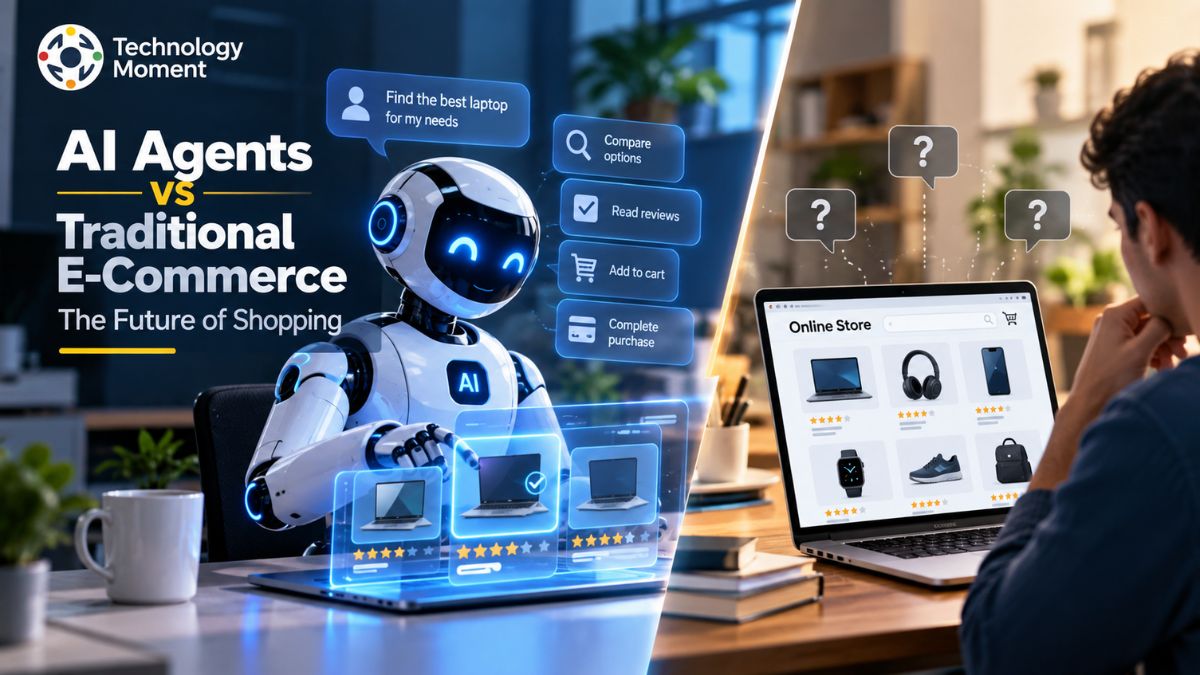
Online shopping has followed a familiar pattern for decades: consumers search for products, browse different websites, compare prices and reviews, and finally complete the purchase themselves. AI shopping agents are emerging as a new layer between consumers and online retailers, capable of understanding what shoppers want, finding relevant products, comparing options, and, in some cases, helping to complete transactions.
This shift is commonly described as agentic commerce, where AI agents can take action on behalf of consumers rather than simply providing information or recommendations. Unlike traditional e-commerce, where shoppers manually move from search to product pages and checkout, AI-powered shopping can turn much of that journey into a conversation. For consumers, this could make product discovery faster and more personalized. For retailers and brands, however, it introduces a fundamental question: if an AI agent increasingly decides which products a shopper sees, compares, and ultimately buys, who controls the shopping experience?
At Technology Moment, we explore the technologies reshaping how businesses and consumers interact in the digital economy. In this article, we examine AI agents vs. traditional e-commerce, how AI shopping agents are changing online shopping, what this means for retailers, and why product data, trust, payments, and customer relationships could become increasingly important in an agent-driven marketplace. The transition is still developing, but one thing is becoming clear: the next generation of e-commerce may not be defined only by better websites. It may be defined by how effectively businesses and AI agents work together to connect consumers with the products they actually want.
How AI Shopping Agents Are Redefining Online Commerce
Agentic commerce is an emerging model of digital commerce in which AI shopping agents can help consumers move through multiple stages of the shopping process, from understanding what they need to discovering products, comparing options and, where supported, completing a purchase. Traditional AI tools often stop at answering questions or recommending products, while agentic systems are designed to take actions across connected services based on a user’s goal, preferences, and permissions. IBM defines agentic commerce as AI agents acting on behalf of consumers or businesses to research, negotiate, and complete purchases, while AWS describes a process that can include product discovery, comparison, price monitoring, and purchasing.
The basic process starts with a natural-language request. Instead of manually searching for “best running shoes under $100,” for example, a shopper could tell an AI shopping assistant what they need, including budget, preferred features, brand preferences, or delivery requirements. The AI agent can then interpret the request, search available product information, identify relevant options, and present a shortlist. In more advanced forms of agentic shopping, the system can compare prices, availability, shipping information,n and other product attributes before helping the consumer decide. Depending on the platform and permissions, the final stage may include an AI-assisted or embedded checkout rather than requiring the shopper to navigate through several separate pages.
This makes AI agents in e-commerce different from a basic chatbot. A chatbot may answer a product question, but an agent can potentially coordinate several steps to achieve a shopping goal. The level of autonomy is not necessarily the same in every system: some experiences keep the consumer involved at the final purchase stage, while others are being designed to execute approved transactions on the user’s behalf.
For retailers, agentic commerce also creates a new technical requirement. Accurate product catalogs, pricing, inventory, shipping information, payment systems,s and checkout infrastructure need to be accessible to AI systems. Shopify’s current implementation, for example, connects structured product information with AI shopping channels and commerce infrastructure.
AI-Powered Shopping / AI Agents vs Traditional E-Commerce
Traditional e-commerce has generally been built around a human-operated shopping journey. A consumer identifies a need, opens a search engine or retailer website, enters keywords, browses product pages, reads descriptions and reviews, compares alternatives, and eventually completes checkout. AI-powered shopping changes this interaction by allowing an AI assistant or shopping agent to perform some of those activities on the consumer’s behalf. The important distinction is not simply that AI is present; it is that the AI can potentially move from providing information to taking actions.
| Shopping Stage | Traditional E-Commerce | AI-Powered / Agentic Shopping |
|---|---|---|
| Starting point | Consumer opens a website or search engine | Consumer describes the shopping goal to an AI assistant |
| Product search | User enters keywords and browses results | AI interprets natural-language requirements |
| Product discovery | User visits multiple product pages | AI can identify and shortlist relevant products |
| Comparison | Consumer manually compares products | AI can organize product features and alternatives |
| Recommendations | Based mainly on website filters and recommendation systems | AI can generate recommendations from the user’s stated needs |
| Price checking | User checks different sellers or marketplaces | Agent can compare available pricing where supported |
| Reviews & information | Consumer reads information across pages | AI can summarize relevant information |
| Decision-making | Consumer handles most evaluation manually | AI can assist with evaluation and trade-offs |
| Checkout | User manually completes checkout | AI may guide, embed or initiate checkout depending on the platform |
| Purchasing | Consumer explicitly completes the transaction | Agent can potentially complete an approved transaction |
| Customer journey | Website-centered | Conversation/AI-centered |
| Retailer visibility | Brand website and marketplace presence are central | Product data must also be discoverable by AI systems |
| Human control | User remains involved throughout | User can delegate selected tasks within defined permissions |
The difference does not mean that traditional e-commerce disappears. In fact, the underlying commerce infrastructure remains important because products still need accurate information, inventory, pricing, payment processing, fraud controls, and fulfillment. Shopify’s description of agentic commerce shows this clearly: AI can handle discovery and parts of the shopping interaction, while established commerce infrastructure continues to support the actual transaction.
How AI Agents Are Changing the Online Shopping Experience
AI agents are changing online shopping by reducing the amount of manual work consumers may need to perform during product discovery and comparison. In traditional e-commerce, shoppers often have to translate their needs into search keywords, open several pages, compare specifications, and decide which information is trustworthy. With AI shopping agents, the interaction can begin with a natural-language request that describes the actual goal rather than a specific search phrase. This allows the system to interpret preferences such as price, size, features, compatibility, brand, and delivery requirements before presenting potential products.
One major change is AI product discovery. Instead of simply returning a list of links, an AI shopping assistant can potentially create a shortlist based on the shopper’s requirements. Product comparison can also become more conversational. A consumer might ask why one product is more suitable than another, request alternatives within a different price range, or change a requirement and ask the agent to update the recommendations. This creates a more dynamic shopping experience in which the user can refine the objective through conversation. Shopify currently describes agentic commerce as allowing shoppers to discover, compare,e and purchase products within an AI-driven interaction.
Personalization is another important area. An AI system can work with information provided during a conversation, such as budget, preferences, and intended use, to narrow the available choices. However, personalization also creates questions around privacy, transparency, and how much information consumers want to share with an AI system. The most significant development is the movement toward automated checkout and purchasing. Some AI shopping experiences are already connecting product discovery with transaction flows, while other systems still require consumers to complete the final purchase themselves.
This means the online shopping experience is evolving from a sequence of search → browse → compare → checkout toward a possible ask → discover → evaluate → approve → purchase model. The technology is still developing, but the direction is clear: AI is becoming not just a shopping assistant, but potentially an active participant in the commerce process.
AI Shopping Agents and the New Customer Journey
The traditional digital customer journey in e-commerce is largely website-driven. A consumer searches for a product, lands on a retailer or marketplace, explores categories, applies filters, reads product information, compares alternatives, and eventually makes a purchase. AI shopping agents introduce another possible path: the consumer can communicate the desired outcome directly, while the agent handles some of the research and decision-support work. This creates a shift from navigating websites to managing an AI-assisted shopping conversation.
The new journey can be understood as a series of connected stages: need identification → AI conversation → product discovery → product comparison → recommendation → decision → checkout → payment → fulfillment. At the first stage, the consumer describes the goal. The AI then interprets requirements and searches available product information. During discovery and comparison, it can narrow choices and explain differences. At the decision stage, the consumer may approve a recommendation or adjust the requirements. Depending on the platform, checkout can remain a human-led step or become part of an agentic transaction.
This could significantly affect consumer behavior because the number of individual actions required to complete a purchase may decrease. Instead of visiting multiple websites, shoppers may increasingly expect AI systems to summarize choices and surface relevant products. Current commerce platforms are already experimenting with product discovery and purchasing inside AI interfaces, demonstrating how the boundaries between search, recommendation,n and transaction are beginning to overlap.
However, the customer journey is unlikely to become completely autonomous for every purchase. Trust remains an important consideration, particularly when an AI agent moves from recommending a product to actually spending money. Recent reporting indicates that consumers are generally more comfortable using AI for research and comparison than giving it unrestricted purchasing authority.
For retailers, this creates a new challenge: being present in the customer’s journey may increasingly mean being visible and understandable to AI systems, not only maintaining an attractive website. Accurate product catalogs, pricing, availability, and transaction infrastructure can become essential components of AI-ready commerce. In this emerging model, the shopping journey does not necessarily remove the consumer from the process. Instead, it can change the consumer’s role from manually performing every shopping step to setting the goal, defining the rules,s and deciding how much authority the AI agent receives.
What Will Happen to Traditional E-Commerce Websites?
Traditional e-commerce websites are unlikely to disappear simply because AI shopping agents are becoming more capable. Instead, their role may change. For years, online retailers have depended on websites and apps as the main destinations where consumers search, compare products, read reviews, and complete purchases. With agentic commerce, some of those activities can increasingly begin inside an AI assistant. A shopper may describe a need in natural language, and an AI agent can search across available products, compare options, and potentially move the customer toward checkout without requiring the same amount of website browsing. Shopify describes this emerging model as AI-assisted discovery, comparison, and purchasing within conversational experiences.
This creates an important distinction between the shopping interface and the commerce infrastructure. The website may become less important as the first place where customers discover products, while remaining important for product information, inventory, pricing, payments, fulfillment, returns, and customer relationships. Current industry analysis also shows retailers trying to capture AI-driven shopping traffic while protecting direct customer relationships and the valuable data generated on their own platforms.
For retailers, this means traditional SEO and attractive product pages may no longer be the only route to visibility. AI-ready commerce will require accurate product catalogs, structured information, current pricing and inventory, and systems that AI agents can understand. Shopify’s executive guidance specifically highlights product data and AI discoverability as important preparation areas.
The likely transition is therefore not simply websites versus AI. Instead, e-commerce websites may increasingly become the infrastructure behind an AI-mediated shopping journey. Consumers could discover products through an AI shopping assistant while retailers continue to manage the transaction and fulfillment behind the scenes.
How AI Agents Could Change Retailers and Brands
AI agents for retail could change the way brands approach product discovery, customer service, marketing, inventory, and transactions. Traditional digital commerce generally requires businesses to attract consumers to their websites, persuade them through product pages,s and guide them toward checkout. In an agentic commerce environment, an AI system can become an additional interface between consumer intent and the retailer. McKinsey describes this as a broader shift toward AI agents helping shoppers understand choices, resolve trade-offs, assemble baskets,s and move toward transactions.
One major change could involve AI product discovery. Instead of competing only for clicks from search engines or marketplace rankings, brands may need to make their products understandable to AI systems. A product catalog that clearly communicates specifications, availability, price, compatibility, shipping,ng and other attributes can give an AI agent more useful information when evaluating alternatives. Deloitte similarly identifies product-data modernization as an important part of preparing for agentic commerce.
AI agents could also affect internal retail operations. Businesses are already experimenting with agents for customer support, inventory planning, demand forecasting, marketing tasks, and other workflows. Shopify describes retail AI agents as systems that can connect with business data and tools and take actions beyond the limited responses of traditional chatbots. For brands, the challenge may therefore extend beyond simply “using AI.” They may need to become AI-ready businesses whose products, policies, and transaction systems can be interpreted and accessed by different AI platforms.
Another important change concerns the customer relationship. If an AI assistant becomes the primary shopping interface, retailers may receive fewer direct interactions with customers. Reuters reported that retailers are already balancing the opportunity of AI-driven referrals with concerns about losing direct customer data and relationships. As a result, brands may increasingly compete on two levels: winning consumer trust and becoming understandable and trustworthy to the AI agents making recommendations.
AI Shopping Agents: Benefits and Opportunities
The potential benefits of AI shopping agents come mainly from reducing friction throughout the shopping journey. Traditional online shopping can require consumers to perform many separate tasks: searching for products, opening different websites, comparing specifications, checking prices, reading reviews,s and determining whether an item meets their requirements. An AI shopping assistant can potentially combine several of these activities into one conversational experience. McKinsey describes current agentic shopping experiences in which AI helps consumers make sense of choices, compare products, and assemble potential purchases.
One opportunity is faster product discovery. Instead of searching with several different keyword combinations, shoppers can describe what they actually need. An AI agent can then interpret requirements such as budget, features, size, timing, or intended use and identify potentially relevant products. This can make AI-assisted shopping more conversational and goal-oriented.
Another benefit is product comparison. Consumers often have to move between multiple product pages to compare specifications and prices. An agent can organize information into a more understandable comparison, allowing shoppers to focus on the differences that matter to them. Shopify describes agentic commerce as supporting discovery, comparison, and purchasing within AI-driven interactions.
Personalization is another potential opportunity. AI can work with preferences provided by the shopper and adjust recommendations as requirements change. For example, a consumer can increase the budget, change a preferred feature,e or prioritize faster delivery and ask the agent to revise the options. For retailers, the opportunity extends beyond consumers. AI retail technology can support customer service, inventory management, demand forecasting, and marketing operations.
However, these benefits depend on accurate information, reliable systems, and appropriate human oversight. Agentic commerce is still developing, and not every shopping task is equally suitable for automation. McKinsey emphasizes that different transactions will require different levels of human involvement.
What Are the Risks of AI Shopping Agents?
The growth of AI shopping agents also introduces risks that traditional online shopping does not always face in the same way. The most obvious concern is what happens when an AI moves from providing information to taking action. A recommendation can be reviewed by the consumer, but an agent that can initiate a purchase, use payment credentials,s or interact with multiple services requires stronger controls. Current industry research emphasizes that human involvement will remain important for many types of transactions.
Privacy is another major issue. An AI shopping assistant may need information about preferences, budgets, previous purchases, addresses,es or other personal details to provide a useful experience. The more information an agent can access, the greater the importance of clear permissions, data protection, and transparency about how information is being used.
There are also risks related to incorrect recommendations and AI errors. If product information is outdated or an AI misunderstands a user’s requirements, it could recommend an unsuitable product. In agentic commerce, inaccurate information can become more consequential if the system has permission to take action rather than merely provide suggestions. Payment and cybersecurity risks are particularly important as AI agents become connected to commerce systems. Recent reporting has highlighted growing concerns about autonomous AI systems and the security challenges that can arise when agents are capable of taking actions across digital environments.
Another issue is consumer trust. Forrester’s 2026 assessment notes that many current agentic shopping experiences remain conversational, with humans still controlling important decisions and checkout in many cases. This suggests that fully autonomous shopping is not yet the default experience. Retailers also face risks around pricing, brand visibility and customer relationships. If AI agents become important intermediaries, businesses may have less direct control over how products are presented to consumers. PwC notes that brands may increasingly need to be discoverable, trusted and transactable by AI agents, not only preferred directly by customers.
Ultimately, the success of autonomous shopping will depend not only on how capable AI agents become, but also on whether consumers, retailers and payment providers can establish sufficient trust, security, transparency and control around them.
Who Controls the Shopping Experience: Consumer, AI Agent, or Retailer?
The rise of agentic commerce introduces a new question for the future of online shopping: who actually controls the customer journey when an AI agent becomes the interface between a shopper and a retailer? In traditional e-commerce, control is relatively straightforward. The consumer searches for products, chooses which websites to visit, compares options,s and decides what to purchase. Retailers influence the journey through product pages, recommendations, pricing, promotions, and checkout design. With AI shopping agents, some of those decisions can increasingly be delegated to software. IBM describes agentic commerce as a model in which AI agents can research, negotiate and complete purchases on behalf of consumers or businesses.
The consumer still sets the objective and can establish important boundaries, such as budget, preferred brands, product requirements, and whether an agent needs approval before purchasing. McKinsey’s analysis emphasizes that shopping automation exists on a continuum, meaning some transactions may involve substantial AI assistance while others will continue to require human involvement.
The AI agent controls the middle layer: it can interpret the request, search available products, compare alternatives, evaluate trade-offs, and potentially prepare or execute a transaction. This makes the agent an increasingly important part of the digital customer journey. Retailers, meanwhile, still control critical infrastructure such as product catalogs, inventory, pricing, fulfillment, payments, and returns.
Therefore, control may become distributed rather than belonging entirely to one participant. Consumers define the goal and permissions, AI agents mediate discovery and decision-making, while retailers provide the products and transaction infrastructure. The important shift is that the shopping interface may move from retailer-controlled websites toward AI-mediated experiences.
Frequently Asked Questions
What is agentic commerce?
Agentic commerce is an e-commerce model where AI agents can research products, compare options, and assist with or complete purchases on behalf of consumers. Unlike basic chatbots, these agents can reason through a shopping task and take actions across connected systems, depending on the permissions and capabilities available.
How do AI shopping agents work?
AI shopping agents interpret a shopper’s request, identify relevant products, compare factors such as features and price, and present recommendations. Depending on the platform, an agent may also check inventory, prepare a cart,t or initiate checkout. Some systems still require human approval before the final purchase.
Can AI agents shop for you?
Yes, AI agents can increasingly handle parts of the shopping process, including product discovery, research,ch and comparison. However, the level of autonomy differs by platform, merchant, and transaction, and many current experiences still keep the consumer involved before purchase.
Can AI agents buy products online?
AI agents can facilitate or complete online purchases in supported commerce environments. Current implementations can connect product discovery with checkout, while some require the shopper to approve the transaction. The exact process depends on the AI platform, retailer, payment infrastructure,e and permissions granted by the consumer.
Will AI agents replace traditional e-commerce?
AI agents are more likely to change the way consumers interact with e-commerce than immediately eliminate traditional e-commerce websites. Retailers will still need product catalogs, inventory, payment systems, fulfillment,nt and customer-service infrastructure, even when AI becomes an important shopping interface.
What are the benefits of AI shopping agents?
Potential benefits include faster product discovery, easier comparison, personalized recommendations, and reduced manual shopping effort. AI agents can potentially handle repetitive research tasks and help consumers navigate large numbers of products. The actual benefit depends on information quality, system reliability, and how much control the shopper gives the agent.
What are the risks of AI shopping agents?
Key risks include inaccurate recommendations, privacy concerns, unauthorized purchases, payment security, unclear accountability,y and excessive dependence on AI-generated decisions. Consumer trust is particularly important when agents move from providing recommendations to spending money. Current research indicates that many shoppers remain more comfortable with AI assistance than fully autonomous purchasing.
How can retailers prepare for agentic commerce?
Retailers can prepare by improving product data, maintaining accurate inventory and pricing, making information easier for AI systems to interpret, testing AI shopping channels, and strengthening payment and fulfillment infrastructure. They should also establish clear rules around customer permissions, transaction approval, data ownership, and accountability.
How is agentic commerce different from traditional e-commerce?
Traditional e-commerce generally requires consumers to search, browse, compare, and purchase products themselves. Agentic commerce allows AI agents to perform some or many of these activities on the consumer’s behalf. The key difference is the level of delegation and action, rather than simply the presence of AI technology.
Are AI shopping agents safe?
Safety depends on how the AI agent, retailer, and payment systems are designed. Important safeguards include explicit purchasing permissions, secure authentication, accurate product information, transparent pricing, and human approval for sensitive transactions. Because agentic commerce is still developing, consumers and businesses need to evaluate the controls provided by each platform rather than assuming all agents operate identically.