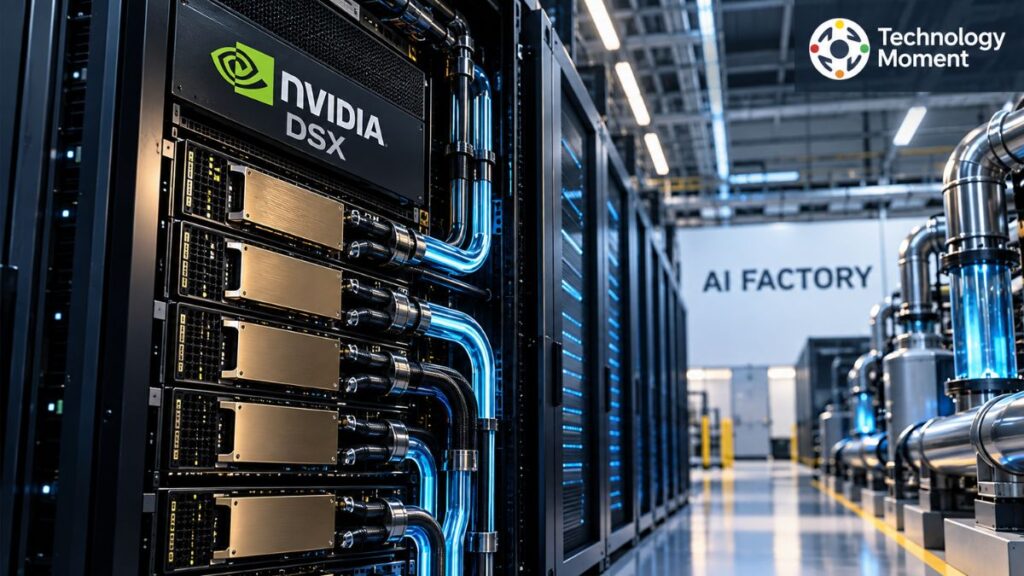
The AI boom is entering a new phase: the question is no longer only how powerful artificial intelligence can become, but whether the technology can generate enough economic value to support the enormous infrastructure being built around it. That gap puts data centers, computing capacity, AI chips, electricity and cloud infrastructure at the center of the AI business story.
Goldman Sachs separately estimates around $7.6 trillion in cumulative AI capital expenditure between 2026 and 2031, covering compute, data centers and power infrastructure. For technology companies, investors, and businesses worldwide, this creates a critical question: where will the revenue come from to support this extraordinary AI infrastructure investment? Enterprise AI, consumer applications, automation, AI-powered advertising, and emerging areas such as physical AI could all contribute, but the scale of the required economic value is unprecedented.
In this article, Technology Moment examines the numbers behind the AI infrastructure boom, the growing demand for data centers and compute capacity, the challenge of AI monetization, and the revenue required to make today’s investment sustainable. More importantly, we explore what this massive buildout could mean for the global technology industry—and why the next stage of the AI revolution may depend as much on revenue and economic value as on innovation itself.
Why Does AI Need $6 Trillion in Annual Revenue by 2031?
The rapid expansion of artificial intelligence is creating a major economic challenge: AI companies and infrastructure providers must generate substantially more revenue to support the enormous capital being invested in computing, data centers, AI chips, power systems, and cloud infrastructure. Industry analysis has increasingly focused on the relationship between AI revenue and AI infrastructure investment, with some estimates suggesting that around $6 trillion in annual AI-related revenue will be required by 2031 to support the scale of investment expected across the ecosystem.
The important point is that this figure should be viewed as an economic requirement under specific assumptions, not as a guaranteed forecast. The underlying question is whether AI adoption, monetization, and productivity gains can grow quickly enough to support the capital deployed today. The challenge becomes clearer when looking at AI CapEx. Goldman Sachs estimates a baseline of approximately $7.6 trillion in cumulative AI capital expenditure between 2026 and 2031 across compute, data centers, and power infrastructure.
Its model suggests a push from about $765 billion in 2026 to approximately $1.6 trillion in 2031. At the same time, BCG estimates that the five largest hyperscalers could commit roughly $5 trillion to AI capital expenditure through 2031. This creates the central AI monetization challenge. Spending on AI infrastructure does not automatically become revenue. Companies must turn GPUs, AI accelerators, cloud computing capacity, and data centers into products and services that customers are willing to pay for. Enterprise AI, generative AI applications, AI agents, automation, advertising, and new AI-powered services could become important sources of future revenue.
How Much Will AI Infrastructure Investment Cost?
AI infrastructure investment is becoming one of the largest technology spending cycles in modern history. The cost extends far beyond purchasing AI chips. Building the infrastructure required for advanced AI workloads involves accelerators, servers, high-speed networking, data center construction, power delivery, cooling systems, storage, and supporting energy infrastructure. Goldman Sachs estimates roughly $7.6 trillion of cumulative AI CapEx from 2026 through 2031 across compute, data centers,s and power, illustrating the potential scale of the AI infrastructure buildout.
AI data center investment is particularly capital intensive because modern AI workloads require much higher power density than conventional cloud computing. Goldman Sachs notes that next-generation AI data centers increasingly fall in a range of roughly $15 million to $20 million per megawatt, compared with approximately $10 million per megawatt for traditional hyperscale cloud facilities in earlier generations. The difference reflects more demanding power delivery, cooling, networking,g and redundancy requirements.
The investment challenge is also connected to the rapid development of AI hardware. A data center designed for one generation of AI chips may require significant upgrades when newer processors demand different power or cooling configurations. This creates a risk that infrastructure assets may need to be adapted more frequently than traditional data centers.
Data center investment therefore includes both physical capacity and the technology installed inside it. AI infrastructure spending covers GPUs and other AI accelerators, cloud infrastructure, networking, liquid cooling, electricity systems, and construction. The scale of this investment means that AI profitability and AI investment returns will depend not only on technological progress but also on how efficiently this infrastructure is utilized. Faster adoption, higher compute utilization, and growing inference workloads could help turn this capital base into recurring revenue.
Why Are Companies Spending So Much on AI Data Centers?
Companies are investing heavily in AI data centers because demand for AI compute is expanding across training, inference, enterprise AI, generative AI, and increasingly sophisticated AI applications. Training large models requires enormous computing resources, but the economics are also shifting toward inference, where AI models process requests continuously after they have been trained. This makes data center capacity an essential part of delivering AI services at scale.
The physical demand is equally significant. JLL estimates that global data center capacity could increase from 103 GW to around 200 GW by 2030, with AI workloads potentially representing about half of total capacity by that point. JLL also estimates that the expansion could require up to $3 trillion in investment through 2030.
This explains why AI data center growth has become closely connected to electricity demand and energy infrastructure. AI accelerators generate substantial heat and require advanced cooling systems, while high-density computing demands reliable power. Goldman Sachs projects US data center power demand could more than double from 31 GW in 2025 to 66 GW in 2027, although delays and cancellations could affect how quickly planned capacity becomes operational.
For technology companies, the goal is therefore not simply to build more data centers. The infrastructure must be utilized efficiently enough to support AI revenue growth. As AI adoption expands, companies are betting that demand for compute will translate into recurring cloud, software, and AI-service revenue.
The Data Center Investment Challenge
The biggest data center investment challenge is that AI infrastructure requires enormous amounts of capital while the supporting revenue is still developing. Building a modern AI data center requires access to land, electricity, advanced cooling, networking equipment, AI chips, and reliable grid connections. Delays in any one of these areas can slow the entire AI infrastructure buildout and increase costs.
Power availability is becoming particularly important. AI data centers operate with much higher power density than many traditional facilities, creating new requirements for electricity generation, transmission, and grid capacity. BCG estimates that the United States could face a potential 50–80 GW power capacity shortfall by 2030 if generating capacity does not keep pace with data center demand. Goldman Sachs also highlights power, data center construction, and chip supply as important components of the broader AI infrastructure investment equation.
Construction timelines create another challenge. Goldman Sachs identifies power interconnection queues, permitting, specialized labor shortages, and long lead times for equipment such as transformers, switchgear, turbines, and cooling systems as factors that can delay AI infrastructure deployment. These bottlenecks can create a gap between when companies commit capital and when new computing capacity actually becomes available.
There is also a technology risk. AI hardware is developing rapidly, which means today’s infrastructure may not always remain optimal for future workloads. Facilities must increasingly accommodate higher rack densities, advanced liquid cooling, and changing AI chip architectures. At the same time, companies need enough utilization to generate attractive AI investment returns.
The future of AI data centers will therefore depend on more than construction volume. The industry must solve the combined problems of compute demand, electricity demand, infrastructure costs, AI monetization,n and long-term profitability. If AI applications generate sustained demand for inference and enterprise workloads, existing infrastructure could become a powerful revenue-generating asset. If monetization develops more slowly, however, companies may face longer return periods on the capital invested.
Where Will the $6 Trillion in AI Revenue Come From?
The biggest question surrounding the AI investment boom is not simply how much companies will spend on infrastructure, but where the revenue required to support that spending will come from. The answer is likely to involve several parts of the AI economy rather than a single business model. Enterprise AI, cloud computing, AI software, AI agents, automation, advertising, cybersecurity, healthcare, robotics and other AI applications could all contribute to future AI revenue. BCG argues that the economics of the current AI buildout ultimately depend on AI creating new sources of value rather than relying only on replacing existing labor costs.
Enterprise AI could become particularly important because many consumer AI users still rely on free services. Goldman Sachs Research says successful enterprise adoption will be critical to making AI economics work, with companies needing to integrate AI into workflows while controlling data and operating costs. Paid enterprise software, AI-powered customer service, coding tools, data analysis, cybersecurity, and business automation could therefore become important sources of recurring revenue.
Another major opportunity is AI inference. Once an AI model has been trained, every user request, automated workflow, or AI-agent action can create additional computing demand. JLL expects inference to become the primary AI data-center workload as adoption grows, creating continuing demand for compute rather than only periodic training requirements.
New markets could ultimately be even more important. AI-accelerated drug discovery, autonomous logistics, personalized medicine, scientific research and advanced robotics represent areas where AI could create economic value that did not previously exist at comparable scale. That makes the $6 trillion challenge fundamentally a question of AI monetization: can new AI applications generate enough willingness to pay to support the enormous investment in chips, data centers and energy infrastructure?
Can AI Revenue Keep Up With AI Infrastructure Spending?
The gap between AI revenue and AI infrastructure spending has become one of the central financial questions surrounding the technology industry. The five largest hyperscalers—Microsoft, Alphabet, Amazon, Meta and Oracle—are projected by BCG to commit roughly $5 trillion in AI capital expenditure through 2031. BCG estimates that under certain assumptions, these investments could require approximately $1.6 trillion to $2.0 trillion in annual AI revenue to cover depreciation, operating costs and a 10% pretax return on invested capital.
That does not mean the industry necessarily needs exactly that amount of revenue, because the outcome depends on assumptions about hardware lifetimes, data-center costs, utilization, operating expenses and required returns. Goldman Sachs likewise emphasizes that estimates of AI CapEx are highly sensitive to infrastructure assumptions. Its baseline model estimates about $7.6 trillion of cumulative AI CapEx from 2026 through 2031, with annual spending rising from approximately $765 billion in 2026 to $1.6 trillion in 2031.
The revenue side could improve as AI workloads shift from model training toward inference. Unlike training, which represents a major upfront computing expense, inference can generate continuing usage as customers interact with AI systems. JLL expects inference to become the dominant AI workload by 2030, potentially creating a more persistent relationship between data-center capacity and AI revenue.
However, infrastructure utilization remains crucial. Goldman Sachs notes that lower occupancy caused by weaker demand or difficulty monetizing AI models would make it harder for data-center operators to generate expected returns. The ultimate test is therefore not simply whether AI revenue grows, but whether it grows fast enough and profitably enough to support the capital being deployed.
What Happens If AI Revenue Does Not Grow Fast Enough?
If AI revenue does not grow quickly enough to support infrastructure spending, the consequences could appear across the technology investment ecosystem. The first pressure point would likely be the economics of data centers. Facilities require substantial upfront capital, and operators depend on high utilization to generate attractive returns. Goldman Sachs has modeled scenarios in which weaker AI monetization reduces data-center occupancy, making it more difficult for operators to achieve expected returns on their capital investments.
AI companies could also become more selective about infrastructure expansion. Instead of continuously adding capacity, businesses could prioritize workloads with stronger revenue potential and improve the utilization of existing GPUs, AI accelerators, and cloud infrastructure. This could shift attention from simply building more capacity toward AI infrastructure efficiency.
Capital markets could also become more important. BCG notes that major hyperscalers are committing enormous amounts of capital to AI and have increasingly turned to corporate debt to help finance these investments. If AI monetization falls behind expectations, financing costs and capital allocation decisions could become more significant factors in future infrastructure investment.
Another possible response would be greater pressure on AI companies to reduce costs. Businesses could develop smaller models, improve inference efficiency, optimize AI workloads, and use specialized AI chips to reduce the cost of delivering services. BCG’s research on AI compute markets highlights the growing importance of metered pricing, cost management,t and more efficient allocation of computing resources. The result would not necessarily mean that AI investment stops. Instead, the industry could enter a more disciplined phase in which companies focus more heavily on AI ROI, AI profitability, and revenue per unit of compute.
How AI Could Make Data Center Investment More Economically Viable
Making AI data center investment economically viable will depend on improving the relationship between computing capacity, utilization,n and revenue. One of the most important changes could be the transition from training-heavy workloads toward inference. JLL expects inference to become the primary driver of AI data-center demand, while McKinsey projects inference to surpass training as the dominant AI workload by 2030.
This matters because inference can transform data-center infrastructure from a largely upfront investment into an asset supporting continuous commercial activity. Every AI assistant interaction, enterprise workflow, automated task,sk or AI-powered application can require computing resources. If these services attract paying customers, higher utilization can improve the economics of existing infrastructure.
Efficiency will also be critical. AI infrastructure companies can improve returns by increasing GPU utilization, optimizing model architecture, reducing energy consumption and improving the performance of AI accelerators. Better cooling systems and more efficient power infrastructure can also reduce operating costs. Goldman Sachs notes that changes in chip architecture, data-center construction costs and the useful life of AI hardware can materially influence the overall economics of the AI buildout.
More efficient AI compute markets could provide another opportunity. BCG estimates that improved pricing and trading mechanisms in AI compute markets could unlock substantial economic value while potentially reducing borrowing costs for data-center construction. Finally, the greatest improvement may come from applications that create new economic value. AI-powered drug discovery, robotics, autonomous logistics, scientific research, and enterprise automation could generate revenue beyond traditional software models. BCG argues that creating new sources of value is essential because labor substitution alone may not be sufficient to close the revenue gap created by today’s AI CapEx.
In other words, the future of AI data center investment may depend on three connected factors: higher AI adoption, greater infrastructure efficiency, and stronger monetization. If those three elements develop together, the enormous investment in computing and data-center capacity can become a productive economic foundation for the next stage of artificial intelligence.
AI Infrastructure Investment Is Also an Energy Story
Artificial intelligence is increasingly becoming an energy-intensive technology story. Behind every AI model, chatbot, AI agent, and enterprise application is a physical infrastructure network that requires electricity, cooling, data-center capacity, and reliable power. The International Energy Agency (IEA) estimates that global data-center electricity consumption could rise from about 485 TWh in 2025 to 950 TWh by 2030, roughly doubling in five years.
AI data centers increasingly use high-density GPU infrastructure, which places greater pressure on power systems and cooling equipment. The IEA reports that the power density of AI servers increased dramatically between 2020 and 2025 and is expected to rise further, putting additional pressure on transformers, power electronics, and other energy infrastructure.
Goldman Sachs Research projects US data-center power demand to increase from 31 GW in 2025 to 66 GW in 2027, while data centers’ share of peak summer electricity demand could reach 8.5% by 2027. For the AI industry, therefore, building more computing capacity also means securing more electricity. Companies are exploring on-site generation, renewable energy, battery storage,ge and other solutions to reduce dependence on constrained grids. JLL identifies energy infrastructure as a critical bottleneck for the global data-center expansion.
The Global Impact of the AI Data Center Boom
The AI data center boom is transforming more than the technology sector. It is creating a global infrastructure investment cycle involving real estate, energy, construction, semiconductors, cloud computing, telecommunications, and financial markets. JLL estimates that global data-center capacity could almost double from 103 GW to 200 GW by 2030, requiring up to $3 trillion of investment over the next five years.
AI is becoming a major driver of this expansion. JLL expects AI workloads to represent approximately half of global data-center capacity by 2030, compared with about one-quarter in 2025. The company also expects AI inference to become the dominant requirement around 2027 as AI applications move from model training toward continuous real-world usage.
The impact extends into capital markets. The IEA says data-center investments have become too large to be funded entirely from corporate balance sheets, increasing the importance of external financing and market expectations about future returns. JLL reported that AI-related bond issuance reached $250 billion in North America during the first half of 2026, highlighting the growing connection between AI infrastructure and debt markets.
Access to electricity, available land, network connectivity, cooling resources, and grid connections increasingly influence data-center investment decisions. Regions with limited grid capacity may struggle to accommodate new projects, while locations with abundant power and faster infrastructure development could attract additional investment. For businesses, the consequences could include greater access to AI compute and cloud infrastructure. For governments and communities, however, the expansion creates questions around electricity demand, water use, construction, environmental impacts, and local infrastructure.
What the $6 Trillion AI Revenue Target Means for the AI Industry
The reported $6 trillion annual AI revenue requirement by 2031 highlights the central economic challenge facing the artificial intelligence industry: enormous AI infrastructure investment must eventually be supported by substantial revenue and economic value. Bain & Company’s 2026 technology research says that financing the growing demand for AI compute could require approximately $6 trillion in annual revenue by 2031, with about $1.5 trillion in annual AI infrastructure spending.
The figure should not be interpreted as a guaranteed forecast of the AI market. It represents an estimate based on assumptions about investment, infrastructure costs, and the economic returns required to support that investment. BCG’s separate analysis shows why the revenue challenge is significant: the five largest hyperscalers could commit roughly $5 trillion in AI CapEx through 2031, while their combined AI revenue would need to grow substantially to cover depreciation, operating costs, and returns on invested capital.
This puts AI monetization at the center of the industry’s future. Revenue could come from enterprise AI software, cloud computing, AI agents, automation, advertising, consumer applications,s and emerging markets such as AI-powered drug discovery, autonomous logistics, and personalized medicine. Bain’s analysis identifies consumer and enterprise AI, integrated advertising, automation, and physical AI as potential contributors to the required economic value.
The target also changes the way investors may evaluate AI companies. Rapid user growth alone may not be enough. Businesses increasingly need to demonstrate recurring revenue, strong utilization of AI infrastructure, sustainable margins, and attractive AI investment returns. For the industry, the $6 trillion figure therefore represents a broader test of AI’s economic potential. The next stage of the AI revolution will depend not only on building powerful models and data centers, but on developing applications capable of turning that infrastructure into measurable and sustainable economic value.
Frequently Asked Questions About AI Revenue and Data Center Investment
What Could AI Infrastructure Spending Look Like?
Estimates vary by methodology. Goldman Sachs projects approximately $7.6 trillion in cumulative AI CapEx between 2026 and 2031, while Bain estimates annual AI infrastructure spending could reach around $1.5 trillion by 2031.
What is AI CapEx?
AI CapEx, or AI capital expenditure, refers to long-term investment in physical and computing infrastructure required for AI. It can include GPUs, AI accelerators, servers, networking equipment, data centers, power systems, and cooling infrastructure.
Can AI revenue justify data-center investment?
It depends on how quickly AI adoption and monetization develop relative to infrastructure costs. BCG’s analysis indicates that AI revenue must grow substantially to support hyperscaler investment, depreciation, operating expenses, and required returns.
What is the biggest AI infrastructure challenge?
The rapid expansion of AI data centers is facing a growing infrastructure bottleneck. Securing sufficient electricity is only one part of the challenge; developers also need timely grid connections, high-capacity transformers, advanced cooling systems, construction resources,s and a reliable supply of AI chips. As AI facilities become more power-intensive, shortages and delays across these interconnected systems can determine how quickly new computing capacity can actually come online.
Will AI infrastructure investment continue growing?
Current industry projections point to continued expansion through 2030, but the pace will depend on AI demand, financing conditions, infrastructure bottlenecks, power availability, and the ability of AI companies to generate sufficient economic returns. JLL currently projects nearly 100 GW of additional global data-center capacity between 2026 and 2030.