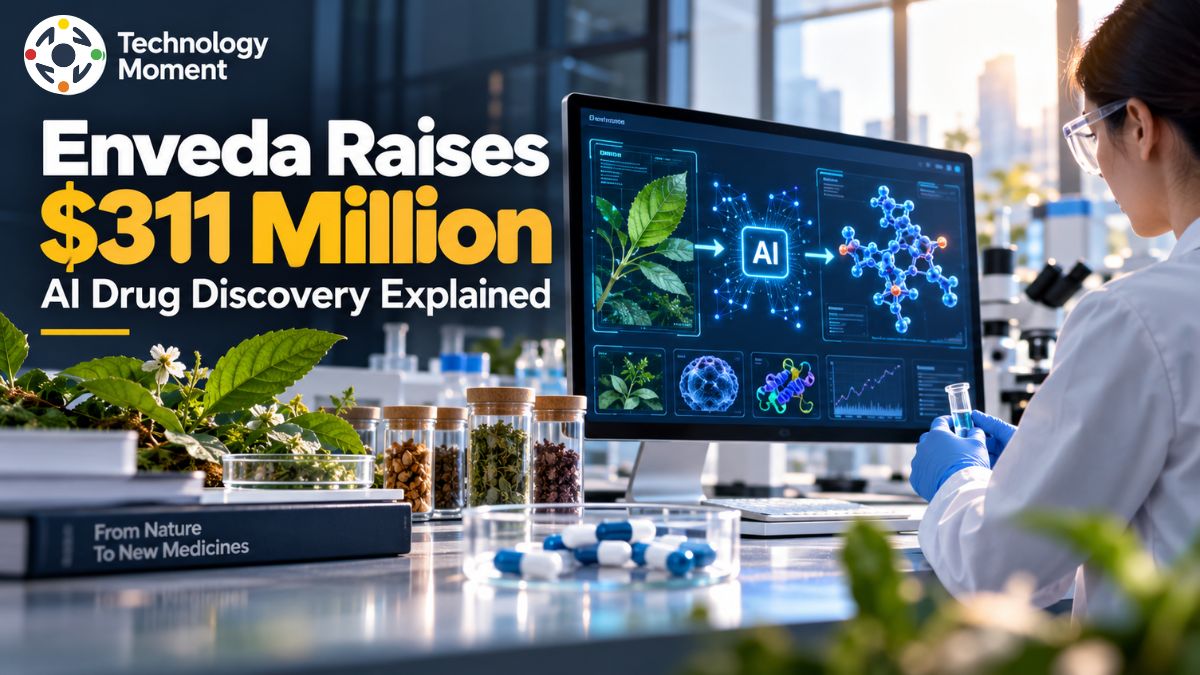
The race to use artificial intelligence in drug discovery is moving from research labs toward real clinical development. One recent example is Enveda, a biotechnology company using AI to search for potential medicines hidden within the chemistry of plants, microbes, and other living systems. On September 23, 2026, the company announced an Enveda Raises $311 Million Series E financing round led by Catalio Capital Management, bringing its total capital raised since inception to more than $845 million.
The funding comes at an important stage for Enveda. The company is already testing three development candidates in humans, while its PRISM platform uses artificial intelligence to identify and characterize naturally occurring molecules and assess their potential as drug candidates. Enveda says the new capital will support later-stage development of ENV-294 and ENV-308, advance ENV-6946, expand clinical programs, and scale the PRISM platform and its automated laboratory infrastructure.
For Technology Moment readers, what makes the story particularly interesting is the approach behind the technology. Instead of relying solely on designing new molecules from scratch, Enveda is attempting to use AI to uncover chemical compounds that already exist in nature. Its PRISM model is designed to analyze mass-spectrometry data and help researchers identify molecules with potentially useful biological activity.
For the wider pharmaceutical industry, Enveda’s funding highlights a larger question: can AI make the earliest and most difficult stages of drug discovery faster and more scalable? As more AI-driven biotech companies move candidates into human trials, the answer will increasingly depend not only on algorithms, but also on laboratory research and clinical evidence.
Enveda Raises $311 Million in Series E Funding
Enveda has raised $311 million in Series E funding, marking a significant financing round for the clinical-stage biotechnology company and adding fresh momentum to its AI-driven drug discovery strategy. The round was led by Catalio Capital Management, with participation from new investors including Durable Capital Partners, ICONIQ, Lightspeed, and Surveyor Capital. According to Enveda, the latest round brings its total capital raised since its founding to more than $845 million.
The funding arrives as Enveda moves from early discovery toward a more advanced stage of AI drug discovery and clinical development. The company says the proceeds will support the continued development of three clinical-stage medicines, including ENV-294, ENV-308 and ENV-6946. It also plans to bring additional medicines into clinical trials targeting inflammatory and metabolic conditions.
The financing is particularly notable because Enveda is not positioning AI simply as a supporting tool for pharmaceutical research. Its approach combines artificial intelligence, natural-molecule research and automated laboratory systems to search for potential medicines in the chemistry produced by living organisms. Since 2019, Enveda says this approach has generated 17 development candidates, with three already in human trials.
The company also plans to use part of the new capital to expand PRISM, its AI-native platform for identifying biologically active molecules found in nature, and to scale the automated laboratory infrastructure supporting the platform. This makes the Enveda $311M funding round more than a conventional biotech financing story: it also provides a current example of how AI is being integrated into pharmaceutical research and drug development.
Why Did Enveda Raise $311 Million?
The main reason behind Enveda’s $311 million funding round is to move its existing drug candidates further through clinical development while expanding the company’s AI-powered drug discovery platform. Rather than using the financing primarily to explore an entirely new business direction, Enveda says the capital will support programs that have already reached clinical development and help bring additional candidates toward human testing.
A major focus is ENV-294, an oral medicine being developed for atopic dermatitis and asthma, and ENV-308, an oral candidate being developed for metabolic health and weight-loss maintenance. Enveda plans to advance both programs into later-stage trials and explore additional indications. The company also intends to advance ENV-6946, an oral candidate for inflammatory bowel disease, through mid-phase development.
The financing also gives Enveda resources to expand its wider drug development pipeline. The company says additional medicines are expected to enter clinical trials for inflammatory and metabolic conditions. This matters because successful drug discovery involves more than identifying a promising molecule. Candidates must move through laboratory research, safety testing,ng and multiple stages of clinical trials before their potential can be properly evaluated.
Another important use of the money is scaling PRISM, Enveda’s AI platform for natural chemistry, along with the automated laboratory that feeds information back into its discovery process. The company describes PRISM as an AI-native foundation model designed to identify and characterize biologically active molecules found in nature.
In that sense, the Enveda Series E funding supports two connected goals: advancing existing medicines toward later-stage clinical development and expanding the technology infrastructure used to discover future drug candidates. For the broader AI biotech sector, it illustrates how investment is increasingly being directed toward platforms that connect artificial intelligence with laboratory research and clinical development.
What Is Enveda Biosciences?
Enveda Biosciences is a clinical-stage biotechnology company focused on discovering medicines using artificial intelligence and the chemistry found in living organisms. Founded in 2019, the company takes a different approach from traditional drug discovery methods that often begin by designing or modifying synthetic molecules in the laboratory. Instead, Enveda searches for potentially useful compounds that already exist in nature, including molecules produced by plants, microbes, and other living systems.
The central idea behind Enveda’s approach is that nature contains an enormous amount of chemical diversity that has not been fully studied. Identifying individual molecules from complex biological mixtures has historically been difficult and time-consuming. Enveda combines mass spectrometry, artificial intelligence, computational analysis, and laboratory experimentation to make that process more scalable. Its technology is intended to help researchers identify previously unexplored natural molecules, determine their structures, and investigate their biological activity.
This places Enveda within the growing field of AI drug discovery, where machine learning and other computational methods are being applied to different stages of pharmaceutical research. However, AI does not replace laboratory experiments or clinical testing. Potential molecules still need to be studied scientifically and evaluated through the drug-development process. Its clinical pipeline includes ENV-294 for atopic dermatitis and asthma, ENV-308 for post-weight-loss maintenance and metabolic health, and ENV-6946 for inflammatory bowel disease.
What makes the company particularly relevant to the wider conversation around artificial intelligence in pharmaceuticals is the combination of AI with natural-products research. Enveda is effectively trying to use modern computational tools to search a biological chemical library that would be extremely difficult to explore manually at the same scale. Its progress therefore provides a useful case study in how AI could influence the future of natural product drug discovery and pharmaceutical research.
What Is Enveda’s PRISM AI Platform?
PRISM is the foundation of Enveda’s AI-driven drug discovery approach. The name stands for Pretrained Representations Informed by Spectral Masking, and Enveda describes it as a foundation model for natural chemistry. The platform is designed to help researchers interpret complex chemical information and identify molecules that could potentially become useful medicines.
One of the key technologies behind PRISM is mass spectrometry, a method widely used to analyze molecules. Enveda’s platform uses mass spectrometry data together with AI models to predict the structures of molecules that may not have been characterized previously. Enveda says PRISM was trained on 1.2 billion small-molecule mass spectra, creating a large foundation for its analysis of natural chemistry.
First, researchers collect chemical information from living organisms. PRISM then helps interpret the resulting data and predict molecular structures. The platform can subsequently support laboratory experiments designed to understand what those molecules do biologically. Promising compounds can then be evaluated and refined by Enveda’s scientists as potential drug candidates. Enveda says PRISM also ranks molecules according to their therapeutic potential.
This is different from simply asking AI to design a molecule from scratch. Enveda’s model focuses on discovering and understanding molecules that already exist in nature. The company’s broader thesis is that biological systems have generated enormous chemical diversity through evolution, while modern AI can provide tools for examining that diversity at a much larger scale.
For the broader AI drug discovery industry, PRISM illustrates how foundation models can be adapted to specialized scientific data rather than general-purpose text or images. The platform connects computational analysis with physical laboratory work, creating a feedback loop between AI predictions and experiments. That combination is central to Enveda’s strategy of using AI to accelerate natural-molecule discovery and drug development.
How AI Is Changing Drug Discovery
Artificial intelligence is changing drug discovery by helping researchers process enormous amounts of biological and chemical information that would be difficult to examine manually. Traditional pharmaceutical research can require scientists to identify promising molecules, understand their structures, test their biological activity, and gradually optimize candidates through repeated laboratory experiments. AI and machine learning can support several of these stages by finding patterns in complex datasets, predicting molecular structures,s and helping researchers decide which compounds deserve further investigation.
Enveda is using this approach through its AI drug discovery platform, but its strategy differs from models that focus primarily on designing synthetic molecules from scratch. Its system is built around discovering and understanding chemistry that already exists in living organisms.
At the center of Enveda’s approach is PRISM, an AI-native drug discovery platform trained on more than a billion small-molecule mass spectra. The company says the model helps translate mass-spectrometry information into predictions about molecular structures, allowing researchers to examine many molecules simultaneously rather than studying them one at a time. Enveda combines this computational process with an automated laboratory, creating a workflow in which AI analysis can guide experiments and laboratory results can generate additional information for discovery.
This illustrates a broader role for artificial intelligence in pharmaceuticals. AI does not eliminate the need for laboratory research or clinical trials; instead, it can help researchers narrow down enormous numbers of possibilities and focus experimental resources on more promising candidates. Enveda says its platform has produced 17 development candidates since 2019, with three currently in human trials.
The significance of AI in drug development therefore extends beyond faster data analysis. The technology could help researchers explore chemical spaces that were previously difficult or expensive to investigate. Enveda’s progress provides one example of how computational tools, automated experimentation, and biological research are increasingly being combined to create new approaches to drug discovery technology.
Why Enveda Looks to Nature for New Medicines
Enveda’s approach to natural products drug discovery begins with a simple observation: living organisms produce an enormous variety of chemical compounds, but much of that chemistry remains poorly understood. Plants, microbes and other organisms have developed molecules with biological functions over extremely long periods of evolution. Enveda’s strategy is to use modern technology to identify and investigate some of these molecules as potential starting points for medicines rather than relying exclusively on molecules designed synthetically in the laboratory. The company describes this unexplored biological chemistry as a large potential source of new drug candidates.
The challenge is that finding useful compounds in nature has traditionally been difficult. A natural sample can contain many different molecules, and identifying an individual compound and determining its structure can require extensive laboratory work. Enveda’s nature-derived drug discovery model combines mass spectrometry, machine learning, and automated laboratory systems to make this process more scalable. Its platform is designed to organize natural chemistry, translate complex chemical data, and experimentally investigate molecules that could have useful biological properties.
This approach also connects directly with Enveda’s PRISM platform. Rather than asking an AI model to invent an entirely new molecule, PRISM is designed to help identify molecules that already exist in nature and predict their structures from mass-spectrometry data. Researchers can then investigate their biological functions and determine whether they have characteristics suitable for further drug development.
The company says its platform has generated 17 development candidates since 2019, demonstrating how its natural-molecule strategy is being translated into a broader drug development pipeline. Three candidates have reached human clinical trials, covering conditions including atopic dermatitis, metabolic health and inflammatory bowel disease.
For the wider natural product drug discovery field, Enveda represents an attempt to combine an old source of medicinal chemistry with modern computational methods. Nature itself is not a guarantee that a molecule will become a safe or effective medicine. Each promising compound still needs rigorous laboratory research, clinical testing,ng and regulatory evaluation. What AI potentially changes is the ability to search, organize, and prioritize this vast chemical landscape more efficiently.
Enveda’s Drug Discovery Pipeline
Enveda’s drug discovery pipeline has moved beyond early research, with three clinical-stage assets currently being developed across several indications. The company’s latest $311 million Series E financing is intended to help advance these programs into later stages, bring additional medicines into clinical trials, and expand the technology and laboratory infrastructure supporting future discoveries. Enveda says it has generated 17 development candidates since its founding in 2019, with three now being tested in humans.
One of the leading programs is ENV-294, an oral small-molecule candidate being developed for atopic dermatitis and asthma. Enveda’s pipeline information lists ENV-294 in Phase 2a development for both indications. The company says the candidate completed a Phase 1b study in atopic dermatitis and has subsequently entered Phase 2a trials. Its development represents an example of how a molecule identified through the company’s AI-enabled discovery approach is progressing toward more advanced clinical evaluation.
The second major program is ENV-308, an oral small molecule focused on metabolic health and post-weight-loss maintenance. Enveda describes it as a first-in-class candidate designed to support longer-term metabolic health and says it is currently in Phase 1 trials. The program is particularly relevant to the growing search for oral approaches to maintaining weight loss after initial treatment.
The third clinical asset is ENV-6946, an oral candidate being investigated for inflammatory bowel disease (IBD). Enveda says the molecule is designed around a novel mechanism and is currently in Phase 1 development. The company describes the candidate as gut-preferred and intended to address multiple inflammatory pathways through a single target. The latest funding is expected to support ENV-294 and ENV-308 as they move into later-stage trials and additional indications, while ENV-6946 is expected to advance through mid-phase development. Enveda also plans to bring additional candidates into clinical testing for inflammatory and metabolic diseases.
Together, these programs show how AI drug discovery can extend beyond identifying molecules. The important next stage is determining whether those discoveries can demonstrate safety, tolerability,y and therapeutic benefit in people. Enveda’s pipeline is therefore an ongoing example of the transition from computational drug discovery to laboratory research and ultimately clinical development.
What the $311M Funding Means for Enveda’s Future
Enveda’s $311 million Series E funding marks a new phase for the company as it moves further from platform development toward clinical execution. The company says the financing will be used to advance ENV-294 and ENV-308 into later-stage trials and additional indications, move ENV-6946 through mid-phase development, and bring additional medicines into clinical trials. The latest round also takes Enveda’s total capital raised since inception to more than $845 million.
For Enveda, the significance of the financing is therefore closely connected to its drug development pipeline. Earlier funding helped the company build and validate its AI-native discovery platform and demonstrate that it could repeatedly generate development candidates. The company now says it has produced 17 development candidates, three of which are in human trials. Two of those programs, ENV-294 and ENV-308, have also reported positive early clinical results in 2026, according to Enveda.
The capital will also allow Enveda to continue expanding the infrastructure behind AI drug discovery. PRISM is designed to interpret the chemistry of living organisms, while Enveda’s automated laboratory generates the experimental data that supports the platform. The company’s strategy is to connect computational discovery with laboratory research rather than treating artificial intelligence as a standalone software layer.
The next stage will depend on clinical development rather than funding alone. Moving a drug candidate into later-stage trials requires additional evidence about safety, tolerability,ty and potential efficacy. Consequently, the $311M funding gives Enveda additional resources to test whether discoveries made through its AI-powered drug discovery model can continue to translate into medicines for patients. It also gives the company room to expand its pipeline while continuing to invest in natural molecule drug discovery, PRISM, and automated experimentation.
Enveda’s $311M Funding in the AI Drug Discovery Landscape
Enveda’s latest financing arrives during a period when AI drug discovery startups are attracting substantial investment from both biotechnology and technology-focused investors. The company’s $311 million Series E, led by Catalio Capital Management, reflects growing interest in companies attempting to combine artificial intelligence with pharmaceutical research and clinical development. The round includes investors from healthcare and technology backgrounds, giving the financing a broader connection to the expanding AI biotech sector.
What distinguishes Enveda is its focus on natural products drug discovery. Instead of relying primarily on AI to design synthetic molecules, the company uses its PRISM platform to identify and characterize molecules produced by living organisms. Enveda says PRISM was trained on more than one billion small-molecule mass spectra and is designed to help researchers interpret natural chemistry at a scale that would be difficult to achieve through conventional analysis alone.
The company’s progress also illustrates an important distinction within the broader artificial intelligence drug discovery industry. AI models can help researchers analyze chemical and biological information, identify patterns and prioritize potential candidates, but promising computational results still have to be tested experimentally and clinically. Enveda currently has three clinical assets, while its pipeline lists six additional IND-enabling assets and 17 development candidates overall.
Enveda is therefore part of a larger movement toward AI in drug development, but its model combines several technologies: machine learning, mass spectrometry, natural-molecule research and automated laboratory experimentation. That combination could make previously difficult chemical searches more systematic, although the ultimate value of any drug-discovery platform depends on whether its candidates demonstrate meaningful results through clinical development.
The company’s $311M funding is consequently relevant beyond Enveda itself. It provides another example of how investors are backing AI pharmaceutical companies that aim to connect computational discovery with real-world medicines. At the same time, Enveda’s clinical programs show why the industry’s progress should ultimately be measured through scientific and clinical evidence rather than funding size alone.
Frequently Asked Questions About Enveda
What is Enveda Biosciences?
Enveda Biosciences is a clinical-stage biotechnology company founded in 2019 that uses artificial intelligence to discover medicines from the chemistry of living organisms. Its approach combines AI, mass spectrometry, natural-molecule research, and automated laboratory systems to identify and investigate potential drug candidates. Enveda currently has three clinical assets and says it has generated 17 development candidates since its founding.
How much funding has Enveda raised?
Enveda raised $311 million in Series E funding in September 2026, bringing its total capital raised since inception to more than $845 million. The latest round was led by Catalio Capital Management and included both new and existing investors. The company plans to use the funding to advance clinical programs, expand its pipeline, and scale its AI drug discovery platform.
Why did Enveda raise $311 million?
The company plans to use the financing to advance ENV-294 and ENV-308 into later-stage trials and additional indications, move ENV-6946 through mid-phase development, bring additional medicines into clinical trials, and continue expanding its PRISM platform and automated laboratory.
What is Enveda’s PRISM platform?
PRISM is Enveda’s AI foundation model for natural chemistry. It is designed to analyze mass-spectrometry data and help researchers identify and characterize molecules found in nature. Enveda says PRISM was trained using more than one billion small-molecule mass spectra, supporting its broader AI-native drug discovery approach.
How does Enveda use AI for drug discovery?
Enveda uses AI to help organize, interpret, and analyze complex chemical information from natural samples. Its platform can help researchers predict molecular structures and prioritize molecules for laboratory investigation. The company combines these computational capabilities with automated experiments rather than relying on AI alone.
What drugs is Enveda developing?
Enveda currently lists three clinical assets: ENV-294, being developed for atopic dermatitis and other inflammatory conditions; ENV-308, focused on post-weight-loss maintenance and metabolic health; and ENV-6946, being developed for inflammatory bowel disease. The company’s pipeline also includes additional IND-enabling assets and earlier development candidates.
What is ENV-308?
ENV-308 is an oral small-molecule candidate designed to support long-term metabolic health, including maintenance after weight loss. Enveda currently lists it in Phase 1 trials. The company has said it plans to advance the program into later-stage development and additional indications using proceeds from the Series E financing.
What is ENV-294?
ENV-294 is an oral small-molecule candidate being developed for atopic dermatitis and other inflammatory conditions. Enveda’s pipeline lists the program in Phase 2a, following completion of Phase 1b trials. The company plans to continue advancing ENV-294 through clinical development.
What is ENV-6946?
ENV-6946 is an oral, gut-preferred small molecule being developed for inflammatory bowel disease. Enveda currently lists the program in Phase 1 and says the Series E funding will support its progression through mid-phase clinical development.
How is AI changing drug discovery?
AI can help researchers process large amounts of chemical and biological information, identify patterns, predict molecular structures,s and prioritize potential candidates for laboratory testing. Enveda applies these capabilities specifically to natural chemistry, using its PRISM platform to help make previously difficult-to-analyze molecules more accessible to drug researchers.
Can AI replace traditional drug discovery?
No. AI can support computational drug discovery, but potential medicines still require laboratory research, clinical trials, and regulatory evaluation. Enveda’s own pipeline illustrates this process: molecules discovered using its platform must progress through human clinical testing before their safety and therapeutic potential can be established.