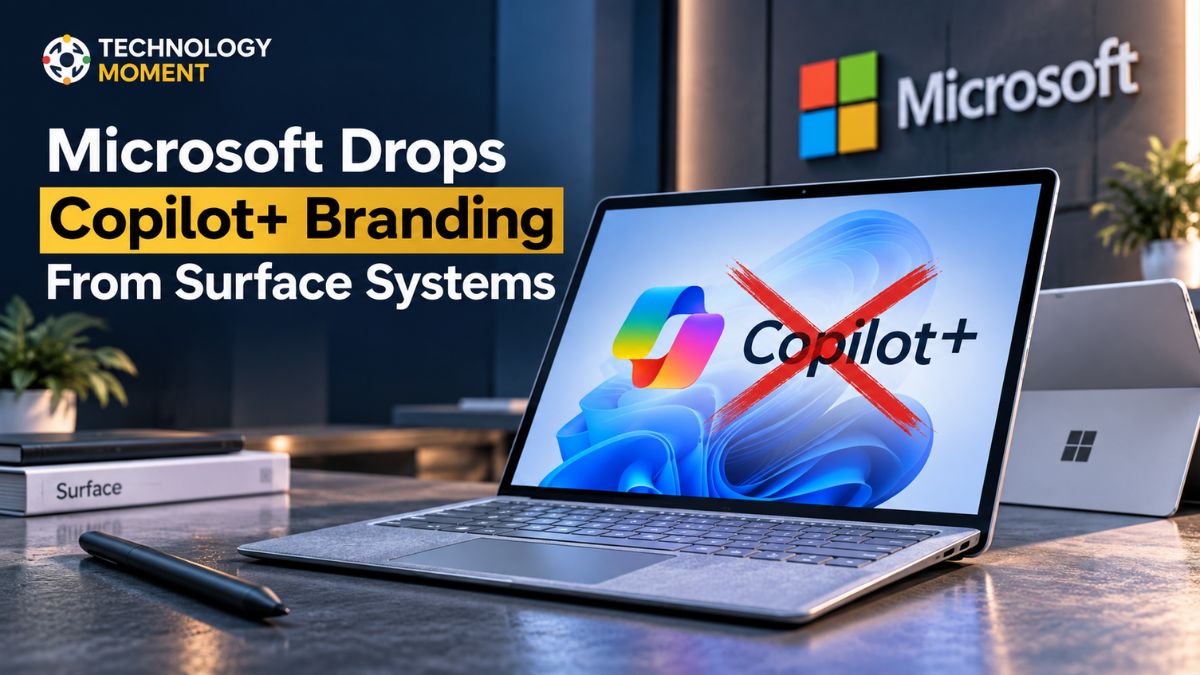
Microsoft is changing how it presents its latest Surface systems, dropping the familiar “Copilot+” branding from some of its new devices. The move has raised questions about what happened to the Copilot+ PC label, whether the new Surface PCs still offer the same AI-focused capabilities, and what the change means for people considering a new Microsoft computer.
The distinction matters because “Copilot+ PC” has increasingly been used to describe a class of Windows PCs built around dedicated hardware and AI capabilities, while Surface identifies Microsoft’s own hardware lineup. Seeing the Copilot+ name disappear from product branding, therefore, does not automatically mean that the underlying AI features or hardware requirements have changed. Understanding that difference is important for anyone trying to make sense of Microsoft’s latest Surface strategy.
At Technology Moment, we focus on separating meaningful technology developments from the noise surrounding them. Instead of simply repeating a product announcement, we look at what has actually changed, what remains the same, and why it could matter to users. That approach is especially useful when a familiar technology term suddenly disappears from product marketing.
In this article, we’ll examine Microsoft’s decision to move away from Copilot+ branding on its new Surface systems, explain the relationship between Surface PCs and Copilot+ PCs, and look at what the change means for prospective buyers. We’ll also address the key questions surrounding Microsoft’s evolving AI PC strategy so you can understand the development without getting lost in the branding.
Microsoft Drops Copilot+ Branding From New Surface Systems
Microsoft is changing the way it presents some of its latest Surface systems, with the familiar Copilot+ branding no longer taking the same prominent role in the product identity. The change is notable because Copilot+ PC has become closely associated with Microsoft’s broader push toward AI-powered PCs and Windows AI features. For users following the Microsoft Surface lineup, the shift naturally raises questions about whether this is simply a marketing change or whether it signals something broader about Microsoft’s approach to AI hardware.
The Surface brand and Copilot+ PC designation have different purposes. Microsoft Surface identifies the company’s own hardware products, including Surface Laptop and Surface Pro devices, while Copilot+ PC describes a category of Windows PCs associated with dedicated AI capabilities. As a result, the removal or reduced use of Copilot+ branding should not automatically be interpreted as the removal of AI functionality from a Surface computer.
For buyers, this distinction is particularly important. A product name can change without every underlying hardware or software capability changing at the same time. Instead of focusing only on whether a device carries a Copilot+ PC logo, users should look at the specifications, processor capabilities, supported Windows 11 features, and the AI functions available on the specific model.
The branding change also comes as Microsoft continues developing its AI strategy across Windows and its hardware ecosystem. For Technology Moment readers, the key issue is therefore not simply that Microsoft has changed a label, but what that change means for the future of Surface PCs and Microsoft’s evolving AI PC strategy.
Why Did Microsoft Drop Copilot+ Branding?
The reason behind Microsoft’s decision to move away from prominent Copilot+ branding is important, but the available material does not establish a definitive explanation from Microsoft for the change. It is therefore useful to separate what is visible in the product branding from assumptions about Microsoft’s internal strategy. A change in terminology does not, by itself, prove that Microsoft has abandoned Copilot+ PCs or its investment in AI computing.
The Copilot+ name has been used to communicate an AI-focused category of Windows PCs, while Surface is Microsoft’s hardware identity. By placing greater emphasis on the Surface name, Microsoft can present its computers primarily as members of the broader Surface lineup rather than making the AI category the central part of the product identity. This could make the naming more straightforward for consumers who already recognize Surface as Microsoft’s PC brand, although the precise motivation should be attributed to Microsoft if and when the company provides an official explanation.
The distinction is also relevant to searches such as “why Microsoft dropped Copilot+ branding” and “why Microsoft removed Copilot+ branding from Surface.” Users may interpret the branding change as a technological downgrade, but branding alone cannot establish that conclusion. Hardware specifications and supported features remain more meaningful indicators of what a particular Microsoft PC can actually do.
For anyone following Microsoft hardware, the development is therefore best understood as a branding change that deserves closer attention rather than as proof of a complete shift away from Copilot+ technology. The important question is how Microsoft describes and supports AI capabilities across its future Surface devices.
What Happened to Copilot+ PC Branding?
The changing role of Copilot+ branding creates understandable confusion because the term has become closely connected with Microsoft’s AI PC strategy. Users searching for “what happened to Copilot+ PC branding” may wonder whether Copilot+ PCs have disappeared or whether Microsoft has simply chosen to present its latest Surface hardware differently. These are two separate questions, and the distinction is important when interpreting the change.
Copilot+ PC refers to a category associated with AI-focused Windows PCs, whereas Microsoft Surface refers specifically to Microsoft’s hardware family. A Surface Laptop or Surface Pro can therefore be discussed as a Surface device while also being evaluated according to the AI capabilities and hardware specifications associated with the Copilot+ category. The disappearance of a particular logo or phrase from product branding does not automatically change the technical characteristics of a device.
This is why consumers should avoid treating the Copilot+ PC logo as the only way to identify an AI-capable Windows computer. Processor architecture, neural processing capabilities, Windows 11 support, and the availability of specific Copilot features can provide more useful information when evaluating a device. The terminology used on a product page is helpful, but it should be considered alongside the technical specifications.
For Microsoft, the change also creates an interesting branding question. Surface has an established identity spanning multiple generations of Microsoft hardware, while Copilot+ represents a newer AI-oriented category. Giving greater attention to the Surface name could make the product family easier to recognize while allowing AI capabilities to become part of the broader Windows experience. For now, the most important takeaway is that a branding change should not automatically be interpreted as the end of Copilot+ PCs.
Are New Surface PCs Still Copilot+ PCs?
Whether new Surface PCs are still considered Copilot+ PCs depends on the individual device and the technical requirements associated with that category, rather than simply on whether the Copilot+ name appears prominently in its marketing. This distinction is particularly important for people comparing Microsoft Surface systems because product branding and hardware capabilities do not always communicate exactly the same thing.
A Surface PC can belong to Microsoft’s hardware lineup while also offering AI-focused capabilities. Surface Laptop and Surface Pro models can therefore need to be evaluated individually rather than treated as one identical category. Buyers should check the specifications of the specific Microsoft Surface device they are considering, including its processor, AI processing capabilities, Windows 11 features, and supported Copilot functions.
The change in branding may make some users question whether Microsoft has moved away from the Copilot+ PC concept altogether. However, the removal or reduced visibility of the Copilot+ label alone does not establish that conclusion. A device’s technical specifications remain the better way to determine which AI capabilities it supports.
This distinction is becoming increasingly relevant as AI PCs become a larger part of the Windows ecosystem. Consumers may encounter different terminology from Microsoft and other PC manufacturers while looking at similar AI-related capabilities. Understanding the difference between a product family such as Microsoft Surface and a technology category such as Copilot+ PC can make those comparisons much easier.
For prospective buyers, the practical approach is simple: do not choose a Surface system solely because of—or reject one solely because of—the presence or absence of the Copilot+ branding. Instead, examine the specific hardware and software features available on that model. That provides a clearer picture of what the new Surface PC can actually deliver.
Microsoft Surface Devices and Copilot+ Features
Microsoft Surface devices sit at the center of the company’s PC hardware strategy, covering products such as Surface Laptop and Surface Pro. As Microsoft changes the way it presents Copilot+ branding, it becomes important to separate the Surface hardware identity from the AI capabilities available on individual systems. The Surface name identifies Microsoft’s hardware lineup, while Copilot+ PC has been used as a category associated with Windows PCs designed around specific AI capabilities.
For users researching Microsoft Surface AI PCs, the practical focus should therefore be on what each device actually supports. Specifications such as the processor, neural processing capabilities, Windows 11 support, and available Copilot features can provide more useful information than branding alone. Two Surface systems may carry similar product branding while offering different hardware configurations and capabilities, so checking the individual model remains important.
The broader shift also reflects the growing role of AI computing in Windows PCs. Microsoft has been integrating AI capabilities into its software ecosystem, making features such as Windows AI and Microsoft Copilot increasingly relevant to the PC experience. However, the availability of a particular feature can depend on the hardware and software configuration of a device.
For Surface buyers, this means the disappearance or reduced prominence of Copilot+ PC branding should not automatically be interpreted as the disappearance of AI features. Instead, users should examine the specifications and supported functionality of the specific Surface device. This provides a more accurate understanding of what a Microsoft Surface PC can deliver and avoids confusing product branding with technical capability.
What This Means for Microsoft Surface Buyers
For people considering a new Microsoft Surface PC, the Copilot+ branding change creates an additional reason to look beyond the product name. Buyers often use familiar labels to quickly understand what a computer offers, but a branding change can make comparisons less straightforward. In this case, the most useful approach is to evaluate the actual hardware, operating system, and supported AI capabilities of each Surface system.
Someone comparing a new Surface Laptop with another Surface device should look at the processor, memory, storage, display, battery specifications, connectivity, and AI-related hardware before making a decision. If AI functionality is particularly important, buyers should also check which Copilot features and Windows 11 capabilities are supported by the exact configuration they intend to purchase.
The distinction between Microsoft Surface branding and Copilot+ PC branding is especially relevant for consumers searching for the latest Microsoft Surface devices. A product can remain part of the Surface lineup even if Microsoft changes how it communicates its AI capabilities. Therefore, the absence of a Copilot+ label should not be treated as a complete description of the device.
The change may also affect how consumers search for and compare AI PCs. Terms such as “Microsoft AI PC,” “Surface AI PC,” and “Copilot+ PC Microsoft Surface” may continue appearing across technology coverage, even when Microsoft emphasizes the Surface identity in its own product presentation.
Ultimately, buyers should prioritize documented specifications and supported features over branding. This makes it easier to determine whether a particular Surface PC meets their needs for productivity, everyday computing, or AI-powered workloads. It also helps prevent marketing terminology from becoming the deciding factor in a hardware purchase.
Copilot+ PC vs. Microsoft Surface PC: What’s the Difference?
The terms Copilot+ PC and Microsoft Surface PC describe different aspects of the Windows computer market, which is why they should not be treated as interchangeable terms. Copilot+ PC is a category associated with specific AI-focused capabilities and hardware requirements, while Microsoft Surface refers to Microsoft’s own family of hardware products.
| Feature | Copilot+ PC | Microsoft Surface PC |
|---|---|---|
| What is it? | A category of Windows PCs designed for advanced AI capabilities | Microsoft’s own PC and hardware product family |
| Brand | Not a single brand | Microsoft Surface |
| Manufacturer | Microsoft and various PC manufacturers | Microsoft |
| Main Purpose | AI-focused computing and on-device AI processing | Premium Windows hardware and Microsoft’s ecosystem |
| Operating System | Windows 11 | Windows 11 |
| NPU Requirement | Requires a high-performance NPU capable of 40+ TOPS | Depends on the specific Surface model |
| RAM Requirement | Generally requires at least 16GB RAM | Varies by model |
| Storage Requirement | Generally requires at least 256GB SSD/UFS | Varies by model |
| AI Processing | Designed for substantial on-device AI workloads | Available on Surface models that meet Copilot+ requirements |
| Copilot+ Features | Supports eligible features such as Recall, Cocreator, and Windows Studio Effects | Available when the Surface model qualifies as a Copilot+ PC |
| Processor Options | Snapdragon X Series, AMD Ryzen AI, Intel Core Ultra and other qualifying platforms | Depends on the Surface generation and model |
| NPU | Core requirement for the Copilot+ classification | Present in qualifying Surface models |
| Device Types | Laptops, 2-in-1s and other Windows PCs | Surface Laptop, Surface Pro and other Surface devices |
| Design | Depends on the manufacturer | Microsoft’s own design language |
| Touchscreen | Model-dependent | Common on Surface devices, especially Surface Pro |
| 2-in-1 Devices | Available from some manufacturers | Surface Pro is a major 2-in-1 product |
| Detachable Keyboard | Available on selected models | Surface Pro supports a detachable keyboard |
| Pen Support | Depends on the device | Surface Pro supports Surface Slim Pen |
| Battery Life | Depends on processor and manufacturer | Depends on the Surface model |
| Ports | Vary significantly by manufacturer | Depends on the Surface model |
| Graphics Performance | Depends on processor/GPU configuration | Depends on the specific Surface model |
| Gaming | Some models can be suitable for gaming | Surface devices are generally not primarily designed as gaming PCs |
| Upgradeability | Depends on manufacturer and model | Often limited compared with traditional desktop/laptop designs |
| Microsoft Ecosystem | Windows + manufacturer’s ecosystem | Strong integration with Microsoft’s hardware and software ecosystem |
| Price Range | Wide range across manufacturers | Varies by Surface model and configuration |
| Examples | HP OmniBook X, Lenovo Yoga Slim 7x, Dell Copilot+ PCs, ASUS Copilot+ PCs | Surface Laptop, Surface Pro |
| Is every Copilot+ PC a Surface? | No | — |
| Is every Surface PC a Copilot+ PC? | No | — |
| Key Advantage | Advanced on-device AI capabilities across different brands | Microsoft’s hardware design and Windows integration |
| Best For | Users specifically looking for modern AI-powered Windows PCs | Users who prefer Microsoft’s own hardware and Surface design |
Frequently Asked Questions About Microsoft Copilot+ Branding
Why did Microsoft drop Copilot+ branding?
Microsoft’s exact reason for changing the branding should be based on an official explanation from the company. The available material establishes a change in how new Surface systems are presented, but it does not provide enough evidence to state a definitive internal reason. The branding change alone does not prove that Microsoft has ended its Copilot+ PC strategy.
Did Microsoft remove Copilot+ from Surface PCs?
The change concerns how Microsoft presents its Surface systems and the use of Copilot+ branding. That does not automatically mean that Copilot+ capabilities have been removed. Buyers should examine the specifications and supported features of each Surface PC to determine whether it offers the AI capabilities they need.
What happened to Copilot+ PC branding?
Copilot+ PC remains a useful category for understanding AI-focused Windows computers, while Surface identifies Microsoft’s hardware family. A change in the visibility of Copilot+ branding on Surface systems should therefore be distinguished from changes to the technical capabilities of individual devices or the wider Windows AI ecosystem.
Are new Surface PCs still Copilot+ PCs?
That depends on the specifications and capabilities of the individual Surface model. The presence or absence of a Copilot+ label alone is not enough to determine its technical classification. Buyers should check the processor, AI processing hardware, Windows 11 support, and documented Copilot+ features for the specific Microsoft Surface device.
Are Surface devices still Copilot+ PCs?
Not every Surface device should automatically be treated as a Copilot+ PC. The designation depends on the capabilities and requirements of the individual system. Microsoft Surface is a hardware family, while Copilot+ PC represents an AI-focused PC category. Checking each model’s specifications provides the clearest answer.
What does Microsoft’s Copilot+ branding change mean?
The change means users may need to look beyond the Copilot+ label when evaluating new Surface systems. Rather than relying only on branding, buyers should compare the device’s hardware, Windows 11 features, processor capabilities, and supported AI functions to understand what the specific Surface PC can actually offer.