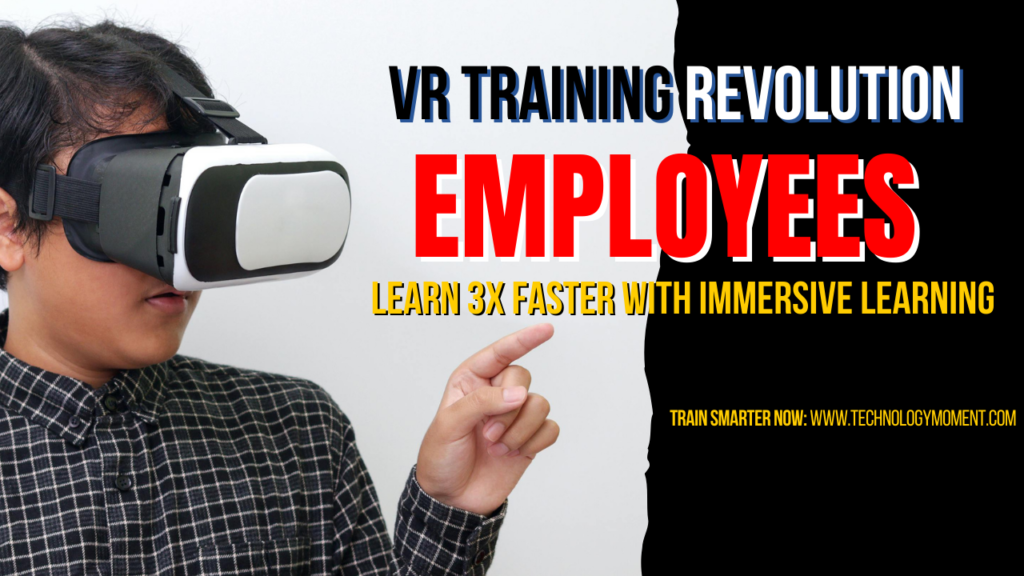
The way we train employees is changing fast. At Technology Moment, we see a clear shift toward virtual reality training for employee development. Companies no longer want boring slides or long video calls. They want results. They want people to learn faster and remember more. That’s where the VR training revolution begins. With immersive learning technology, employees step inside real-life simulations instead of just reading about them. This hands-on digital experience helps them build skills up to 3x faster compared to traditional training methods.
So, what is driving this immersive VR corporate training trend? Simple. Attention spans are short, and businesses move quickly. Modern workplaces need smart training solutions that are interactive, measurable, and scalable. VR-based learning uses 3D simulations, motion tracking, and real-time feedback to create safe, realistic scenarios. Think about a factory worker practicing safety drills without real danger. Or a retail employee handling tough customer situations in a virtual store. This type of simulation-based employee training improves focus, boosts engagement, and increases knowledge retention.
Another reason behind the rise of enterprise virtual reality training solutions is global workforce expansion. Teams now work from different countries and time zones. VR allows companies to deliver consistent training anywhere in the world. A company in the US can train staff in Asia, Europe, or Africa using the same immersive module. This improves skill alignment and cuts travel costs. Compared to classroom sessions or outdated e-learning tools, VR training offers higher engagement, better memory recall, and measurable performance data. Businesses can track progress in real time and adjust content instantly.
Let’s talk about real impact. Studies show that VR learning for workforce development increases confidence and reduces on-the-job mistakes. Employees feel prepared because they have already “experienced” the task. Industries like healthcare, manufacturing, aviation, and customer service are already using immersive training systems. For example, medical staff can practice surgery simulations, and warehouse teams can train on equipment safely. These are not future ideas. They are happening now. And they are changing how companies approach professional growth.
The VR training revolution in corporate learning is not just about technology. It’s about smarter learning. It’s about helping people grow faster, safer, and more effectively. At Technology Moment, we believe this shift marks a major milestone in the future of work. Businesses that adopt immersive training early will gain a strong competitive edge. The question is simple: will you watch the revolution, or will you lead it?
What Is Virtual Reality Training?
Virtual reality training is a digital learning method that places you inside a computer-generated world. You wear a headset, and suddenly you are not just watching a lesson. You are inside it. You can move, touch, respond, and make decisions in real time. It feels real, even though it is powered by smart software and immersive technology.
Unlike traditional online training, VR employee training is active. You do not just read or listen. You practice tasks in a safe virtual space. For example, a factory worker can handle heavy machines without real danger. A manager can practice tough conversations without real conflict. This hands-on approach changes how fast people learn.
Many people confuse VR with augmented reality. VR creates a fully digital world around you. Mixed reality blends both. But when we talk about virtual reality corporate training, we focus on full immersion. That deep immersion builds strong focus.
Today, companies use VR training software for remote teams, hybrid workplaces, and global staff onboarding. The technology works across countries. It supports many languages. It helps businesses deliver consistent, high-quality training anywhere in the world.
Why VR Training Helps Employees Learn 3x Faster
Have you ever noticed how you remember things better when you do them yourself? That is the secret behind immersive learning. VR training for employees follows the “learn by doing” model. When you act in a virtual environment, your brain treats it like a real experience. This boosts memory retention.
Focus also plays a big role. In normal training, distractions are everywhere. Emails pop up. Phones buzz. People multitask. But when you wear a VR headset, your world changes. You are fully present. That deep focus increases learning speed. Many companies report that VR-based training improves learning retention dramatically.
Emotion matters too. If you feel something, you remember it longer. Virtual reality simulations create emotional engagement. A safety training scenario may show the real consequences of mistakes. A leadership simulation may trigger real stress. These emotions lock lessons into long-term memory.
Speed comes from repetition without risk. In traditional training, practice time is limited. In VR, you can repeat a task again and again. No damage. No injury. No extra cost. That is why many businesses say immersive corporate training helps employees learn three times faster than classroom methods.
Key Benefits of Virtual Reality Corporate Training
The biggest benefit of VR corporate training is safe practice. High-risk industries like construction, oil and gas, and healthcare use VR safety training programs to reduce accidents. Workers can make mistakes in a virtual space and learn from them. That builds confidence before real work begins.
Cost savings may surprise you. Yes, VR hardware has an upfront cost. But travel, trainers, printed materials, and downtime cost more over time. With scalable VR training platforms, companies train thousands of employees with the same program. That lowers long-term expenses.
Consistency is another major win. Global companies often struggle to deliver the same quality of training across regions. Virtual reality employee development programs ensure everyone receives identical instruction. Whether your team is in Asia, Europe, or North America, the experience stays the same.
Employee engagement improves as well. Modern workers expect digital learning tools. VR feels innovative. It feels exciting. It increases motivation. When people enjoy training, they take it seriously. And when they take it seriously, results improve.
Industries Leading the VR Training Revolution
Healthcare is one of the fastest adopters of VR medical training simulations. Surgeons practice complex procedures in virtual operating rooms. Nurses rehearse emergency responses. Medical students gain hands-on experience without risking patient safety. This reduces errors and builds skill faster.
Manufacturing and industrial sectors also lead the way. VR industrial safety training helps workers handle heavy machinery and hazardous materials safely. Employees learn emergency procedures in realistic simulations. This reduces workplace injuries and improves compliance with safety standards.
Retail and customer service industries use VR for soft skills training. Staff practice handling difficult customers, upselling products, and improving communication. Virtual reality customer service training builds confidence before employees face real shoppers. This boosts satisfaction and sales performance.
Aviation and defense rely heavily on simulation. Pilots train in virtual cockpits. Military personnel rehearse missions in digital battlefields. These industries understand one thing clearly. Real-world mistakes are costly. VR provides intense, realistic preparation without real danger.
How VR Training Improves Employee Performance Metrics
Performance metrics matter in every organization. VR training improves skill acquisition speed. Employees reach competency faster. That shortens onboarding time. It also reduces supervision costs. Managers spend less time correcting repeated mistakes.
Error rates drop significantly with immersive training programs. When employees practice real scenarios in advance, they feel prepared. They know what to expect. They react faster. That leads to fewer accidents, fewer compliance violations, and better operational efficiency.
Confidence is often overlooked, but it changes everything. When employees feel ready, they perform better. VR-based employee training builds confidence through repeated simulation. A confident worker makes decisions quickly. They communicate clearly. They handle stress better.
Data tracking makes VR even stronger. Modern virtual reality learning platforms collect performance data in real time. Companies can measure reaction time, decision quality, and completion speed. This data helps improve training programs. It also connects learning outcomes directly to business performance.
The Science Behind Immersive Learning
Immersive learning works because your brain loves action. When you step into virtual reality employee training, your mind thinks it is real. Your heart rate changes. Your senses wake up. You are not just reading words. You are living the moment. That is why immersive learning improves memory retention in ways traditional training never could.
Your brain stores memories based on experience. Think about your first driving lesson. You remember it clearly, right? That is experiential learning in action. VR corporate training uses this same idea. When employees practice skills in a virtual environment, their brains build stronger neural pathways. This makes virtual reality skill training more powerful than passive learning.
There is also something called emotional engagement. When you feel something, you remember it longer. In immersive safety training, for example, a worker can see the impact of a mistake without real danger. The brain reacts with emotion. That emotional trigger improves long-term memory retention. It turns simple lessons into lasting habits.
Another key factor is active participation. In traditional training, employees listen. In VR training programs for companies, they act. They move. They solve problems. The brain learns faster when it is involved. This is why studies show employees learn up to three times faster with immersive learning technology.
Finally, focus improves inside a headset. There are no phone alerts. No side conversations. Just the task in front of you. That deep focus boosts cognitive processing speed. It makes immersive employee training one of the most effective learning methods today.
Challenges of Implementing VR Training
Let’s be real. Virtual reality corporate training sounds exciting, but it is not magic. Many organizations face real challenges when adopting VR training solutions. The first issue is cost perception. People think VR is expensive. While prices are dropping, the upfront investment can still feel big.
Another challenge is resistance to change. Employees may feel nervous about new technology. Some worry they are not “tech-savvy.” Others think VR is only for gaming. This mindset can slow down adoption. That is why companies must build awareness before launching immersive training programs.
Content creation is also a major hurdle. You cannot just upload a PowerPoint to a headset. VR training content must be interactive. It must feel real. Developing high-quality custom VR learning experiences requires time and expertise. Without strong content, the results will disappoint.
There is also the hardware management issue. Devices need updates. They must be cleaned and maintained. In global teams, logistics can become complex. Managing virtual reality training for remote employees requires strong coordination and planning.
Finally, measuring impact can feel tricky at first. Leaders want data. They want proof of learning. Without proper tracking tools, it is hard to show results. That is why choosing the best VR training platform with analytics features is critical for success.
How to Implement VR Training in Your Organization
If you are thinking about adopting VR training for your workforce, start with clarity. Do not begin with the headset. Begin with the problem. Ask yourself: what skills need improvement? Is it safety? Leadership? Customer service? Identifying training gaps is the first step toward a strong immersive learning strategy.
Next, choose the right virtual reality training software. Not every platform fits every company. Some focus on soft skills VR training. Others specialize in industrial safety simulation training. Look for scalable solutions. Make sure the platform supports global teams and remote learning environments.
After that, run a pilot program. Start small. Test immersive employee training with one department. Gather feedback. Measure performance improvements. Look at engagement rates. Compare error reduction before and after VR-based training. This gives you real data before a full rollout.
It is also important to prepare your people. Offer short onboarding sessions. Explain how VR works. Show them the benefits of immersive learning technology. When employees feel confident, adoption increases. Change feels easier when it is explained clearly.
Finally, measure and improve. Use analytics to track completion rates, skill mastery, and behavior change. Treat VR corporate training like a living system. Adjust scenarios. Update content. Improve realism. Continuous improvement keeps your virtual reality employee training effective and future-ready.
Future Trends in Virtual Reality Employee Training
The future of VR training looks bold and exciting. One major trend is AI-powered adaptive learning. Imagine a virtual training system that adjusts difficulty based on your performance. If you struggle, it slows down. If you excel, it challenges you more. This creates personalized immersive training experiences.
Another growing trend is metaverse-based corporate learning. Companies are building virtual campuses where employees meet, collaborate, and train. This blends remote work with immersive technology. It makes global teams feel connected. The metaverse workplace training model is already gaining traction worldwide.
Wearable technology is also evolving fast. Haptic feedback suits can simulate touch and pressure. This adds realism to technical skill training in VR. Surgeons, engineers, and mechanics can practice with more accuracy. The learning experience becomes almost identical to real life.
Cloud-based VR training platforms are becoming more common. They allow companies to update content instantly across locations. This is perfect for hybrid and remote teams. It supports scalable virtual reality employee development programs without complex hardware setups.
Data analytics will also play a bigger role. Future immersive learning platforms will track behavior patterns, reaction time, and decision-making quality. This helps companies improve training design. It turns VR corporate training into a powerful data-driven strategy.
ROI of VR Training Programs
Every business leader asks the same question. Is VR training worth it? The answer depends on measurable outcomes. When employees learn faster, companies save time. Faster learning means fewer training hours. That directly reduces productivity loss.
Error reduction is another major benefit. In industries like manufacturing and healthcare, mistakes cost money. Sometimes they cost lives. Virtual reality safety training allows employees to practice without real risk. This lowers accident rates and improves compliance.
Employee confidence also increases. When people practice real-world scenarios in a safe virtual environment, they feel prepared. Confident employees perform better. Better performance leads to higher customer satisfaction. That impacts revenue and brand trust.
There are long-term savings, too. Traditional training requires travel, venues, instructors, and printed materials. VR-based corporate training reduces these recurring costs. Once developed, scenarios can be reused and updated digitally. This improves long-term cost efficiency.
Finally, immersive learning boosts engagement. Engaged employees stay longer. Lower turnover reduces hiring costs. When you combine faster learning, fewer errors, lower costs, and higher retention, the return on investment becomes clear. VR training programs are not just a trend. They are a smart business decision for the modern global workforce.
Small Businesses and VR Training – Is It Affordable?
When people hear about virtual reality training, they often think it is only for big corporations. That idea is outdated. Today, affordable VR training for small businesses is no longer a dream. The cost of VR headsets has dropped, and cloud-based VR training platforms now offer subscription models that fit small budgets.
You do not need a massive tech team to get started. Many providers offer ready-made VR employee training modules for industries like retail, healthcare, and customer service. This reduces content creation costs. Small business owners can start with one department and scale later.
Think about the hidden costs of traditional training. Travel expenses, venue bookings, printed materials, and lost work hours add up quickly. VR corporate training cuts many of these expenses. Employees train in less time and return to work faster, which improves productivity.
There is also a strong return on investment. When employees learn skills three times faster, mistakes decrease. Fewer mistakes mean fewer losses. For a small business, even small improvements in efficiency can create a big financial impact.
If you are running a startup or a growing company, VR training solutions for small businesses can be a smart move. Start small, test results, and expand gradually. You do not need millions. You need a strategy.
VR Training for Soft Skills Development
Many people assume VR training is only for technical skills. That is not true. Virtual reality soft skills training is one of the fastest-growing trends in corporate learning. Why? Because human interaction is hard to teach through slides.
Imagine practicing a tough conversation with a virtual employee. Or handling an angry customer in a simulated store. VR creates realistic scenarios where employees can practice without fear. This builds confidence in a safe space.
Leadership training in virtual reality is also powerful. Managers can practice decision-making in high-pressure simulations. They can see the impact of their choices instantly. That kind of feedback sticks in the mind.
Diversity and inclusion VR training is another trending topic. Employees can experience situations from different perspectives. This builds empathy. When people experience it, they understand it better than when they just read about it.
Sales training in VR is also changing the game. Reps can practice negotiation skills and product pitches in immersive environments. They refine their tone and body language. That makes them stronger in real-world meetings.
Soft skills are human skills. And humans learn best by doing. That is why immersive soft skills development is becoming a global standard.
Common Myths About VR Corporate Training
There are many myths around virtual reality corporate training. Let’s clear them up.
One common myth is that VR is just for gaming. Yes, gaming made VR popular. But corporate VR training platforms are designed for serious learning. They use data tracking, performance analytics, and real-world simulations to improve outcomes.
Another myth is that VR training is too expensive. This might have been true years ago. Today, affordable VR learning solutions and subscription-based models make it accessible. When you compare it to long-term traditional training costs, VR can actually save money.
Some leaders worry that employees will resist new technology. In reality, most employees enjoy interactive learning experiences. Younger generations already use immersive tech daily. Even older employees adapt quickly when the system is simple and user-friendly.
There is also a belief that VR training is complicated to manage. Modern VR training software is designed for ease. Many systems offer dashboards, remote updates, and analytics tools. This makes management simple and clear.
When you remove these myths, you see the real picture. VR corporate learning is practical, scalable, and effective.
Conclusion
The VR training revolution is not a trend that will disappear. It is reshaping how employees learn across the globe. From small businesses to multinational companies, immersive learning technology is proving its value every day.
Employees learn faster when they experience training rather than hear about it. They remember more. They make fewer mistakes. They feel more confident. That is a powerful combination.
Affordable VR training for small businesses is now realistic. Soft skills development through virtual reality is becoming mainstream. And the old myths about cost and complexity are fading away.
If you want your team to learn three times faster, improve performance, and stay future-ready, it may be time to explore VR employee training solutions. The future of corporate learning is immersive. And it is already here.
FAQs
Is VR training really effective for small businesses?
Yes, it can be highly effective. Small businesses benefit from faster skill development and fewer training errors. Modern VR training platforms offer scalable pricing. This makes it practical for companies with limited budgets.
How much does virtual reality employee training cost?
The cost depends on the platform and content. Basic VR headsets are more affordable than ever. Many providers offer monthly subscription plans. Compared to traditional training expenses, the long-term savings can be significant.
Can VR be used for leadership and communication training?
Absolutely. Virtual reality soft skills training is one of the fastest-growing areas. Leaders can practice difficult conversations and decision-making in realistic simulations. This builds confidence and improves communication skills.
Do employees need technical skills to use VR training?
No, most VR systems are user-friendly. They are designed for simple navigation. Employees usually learn how to use them within minutes. Clear instructions and guided modules make the process smooth.
What industries benefit most from VR corporate training?
Many industries use VR today. Healthcare, retail, manufacturing, aviation, and customer service see strong results. However, any business that values faster learning and better performance can benefit from immersive training solutions.