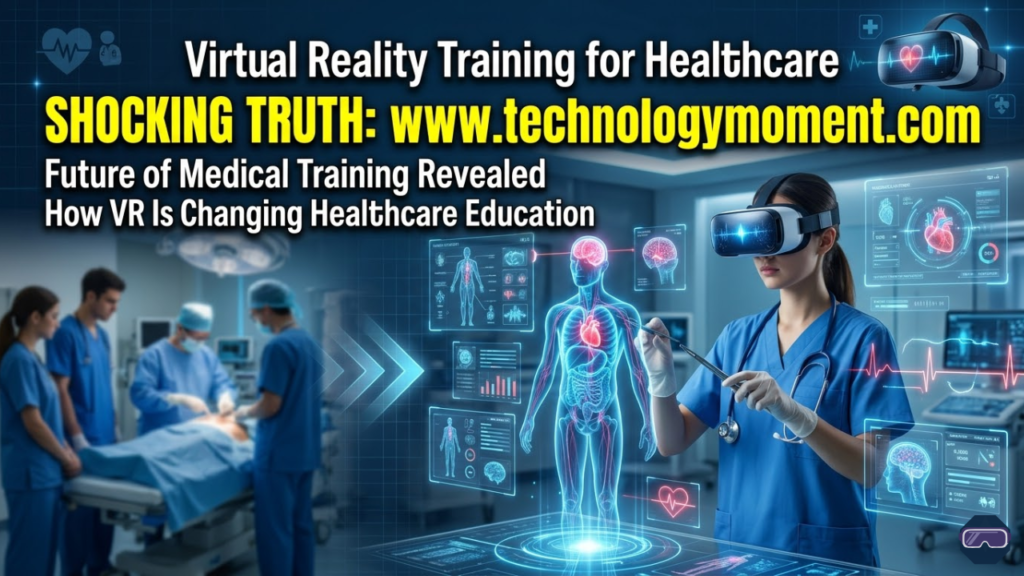
The world of medicine is changing fast, and virtual reality training for healthcare professionals is at the center of that transformation. At Technology Moment, we explore how cutting-edge innovations reshape industries, and healthcare education is one of the most exciting examples. Medical students and doctors once relied only on books, lectures, and limited clinical practice. Today, immersive VR simulations allow them to step inside a digital operating room and learn complex procedures without putting a real patient at risk.
This shift is more than just a tech upgrade. It represents a safer, smarter, and more interactive way to train the next generation of healthcare professionals. As global healthcare systems face increasing pressure, VR technology offers a practical solution that blends medical education innovation, simulation training, and immersive learning technology.
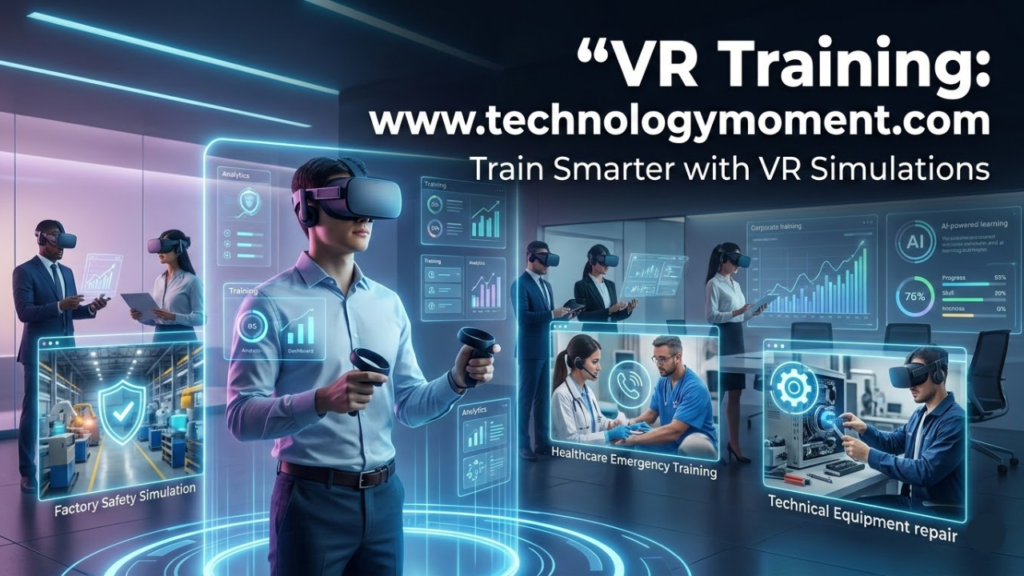
One of the biggest breakthroughs in recent years is immersive VR medical training simulations that replicate real hospital environments. Instead of reading about a procedure, learners can perform it in a fully interactive digital space. For example, a student can practice inserting an IV line, managing trauma cases, or performing surgery in a simulated emergency room. Each mistake becomes a learning opportunity rather than a life-threatening error. These VR healthcare simulation platforms also allow repeated practice, which strengthens memory and skill retention. Hospitals and universities worldwide are exploring this approach because it combines medical training technology, simulation-based learning, and virtual patient interaction in one powerful tool.
Another reason VR is gaining momentum is the demand for advanced medical training technology for healthcare education. Healthcare professionals must constantly update their skills as treatments and technologies evolve. Traditional training methods often struggle to keep up with this pace. Virtual reality solves this problem by offering flexible, scalable training modules that can be updated instantly. Imagine a global medical institution launching a new surgical technique. With VR, doctors around the world can learn the procedure in a digital lab before performing it in real life. This approach supports digital healthcare education, remote medical training, and next-generation medical simulation, making it easier for institutions to train staff efficiently.
There are also strong real-world benefits that make VR healthcare training solutions more than just a futuristic idea. Hospitals report that immersive simulation training helps reduce errors and improve decision-making during critical situations. When medical professionals face emergencies in real life, they already have virtual experience handling similar cases. This kind of preparation builds confidence and sharpens reaction time. In fields like emergency medicine, surgery, and trauma care, such practice can directly impact patient safety. By combining healthcare technology innovation, VR simulation training, and digital learning platforms, the industry is creating safer training environments that ultimately protect patients.
At Technology Moment, we believe that the future of healthcare education will be deeply connected to immersive technologies like VR, artificial intelligence, and advanced simulation tools. The real story behind this transformation is both exciting and surprising. Virtual reality does not just change how students learn; it redefines what medical training can look like in the digital age. As VR platforms become more accessible and powerful, healthcare institutions worldwide are embracing them as essential tools for modern education. Understanding this shift helps us see why virtual reality in healthcare training is quickly becoming one of the most important technological trends shaping the future of medicine.
What Is Virtual Reality Medical Training?
Virtual reality medical training is a modern learning method where doctors, nurses, and medical students enter a fully digital hospital environment using a VR headset. When someone wears the headset, they see a three-dimensional simulation of a medical scenario. It could be an operating room, an emergency ward, or even a complex surgical procedure. Instead of just reading about medicine in textbooks, learners can interact with digital patients and medical tools. This immersive experience helps them practice real healthcare skills without putting a human life at risk.
Think of it like a flight simulator for pilots, but designed for healthcare professionals. Pilots practice flying in a simulated cockpit before they control a real aircraft. In the same way, medical professionals can practice surgery, diagnosis, and patient care inside a virtual environment. If a mistake happens, the system resets instantly. This allows learners to repeat procedures many times until they gain confidence. That is why virtual reality healthcare training platforms are becoming an important part of modern medical education.
The technology behind VR medical training combines several advanced tools. These include 3D modeling, motion tracking, AI-driven simulations, and sometimes haptic feedback devices that mimic the feeling of touching human tissue or surgical instruments. When these elements work together, the simulation becomes incredibly realistic. A trainee might hear the sound of medical equipment, see a patient’s vital signs changing, and respond to sudden emergencies such as cardiac arrest.
The biggest advantage of this method is safe skill development. Medical professionals can practice difficult procedures like laparoscopic surgery, trauma response, or intensive care management without real-world consequences. This is why many universities and hospitals now view VR simulation training for healthcare professionals as one of the most powerful innovations in modern medical learning.
Why Healthcare Institutions Are Rapidly Adopting VR
Hospitals and medical schools across the world are moving quickly toward virtual reality healthcare training programs. The main reason is simple: traditional medical training has limits. Students often wait months or years to see certain rare cases in hospitals. With VR, these rare situations can be recreated instantly. Learners can experience hundreds of clinical scenarios in a short time. This makes training faster, deeper, and more practical.
Another reason for the rapid adoption is patient safety. Medical errors remain a serious global concern. Healthcare institutions want doctors to practice procedures many times before they treat real patients. VR simulation provides a controlled environment where mistakes become learning opportunities instead of real-world disasters. Because of this, many hospitals now include VR surgical simulation training in residency programs and nursing education.
Cost efficiency also plays a big role. Running physical simulation labs requires expensive equipment, cadavers, and constant supervision. Virtual environments reduce these expenses over time. Once a hospital invests in a VR system, thousands of trainees can use the same simulation software. This makes VR medical education technology a long-term investment rather than a recurring cost.
Another powerful reason is accessibility. Medical professionals in remote areas often struggle to access advanced training programs. VR platforms allow them to participate in global virtual healthcare training programs from anywhere in the world. A student in India, Brazil, or Africa can train on the same advanced surgical simulation used by doctors in the United States or Europe. This global accessibility is one of the most exciting trends in the future of healthcare education.
Global Market Growth and Trends in Virtual Reality Training for Healthcare Training
The global demand for virtual reality training in healthcare is growing at a remarkable pace. Hospitals, universities, and research institutions are investing heavily in immersive technologies to modernize medical education. Industry analysts predict that the VR healthcare training market will expand rapidly over the next decade as new simulation technologies become more affordable and more realistic.
One major trend is the integration of artificial intelligence with VR training platforms. AI can analyze how a trainee performs during a virtual procedure. It can track hand movement, decision-making speed, and accuracy. This turns VR into more than just a simulation tool. It becomes an intelligent learning platform that adapts to each student’s strengths and weaknesses.
Another trend shaping the market is the rise of metaverse-style medical classrooms. In these environments, students from different countries can enter the same virtual space. They can watch a surgery together, interact with instructors, and collaborate on complex medical cases. This concept is already attracting attention from medical universities that want to create global collaborative healthcare training ecosystems.
Hardware improvements are also pushing the market forward. VR headsets are becoming lighter, more powerful, and more affordable every year. Better graphics and realistic anatomy models make simulations feel closer to real surgery. As these technologies improve, immersive medical training using VR and AR will likely become a standard part of healthcare education rather than a futuristic experiment.
Latest Statistics on VR Training in Healthcare
Recent research shows just how quickly virtual reality healthcare training adoption is expanding worldwide. Studies from medical training organizations suggest that VR-based learning can improve knowledge retention by up to 75 percent compared with traditional classroom teaching. This means students remember procedures and clinical decisions more effectively when they practice them inside immersive simulations.
Another interesting statistic reveals that many medical professionals prefer VR training over traditional lectures. Surveys indicate that more than 80 percent of healthcare learners report higher engagement levels when using immersive simulations. They feel more confident performing procedures because they have already practiced them multiple times in a safe environment. This level of confidence can significantly improve real-world patient care.
Hospitals are also seeing measurable benefits. Research suggests that VR surgical training can reduce surgical errors and improve procedural efficiency among medical residents. Some healthcare training programs report shorter learning curves when VR simulation is introduced early in medical education. This allows hospitals to prepare skilled professionals faster without compromising training quality.
Investment numbers also reflect this growing interest. Global spending on VR and AR healthcare training technologies continues to increase each year as medical institutions recognize their long-term value. With the rising demand for skilled healthcare workers and the growing complexity of modern medicine, immersive technologies are becoming an essential tool in the future of global healthcare education.
How Virtual Reality Is Transforming Medical Education
Virtual reality is quietly reshaping how doctors, nurses, and medical students learn around the world. In the past, medical education depended on textbooks, lectures, and limited hospital practice. Students often had to wait months or even years before they could observe complex procedures. With virtual reality medical training, learners can step into a simulated hospital environment anytime and practice advanced procedures without harming real patients. This shift is changing the rhythm of medical learning. Instead of watching someone else perform a surgery, students can now perform the procedure themselves inside a 3D immersive healthcare simulation.
The transformation becomes clearer when you look at how immersive learning improves understanding. In a VR classroom, learners can explore a beating heart, examine organs from every angle, or walk through the bloodstream as if they were inside the body. That level of visualization makes complicated concepts easier to understand. Many educators now use interactive VR anatomy training to replace static diagrams. When students see and interact with organs in a virtual environment, they remember information faster and retain it longer. It feels less like studying and more like experiencing real medicine.
Another powerful change is accessibility. Medical training used to be limited by physical resources such as cadavers, expensive labs, or hospital placements. Virtual reality removes many of these barriers. A student in India, Brazil, or Africa can access the same global virtual medical training platform used by students in top universities. As long as they have a headset and an internet connection, they can practice clinical scenarios from anywhere. This democratization of education is one reason why VR healthcare education technology is gaining attention worldwide.
Virtual reality also encourages continuous learning. Healthcare professionals must update their skills throughout their careers. Traditionally, that required attending workshops or traveling to conferences. VR training platforms now allow doctors to practice new techniques from home or their workplace. Imagine a surgeon preparing for a new procedure by rehearsing it multiple times in a virtual operating room. By the time they perform the surgery in real life, the process already feels familiar. That level of preparation explains why VR surgical training programs are becoming an important part of modern medical education.
VR Training for Emergency and Critical Care Scenarios
Emergency medicine is one of the most stressful areas in healthcare. Doctors and nurses often face life-or-death situations where every second matters. Training for these situations is extremely difficult because real emergencies cannot be recreated easily in traditional classrooms. This is where VR emergency medical simulation training becomes incredibly valuable. Virtual reality allows healthcare professionals to practice responding to crises such as cardiac arrest, trauma injuries, or severe allergic reactions inside a realistic digital environment.
Inside a VR simulation, a trainee might suddenly encounter a patient experiencing respiratory failure. The system tracks every decision the trainee makes. Did they check vital signs quickly? Did they administer the correct medication? Did they call for help at the right time? Each action affects how the scenario unfolds. This interactive learning process teaches professionals how to think under pressure. Many hospitals now use virtual reality critical care training programs to prepare staff for rare but dangerous medical situations.
Another advantage of VR emergency training is repetition. In real life, a doctor might only see certain critical cases once or twice in their career. With VR simulations, the same emergency scenario can be repeated many times. This repetition builds muscle memory and decision-making speed. Over time, trainees develop the confidence to handle complex situations calmly. That confidence can make a huge difference when real patients are involved.
Global healthcare systems are also using VR to train teams rather than individuals. Emergency medicine often requires coordinated teamwork between doctors, nurses, and paramedics. VR platforms allow multiple participants to enter the same simulation and practice working together. They can communicate, divide responsibilities, and solve problems in real time. This type of collaborative virtual healthcare training prepares medical teams for high-pressure situations where clear communication saves lives.
Real Benefits of Virtual Reality Training in Healthcare
One of the biggest advantages of virtual reality healthcare training is the ability to learn without risk. Medical errors in real hospitals can have serious consequences. VR creates a safe environment where mistakes become learning opportunities rather than tragedies. Students can practice difficult procedures repeatedly until they master them. This freedom to experiment helps learners build confidence before working with actual patients.
Another powerful benefit is faster skill development. Traditional training often moves slowly because students must wait for clinical opportunities. In a VR environment, those opportunities appear instantly. A trainee can practice diagnosing diseases, performing surgeries, or treating trauma patients within minutes. Because the experience is immersive and interactive, the brain processes information more effectively. Research in learning psychology shows that people remember experiences better than lectures. That is why immersive medical training technology can accelerate learning dramatically.
Cost efficiency is another reason hospitals are investing in VR education systems. Medical equipment, operating rooms, and training mannequins can be extremely expensive. Virtual reality simulations reduce many of these costs because digital environments can be reused indefinitely. A hospital can train hundreds of employees using the same VR program without setting up physical training facilities. This scalability makes VR medical simulation platforms attractive for healthcare institutions trying to manage budgets while maintaining high training standards.
Patient safety also improves when healthcare professionals train with virtual reality. When doctors and nurses practice procedures multiple times before performing them in real life, they become more precise and confident. Studies have shown that simulation-trained surgeons often complete operations faster and with fewer complications. This direct link between training quality and patient outcomes explains why virtual reality patient safety training is becoming a trending topic in healthcare technology discussions worldwide.
The Shocking Reality Behind VR Healthcare Training
Despite the excitement around virtual reality in medicine, there is a side that many people rarely discuss. The technology is powerful, but it is not perfect. One surprising reality is the high cost of building advanced VR training systems. High-quality simulations require sophisticated software, powerful computers, and specialized headsets. Smaller hospitals or medical schools in developing regions may struggle to afford these tools. As a result, VR healthcare training adoption challenges remain a real issue.
Another hidden challenge involves the human body itself. Some users experience dizziness, headaches, or motion sickness when using VR headsets for long periods. This phenomenon, often called cyber sickness, can affect concentration and reduce training effectiveness. Developers are working to reduce this problem by improving display technology and motion tracking. Still, it reminds us that immersive technology must adapt to human comfort before it can become universal in healthcare education.
There is also the question of realism. While VR simulations are incredibly detailed, they cannot fully replicate the complexity of treating a living human being. Real patients react unpredictably. They feel pain, fear, and emotions that are difficult to reproduce in a digital simulation. Medical educators worry that students might become overly confident if they rely only on virtual practice. That is why most experts believe virtual reality clinical training should complement traditional education rather than replace it completely.
The final shocking truth is that technology alone cannot make someone a great doctor. Compassion, communication skills, and human empathy remain essential parts of healthcare. Virtual reality can teach procedures and decision-making, but it cannot replace the emotional connection between doctors and patients. When used wisely, VR becomes a powerful training partner. When used blindly, it risks turning medicine into a purely technical discipline. The real challenge for global healthcare systems is finding the right balance between advanced VR medical education tools and the timeless human qualities that define good healthcare.
Limitations of VR Training for Medical Professionals
Virtual reality training sounds almost perfect at first glance. Doctors can practice surgeries, nurses can rehearse emergency responses, and students can learn complex anatomy in immersive 3D environments. But when we look closer, the limitations of VR training for medical professionals start to appear. One major challenge is that virtual environments cannot fully replicate the unpredictable nature of real patients. In a real hospital, patients react differently. Emotions, pain tolerance, and unexpected complications all influence treatment. VR simulations try to model these factors, but they still follow programmed scenarios. This means medical professionals may face situations in the real world that the simulation never prepared them for.
Another concern revolves around the high cost of VR healthcare training technology. Advanced VR systems require powerful computers, specialized headsets, motion sensors, and sometimes haptic gloves to simulate touch. For hospitals and universities in developing regions, these systems can be expensive to purchase and maintain. Even large institutions struggle with regular upgrades as VR hardware evolves rapidly. When budgets are tight, medical schools may still rely heavily on traditional training methods such as cadavers and clinical observation. As a result, access to advanced VR medical training programs remains uneven across the world.
Human interaction is another element that VR cannot fully capture. Healthcare is not only about procedures. It is also about empathy, communication, and trust between doctors and patients. In real life, a doctor reads subtle body language, tone of voice, and emotional cues before making decisions. VR avatars often lack these complex human signals. A medical student might perform a flawless simulated surgery yet struggle when facing a nervous patient or worried family member. Because of this gap, experts often say virtual reality should complement medical training, not replace human-centered clinical education.
There is also a risk of overconfidence. When learners perform well in simulations, they may feel ready for real procedures sooner than they actually are. Virtual patients do not always react like real bodies. A small error in real surgery could lead to bleeding, infection, or organ damage, while a simulation might simply restart the scenario. That difference matters. Healthcare professionals still need supervised clinical experience to develop judgment and adaptability. So while VR simulation training in healthcare education is powerful, it works best when combined with real patient exposure and mentorship from experienced doctors.
Future of Virtual Reality Training in Healthcare
The future of virtual reality training in healthcare looks incredibly exciting. Technology evolves quickly, and each new generation of VR tools becomes more realistic and accessible. Developers are now combining virtual reality with artificial intelligence, advanced graphics engines, and cloud computing. This means medical students can soon interact with AI-driven virtual patients who respond dynamically to treatment decisions. Imagine diagnosing a digital patient whose symptoms change depending on how you treat them. That level of realism could transform medical simulation training for doctors and nurses worldwide.
Artificial intelligence will play a huge role in the next stage of VR medical education. AI systems can analyze a trainee’s actions during a simulation and provide instant feedback. If a surgeon places an incision incorrectly, the system can highlight the error and suggest improvements. Over time, AI can track performance patterns and create personalized learning paths. This kind of AI-powered VR medical training platform helps healthcare professionals learn faster and improve specific skills. Instead of generic lessons, training becomes tailored to each learner’s strengths and weaknesses.
Another emerging trend is the integration of VR healthcare training with the metaverse and cloud-based collaboration platforms. Medical students from different countries could enter the same virtual operating room and practice together. A surgeon in London might guide a trainee in India through a complex procedure in real time. These global training environments reduce geographical barriers and allow institutions to share expertise. As internet speeds improve and hardware becomes cheaper, this global collaboration could become a standard feature of modern medical education.
We are also seeing rapid progress in haptic technology, which simulates the sense of touch. In the future, VR gloves and controllers may allow surgeons to feel tissue resistance, bone density, and surgical instrument pressure. This would make immersive surgical simulation training far more realistic than today’s systems. When these innovations combine with augmented reality and mixed reality tools, healthcare training could reach a level where digital practice closely mirrors real-world surgery. For many experts, the long-term vision is clear: VR will become a core pillar of medical education across the globe.
Conclusion
Virtual reality has already started to reshape how healthcare professionals learn and practice. From surgical simulations to emergency response training, VR technology in medical education offers opportunities that traditional methods could never provide. Students can repeat complex procedures, learn from mistakes safely, and explore detailed anatomical structures in ways that textbooks cannot replicate. This immersive learning environment improves engagement and helps medical professionals build confidence before they step into real clinical settings.
At the same time, it is important to recognize the limits of this technology. VR cannot fully replace real patient interaction, clinical judgment, and emotional intelligence. Healthcare is deeply human. Doctors must communicate, empathize, and adapt to unpredictable circumstances. Virtual simulations provide a powerful foundation, but they work best when combined with real-world clinical practice and mentorship. That balanced approach ensures that VR healthcare training programs enhance skills without creating unrealistic expectations.
Looking ahead, innovation will likely solve many current limitations. AI-driven simulations, global collaborative VR platforms, and advanced haptic feedback systems are already under development. As costs drop and technology becomes more accessible, medical schools and hospitals around the world will adopt next-generation virtual reality medical training solutions. This evolution could reduce medical errors, improve patient safety, and help train healthcare professionals more efficiently than ever before.
The shocking truth behind VR training in healthcare is not that it replaces doctors or nurses. Instead, it reveals how powerful technology can amplify human potential. When used responsibly, virtual reality becomes a tool that helps medical professionals learn faster, practice more safely, and ultimately deliver better care to patients everywhere.
FAQs
What is virtual reality training in healthcare?
Virtual reality training in healthcare uses immersive digital environments to teach medical skills. Learners wear VR headsets and interact with simulated patients, tools, and clinical scenarios. This method allows doctors, nurses, and medical students to practice procedures safely without risking patient safety. Because the experience feels realistic, it improves skill development and confidence. Many universities and hospitals now use VR simulation training for medical education as part of their curriculum.
Why is VR becoming popular in medical education?
The popularity of VR in healthcare education comes from its ability to provide safe, repeatable learning experiences. Students can practice complex surgeries, emergency care, and patient diagnosis many times until they master the skill. Unlike traditional training, VR simulations allow mistakes without real-world consequences. This improves learning speed and retention. As a result, virtual reality medical training programs are becoming an essential part of modern healthcare education.
What are the main disadvantages of VR healthcare training?
Despite its advantages, VR training has limitations. The technology can be expensive, especially for institutions with limited budgets. Some simulations may also lack the emotional and unpredictable elements of real patient care. Another concern is that users might experience motion sickness or fatigue during long sessions. Because of these factors, experts recommend using VR healthcare simulation training alongside real clinical experience rather than relying on it alone.
Can VR replace traditional medical training?
VR is not designed to replace traditional medical training completely. Instead, it acts as a powerful supplement to existing teaching methods. Students still need real hospital experience to develop communication skills, empathy, and clinical judgment. Virtual simulations provide practice opportunities before facing real patients. This blended approach creates a more effective learning system for future healthcare professionals.
What is the future of VR in healthcare training?
The future of VR in healthcare training will likely include artificial intelligence, global virtual classrooms, and advanced haptic technology. AI will create smarter simulations that adapt to each learner’s actions. Doctors from different countries may collaborate in shared virtual environments. These innovations will make immersive VR medical education platforms more realistic and accessible. Over time, virtual reality could become one of the most important tools for training healthcare professionals worldwide.