Welcome to Technology Moment, where complex tech ideas slow down, take a breath, and finally make sense. If you’ve ever heard terms like AR, VR, and MR and thought, “Sounds cool… but what does it actually mean for me?”—you’re in the right place. This space is built for curious minds who want clarity, not confusion.
We are living in a powerful technology moment. Immersive technologies are changing how we see the world, learn new skills, and connect with digital experiences. From augmented reality on smartphones to virtual reality headsets and mixed reality for businesses, these tools are no longer futuristic ideas. They are already part of daily life, and they’re growing fast.
In this blog, we break down AR vs VR vs MR in a simple, human way. No heavy jargon. No tech overload. Just clear explanations, real examples, and practical insights. Whether you’re a student, creator, developer, or business owner, this guide helps you understand what each technology does and why it matters right now.
This article starts with a deep yet easy introduction to immersive technologies. We’ll explore how these digital layers blend with the real world and why global tech leaders are investing heavily in them. You’ll see how spatial computing, AI-powered XR, and the metaverse trend connect to everyday experiences.
So grab a coffee and stay with us. This is your moment to understand the future—one clear idea at a time. Let’s explore how AR, VR, and MR are changing everything, starting now.
What Is Augmented Reality (AR)?
Augmented Reality, or AR, is a technology that adds digital elements to the real world around you. Instead of replacing reality, it enhances what you already see. Imagine looking through your phone camera and seeing directions, labels, or 3D objects placed right in front of you. That’s AR working quietly in the background. It blends the digital and physical worlds in a way that feels natural and useful. Today, AR is one of the most searched immersive technologies because it fits easily into daily life.
AR works by using a camera, sensors, and software to understand your surroundings. It detects surfaces, depth, and movement in real time. Then it places digital content exactly where it should appear. This feels almost magical, but it’s powered by computer vision and AI. From scanning a room to placing virtual furniture, AR responds instantly. That speed is why AR applications are booming across industries.
AR is already in your pocket, even if you don’t realize it. Social media filters that change your face use AR technology. Shopping apps let you try glasses, shoes, or makeup virtually. Navigation apps overlay arrows on real roads. These examples show how AR solves small problems fast. That everyday usefulness makes AR a trending keyword worldwide.
Smartphones are the biggest drivers of AR adoption globally. With no extra hardware needed, anyone can access AR features instantly. Smart glasses are the next step, offering hands-free AR experiences. Big tech companies are investing heavily in this space. As devices become lighter and smarter, AR will feel less like technology and more like common sense. That’s why AR is shaping the future of digital interaction.
What Is Virtual Reality (VR)?
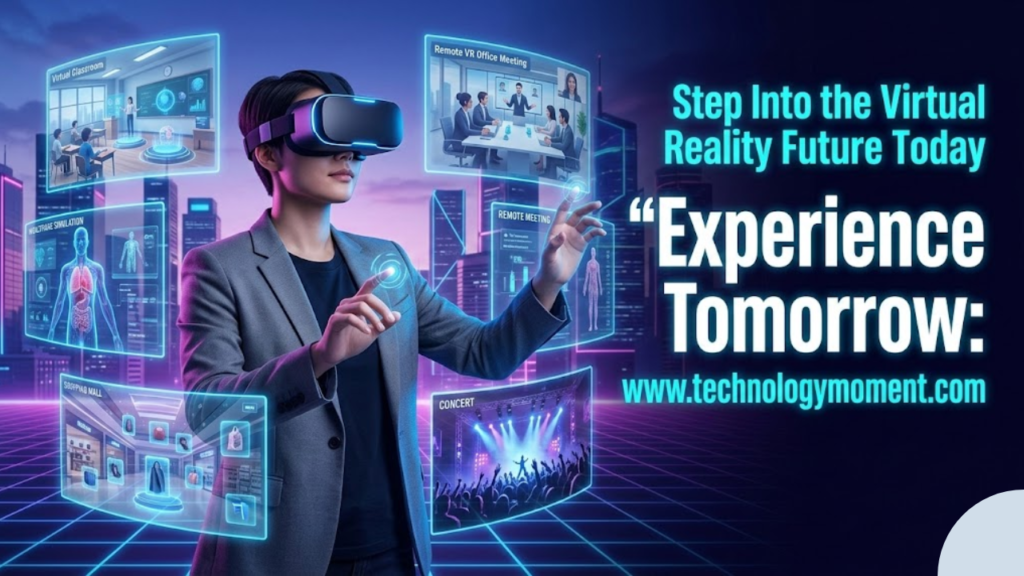
Virtual Reality, or VR, takes you out of the real world and places you inside a digital one. The real world fades away, and a new world takes over. This creates deep focus and full immersion. VR is powerful because it controls your entire visual experience. That’s why VR is often linked with gaming, training, and simulations.
VR uses headsets, motion tracking, and 3D graphics to simulate reality. This tricks your brain into feeling present inside the experience. Sound also plays a big role, making environments feel real. The result is a sense of “being there.” This level of immersion is what sets VR apart from AR and MR.
VR headsets range from simple mobile-based devices to advanced standalone systems. Some connect to powerful computers, while others work independently. Gaming platforms, virtual meeting spaces, and training apps rely heavily on VR. These platforms continue to grow as hardware becomes more affordable. As a result, VR searches are rising globally. People want deeper digital experiences, and VR delivers that.
Gaming is where VR truly shines. Players don’t just control characters; they become part of the game. Movies and concerts are also entering VR spaces. You can attend events without leaving your home. This changes how entertainment feels and functions. VR turns passive watching into active participation, which is why it keeps trending worldwide.
What Is Mixed Reality (MR)?
Mixed Reality, or MR, combines the best of AR and VR into one experience. It allows digital objects to exist and interact with the real world. Unlike AR, these objects understand their environment. They can sit on tables, hide behind walls, or respond to your actions. MR feels more intelligent and more interactive. It’s often described as the most advanced immersive technology today.
AR adds visuals, but MR adds interaction. In MR, digital content doesn’t just appear—it behaves realistically. Objects can be touched, moved, and anchored in space. This requires advanced sensors and spatial mapping. MR understands depth, scale, and context better than AR. That extra intelligence is why MR is popular in professional and industrial use cases.
MR is changing how people design, collaborate, and solve problems. Engineers can view 3D models floating in real space. Teams can work together on virtual objects from different locations. Training becomes more hands-on and realistic. These applications save time and reduce errors. That practical value makes MR a rising star in global tech trends.
Businesses use MR for complex tasks like remote assistance and product design. A technician can see instructions layered over real machinery. Doctors can study 3D organs before surgery. These experiences improve accuracy and confidence. MR reduces learning curves and boosts productivity. As industries adopt it faster, MR continues to gain global attention.
AR vs VR vs MR: Key Differences Explained
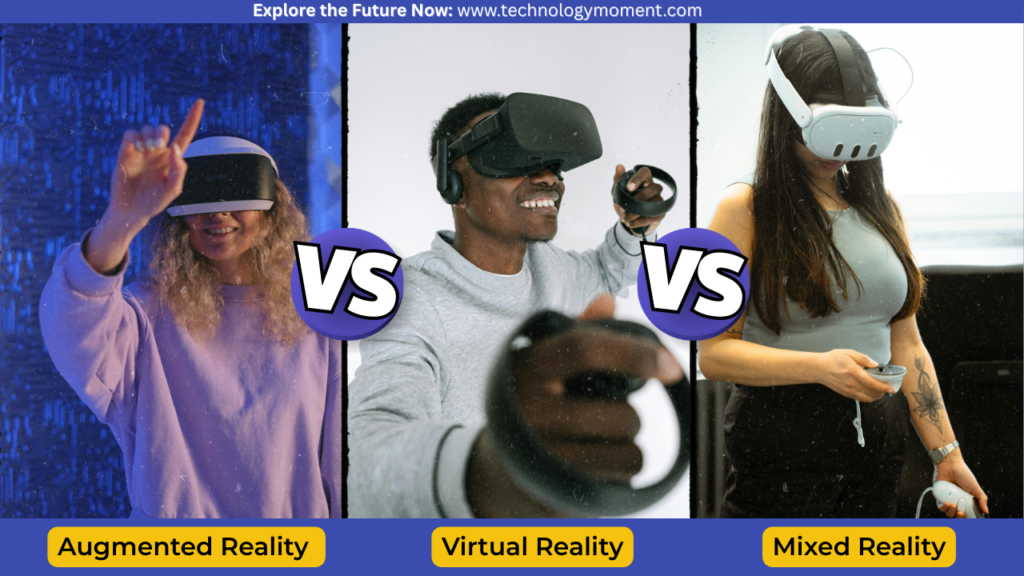
Augmented Reality, Virtual Reality, and Mixed Reality may sound similar, but they work very differently in real life. AR adds digital layers to the real world. VR replaces the real world completely. MR blends both and lets digital objects interact with physical space. Think of AR as an extra filter, VR as a new universe, and MR as a smart bridge between the two.
AR keeps you grounded in reality. You still see your room, your street, or your office. Digital elements appear on top of it. VR, on the other hand, shuts the door to the real world. Once you wear a headset, everything you see is computer-generated. MR goes one step further. It understands the environment and allows virtual objects to respond to real-world movement.
The level of immersion is the biggest difference. AR offers light immersion and quick access. VR offers deep immersion and total focus. MR offers intelligent immersion, where digital content feels anchored to real life. This makes MR powerful but also more complex and expensive.
Hardware also separates them. AR often works on smartphones and smart glasses. VR needs headsets and controllers. MR usually requires advanced devices with sensors and spatial mapping. Each technology fits different goals, users, and industries.
6 Powerful Insights That Are Changing Everything
The first major insight is that AR is becoming invisible yet powerful. People use AR daily without thinking about it. Social media filters, navigation arrows, and shopping previews are all AR. This silent adoption makes AR the fastest-growing immersive technology worldwide.
The second insight is how VR is transforming learning and training. VR allows people to practice without risk. Pilots can fly virtual planes. Doctors can rehearse surgeries. This hands-on experience boosts confidence and reduces mistakes in the real world.
The third insight is that MR is redefining workspaces. Engineers can see 3D models floating in front of them. Teams can collaborate with holograms across countries. MR turns physical offices into interactive digital environments.
The fourth insight focuses on healthcare innovation. AR assists surgeons in real time. VR helps patients manage pain and anxiety. MR supports complex medical planning. Immersive tech is no longer optional in modern healthcare.
The fifth insight is the rise of AI-powered XR. When artificial intelligence meets AR, VR, and MR, experiences become smarter. Systems learn user behavior and adapt instantly. This fusion is shaping the future of immersive computing.
The sixth insight is accessibility. These technologies are becoming cheaper and lighter. More people can access immersive experiences. This global reach is accelerating adoption across industries and cultures.
AR vs VR vs MR in Business and Marketing
In business, attention is currency, and immersive tech captures it fast. AR allows customers to try products before buying. They can place furniture in their room or test makeup on their face. This builds trust and reduces returns.
VR changes how brands tell stories. Instead of watching ads, users step inside them. Virtual showrooms and immersive product launches create emotional connections. These experiences stay longer in the customer’s memory.
MR brings collaboration and efficiency to businesses. Teams can visualize data in 3D space. Designers can modify prototypes in real time. This reduces costs and speeds up decision-making.
Marketing strategies also benefit from immersive analytics. Brands can track user interaction in virtual spaces. This data helps improve campaigns and personalize experiences. The result is higher engagement and better conversions.
AR vs VR vs MR in Education
Education is shifting from passive learning to active exploration. AR helps students visualize complex concepts. A human heart can appear on a desk. A solar system can float in a classroom. Learning becomes more engaging and fun.
VR takes students beyond the classroom. They can visit ancient cities or explore space. This emotional connection improves understanding and memory. Students learn by experiencing, not memorizing.
MR blends theory and practice seamlessly. Medical students can interact with virtual organs while seeing real tools. Engineering students can test designs in real environments. This hybrid learning boosts skills and confidence.
These technologies also support remote education. Students from different countries can meet in shared virtual spaces. This creates inclusive, global learning environments with equal opportunities.
AR vs VR vs MR in Healthcare
Healthcare is one of the biggest beneficiaries of immersive technology. AR supports doctors during surgeries by overlaying critical data. This improves precision and reduces errors. It acts like a digital assistant in real time.
VR plays a powerful role in therapy and mental health. Patients use VR to manage stress, phobias, and chronic pain. The brain responds strongly to immersive environments, making treatment more effective.
MR enhances medical training and planning. Surgeons can practice complex procedures using interactive holograms. Hospitals can plan operations more accurately. This leads to safer outcomes and better patient care.
These technologies also improve patient education. People understand their conditions better through visual explanations. This builds trust and encourages active participation in treatment.
Challenges and Limitations of AR, VR, and MR
Immersive technologies sound exciting, but let’s be honest—they are not perfect yet. AR, VR, and MR still face real-world challenges that slow down mass adoption. Hardware cost is the first big wall. High-quality headsets, sensors, and compatible devices are still expensive for many users across the globe. This makes immersive tech feel exclusive instead of universal.
Another challenge is comfort and usability. Wearing a headset for long hours can cause eye strain, dizziness, or motion sickness. Not everyone adapts easily, especially first-time users. For global audiences, this is a serious concern because technology should feel natural, not exhausting. If it feels heavy on your head or mind, adoption drops quickly.
Content availability is another limitation. Great hardware without meaningful content is like a sports car without fuel. Many industries still lack localized, culturally relevant AR, VR, and MR experiences. Global users want content in their language, aligned with their daily needs. That gap still exists in many regions.
Privacy and data security also raise red flags. AR and MR scan physical spaces, faces, and movements. That data is powerful, but also sensitive. Without strong global regulations and ethical standards, trust becomes fragile. Users want innovation, but they also want safety.
Future Trends of AR, VR, and MR
The future of AR, VR, and MR looks lighter, smarter, and more human. Headsets are becoming smaller and more stylish. Smart glasses are slowly replacing bulky devices. This shift matters because people want technology that blends into life, not interrupts it. Wearable XR is becoming a daily companion, not a special tool.
Artificial intelligence is the silent engine behind the next wave. AI will make immersive experiences more adaptive and personal. Imagine AR apps that understand your environment instantly or VR training that adjusts to your learning speed. This mix of AI and XR is one of the hottest global tech trends right now.
Another major trend is spatial computing. Digital objects will stay anchored in the real world. Virtual screens will float in your room. Digital twins will mirror factories, cities, and even human bodies. This is not about entertainment alone. It’s about productivity, planning, and problem-solving at scale.
Cloud-based XR is also gaining momentum. Heavy processing will move to the cloud, making devices cheaper and faster. This shift supports global accessibility. Users in different countries will access the same immersive experience without owning expensive hardware.
Which Technology Should You Choose?
Choosing between AR, VR, and MR depends on your goal, not hype. If you want quick access and everyday usefulness, AR is your best friend. It works on smartphones and tablets. It enhances reality instead of replacing it. That’s why AR dominates e-commerce, navigation, and social media worldwide.
If your goal is deep focus and full immersion, VR takes the lead. VR is perfect when you want to escape distractions and enter a controlled environment. Training simulations, virtual classrooms, and immersive gaming shine here. VR works best when the real world needs to fade away for learning or experience.
MR sits in the middle and thinks bigger. It’s ideal for professionals and enterprises. Engineers, doctors, and designers benefit most from MR. It allows digital objects to interact with the real world in real time. If collaboration, precision, and interaction matter, MR delivers unmatched value.
There is no universal winner. Think of these technologies as tools in a toolbox. The smartest choice depends on your industry, audience, and budget. Many global businesses now combine AR, VR, and MR instead of choosing just one.
Conclusion
AR, VR, and MR are not competing technologies. They are evolving together. Each one solves a different problem and serves a different human need. AR improves what already exists. VR creates what doesn’t. MR connects both worlds intelligently.
The real power of immersive technology lies in how it feels human. When used correctly, it saves time, reduces errors, and boosts understanding. From education to healthcare, from marketing to manufacturing, XR is changing how people interact with information.
The journey is still unfolding. Challenges remain, but innovation moves faster every year. As devices get lighter and software gets smarter, immersive tech will feel less like technology and more like instinct. The future isn’t virtual or real. It’s a seamless blend of both.
FAQs
What is the main difference between AR, VR, and MR?
AR adds digital elements to the real world. MR blends both and allows interaction between physical and digital objects.
Which technology is best for beginners?
AR is the easiest to start with because it works on smartphones. No headset is required, and the learning curve is low.
Is VR safe for long-term use?
VR is generally safe but should be used in moderation. Long sessions can cause eye strain or motion discomfort for some users.
Will AR, VR, and MR replace smartphones?
Not immediately. Smartphones will coexist with immersive devices. Over time, smart glasses may reduce screen dependency.
Which industries benefit most from immersive technology?
Education, healthcare, real estate, gaming, retail, manufacturing, and remote collaboration are leading adopters globally.