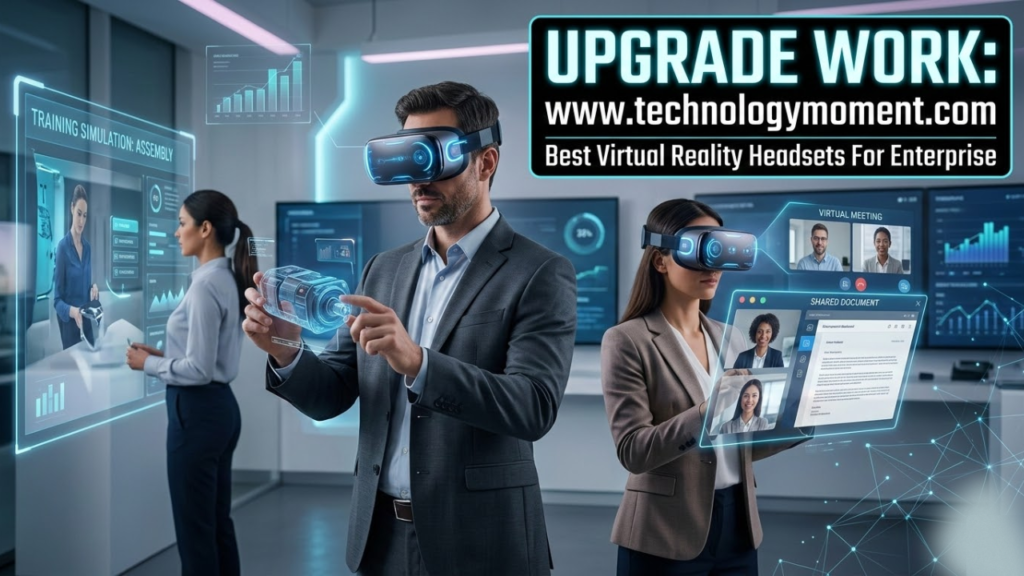
Technology is changing the way businesses train, collaborate, and build products. At Technology Moment, we explore tools that help companies work smarter, and one of the most exciting tools right now is virtual reality for enterprise use. Not long ago, VR headsets were mainly for gaming. Today, they are becoming powerful business tools. Companies use them for employee training, remote collaboration, product design, and even customer experiences. If your business wants to stay competitive in a fast-moving digital world, understanding the best virtual reality headsets for enterprise use is a smart place to start.
The rise of enterprise VR solutions for business training and collaboration is not an accident. Organizations across industries are looking for ways to reduce costs, improve learning speed, and increase productivity. Virtual reality makes this possible by creating immersive environments where employees can practice real tasks without real risks. Imagine a new factory worker learning how to operate heavy machinery in a virtual simulation before touching the real equipment. Or think about a medical student practicing surgery in a virtual lab. These VR-based corporate training solutions make learning safer, faster, and more engaging. Businesses also save money on travel, equipment, and training materials.
When people talk about enterprise VR, the headset is the heart of the experience. A high-quality device can turn simple training modules into fully interactive environments. That is why companies are searching for the best VR headsets for enterprise training and professional use. Modern headsets now offer ultra-clear displays, advanced motion tracking, mixed reality features, and long battery life. These improvements allow teams to collaborate in virtual meeting rooms, review 3D product prototypes, and explore architectural designs before construction even begins. With remote work becoming normal across the globe, virtual collaboration using VR headsets is quickly becoming a practical solution for many organizations.
Across industries, companies are already seeing the benefits of virtual reality headsets for business applications. In manufacturing, engineers use VR to test new machine designs before building expensive prototypes. In healthcare, doctors practice procedures in a virtual environment to improve accuracy and confidence. Retail companies use VR to design store layouts and analyze customer behavior. Even large corporations now host immersive onboarding programs where new employees enter a virtual workplace to learn company systems and culture. These examples show how enterprise VR technology for corporate innovation is no longer experimental—it is becoming an essential part of digital transformation strategies.
The future of work is becoming more immersive, collaborative, and technology-driven. Companies that adopt virtual reality headsets for enterprise productivity today will likely gain a competitive advantage tomorrow. As hardware becomes more powerful and software platforms continue to grow, VR will play an even bigger role in training, design, communication, and customer experience. At Technology Moment, our goal is to help readers understand these innovations in simple terms and make informed decisions about new technology. If your organization wants to explore the next generation of digital tools, learning about the best virtual reality headsets for enterprise use is the first step toward building a smarter and more connected workplace.
Why Businesses Are Investing in Virtual Reality
Virtual Reality is no longer a futuristic idea. Companies around the world are using virtual reality for business training, product design, and remote collaboration. Why? VR creates an environment where people can learn, test, and interact without real-world risks. Imagine a factory worker learning how to operate heavy machinery in a virtual space before touching the real machine. That kind of training saves money and prevents accidents. Many global companies now see VR as a smart investment rather than an experimental technology.
Another reason businesses invest in enterprise VR solutions is efficiency. Traditional training often requires travel, trainers, and physical equipment. VR removes many of these costs. Employees can train from anywhere in the world while wearing a headset. A healthcare trainee in India can practice a medical procedure inside a simulated hospital environment. A retail employee in Europe can learn customer service skills through virtual scenarios. This flexibility makes VR training faster and more scalable for global companies.
Companies also use VR to improve collaboration. Teams no longer need to sit in the same office to work together. In a virtual workspace, employees can meet as avatars and interact with 3D objects. Engineers can examine digital prototypes together. Designers can modify products in real time. Remote teams feel more connected when they share the same immersive environment. This is why many organizations are searching for the best virtual reality headsets for enterprise use.
There is also a competitive advantage. Businesses that adopt VR early often move faster than their competitors. They innovate more quickly, train employees better, and test products more efficiently. Industries like automotive, aerospace, healthcare, and real estate already rely heavily on enterprise virtual reality technology. As the technology improves and costs fall, more companies will join this trend. For many organizations today, investing in VR is not just about technology. It is about staying ahead in a rapidly changing digital world.
Key Features to Look for in Enterprise VR Headsets
Choosing the right headset for business use is not as simple as picking the most popular device. Enterprise environments require reliability, comfort, and strong performance. When companies search for the best VR headset for business applications, they must evaluate several important features. These features determine whether the headset will work smoothly for training, simulations, or collaboration.
Display quality is one of the first things to check. A headset with high resolution and clear visuals makes the virtual world feel realistic. Employees can read text, inspect designs, and analyze data without eye strain. Low-resolution displays can cause discomfort and reduce productivity. That is why many modern enterprise virtual reality headsets now offer 4K-level displays and advanced optics.
Comfort also plays a huge role in enterprise use. Business training sessions often last longer than gaming sessions. If a headset feels heavy or tight, employees will not want to use it for long periods. A good enterprise headset should have adjustable straps, balanced weight distribution, and breathable materials. Companies want workers to focus on learning and collaboration, not on adjusting their headsets every few minutes.
Another key factor is software compatibility. Businesses use specialized tools such as VR training platforms, simulation software, and collaboration apps. The headset must integrate smoothly with these systems. Many enterprise VR headsets support cloud platforms and management tools that allow IT teams to monitor devices. Security also matters. Corporate data must stay protected, especially when teams work in virtual environments.
Finally, scalability matters for large organizations. A small startup might need only a few headsets. But a multinational company may deploy hundreds or thousands of devices. Enterprise VR solutions must support device management, updates, and analytics across multiple locations. When all these features come together, businesses can confidently invest in VR technology that supports growth and innovation.
Top Virtual Reality Headsets for Enterprise Use
The enterprise VR market has grown quickly in recent years. Many technology companies now design headsets specifically for business applications. These devices combine powerful hardware with advanced software tools. They allow organizations to run immersive training programs, build digital prototypes, and create virtual collaboration spaces. When searching for the best virtual reality headsets for enterprise use, businesses often compare several leading models.
One major option is mixed reality headsets that blend digital elements with the real world. These devices allow users to see physical surroundings while interacting with virtual objects. This technology is useful for engineering, healthcare training, and manufacturing simulations. Workers can view instructions, 3D models, or data overlays while performing real tasks. Mixed reality headsets bring virtual information directly into the physical workspace.
Another category focuses on standalone VR headsets. These devices do not require a powerful computer or external sensors. They contain built-in processors and tracking systems. This makes them easier to deploy across large organizations. Companies can distribute headsets to employees without a complex setup. Standalone devices are especially popular for corporate VR training programs because they are simple and portable.
There are also premium enterprise headsets designed for high-end productivity. These models offer ultra-high resolution displays, advanced spatial tracking, and powerful processors. They support detailed design work, immersive simulations, and virtual offices. Businesses in architecture, automotive design, and product development often prefer these advanced headsets. Their ability to display detailed 3D models makes them valuable tools for creative teams.
As the VR market evolves, companies continue to launch new devices with better performance and features. Some focus on affordability, while others emphasize cutting-edge technology. A training-focused organization might prioritize ease of use, while a design studio may need the highest visual fidelity available. Understanding these differences helps businesses choose the right VR headset for their needs.
1. Apple Vision Pro for Enterprise Productivity
The Apple Vision Pro has generated huge attention in the technology world. While many people see it as a consumer device, it also offers strong potential for enterprise productivity. Apple designed this headset as a spatial computing platform. Instead of simply displaying virtual environments, it allows users to interact with digital content naturally. Businesses exploring mixed reality for enterprise workflows often consider the Vision Pro as a powerful option.
One of the most impressive features of the Vision Pro is its display quality. The headset uses extremely high-resolution micro-OLED displays that deliver sharp and detailed visuals. This clarity is important for professional tasks. Designers can inspect product models closely. Engineers can analyze complex structures. Even small text appears crisp inside the virtual workspace. For businesses that rely on precision, this level of visual quality makes a big difference.
Another strength of the Vision Pro is its intuitive interface. Users control the system using eye tracking, hand gestures, and voice commands. This natural interaction style feels similar to using a computer, but in a three-dimensional space. Employees can open multiple virtual screens, arrange documents around them, and work with digital tools in a flexible environment. It feels like stepping inside a futuristic office.
Enterprise productivity also improves through Apple’s ecosystem. The Vision Pro integrates with Mac computers, cloud apps, and productivity tools. Teams can collaborate in shared virtual spaces or view data in immersive formats. For example, architects can walk through a digital building model. These capabilities show why many companies are watching the Apple Vision Pro enterprise use cases closely.
As spatial computing continues to grow, devices like the Vision Pro may reshape how people work. Instead of flat monitors and traditional desks, professionals could operate inside immersive digital workspaces. This shift might sound dramatic, but the technology is already here. Companies exploring advanced mixed reality productivity tools see the Vision Pro as a glimpse into the future of work.
2. Meta Quest 3 for Corporate Training
The Meta Quest 3 has become one of the most popular VR headsets for business training programs. Many companies choose it because it balances performance, affordability, and ease of use. Unlike traditional VR systems, the Quest 3 is a standalone device. It does not require a powerful computer or external sensors. This makes it perfect for organizations that want to deploy virtual reality training solutions across multiple locations.
Corporate training often involves complex scenarios that are difficult to replicate in real life. For example, safety training in construction or manufacturing can be expensive and risky. VR changes that. With the Quest 3, employees can practice dangerous tasks in a safe digital environment. They can repeat procedures, make mistakes, and learn without real-world consequences. This immersive experience improves memory and skill development.
Another advantage of the Quest 3 is its mixed reality capability. The headset can blend virtual objects with the physical world. This feature allows businesses to create interactive learning experiences. For instance, a technician can see virtual instructions overlaid on real equipment. A retail employee can practice customer interactions in simulated store environments. These immersive corporate training simulations make learning more engaging and effective.
The Quest 3 also supports a growing ecosystem of enterprise software platforms. Many training companies build VR courses specifically for this device. Businesses can track employee progress, monitor training results, and update programs easily. This data helps organizations improve their learning strategies over time This data helps organizations improve their learning strategies over time. The headset becomes more than just hardware; it becomes part of a complete digital training system.
Another important factor is scalability. Large organizations need solutions that can expand quickly. The Quest 3 allows companies to manage multiple devices through centralized tools. IT teams can install apps, control settings, and update systems remotely. This makes large deployments much easier. Because of these advantages, the Meta Quest 3 for enterprise training has become a common choice for businesses exploring virtual learning environments.
For many companies, the goal is simple: train employees better and faster. VR makes that possible by combining realism with flexibility. The Quest 3 offers a practical entry point into this technology. As businesses continue adopting immersive training methods, devices like the Quest 3 will likely play a major role in the future of workplace education.
3. HTC Vive XR Elite for Enterprise Simulations
When companies talk about enterprise VR simulations, the device that often comes up in discussions is the HTC Vive XR Elite. This headset blends virtual reality and mixed reality into a compact design that works well for professional environments. Many global businesses use it to create safe training environments where employees can practice difficult tasks without real-world risks. Think about industries like aviation, manufacturing, or healthcare. Instead of reading manuals, employees can step into a simulated workplace and learn by doing.
One of the strongest reasons companies choose this headset is its powerful spatial tracking and high-resolution display. Clear visuals matter a lot in enterprise simulations. When a trainee sees realistic equipment, tools, and environments, learning becomes faster and more natural. The Vive XR Elite delivers sharp visuals with a high refresh rate, which helps reduce motion sickness during long training sessions. That makes it ideal for companies that run multi-hour VR learning programs.
Another important feature is enterprise software compatibility. Businesses often use custom training platforms or simulation software. The Vive XR Elite supports many popular VR development platforms such as Unity and Unreal Engine. This flexibility allows organizations to build tailored simulations for safety training, technical education, or equipment operation. When companies want a professional VR simulation headset, this device often becomes a strong candidate because it balances performance, portability, and developer support.
4. Samsung Galaxy XR for Mixed Reality Workspaces
The upcoming Samsung Galaxy XR headset is gaining attention as a powerful tool for mixed reality workspaces and immersive productivity. Instead of isolating the user inside a fully virtual world, mixed reality blends digital elements with the real environment. This approach allows professionals to interact with both physical and digital objects at the same time. Imagine sitting at your desk while large virtual monitors float around you. That is the kind of experience enterprise mixed reality promises.
Companies that focus on remote collaboration and virtual offices are especially interested in this technology. With mixed reality headsets, employees can join immersive meetings where 3D models, presentations, and data dashboards appear in front of them. Engineers can inspect product prototypes in 3D. Designers can modify models in real time while colleagues watch from other countries. The Galaxy XR aims to make these tasks smoother with advanced sensors and powerful computing capabilities.
Another factor driving enterprise interest is the integration with Android and cloud ecosystems. Samsung’s XR ecosystem is expected to work closely with cloud collaboration tools and productivity platforms. This means businesses can connect their existing apps with immersive XR interfaces. For global teams that work across time zones, mixed reality workspaces may soon replace traditional video meetings. The Galaxy XR is positioned to become a future-ready enterprise XR headset for collaboration, design, and productivity.
5. Pico 4 Ultra Enterprise for Business Deployments
The Pico 4 Ultra Enterprise headset is designed specifically for large-scale enterprise VR deployments. Many organizations want to distribute VR devices to hundreds or even thousands of employees. That kind of rollout requires centralized device management, strong security, and stable performance. Pico built the enterprise version of this headset to meet those needs, making it attractive for corporations and training institutions worldwide.
One of the most practical advantages of the Pico 4 Ultra Enterprise is its device management system. IT teams can control headsets remotely, install applications, and monitor usage across multiple locations. This makes the headset ideal for companies that operate global training programs. Instead of configuring every device manually, administrators can deploy updates from a central dashboard. That saves time and reduces operational complexity.
Comfort and usability also play a major role in enterprise adoption. Employees might wear VR headsets for extended training sessions, so the device must feel lightweight and balanced. The Pico 4 Ultra Enterprise focuses on ergonomic design while maintaining strong graphics performance. Companies that want an affordable enterprise VR headset with scalable deployment options often consider this device a strong choice for training, onboarding, and immersive learning programs.
Comparison Table of Enterprise VR Headsets
When businesses evaluate enterprise virtual reality headsets, they usually compare multiple factors before making a decision. Display quality, comfort, ecosystem support, and device management capabilities all influence the final choice. Some headsets focus on high-end mixed reality experiences, while others prioritize scalability and enterprise security. Looking at a comparison can help organizations understand which device best fits their operational goals.
The following table highlights some key differences among popular enterprise VR headsets used in professional environments.
| VR Headset | Best For | Key Strength | Enterprise Feature | Ideal Industries |
|---|---|---|---|---|
| HTC Vive XR Elite | Advanced simulations | High-resolution mixed reality | Developer-friendly ecosystem | Manufacturing, aviation, healthcare |
| Samsung Galaxy XR | Mixed reality workspaces | Immersive collaboration | Cloud ecosystem integration | Design, remote teams, engineering |
| Pico 4 Ultra Enterprise | Large deployments | Centralized device management | Enterprise security tools | Corporate training, education |
| Meta Quest 3 | Cost-effective VR training | Large app ecosystem | Standalone VR system | Retail training, customer service |
Choosing the best headset depends heavily on the company’s main use case. If the goal is realistic training simulations, high-end devices with advanced sensors may work best. If the goal is collaboration and productivity, mixed reality headsets may offer greater value. Businesses must evaluate both current needs and future expansion plans before selecting a device.
Real Enterprise Use Cases of VR Headsets
Virtual reality has moved far beyond experimental technology. Many organizations already use it to solve real business challenges. The most common use case today is employee training and skill development. Instead of learning through slides or videos, employees can practice real tasks inside immersive simulations. A warehouse worker can learn equipment operation. These experiences make learning faster and safer.
Another powerful application is product design and engineering visualization. Designers often need to inspect complex 3D models before manufacturing begins. With VR headsets, teams can walk around a virtual prototype and examine every detail. They can identify design flaws early and reduce production costs. Automotive companies, aerospace engineers, and architecture firms frequently use VR for this purpose.
Remote collaboration is also transforming how global teams work. VR meeting spaces allow employees from different countries to interact in shared virtual environments. Instead of staring at flat video calls, participants can interact with 3D models, whiteboards, and presentations together. As remote work continues to grow, enterprise virtual reality collaboration tools are becoming an important part of digital workplaces.
Benefits of Using VR in Enterprises
Businesses across the world are discovering that virtual reality in enterprises is not just a fancy technology—it’s a powerful productivity tool. When companies use VR, they can create immersive environments where employees learn by doing instead of just watching slides or reading manuals. Imagine a technician learning how to repair complex machinery inside a safe virtual environment before touching real equipment. That kind of training reduces mistakes and increases confidence. This is why VR employee training solutions are becoming popular in industries like healthcare, aviation, manufacturing, and even retail.
Another huge benefit is cost savings over time. Traditional training often requires travel, physical equipment, instructors, and special training facilities. With enterprise VR training platforms, companies can simulate the same situations digitally. A global company can train thousands of employees without flying them across continents. Even better, the training experience stays consistent. Every employee sees the same scenario and practices the same steps. Many companies report that VR training can reduce training time by up to 40% while improving knowledge retention, because people remember experiences better than lectures.
VR also improves collaboration, especially for global teams. Today, many companies operate with employees spread across different countries and time zones. Using VR collaboration tools for remote teams, workers can meet in a virtual office, interact with 3D models, and discuss projects as if they were physically present. Designers can inspect product prototypes together. Engineers can test designs in virtual simulations. This kind of immersive teamwork often leads to faster decisions and fewer misunderstandings.
Finally, VR opens the door to innovation. Businesses can experiment with ideas that would be expensive or risky in the real world. Retail brands can test store layouts. Automotive companies can evaluate vehicle designs. Medical organizations can practice surgical procedures. When organizations use virtual reality for product design, training, and simulations, they create a culture where experimentation becomes safe and affordable. That freedom to explore often leads to smarter solutions and better products.
Challenges Companies Face with VR Adoption
Even though the advantages are impressive, companies still face several challenges when adopting enterprise virtual reality solutions. High-quality VR headsets, enterprise software licenses, and custom VR training programs can cost a lot in the beginning. For small businesses, this upfront cost can feel risky. Decision-makers often ask themselves whether the technology will deliver a real return on investment.
Another challenge is content creation. Buying a headset is easy. Creating effective enterprise VR training content is much harder. Companies need specialized developers, designers, and subject-matter experts to build immersive experiences that actually help employees learn. If the VR experience feels confusing or unrealistic, employees may lose interest quickly. In other words, the hardware alone does not create value—the content must also be high quality.
Comfort and usability also matter more than many people expect. Employees may need to wear VR headsets for long training sessions or collaborative meetings. If the device feels heavy, causes motion sickness, or has poor battery life, users may avoid it. Businesses must carefully select comfortable VR headsets for long enterprise training sessions. A device that works well for gaming may not work well in a corporate environment where people use it for hours.
Another barrier involves integration with existing systems. Many organizations already use tools like learning management systems (LMS), design software, and collaboration platforms. VR solutions must connect smoothly with these systems. If integration becomes complicated, companies may struggle to scale their VR initiatives. This is why many organizations now look for enterprise-ready VR ecosystems that include security features, device management, and software compatibility.
How to Select the Most Suitable VR Headset for Your Company
Selecting the best VR headset for enterprise use requires more than checking price tags or popularity. Businesses need to consider how the device will actually support their goals. Start by identifying the primary purpose of VR inside the organization. Some companies use VR mainly for training. Others focus on design simulations or remote collaboration. The use case determines the type of headset required.
In enterprise environments, employees often interact with small text, detailed diagrams, or complex 3D models. A headset with low resolution can make these tasks frustrating. Devices with high-resolution displays and wide fields of view provide a much more natural experience. When evaluating high-resolution VR headsets for professional use, companies should prioritize clarity and visual comfort.
Another critical factor is software compatibility. Businesses rarely operate with a single tool. Instead, they rely on a wide ecosystem of productivity and design applications. The best enterprise VR headsets for training and collaboration support major development platforms and integrate easily with business software. Compatibility ensures that the headset becomes part of the workflow rather than an isolated gadget.
Comfort and scalability also deserve serious attention. Employees may use VR devices repeatedly throughout the day. Lightweight headsets with adjustable straps, good ventilation, and long battery life will improve user adoption. Organizations should also consider device management tools that allow IT teams to monitor multiple headsets across offices. When companies think beyond the hardware and consider the full enterprise VR deployment strategy, they make smarter long-term investments.
Conclusion
Virtual reality has moved far beyond entertainment. Today, it is becoming a powerful technology that helps companies train employees, design products, and collaborate across borders. Organizations that invest in enterprise VR solutions often discover new ways to improve efficiency and reduce operational risks. Instead of learning through theory alone, employees can practice tasks in immersive environments that feel real and engaging.
At the same time, VR adoption requires thoughtful planning. Companies must consider costs, content development, and integration with existing systems. Choosing the right hardware is only part of the equation. Businesses must also create meaningful experiences that solve real problems. When implemented strategically, virtual reality for business productivity and training can transform how organizations operate.
Looking ahead, the future of enterprise VR looks extremely promising. As hardware becomes lighter, software becomes smarter, and mixed reality technologies evolve, immersive workspaces may become as common as video meetings today. Companies that explore VR now position themselves ahead of the curve. They gain experience with immersive workflows while competitors are still experimenting. That early advantage can shape innovation for years to come.
FAQs
What industries benefit the most from enterprise VR?
Many industries gain significant value from virtual reality for enterprise applications. Healthcare organizations use VR for surgical training and patient simulations. Manufacturing companies rely on VR to train workers on complex equipment without risking damage. Retail brands experiment with virtual store layouts. Even corporate offices use VR collaboration platforms to improve remote teamwork.
Is VR training more effective than traditional training?
Studies suggest that VR training programs for employees can improve knowledge retention and engagement. People often learn faster when they experience situations instead of just reading about them. VR allows employees to practice real tasks in safe environments. This hands-on approach helps them build confidence before performing the same tasks in real life.
Are VR headsets safe for long work sessions?
Modern enterprise VR headsets are designed with improved ergonomics and adjustable designs. Many devices now reduce motion sickness and offer better weight distribution. However, companies should still encourage breaks during long sessions. Choosing comfortable hardware and designing shorter immersive modules can make VR usage safer and more enjoyable.
How much does an enterprise VR setup cost?
The cost of VR solutions for business training and collaboration depends on hardware, software, and content development. Entry-level enterprise setups may start around a few hundred dollars per headset, while advanced mixed reality devices can cost several thousand dollars. Custom VR training environments can also increase the total investment.
Will VR replace traditional workplace tools?
VR is unlikely to replace every traditional tool. Instead, it works best as a complement to existing technologies. Many companies combine VR collaboration tools with video conferencing, cloud platforms, and productivity apps. The goal is not replacement but enhancement—creating immersive experiences where traditional tools fall short.