Welcome to Technology Moment, where we break down powerful tech ideas into simple, human-friendly stories. If technology ever feels confusing or too fast, you’re in the right place. Here, we talk about innovation the way real people experience it—practical, exciting, and easy to understand. Today, we’re diving into one of the most talked-about trends shaping classrooms worldwide: Augmented Reality in Education.
Education is changing, and honestly, it’s about time. Students today grow up with smartphones, apps, and instant access to information. So why should learning stay flat and boring? This is where augmented reality learning steps in. It blends the real world with digital elements to create lessons that feel alive. Think of it as learning that jumps out of the book and into your space.
At Technology Moment, we believe learning should spark curiosity. AR in education does exactly that. It helps students see complex ideas, not just read about them. Whether it’s a 3D solar system floating in the classroom or a virtual anatomy lesson on a tablet, AR turns “I don’t get it” into “Wow, now I see it.”
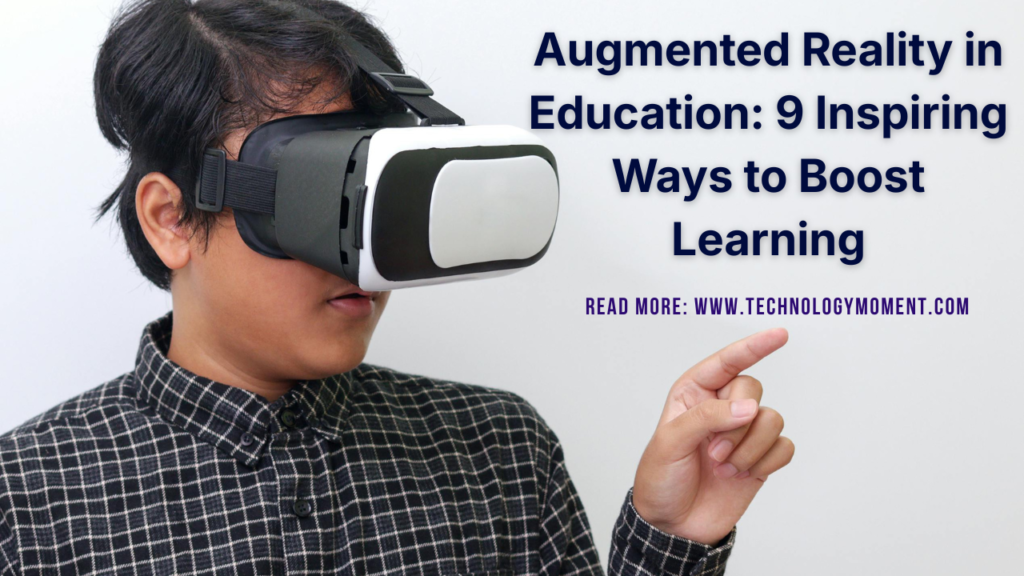
This article, “Augmented Reality in Education: 9 Inspiring Ways to Boost Learning,” explores how this technology is reshaping modern education. We’ll look at real-world uses, benefits, and trends driving global adoption. From schools and universities to skill-based training, AR is becoming a powerful learning tool.
If you’re an educator, student, parent, or tech enthusiast, you’ll find value here. We keep things simple, practical, and future-focused. So let’s explore how augmented reality technology in education is not just enhancing learning—but transforming it.
How Augmented Reality Is Transforming Classrooms Globally
Classrooms around the world are changing faster than ever, and augmented reality is one of the biggest reasons. Learning is no longer flat or passive. With AR, lessons feel alive. Students do not just read about concepts. They see them, move them, and interact with them in real time.
In many countries, teachers now use AR to turn abstract ideas into visual experiences. A history lesson can suddenly place students inside an ancient city. A geography class can show mountains rising from a desk. This shift helps students understand topics faster, no matter their language or background.
Augmented reality also breaks physical boundaries. Schools in remote areas can access the same quality of learning as top institutions. All they need is a smartphone or tablet. This makes AR in education a powerful equalizer on a global scale.
Another major change is how students behave in AR-powered classrooms. They ask more questions. They stay curious. They feel involved. Instead of listening quietly, they explore actively. That sense of control makes learning feel personal and meaningful.
Teachers benefit too. AR helps them explain complex ideas with less effort. Visual teaching reduces confusion. It saves time. It also helps teachers connect better with students who learn visually rather than through text alone.
In short, augmented reality is not replacing teachers. It is amplifying them. It turns classrooms into interactive spaces where learning feels natural, engaging, and truly global.
Benefits of Augmented Reality in Education
One of the biggest benefits of augmented reality in education is engagement. Students today grow up with digital content. AR speaks their language. When lessons feel interactive, attention spans increase. Learning no longer feels like a chore.
Another key advantage is a better understanding. AR allows students to see concepts instead of imagining them. This is especially helpful for science, math, and engineering topics. When students can rotate a 3D model or zoom in on details, clarity improves instantly.
Augmented reality also improves memory retention. Experiences stay longer in the brain than plain text. When students interact with content, they remember it better. This makes AR learning tools valuable for long-term education outcomes.
Inclusivity is another strong benefit. AR supports different learning styles. Visual learners, slow learners, and students with language barriers all benefit. It creates a more balanced learning environment where no one feels left behind.
AR also boosts confidence. Students can practice skills safely without fear of failure. They can repeat lessons at their own pace. This builds self-belief and encourages independent learning.
Overall, the benefits of augmented reality in education go beyond technology. It supports curiosity, confidence, and creativity. These are skills students need in a fast-changing world.
9 Inspiring Ways Augmented Reality Boosts Education
1. Interactive 3D Learning Experiences
Augmented reality turns flat diagrams into living models. Students can explore the solar system, human anatomy, or machinery in 3D. This makes learning feel hands-on and real.
When students touch and rotate objects, understanding improves. Concepts stop feeling abstract. This is especially powerful for STEM education, where visuals matter most.
3D AR learning also supports self-paced study. Students can explore topics again and again. This reduces pressure and increases clarity. As a result, classrooms become spaces of discovery, not memorization.
2. Virtual Field Trips Without Borders
AR makes travel possible without leaving the classroom. Students can visit museums, landmarks, and natural wonders instantly. This is a major win for global education.
Virtual field trips save time and cost. Schools with limited budgets can still offer rich experiences. Learning becomes inclusive and fair. These AR experiences spark curiosity. Students feel emotionally connected to what they see. That connection deepens learning.
It also encourages cultural awareness and global thinking from an early age.
3. AR-Powered Science and Lab Experiments
Science becomes safer and smarter with augmented reality. Students can perform experiments virtually before trying them physically. This reduces risk and builds confidence.
AR labs help explain complex processes step by step. Students can slow down reactions or repeat them. This improves understanding. Schools without full lab facilities benefit the most. AR removes infrastructure barriers. Quality science education becomes accessible everywhere.
This makes AR a powerful tool for modern science classrooms.
4. Gamified Learning Through AR
Learning feels more fun when it feels like a game. AR gamification adds challenges, rewards, and interaction to lessons. Students stay motivated. Gamified AR learning improves focus and participation. Students want to complete tasks, not avoid them. This changes learning behavior.
It also encourages teamwork and problem-solving. Students collaborate naturally while playing and learning. Gamification through AR makes education joyful and effective at the same time.
5. Language Learning With Real-World Context
Learning a new language becomes easier with AR. Students can see objects labeled in real time. This connects words with real-life meaning. Pronunciation and vocabulary improve faster when learners interact visually. AR reduces the fear of making mistakes.
This method works well for global learners. It supports multilingual classrooms and cultural diversity. AR language learning feels natural, practical, and engaging.
6. Medical and Healthcare Training Using AR
Medical education demands precision. AR allows students to study anatomy in detail without real patients. This improves safety and accuracy. Trainees can practice procedures virtually. Mistakes become learning moments, not risks.
Healthcare AR training also supports remote learning. Students worldwide can access the same quality content. This makes augmented reality vital for future medical education.
7. Skill-Based and Vocational Training
AR supports hands-on skills like mechanics, engineering, and design. Learners can follow step-by-step visual guides. Mistakes are easier to fix in AR environments. Confidence grows with practice.
This is perfect for job-ready education and workforce training. Skills become easier to learn and apply. AR bridges the gap between theory and practice.
8. Personalized Learning Paths
Every student learns differently. AR adapts content to individual needs. Learners move at their own speed. This personalization reduces stress and frustration. Students feel supported, not rushed.
Teachers can track progress easily. Lessons become smarter and more focused. Personalized AR learning improves outcomes for all learners.
9. Teacher Support and Smart Lesson Planning
AR is not just for students. Teachers use it to design better lessons. Visual aids make explanations clearer. Lesson planning becomes faster and more creative. Teachers save time and energy.
AR also helps assess student understanding in real time. Feedback becomes instant. This strengthens the teacher-student connection and improves classroom results.
Use Cases of Augmented Reality in Education
In schools, augmented reality makes learning feel alive instead of forced. Young students can see planets floating above their desks or animals walking across their books. This visual approach keeps attention high and reduces boredom. Teachers notice that students ask more questions when AR is used. Concepts that once felt abstract suddenly become clear. This makes augmented reality in school education a powerful tool worldwide.
In colleges and universities, AR supports deep and practical learning. Medical students can study human anatomy layer by layer without touching a cadaver. Engineering students can inspect machines in 3D before building them. This saves time, reduces risk, and improves understanding. Professors also use AR to explain complex theories visually. That’s why augmented reality in higher education is growing fast across the globe.
Companies now use AR to train employees faster and smarter. New hires can practice tasks in real environments without real-world mistakes. For example, technicians can see repair steps overlaid on machines. This improves confidence and job performance. Training becomes consistent across countries and teams. As a result, AR-based learning for professionals is becoming a global trend.
Challenges of Implementing AR in Education
One major challenge is the cost of AR tools and devices. Not every school or institution can afford advanced technology. Some regions also lack strong internet connectivity. This creates a digital gap between learners. However, mobile-based AR is slowly reducing this issue. Still, AR implementation in education needs smart planning.
Technology works only when teachers feel confident using it. Many educators hesitate because AR feels complex at first. Without proper training, AR tools may stay unused. Teachers need time to adapt and experiment. Support and simple interfaces make a big difference. This human factor is often overlooked in augmented reality adoption in classrooms.
AR systems can face glitches, lag, or compatibility issues. Devices may overheat or fail during lessons. This can break the learning flow and cause frustration. Regular updates and maintenance are required. Institutions must plan for technical support. These limitations remind us that AR in education technology is powerful but not perfect.
Future Trends of Augmented Reality in Education
The future looks exciting when AI meets AR. Smart AR systems will adapt lessons based on student behavior. Struggling learners will get extra help instantly. Teachers will receive real-time insights. This blend creates more personalized education. AI-powered augmented reality learning is a major upcoming trend.
The idea of the metaverse is reshaping digital education. Students may soon attend virtual classrooms that feel real. They can interact, collaborate, and explore together. Learning will feel social and immersive. Geography will no longer limit education. This is why the metaverse and AR in education are gaining global attention.
AR will not stay limited to classrooms or phones. Smart glasses and wearable devices are entering education. Students can learn anytime, anywhere. Short lessons will appear in real-life contexts. This supports microlearning and lifelong education. The rise of AR learning apps and wearable technology signals a flexible future.
Best Practices for Using AR in Education
Using augmented reality in education works best when it feels natural, not forced. The first rule is simple. Start with learning goals, not technology. When teachers choose AR tools that directly support concepts like science visualization or interactive history lessons, students stay focused on learning instead of just playing with effects. AR should act like a bridge, not a distraction.
Another best practice is keeping the experience simple and accessible. Not every classroom has high-end devices, and that’s okay. Mobile-based AR apps are trending globally because they run smoothly on smartphones and tablets. When AR content loads fast and works offline or with low bandwidth, it becomes inclusive for learners everywhere.
Teacher readiness also matters more than people think. Educators don’t need to be tech experts. They just need confidence. Short training sessions and hands-on practice help teachers integrate AR into daily lessons. When teachers feel comfortable, students sense it instantly, and adoption becomes smooth.
Finally, feedback closes the loop. AR lessons should evolve based on student responses. Ask learners what helped them understand better. Use analytics from AR learning platforms to see engagement patterns. This reflective approach ensures augmented reality in classrooms stays effective, relevant, and future-ready.
Conclusion
Augmented reality in education is not a trend that will fade away. It is becoming a core part of digital learning worldwide. When used thoughtfully, AR turns abstract ideas into experiences students can see, feel, and remember. Learning stops being passive and starts feeling alive.
The real power of AR lies in balance. Technology alone does not create better education. Purposeful design does. When AR aligns with curriculum goals, supports teachers, and respects diverse learning environments, it delivers long-term value. That’s when classrooms truly transform.
As global education moves toward immersive and personalized learning, AR stands at the center of innovation. Schools, universities, and training programs that adopt AR today are not just keeping up. They are preparing learners for a smarter, more interactive future.
FAQs
What makes augmented reality effective in education?
Augmented reality becomes effective when it improves understanding, not just engagement. It works best when learners can interact with concepts in real time. Visualizing complex topics through AR boosts comprehension and memory. This is why AR-based learning tools are trending globally.
Is augmented reality suitable for all age groups?
Yes, augmented reality supports learners of all ages. Younger students enjoy interactive storytelling and visual aids. Older learners benefit from simulations and skill-based training. The key is designing age-appropriate AR content that matches learning goals.
Do schools need expensive devices to use AR?
Not at all. Many modern AR education apps work on basic smartphones and tablets. Web-based AR is also growing fast. This makes AR learning accessible even in low-resource environments, which is crucial for global education systems.
How does AR improve student engagement?
AR pulls students into the lesson instead of pushing information at them. When learners explore content actively, attention improves naturally. Engagement rises because students feel involved, curious, and motivated to learn more.
What is the role of augmented reality in the future of education?
The future looks immersive and intelligent. AR will blend with AI, adaptive learning, and the metaverse. Personalized AR lessons and real-time feedback will become standard. Education will feel less like instruction and more like exploration.